
Key takeaways:
~ The PPARG gene has been associated with obesity, metabolic syndrome, and risk for type-2 diabetes.
~ PPARG regulates fatty acid storage and glucose metabolism.
~ Genetic variants in the PPARG gene interact with weight, cholesterol, glucose levels, and cancer risk.
Members will see their genotype report below and the solutions in the Lifehacks section. Consider joining today.
What is PPARG?
The PPARG gene codes for a protein that is important in how your body regulates fat storage and blood glucose metabolism. For example, PPAR-gamma (PPARγ) is activated by long-chain polyunsaturated fatty acids (PUFAs) and regulates the formation of adipocytes (fat cells).
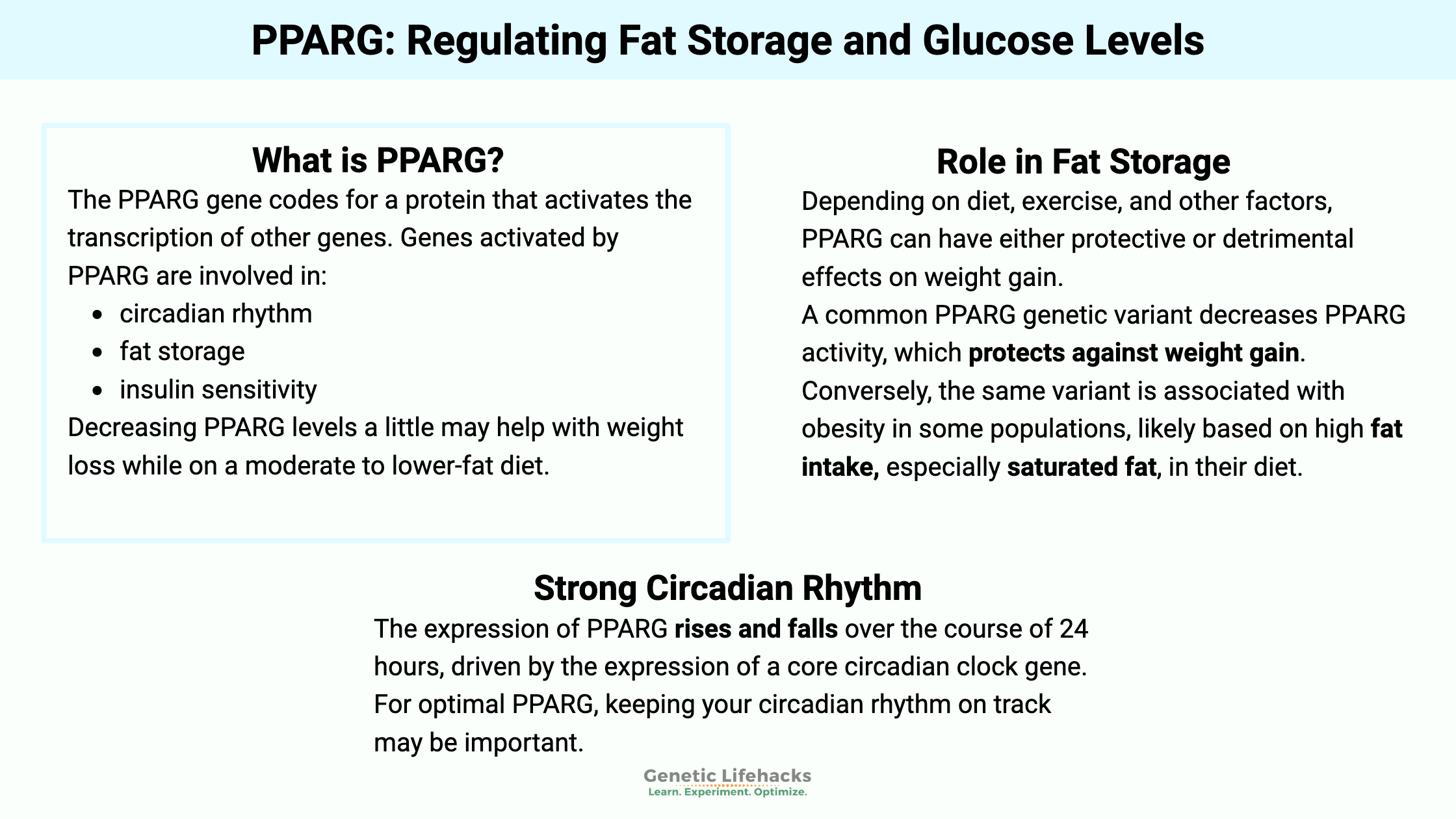
More specifically, PPARG is a nuclear transcription factor, which means that it activates the transcription of other genes. This gives it a wide range of functions. Genes activated by PPARG are involved in[ref]
circadian rhythm
fat storage
insulin sensitivity
PPARG belongs to the family of PPAR receptor genes (peroxisome proliferator-activated receptors). All of the PPARs are found in the cytosol of cells and bind to specific substances – called ligands- along with a retinoid x receptor. When activated by their ligand, they move into the cell nucleus and turn on genes under their control.
Activating genes: PPARG receptors in different types of cells
PPARG acts as a receptor that causes other genes to be turned on for transcription. It is found in adipose (fat) cells, intestinal cells, and macrophages (immune system cells).
PPARG works in conjunction with a retinoid X receptor. When these paired receptors are activated, they cause the transcription of genes involved in creating new fat cells. They can also increase the uptake of lipids into fat cells and cause glucose to move into other cells. [ref]
In fat cells (adipocytes), PPARγ activates genes encoding proteins related to triglycerides, fatty acid uptake, cytokines, adipokines, glucose transporters, and leptin. Thus PPARG is thought to be key to energy homeostasis and insulin sensitivity — essentially controlling fat storage, the way glucose is used in cells, and inflammation due to fat accumulation.[ref]
In macrophages, activation of PPARG is part of the way that macrophages switch to the inflammatory M2 polarization. Interleukin-4 activates PPARG in macrophages. Macrophage activation is an important part of how the body fights off pathogens. In influenza, PPAR-gamma is essential for macrophage activation and clearance of severe lung infections. Researchers discovered this using a mouse model that had PPARG deficiency only in macrophage cells.[ref][ref]
In intestinal cells, PPARG helps regulate fat absorption in the intestines. An animal study showed that the lack of PPARG in intestinal cells resulted in increased fatty acid levels when exposed to higher amounts of canola oil, a long-chain polyunsaturated fatty acid (PUFA), compared to normal mice. In contrast, the uptake of coconut oil, a medium-chain saturated fat, did not differ. This suggests a role for PPARG in the intestines to regulate the uptake of long-chain PUFAs.[ref]
In skin and airway epithelial cells, PPAR-gamma is involved in regulating allergic responses. People who take diabetes drugs that activate PPAR-gamma have reduced allergic responses. However, in some situations, activation of PPARG may exacerbate allergic inflammation. Researchers believe that environmental factors that activate PPARG, such as phthalates, may play a role in the increase in certain types of allergies.[ref][ref]
PPARG Ligands: What activates PPAR Gamma?
Natural activators of PPAR-gamma include polyunsaturated fatty acids and their metabolites, such as leukotriene B4.[ref]
Foods can also activate PPARG in intestinal cells. Glutamine, fatty acids, curcumin, capsaicin, and vitamin E have been shown to interact with PPARG.[ref] Emodin, a component of rhubarb, can also bind to PPAR-gamma in the gut.[ref]
Environmental exposure may also play a role in PPARG expression. A study of pregnant women found that phthalate levels correlated with PPARG expression in the placenta. Phthalates are a component of vinyl and artificial fragrances.[ref]
PFAS (or PFOA) exposure also interacts with the PPARG gene. In placental cells, PPAR-gamma signaling is inhibited by PFOS.[ref] In animal studies, PFOAs have been shown to upregulate PPARG.[ref]
Role in fat storage:
PPARG can be thought of as a gateway that activates a fat cell to store more fatty acids. It is activated by polyunsaturated fatty acids, causing fat cells to take fatty acids out of circulation and store them. This then causes cells in the body to take up glucose (mainly from carbohydrates) and use it for energy.
This is the way our metabolism normally works – when glucose is available, it is used first for energy, while fat is stored to be used later when glucose isn’t available.
Depending on diet, exercise, and other factors, PPARG can have either protective or detrimental effects on weight gain.
On the one hand, PPARG causes fat cells to store fatty acids and glucose, lowering blood glucose levels. However, it is also important in how adipose tissue (fat cells) release leptin and adiponectin, which play a role in insulin sensitivity. [ref]
Diabetes medications and PPARG:
One type of diabetes drug, thiazolidinediones or TZDs, works by binding to PPARG.
When the drug binds to PPARG, it causes fat cells to take up all available fatty acids, causing the rest of the cells in the body to take up more glucose for energy. While this does cause blood glucose levels to decrease, a very common side effect is weight gain.
PPARG and weight regulation:
The most commonly studied variant, rs1801282 or Pro12Ala, is thought to decrease PPARG activity, which protects against weight gain with certain dietary patterns.[ref] Conversely, the variant is associated with obesity in some populations, likely based on fat intake and possibly the type of fat that is common in their diet. (Check your genotype below in the Genotype Report section)
One study found that those carrying the rs1801282 G allele were more likely to be obese if they ate a diet high in saturated fat, while those with the G allele were not at a higher risk of obesity if their fat intake was based more on polyunsaturated fats.[ref] This makes sense when you think about it. In people with the PPARG variant, the body isn’t getting the normal signal from polyunsaturated fatty acids which should make the fat cells fatter.
A study that bred mice with the rs1801282 (Ala) variant confirmed some of the human studies and explained the differences seen in people who eat different diets. The mice with the variant, when fed normal chow, were a little leaner, had better glucose tolerance, and lived a little longer. They were also a little more active in the evening, so they may have expended a little more energy from the same amount of food. When those same mice with the variant were fed high-fat chow, the mice with the variants became fatter than the mice without the variant. [ref]
Genotype report: PPARG
Members: Log in to see your data below. Not a member? Join here.
Access this content:
An active subscription is required to access this content.
Diet:
For those with the PPARG rs1801282 Ala variant, sticking to a diet lower in saturated fat might protect against weight gain. (This may be more important in those eating a normal diet with a mixture of fats, carbs, and protein, rather than for someone on a ketogenic diet.)
In general, decreasing PPARG levels a little may help with weight loss while on a moderate to lower-fat diet.[ref]
Lifestyle changes:
Strong circadian rhythm: The expression of PPARG rises and falls over the course of 24 hours, driven by the expression of a core circadian clock gene.[ref] For optimal PPARG, keeping your circadian rhythm on track may be important.
Humans are diurnal, meaning we are active (including eating) during the daylight and sleep at night. To keep circadian rhythm on track, it is important to eat and sleep at approximately the same times each day and night. Light helps to set circadian rhythm, and avoiding light at night – especially from screens – can help to optimize circadian rhythm. Similarly, getting out into the sunshine or full-spectrum light is important first thing in the morning.
Exercise:
High-intensity interval training (HIIT) decreases PPAR-gamma levels.[ref] A study that looked at aerobic exercise found that it helped with weight loss for everyone, regardless of PPARG genotype.[ref]
Natural supplements that interact with PPARG:
Access this content:
An active subscription is required to access this content.
Ahmadian, Maryam, et al. “PPARγ Signaling and Metabolism: The Good, the Bad and the Future.” Nature Medicine, vol. 19, no. 5, May 2013, p. 10.1038/nm.3159. PubMed Central, https://doi.org/10.1038/nm.3159.
Cardoso, Glêbia Alexa, et al. “Pro12Ala Polymorphism on the PPARγ2 Gene and Weight Loss After Aerobic Training: A Randomized Controlled Trial.” Frontiers in Physiology, vol. 11, May 2020, p. 385. PubMed Central, https://doi.org/10.3389/fphys.2020.00385.
Dong, Xiaoxv, et al. “Emodin: A Review of Its Pharmacology, Toxicity and Pharmacokinetics.” Phytotherapy Research, vol. 30, no. 8, Aug. 2016, pp. 1207–18. PubMed Central, https://doi.org/10.1002/ptr.5631.
Duszka, Kalina, et al. “PPARγ Modulates Long Chain Fatty Acid Processing in the Intestinal Epithelium.” International Journal of Molecular Sciences, vol. 18, no. 12, Nov. 2017, p. 2559. PubMed Central, https://doi.org/10.3390/ijms18122559.
Garaulet, Marta, et al. “PPARγ Pro12Ala Interacts with Fat Intake for Obesity and Weight Loss in a Behavioural Treatment Based on the Mediterranean Diet.” Molecular Nutrition & Food Research, vol. 55, no. 12, Dec. 2011, pp. 1771–79. PubMed Central, https://doi.org/10.1002/mnfr.201100437.
Grimaldi, Benedetto, et al. “PER2 Controls Lipid Metabolism by Direct Regulation of PPARγ.” Cell Metabolism, vol. 12, no. 5, Nov. 2010, pp. 509–20. PubMed Central, https://doi.org/10.1016/j.cmet.2010.10.005.
Harrington, W. Wallace, et al. “The Effect of PPARalpha, PPARdelta, PPARgamma, and PPARpan Agonists on Body Weight, Body Mass, and Serum Lipid Profiles in Diet-Induced Obese AKR/J Mice.” PPAR Research, vol. 2007, 2007, p. 97125. PubMed, https://doi.org/10.1155/2007/97125.
Heikkinen, Sami, et al. “The Pro12Ala PPARγ2 Variant Determines Metabolism at the Gene-Environment Interface.” Cell Metabolism, vol. 9, no. 1, Jan. 2009, pp. 88–98. ScienceDirect, https://doi.org/10.1016/j.cmet.2008.11.007.
Huang, Su, Nick P. Goplen, et al. “Macrophage PPAR-γ Suppresses Long-Term Lung Fibrotic Sequelae Following Acute Influenza Infection.” PLoS ONE, vol. 14, no. 10, Oct. 2019, p. e0223430. PubMed Central, https://doi.org/10.1371/journal.pone.0223430.
Huang, Su, Bibo Zhu, et al. “PPAR-γ in Macrophages Limits Pulmonary Inflammation and Promotes Host Recovery Following Respiratory Viral Infection.” Journal of Virology, vol. 93, no. 9, Apr. 2019, pp. e00030-19. PubMed Central, https://doi.org/10.1128/JVI.00030-19.
Huang, Yujing, et al. “Peroxisome Proliferator Activated Receptor Gamma in Human Placenta May Mediate the Adverse Effects of Phthalates Exposure in Pregnancy.” Reproductive Toxicology (Elmsford, N.Y.), vol. 75, Jan. 2018, pp. 121–26. PubMed, https://doi.org/10.1016/j.reprotox.2017.10.001.
Jang, Eun Jeong, et al. “Correlation between PPARG Pro12Ala Polymorphism and Therapeutic Responses to Thiazolidinediones in Patients with Type 2 Diabetes: A Meta-Analysis.” Pharmaceutics, vol. 15, no. 6, June 2023, p. 1778. PubMed, https://doi.org/10.3390/pharmaceutics15061778.
Jia, Yaoyao, et al. “The Natural Carotenoid Astaxanthin, a PPAR-α Agonist and PPAR-γ Antagonist, Reduces Hepatic Lipid Accumulation by Rewiring the Transcriptome in Lipid-Loaded Hepatocytes.” Molecular Nutrition & Food Research, vol. 56, no. 6, June 2012, pp. 878–88. PubMed, https://doi.org/10.1002/mnfr.201100798.
Kawai, Masanobu, and Clifford J. Rosen. “PPARγ: A Circadian Transcription Factor in Adipogenesis and Osteogenesis.” Nature Reviews. Endocrinology, vol. 6, no. 11, Nov. 2010, pp. 629–36. PubMed Central, https://doi.org/10.1038/nrendo.2010.155.
Kintscher, Ulrich, and Ronald E. Law. “PPARgamma-Mediated Insulin Sensitization: The Importance of Fat versus Muscle.” American Journal of Physiology. Endocrinology and Metabolism, vol. 288, no. 2, Feb. 2005, pp. E287-291. PubMed, https://doi.org/10.1152/ajpendo.00440.2004.
Li, Juan-E., et al. “Cinnamaldehyde Contributes to Insulin Sensitivity by Activating PPARδ, PPARγ, and RXR.” The American Journal of Chinese Medicine, vol. 43, no. 5, 2015, pp. 879–92. PubMed, https://doi.org/10.1142/S0192415X15500512.
Liang, Xuemin, et al. “Peroxisome Proliferators-Activated Receptor Gamma Polymorphisms and Colorectal Cancer Risk.” Journal of Cancer Research and Therapeutics, vol. 14, no. Supplement, June 2018, pp. S306–10. PubMed, https://doi.org/10.4103/0973-1482.235346.
Lo Furno, Debora, et al. “A Citrus Bergamia Extract Decreases Adipogenesis and Increases Lipolysis by Modulating PPAR Levels in Mesenchymal Stem Cells from Human Adipose Tissue.” PPAR Research, vol. 2016, 2016, p. 4563815. PubMed Central, https://doi.org/10.1155/2016/4563815.
Luo, Shuang, et al. “Emodin Targeting the Colonic Metabolism via PPARγ Alleviates UC by Inhibiting Facultative Anaerobe.” Phytomedicine, vol. 104, Sept. 2022, p. 154106. ScienceDirect, https://doi.org/10.1016/j.phymed.2022.154106.
Malapaka, Raghu R. V., et al. “Identification and Mechanism of 10-Carbon Fatty Acid as Modulating Ligand of Peroxisome Proliferator-Activated Receptors.” The Journal of Biological Chemistry, vol. 287, no. 1, Jan. 2012, pp. 183–95. PubMed Central, https://doi.org/10.1074/jbc.M111.294785.
Motta, Victor F., et al. “High-Intensity Interval Training (Swimming) Significantly Improves the Adverse Metabolism and Comorbidities in Diet-Induced Obese Mice.” The Journal of Sports Medicine and Physical Fitness, vol. 56, no. 5, May 2016, pp. 655–63.
Muntean, Carmen, et al. “Effects of PPARG and PPARGC1A Gene Polymorphisms on Obesity Markers.” Frontiers in Public Health, vol. 10, 2022, p. 962852. PubMed, https://doi.org/10.3389/fpubh.2022.962852.
Nakamichi, Renata, et al. “Action of Nicotinic Acid on the Reversion of Hypoxic-Inflammatory Link on 3T3-L1 Adipocytes.” Lipids in Health and Disease, vol. 15, May 2016, p. 91. PubMed Central, https://doi.org/10.1186/s12944-016-0260-1.
Pomari, Elena, et al. “Effects of Two Different Rhodiola Rosea Extracts on Primary Human Visceral Adipocytes.” Molecules (Basel, Switzerland), vol. 20, no. 5, May 2015, pp. 8409–28. PubMed, https://doi.org/10.3390/molecules20058409.
Regieli, Jakub J., et al. “PPAR Gamma Variant Influences Angiographic Outcome and 10-Year Cardiovascular Risk in Male Symptomatic Coronary Artery Disease Patients.” Diabetes Care, vol. 32, no. 5, May 2009, pp. 839–44. PubMed, https://doi.org/10.2337/dc08-1819.
Song, Yongyan, et al. “PPARγ Gene Polymorphisms, Metabolic Disorders, and Coronary Artery Disease.” Frontiers in Cardiovascular Medicine, vol. 9, Mar. 2022, p. 808929. PubMed Central, https://doi.org/10.3389/fcvm.2022.808929.
Stark, Julian M., et al. “The Role of PPAR-γ in Allergic Disease.” Current Allergy and Asthma Reports, vol. 21, no. 11, 2021, p. 45. PubMed Central, https://doi.org/10.1007/s11882-021-01022-x.
Tang, Weifeng, et al. “Peroxisome Proliferator-Activated Receptor Gamma (PPARG) Polymorphisms and Breast Cancer Susceptibility: A Meta-Analysis.” International Journal of Clinical and Experimental Medicine, vol. 8, no. 8, 2015, pp. 12226–38.
Tiongco, Raphael Enrique, et al. “Association of the Rs3856806 Polymorphism in the PPARG Gene with Type 2 Diabetes Mellitus: A Meta-Analysis of 11,811 Individuals.” Laboratory Medicine, vol. 54, no. 2, Mar. 2023, pp. 193–98. PubMed, https://doi.org/10.1093/labmed/lmac095.
Tran, Lieu, et al. “Diet and PPARG2 Pro12Ala Polymorphism Interactions in Relation to Cancer Risk: A Systematic Review.” Nutrients, vol. 13, no. 1, Jan. 2021, p. 261. PubMed Central, https://doi.org/10.3390/nu13010261.
Urban, Thomas J., et al. “Limited Contribution of Common Genetic Variants to Risk for Liver Injury Due to a Variety of Drugs.” Pharmacogenetics and Genomics, vol. 22, no. 11, Nov. 2012, pp. 784–95. PubMed Central, https://doi.org/10.1097/FPC.0b013e3283589a76.
Wan Ibrahim, Wan Norhamidah, et al. “Perfluorooctane Sulfonate Induces Neuronal and Oligodendrocytic Differentiation in Neural Stem Cells and Alters the Expression of PPARγ in Vitro and in Vivo.” Toxicology and Applied Pharmacology, vol. 269, no. 1, May 2013, pp. 51–60. ScienceDirect, https://doi.org/10.1016/j.taap.2013.03.003.
Wan, Renhui, et al. “Effects Of PPARγ2 Pro12Ala Variant On Adipocyte Phenotype Dependent Of DHA.” Diabetes, Metabolic Syndrome and Obesity: Targets and Therapy, vol. 12, Nov. 2019, pp. 2273–79. PubMed Central, https://doi.org/10.2147/DMSO.S214526.
Xu, Pengfei, et al. “The Role of PPAR and Its Cross-Talk with CAR and LXR in Obesity and Atherosclerosis.” International Journal of Molecular Sciences, vol. 19, no. 4, Apr. 2018, p. 1260. PubMed Central, https://doi.org/10.3390/ijms19041260.
https://diabetes.diabetesjournals.org/content/50/3/686. Accessed 18 Mar. 2026.
About the Author: Debbie Moon is a biologist, engineer, author, and the founder of Genetic Lifehacks where she has helped thousands of members understand how to apply genetics to their diet, lifestyle, and health decisions. With more than 10 years of experience translating complex genetic research into practical health strategies, Debbie holds a BS in engineering from Colorado School of Mines and an MSc in biological sciences from Clemson University. She combines an engineering mindset with a biological systems approach to explain how genetic differences impact your optimal health.