will see their genotype report below and the solutions in the Lifehacks section.
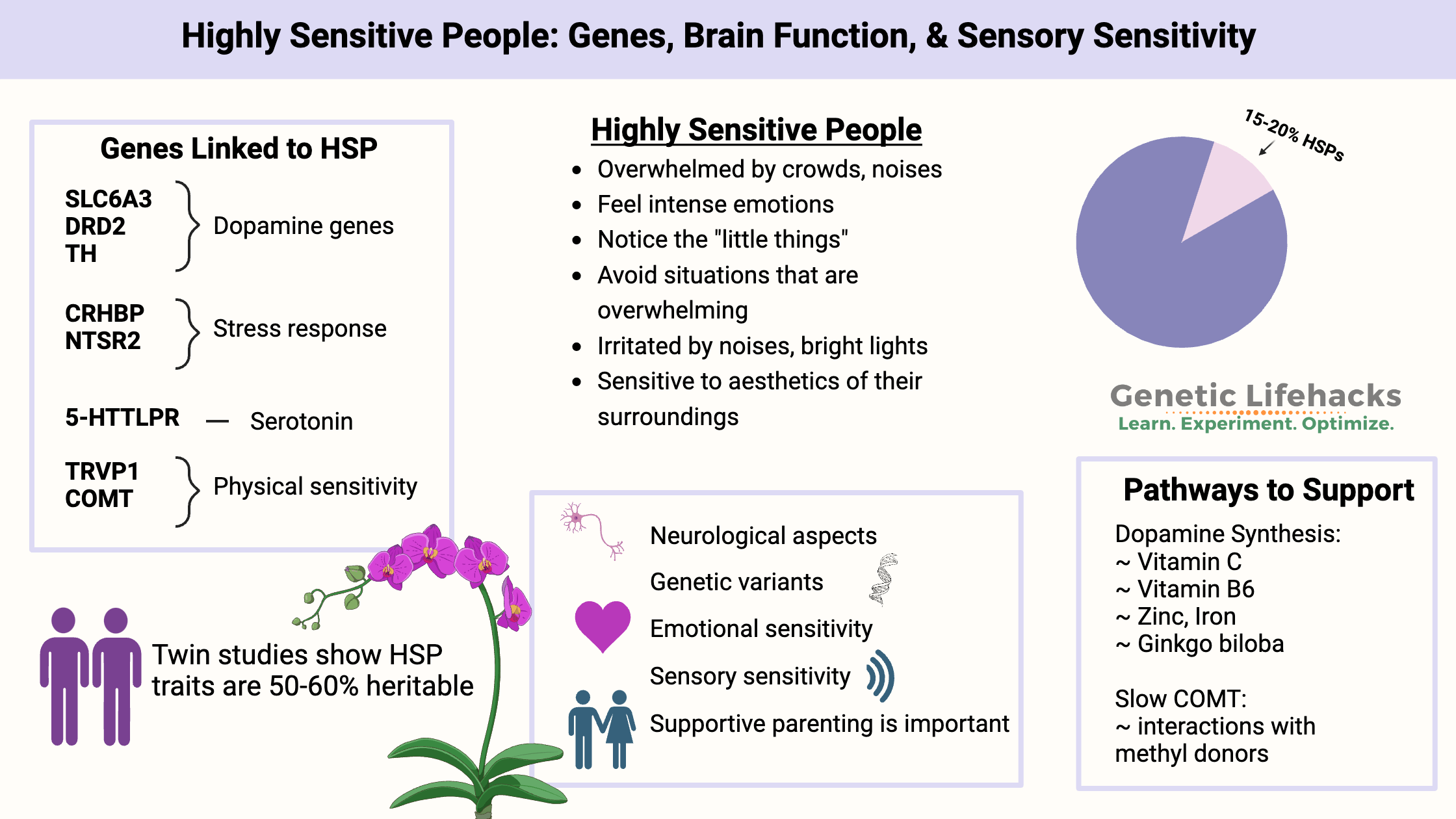
Highly Sensitive People (HSPs) are individuals with heightened sensitivity to environmental stimuli, deeper cognitive processing, and high emotional reactivity. The term was popularized by psychiatrist Dr. Elaine Aron, who began studying and writing about the characteristics of HSPs in the 1990s.[ref]
In short, some people are simply more sensitive to both emotions and physical stimuli – such as small sounds, visual distractions, or the feelings of others around them. HSP is increasingly understood in the context of genetic variants, the combination of genetics and childhood experiences, and changes that can be seen on brain imaging scans.
Dr. Aron created a psychological test and scale to measure sensitivity. Based on this Highly Sensitive Person Scale, researchers narrow down the three factors that influence sensitivity:[ref]
The terms “highly sensitive person,” “environmental sensitivity,” or “sensory processing sensitivity” are used in psychological research. While there are some technical differences in the definitions of these terms, in essence, researchers are able to quantify and describe the differences found in people who are highly sensitive to both negative and positive environments. These differences may include a heightened awareness of interactions with other people or a heightened sensitivity to the physical environment.
Some of the earliest research on this topic was done by psychologists, Dr. Elaine Aron and Dr. Arthur Aron, in the 1990s. Dr. Aron offers a free quiz if you want to find out if you are a highly sensitive person.
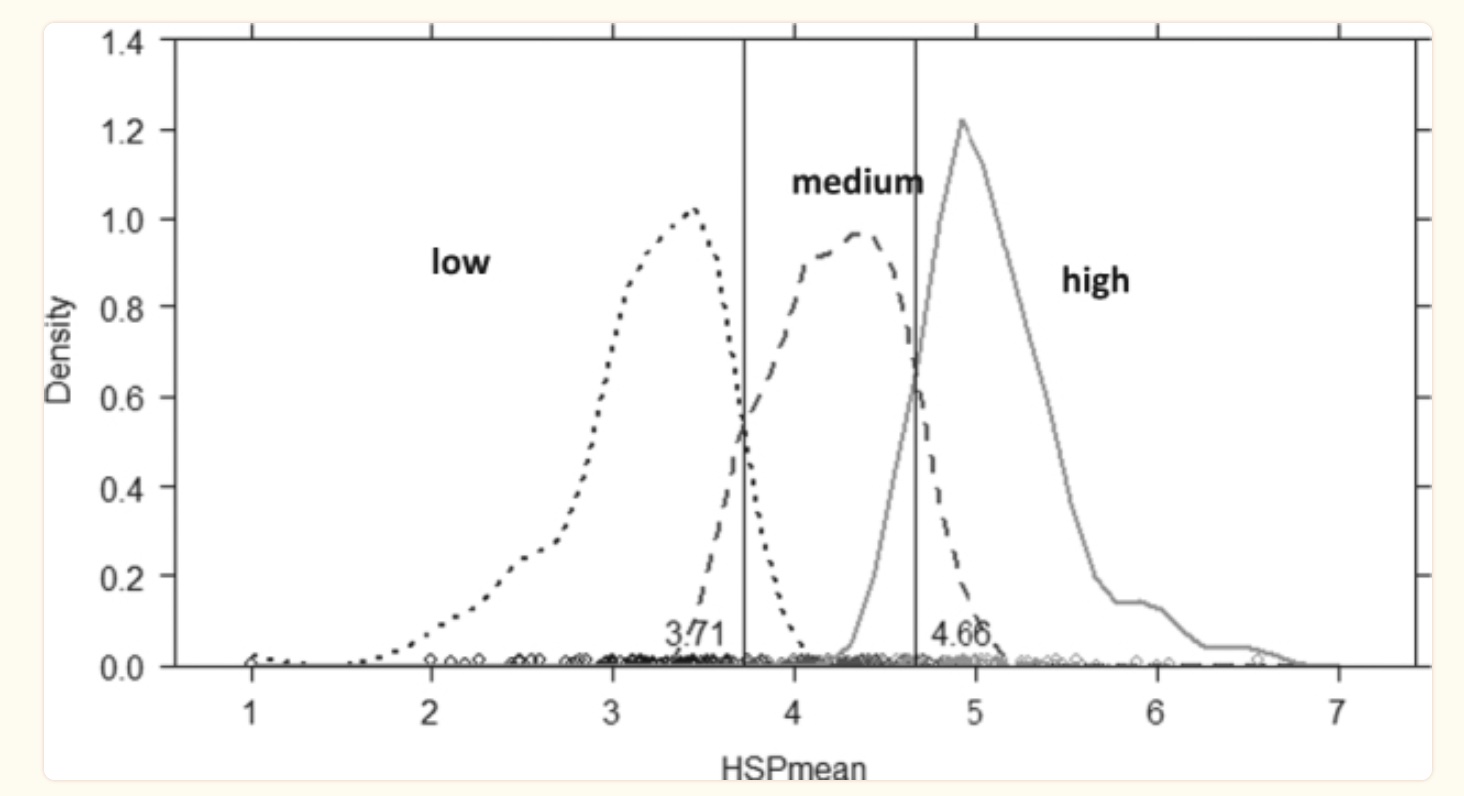
Researchers have found that people tend to fall into three classes – high, medium, and low sensitivity.[ref]
Recap: HSPs are characterized by deeper cognitive processing, emotional intensity, and a low threshold for sensory input. These traits can be measured and quantified using established psychological scales
Sensory Processing Sensitivity (SPS) is a psychological trait defined by psychologists as a heightened response to stimuli that most people find normal. People with SPS are more easily aroused and excitable, and they tend to avoid upsetting situations. They also have a low threshold for sensory discomfort and are preoccupied with details in their environment. [ref][ref]
Aron, E. N., and A. Aron. “Sensory-Processing Sensitivity and Its Relation to Introversion and Emotionality.” Journal of Personality and Social Psychology, vol. 73, no. 2, Aug. 1997, pp. 345–68. PubMed, https://doi.org/10.1037//0022-3514.73.2.345.
Arpawong, Thalida E., et al. “Effects of Recent Stress and Variation in the Serotonin Transporter Polymorphism (5-HTTLPR) on Depressive Symptoms: A Repeated-Measures Study of Adults Age 50 and Older.” Behavior Genetics, vol. 46, no. 1, Jan. 2016, pp. 72–88. PubMed Central, https://doi.org/10.1007/s10519-015-9740-8.
Assary, Elham, et al. “Genetic Architecture of Environmental Sensitivity Reflects Multiple Heritable Components: A Twin Study with Adolescents.” Molecular Psychiatry, vol. 26, no. 9, Sept. 2021, pp. 4896–904. www.nature.com, https://doi.org/10.1038/s41380-020-0783-8.
Barbosa, Flávia Regina, et al. “Influence of Catechol-O-Methyltransferase (COMT) Gene Polymorphisms in Pain Sensibility of Brazilian Fibromialgia Patients.” Rheumatology International, vol. 32, no. 2, Feb. 2012, pp. 427–30. PubMed, https://doi.org/10.1007/s00296-010-1659-z.
Beck, Stefanie M., et al. “Effects of Ginkgo Biloba Extract EGb 761® on Cognitive Control Functions, Mental Activity of the Prefrontal Cortex and Stress Reactivity in Elderly Adults with Subjective Memory Impairment – a Randomized Double-Blind Placebo-Controlled Trial.” Human Psychopharmacology, vol. 31, no. 3, May 2016, pp. 227–42. PubMed, https://doi.org/10.1002/hup.2534.
Binder, Andreas, et al. “Transient Receptor Potential Channel Polymorphisms Are Associated with the Somatosensory Function in Neuropathic Pain Patients.” PLoS ONE, vol. 6, no. 3, Mar. 2011, p. e17387. PubMed Central, https://doi.org/10.1371/journal.pone.0017387.
Carroll, Susan, et al. “Flourishing as a Highly Sensitive Person: A Mixed Method Study on the Role of Nature Connectedness and Chaotic Home Environment.” Frontiers in Psychology, vol. 16, Apr. 2025. Frontiers, https://doi.org/10.3389/fpsyg.2025.1480669.
Chen, Chunhui, et al. “Contributions of Dopamine-Related Genes and Environmental Factors to Highly Sensitive Personality: A Multi-Step Neuronal System-Level Approach.” PLoS ONE, vol. 6, no. 7, July 2011, p. e21636. PubMed Central, https://doi.org/10.1371/journal.pone.0021636.
Chen, Jingshan, et al. “Functional Analysis of Genetic Variation in Catechol-O-Methyltransferase (COMT): Effects on mRNA, Protein, and Enzyme Activity in Postmortem Human Brain.” American Journal of Human Genetics, vol. 75, no. 5, Nov. 2004, pp. 807–21. PubMed, https://doi.org/10.1086/425589.
D’Addario, Claudio, et al. “A Relevant Role for Dopamine Transporter Gene in Highly Sensitive Persons under Stressful Conditions: Focus on Genetic and Epigenetic Regulation.” 15 Feb. 2024. Research Square, https://doi.org/10.21203/rs.3.rs-3955799/v1.
Deering-Rice, Cassandra E., et al. “Characterization of Transient Receptor Potential Vanilloid-1 (TRPV1) Variant Activation by Coal Fly Ash Particles and Associations with Altered Transient Receptor Potential Ankyrin-1 (TRPA1) Expression and Asthma.” The Journal of Biological Chemistry, vol. 291, no. 48, Nov. 2016, pp. 24866–79. PubMed Central, https://doi.org/10.1074/jbc.M116.746156.
Firfirey, Firzana, et al. “Polymorphisms in COMT and OPRM1 Collectively Contribute to Chronic Shoulder Pain and Disability in South African Breast Cancer Survivors’.” Genes, vol. 14, no. 1, Dec. 2022, p. 9. PubMed Central, https://doi.org/10.3390/genes14010009.
Forstenpointner, Julia, et al. “Short Report: TRPV1-Polymorphism 1911 A>G Alters Capsaicin-Induced Sensory Changes in Healthy Subjects.” PloS One, vol. 12, no. 8, 2017, p. e0183322. PubMed, https://doi.org/10.1371/journal.pone.0183322.
Fuladi, Sara, et al. “Assessment of the Efficacy of Withania Somnifera Root Extract in Patients with Generalized Anxiety Disorder: A Randomized Double-Blind Placebo- Controlled Trial.” Current Reviews in Clinical and Experimental Pharmacology, vol. 16, no. 2, 2021, pp. 191–96. PubMed, https://doi.org/10.2174/1574884715666200413120413.
Guilarte, Tomas R. “Effect of Vitamin B-6 Nutrition on the Levels of Dopamine, Dopamine Metabolites, Dopa Decarboxylase Activity, Tyrosine, and GABA in the Developing Rat Corpus Striatum.” Neurochemical Research, vol. 14, no. 6, June 1989, pp. 571–78. Springer Link, https://doi.org/10.1007/BF00964920.
Haigh, Sarah M., et al. “Auditory Discomfort in Visually Sensitive Individuals.” Frontiers in Psychology, vol. 14, Nov. 2023, p. 1126481. PubMed Central, https://doi.org/10.3389/fpsyg.2023.1126481.
Homberg, Judith R., et al. “Sensory Processing Sensitivity and Serotonin Gene Variance: Insights into Mechanisms Shaping Environmental Sensitivity.” Neuroscience & Biobehavioral Reviews, vol. 71, Dec. 2016, pp. 472–83. ScienceDirect, https://doi.org/10.1016/j.neubiorev.2016.09.029.
Iimura, Shuhei, and Satoshi Takasugi. “Sensory Processing Sensitivity and Gastrointestinal Symptoms in Japanese Adults.” International Journal of Environmental Research and Public Health, vol. 19, no. 16, Aug. 2022, p. 9893. PubMed Central, https://doi.org/10.3390/ijerph19169893.
Jensen, Karin B., et al. “Increased Sensitivity to Thermal Pain Following a Single Opiate Dose Is Influenced by the COMT Val158met Polymorphism.” PLOS ONE, vol. 4, no. 6, June 2009, p. e6016. PLoS Journals, https://doi.org/10.1371/journal.pone.0006016.
Jothie Richard, Edwin, et al. “Anti-Stress Activity of Ocimum Sanctum: Possible Effects on Hypothalamic-Pituitary-Adrenal Axis.” Phytotherapy Research: PTR, vol. 30, no. 5, May 2016, pp. 805–14. PubMed, https://doi.org/10.1002/ptr.5584.
Kehr, J., et al. “Ginkgo Biloba Leaf Extract (EGb 761®) and Its Specific Acylated Flavonol Constituents Increase Dopamine and Acetylcholine Levels in the Rat Medial Prefrontal Cortex: Possible Implications for the Cognitive Enhancing Properties of EGb 761®.” International Psychogeriatrics, 24 Suppl 1, Aug. 2012, pp. S25-34. PubMed, https://doi.org/10.1017/S1041610212000567.
Kyriatzis, Grigorios, et al. “Neurotensin and Neurotensin Receptors in Stress-Related Disorders: Pathophysiology & Novel Drug Targets.” Current Neuropharmacology, vol. 22, no. 5, 2024, pp. 916–34. PubMed, https://doi.org/10.2174/1570159X21666230803101629.
Li, Wanjun, et al. “Pain in Parkinson’s Disease Associated with COMT Gene Polymorphisms.” Behavioural Neurology, vol. 2014, 2014, p. 304203. PubMed, https://doi.org/10.1155/2014/304203.
Li, Wenwen, et al. “High-Dose Vitamin C Improves Norepinephrine Level in Patients with Septic Shock: A Single-Center, Prospective, Randomized Controlled Trial.” Medicine, vol. 103, no. 15, Apr. 2024, p. e37838. PubMed, https://doi.org/10.1097/MD.0000000000037838.
Licht, Cecilie L., et al. “Serotonin Transporter Gene ( SLC6A4 ) Variation and Sensory Processing Sensitivity—Comparison with Other Anxiety‐related Temperamental Dimensions.” Molecular Genetics & Genomic Medicine, vol. 8, no. 8, Aug. 2020, p. e1352. DOI.org (Crossref), https://doi.org/10.1002/mgg3.1352.
Ling, Daijun, et al. “Association between Polymorphism of the Dopamine Transporter Gene and Early Smoking Onset: An Interaction Risk on Nicotine Dependence.” Journal of Human Genetics, vol. 49, no. 1, 2004, pp. 35–39. PubMed, https://doi.org/10.1007/s10038-003-0104-5.
Lionetti, Francesca, et al. “Dandelions, Tulips and Orchids: Evidence for the Existence of Low-Sensitive, Medium-Sensitive and High-Sensitive Individuals.” Translational Psychiatry, vol. 8, Jan. 2018, p. 24. PubMed Central, https://doi.org/10.1038/s41398-017-0090-6.
Listou Grimen, Hanne, and Åge Diseth. “Sensory Processing Sensitivity: Factors of the Highly Sensitive Person Scale and Their Relationships to Personality and Subjective Health Complaints.” Perceptual and Motor Skills, vol. 123, no. 3, Dec. 2016, pp. 637–53. PubMed, https://doi.org/10.1177/0031512516666114.
Lopresti, Adrian L., et al. “An Investigation into the Stress-Relieving and Pharmacological Actions of an Ashwagandha (Withania Somnifera) Extract.” Medicine, vol. 98, no. 37, Sept. 2019, p. e17186. PubMed Central, https://doi.org/10.1097/MD.0000000000017186.
May, James M., et al. “Mechanisms of Ascorbic Acid Stimulation of Norepinephrine Synthesis in Neuronal Cells.” Biochemical and Biophysical Research Communications, vol. 426, no. 1, Sept. 2012, pp. 148–52. PubMed, https://doi.org/10.1016/j.bbrc.2012.08.054.
Meyerson, Joseph, et al. “Burnout and Professional Quality of Life among Israeli Dentists: The Role of Sensory Processing Sensitivity.” International Dental Journal, vol. 70, no. 1, Oct. 2020, pp. 29–37. PubMed Central, https://doi.org/10.1111/idj.12523.
Nackley, Andrea G., et al. “Low Enzymatic Activity Haplotypes of the Human Catechol-O-Methyltransferase Gene: Enrichment for Marker SNPs.” PLoS ONE, vol. 4, no. 4, Apr. 2009, p. e5237. PubMed Central, https://doi.org/10.1371/journal.pone.0005237.
Oniszczenko, Włodzimierz, and Wojciech Ł. Dragan. “Association between Temperament in Terms of the Regulative Theory of Temperament and DRD4 and DAT1 Gene Polymorphisms.” Comprehensive Psychiatry, vol. 53, no. 6, Aug. 2012, pp. 789–96. PubMed, https://doi.org/10.1016/j.comppsych.2012.01.001.
Park, Sunmin, et al. “TRPV1 Gene Polymorphisms Are Associated with Type 2 Diabetes by Their Interaction with Fat Consumption in the Korean Genome Epidemiology Study.” Journal of Nutrigenetics and Nutrigenomics, vol. 9, no. 1, 2016, pp. 47–61. PubMed, https://doi.org/10.1159/000446499.
Peel, Alicia J., et al. “A Multivariate Genetic Analysis of Anxiety Sensitivity, Environmental Sensitivity and Reported Life Events in Adolescents.” Journal of Child Psychology and Psychiatry, and Allied Disciplines, vol. 64, no. 2, Feb. 2023, pp. 289–98. PubMed Central, https://doi.org/10.1111/jcpp.13725.
Pérez-Chacón, Manuela, et al. “Personality Traits and Coping Strategies as Psychological Factors Associated with Health-Related Quality of Life in Highly Sensitive Persons.” International Journal of Environmental Research and Public Health, vol. 20, no. 9, Apr. 2023, p. 5644. PubMed Central, https://doi.org/10.3390/ijerph20095644.
Pino, Jessica M. V., et al. “Iron-Restricted Diet Affects Brain Ferritin Levels, Dopamine Metabolism and Cellular Prion Protein in a Region-Specific Manner.” Frontiers in Molecular Neuroscience, vol. 10, May 2017, p. 145. PubMed Central, https://doi.org/10.3389/fnmol.2017.00145.
Pinsonneault, Julia K., et al. “Dopamine Transporter Gene Variant Affecting Expression in Human Brain Is Associated with Bipolar Disorder.” Neuropsychopharmacology, vol. 36, no. 8, July 2011, pp. 1644–55. PubMed Central, https://doi.org/10.1038/npp.2011.45.
Ponce-Valencia, Alicia, et al. “An Interpretable Machine Learning Approach to Predict Sensory Processing Sensitivity Trait in Nursing Students.” European Journal of Investigation in Health, Psychology and Education, vol. 14, no. 4, Apr. 2024, pp. 913–28. PubMed Central, https://doi.org/10.3390/ejihpe14040059.
Romero, Sally A. D., et al. “Genetic Predictors to Acupuncture Response for Hot Flashes: An Exploratory Study of Breast Cancer Survivors.” Menopause (New York, N.Y.), vol. 27, no. 8, Aug. 2020, pp. 913–17. PubMed, https://doi.org/10.1097/GME.0000000000001545.
Schmahl, Christian, et al. “COMT Val158met Polymorphism and Neural Pain Processing.” PLOS ONE, vol. 7, no. 1, Jan. 2012, p. e23658. PLoS Journals, https://doi.org/10.1371/journal.pone.0023658.
“Sensitivity Research | Evidence, Resources & Self-Tests.” Sensitivity Research, https://sensitivityresearch.com/. Accessed 23 Feb. 2026.
Trå, Hilde Visnes, et al. “High Sensitivity: Factor Structure of the Highly Sensitive Person Scale and Personality Traits in a High and Low Sensitivity Group. Two Gender—Matched Studies.” Nordic Psychology, vol. 75, no. 4, Oct. 2023, pp. 328–50. DOI.org (Crossref), https://doi.org/10.1080/19012276.2022.2093778.
Turjeman-Levi, Yaara, and Avraham N. Kluger. “Sensory-Processing Sensitivity versus the Sensory-Processing Theory: Convergence and Divergence.” Frontiers in Psychology, vol. 13, Dec. 2022, p. 1010836. PubMed Central, https://doi.org/10.3389/fpsyg.2022.1010836.
Vinkhuyzen, Anna A. E., et al. “Identification of Tag Haplotypes for 5HTTLPR for Different Genome-Wide SNP Platforms.” Molecular Psychiatry, vol. 16, no. 11, Nov. 2011, pp. 1073–75. PubMed Central, https://doi.org/10.1038/mp.2011.68.
———. “Identification of Tag Haplotypes for 5HTTLPR for Different Genome-Wide SNP Platforms.” Molecular Psychiatry, vol. 16, no. 11, Nov. 2011, pp. 1073–75. PubMed Central, https://doi.org/10.1038/mp.2011.68.
Wang, Liang-Jen, et al. “A Potential Interaction between COMT and MTHFR Genetic Variants in Han Chinese Patients with Bipolar II Disorder.” Scientific Reports, vol. 5, Mar. 2015, p. 8813. PubMed Central, https://doi.org/10.1038/srep08813.
Yalcin, Ipek, et al. “Chronic Treatment with Agonists of Beta(2)-Adrenergic Receptors in Neuropathic Pain.” Experimental Neurology, vol. 221, no. 1, Jan. 2010, pp. 115–21. PubMed, https://doi.org/10.1016/j.expneurol.2009.10.008.
Zeng, Siyao, et al. “The Effect of CRHBP Rs10062367 Polymorphism and Parenting Styles on Internalizing Problems in Preschoolers: The Moderating Effect of Sensory Processing Sensitivity.” Child Psychiatry and Human Development, vol. 55, no. 3, June 2024, pp. 644–54. PubMed, https://doi.org/10.1007/s10578-022-01418-4.