
Join Here   |   Log In

CBS Gene Variants and Low Sulfur Diet

Key takeaways:

  • The CBS gene impacts the transsulfuration pathway and influences homocysteine levels.
  • Despite a lot of popular advice promoting a low-sulfur diet for CBS variants, there isn’t much research that backs this up.
  • Studies show that CBS gene variants may have minimal effects on cholesterol and cleft lip risks.
  • One specific mutation in CBS is linked to high homocysteine levels, and vitamin B6 has been shown to help people with this variant. You can check your raw data for this in the genotype report.
Members will see their genotype report below and the solutions in the Lifehacks section. Consider joining today

CBS Gene: Does Research Show that You Should Eat a Low Sulfur Diet?

What is the CBS gene?

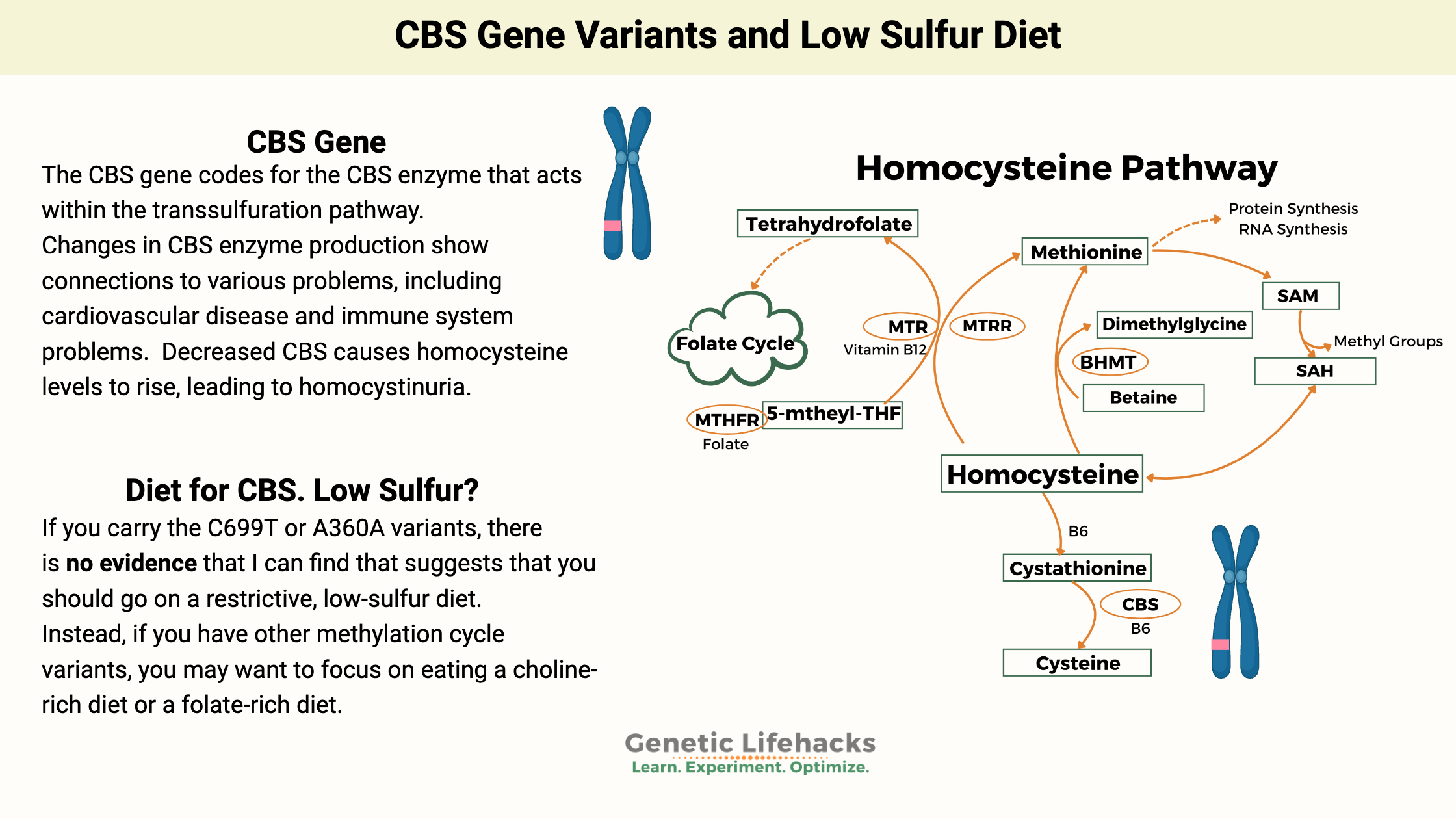
The CBS gene – cystathionine beta-synthase – codes for the CBS enzyme that acts within the transsulfuration pathway. The CBS enzyme reduces homocysteine to an intermediate (cysteine) that eventually can become glutathione, an important antioxidant in the body. Additionally, the CBS enzyme participates in a desulfation reaction to help create hydrogen sulfide, H2S.  Hydrogen sulfide, a molecule needed by the body in just the right amount, at low levels, acts as a mitochondrial electron donor, but at high levels, it is poisonous to the mitochondria. Likewise, the importance of the body maintaining the right levels of homocysteine should not be understated because high levels of homocysteine are associated with heart disease.[ref]

Changes in CBS enzyme production show connections to various problems, including cardiovascular disease and immune system problems.  Decreased CBS causes homocysteine levels to rise, leading to homocystinuria.

Something to note here: Vitamin B6 is a cofactor needed in the reaction that converts homocysteine.

What do online clinicians say about the CBS gene?

CBS is often mentioned on websites that discuss the methylation cycle, with speculation by a couple of well-known clinicians that some of the variants listed below upregulate or increase the amount of the CBS enzyme. Websites that discuss these clinicians’ ideas often caution that people with CBS upregulation variants should avoid eating foods that contain sulfur (meat, garlic, eggs, etc.) and warn of too much ammonia.[ref][ref]

Note that I found no research studies that show that the common CBS variants indicate that sulfur foods should be restricted.

What does the research actually show on the CBS variants?

The research on the variants:

  • does not show that these variants are a problem
  • does not indicate that everyone with the variants should be on low-sulfur or low-protein diets
  • does not show that people with the variants should shell out money for specific ammonia-reducing supplements

Instead, the research indicates that the common CBS variants may have a subtle effect on cholesterol levels. One of the variants slightly decreases the risk of having a baby with a cleft lip, which indicates a positive connection to the methylation cycle.[ref][ref]


CBS Genotype Report:

Access this content:

An active subscription is required to access this content.

Join as a member


Lifehacks:

The most impactful variant above is the rs5742905 variant, which increases the risk of high homocysteine.

When to test your homocysteine levels:

There is a well-researched connection between high homocysteine levels and an increased risk of heart disease as well as other health impacts. If you do have the variant and high homocysteine levels, the good news is that vitamin B6 is likely to help.

Related article: Homocysteine: research studies and genetic connections

If your data shows the rare rs5742905 G  allele, you may want to get your homocysteine levels checked. Talk with your doctor about homocysteine risk factors and get them to order the test for you. Or, if you are in the US, you can order the test yourself through UltaLabs or other online lab test retailers. It’s a relatively inexpensive test.

Diet for CBS C699T or A360A:

Access this content:

An active subscription is required to access this content.

Join as a member


Related Articles and Topics:

MTHFR Mutation: What is it? How to check your raw data.

COMT: How to Optimize Your Supplements for Your COMT Genotype


References:

Boyles, Abee L., et al. “Folate and One-Carbon Metabolism Gene Polymorphisms and Their Associations with Oral Facial Clefts.” American Journal of Medical Genetics. Part A, vol. 146A, no. 4, Feb. 2008, pp. 440–49. PubMed, https://doi.org/10.1002/ajmg.a.32162.
———. “Folate and One-Carbon Metabolism Gene Polymorphisms and Their Associations with Oral Facial Clefts.” American Journal of Medical Genetics. Part A, vol. 146A, no. 4, Feb. 2008, pp. 440–49. PubMed, https://doi.org/10.1002/ajmg.a.32162.
CBS Gene: MedlinePlus Genetics. https://medlineplus.gov/genetics/gene/cbs/. Accessed 3 Dec. 2025.
Fredriksen, Ase, et al. “Large-Scale Population-Based Metabolic Phenotyping of Thirteen Genetic Polymorphisms Related to One-Carbon Metabolism.” Human Mutation, vol. 28, no. 9, Sept. 2007, pp. 856–65. PubMed, https://doi.org/10.1002/humu.20522.
Hendrix, Philipp, et al. “Association of Cystathionine Beta-Synthase Polymorphisms and Aneurysmal Subarachnoid Hemorrhage.” Journal of Neurosurgery, vol. 128, no. 6, June 2018, pp. 1771–77. PubMed, https://doi.org/10.3171/2017.2.JNS162933.
Jockers, Dr. “CBS Mutation and Low Sulfur Diet.” DrJockers.Com, 10 Dec. 2014, https://drjockers.com/cbs-mutation-low-sulfur-diet/.
Kruger, W. D., et al. “Polymorphisms in the CBS Gene Associated with Decreased Risk of Coronary Artery Disease and Increased Responsiveness to Total Homocysteine Lowering by Folic Acid.” Molecular Genetics and Metabolism, vol. 70, no. 1, May 2000, pp. 53–60. PubMed, https://doi.org/10.1006/mgme.2000.2993.
Lim, Unhee, et al. “Gene-Nutrient Interactions among Determinants of Folate and One-Carbon Metabolism on the Risk of Non-Hodgkin Lymphoma: NCI-SEER Case-Control Study.” Blood, vol. 109, no. 7, Apr. 2007, pp. 3050–59. PubMed Central, https://doi.org/10.1182/blood-2006-07-034330.
Porter, Kristin E., et al. “Association of Genetic Variation in Cystathionine-β-Synthase and Arsenic Metabolism.” Environmental Research, vol. 110, no. 6, Aug. 2010, pp. 580–87. PubMed Central, https://doi.org/10.1016/j.envres.2010.05.001.
Return to Autism Page. https://www.heartfixer.com/AMRI-Nutrigenomics.htm#CBS%20(Cystathionine%20Beta%20Synthase)%20Explanation%20and%20Generic%20Plan%20of%20Action. Accessed 3 Dec. 2025.
Sharma, Amitabh, et al. “Network-Based Analysis of Genome Wide Association Data Provides Novel Candidate Genes for Lipid and Lipoprotein Traits.” Molecular & Cellular Proteomics : MCP, vol. 12, no. 11, Nov. 2013, pp. 3398–408. PubMed Central, https://doi.org/10.1074/mcp.M112.024851.
———. “Network-Based Analysis of Genome Wide Association Data Provides Novel Candidate Genes for Lipid and Lipoprotein Traits.” Molecular & Cellular Proteomics : MCP, vol. 12, no. 11, Nov. 2013, pp. 3398–408. PubMed Central, https://doi.org/10.1074/mcp.M112.024851.
Skovby, Flemming, et al. “A Revisit to the Natural History of Homocystinuria Due to Cystathionine β-Synthase Deficiency.” Molecular Genetics and Metabolism, vol. 99, no. 1, Jan. 2010, pp. 1–3. DOI.org (Crossref), https://doi.org/10.1016/j.ymgme.2009.09.009.
Zhu, Haoran, et al. “Cystathionine β-Synthase in Physiology and Cancer.” BioMed Research International, vol. 2018, June 2018, p. 3205125. PubMed Central, https://doi.org/10.1155/2018/3205125.

About the Author:
Debbie Moon is a biologist, engineer, author, and the founder of Genetic Lifehacks where she has helped thousands of members understand how to apply genetics to their diet, lifestyle, and health decisions. With more than 10 years of experience translating complex genetic research into practical health strategies, Debbie holds a BS in engineering from Colorado School of Mines and an MSc in biological sciences from Clemson University. She combines an engineering mindset with a biological systems approach to explain how genetic differences impact your optimal health.