
You just connected your file. Below is one trait pulled straight from your data — and it’s one you can check against yourself right now. This is a miniature Genetic Lifehacks report: your genotype, the research, and what it means for you. Full articles + genotype reports are much more detailed and longer.
Can you actually digest that latte? Your DNA has the answer.
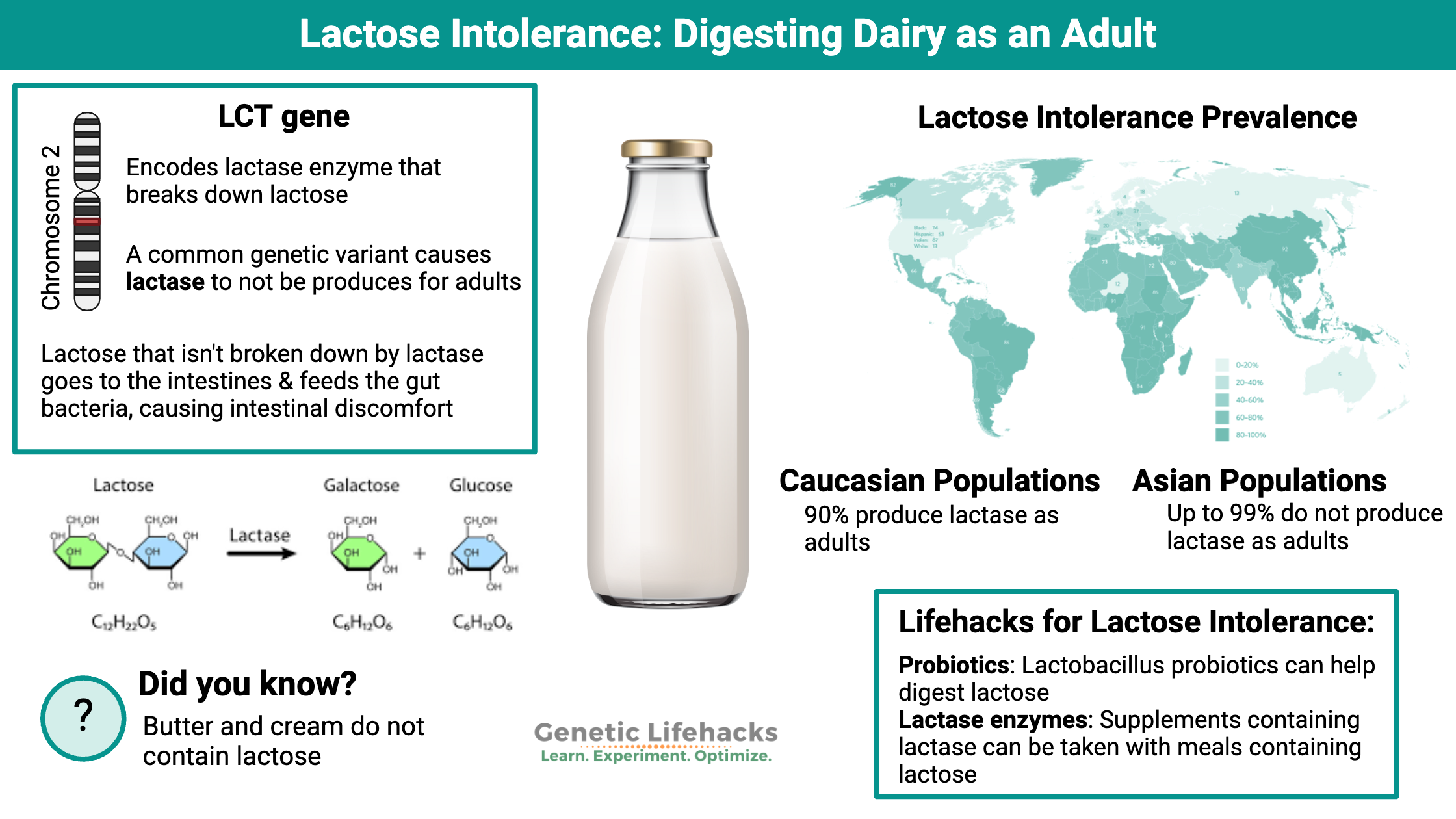
Whether you can digest dairy as an adult comes down to a single genetic switch.
Lactase is the enzyme that breaks down lactose, the sugar in milk and dairy. Everyone makes it as a baby — but for many adults, the body stops.
Whether your body keeps producing lactase into adulthood is set by a genetic variant near the LCT gene. The main marker for this is rs4988235, in the neighboring MCM6 gene, for people of Caucasian or Asian ancestry. For African or Middle Eastern ancestry, there is a different rs id to look at (included below).
Lactose Intolerance Genotype Report
The ability to digest milk as an adult has arisen differently over history in different population groups. For people in other ancestry groups, lactase persistence may be found in different genetic variants. [ref]For people with Caucasian ancestry:
Research & references
Research & references
Research & references
Done testing your file? Click the Clear Data button.
Lifehacks for Lactose Intolerance
Just because you are genetically not producing lactase as an adult doesn’t mean that you can’t digest any lactose. Instead, this means that you are relying on your gut microbiome to break down the lactose. Exceeding the amount that your gut microbiome can handle at one time is what causes ‘gastrointestinal distress’.
Foods High in Lactose (avoid if not producing lactase):[ref]
The foods highest in lactose are:
- Milk and buttermilk contain about 12 g/cup.
- A cup of evaporated milk contains about 25 g of lactose.
- Ice cream varies by brand because some brands add in extra lactose.
Cow’s milk tends to be the highest in lactose, but goat and sheep milk also contain lactose.
Dairy foods low in lactose (still able to consume if not producing lactase):
- Butter and cream contain virtually no lactose, and hard cheeses are usually pretty low in lactose as well.
- Yogurt does contain lactose, but it also contains Lactobacillus bacteria that can break down the lactose. Many people with lactose intolerance do fine with yogurt in moderate amounts.
Specific probiotics and enzyme supplement:
Quite a few studies have looked at the effect of probiotics on lactose intolerance. For example, a study found that a specific strain of Lactobacillus acidophilus significantly reduced the symptoms of lactose intolerance. [ref]
There are many species of Lactobacillus bacteria available as probiotics, and you can also get Lactobacillus in yogurt or other fermented dairy foods. Some strains will likely be more effective than others in reducing lactose intolerance symptoms for an individual. Thus, it may be worthwhile to try several different types of Lactobacillus sp. probiotics.
Include a little milk each day:
Regularly consuming some dairy (lactose) feeds your lactose-loving gut bacteria. A study found that consuming lactose for 10 days straight allowed for the colon microbiome to adapt to it. [ref] Thus, a moderate amount of cheese each day or milk in your coffee each morning will keep your Lactobacillus bacteria happily living in your gut microbiome, ready to take care of any lactose you consume.
Lactase enzyme supplements:
In most countries, you can buy the lactase enzyme in health food stores and take it along with foods containing dairy. Simply take the enzymes before your dairy-containing meal, and the lactase enzyme will be available in your gut to break down the lactose in the dairy.
Lactose-free dairy products are also readily available. Often these are made by adding lactase enzymes to the product.
DIY lactose-free milk:
If you don’t have access to lactose-free milk, you can create your own using lactase enzyme pills added to the milk. Try adding the tablets (or even easier, the liquid drops) to the milk about six hours before you want to drink it. The added lactase may shorten the shelf-life of your milk, so experiment with smaller amounts before adding it to a whole gallon. Read the label on the lactose tablet or drops to figure out how many you need for the amount of milk you will be making lactose-free.
Osteoporosis? Decreased dairy may not be a problem:
Interestingly, a Dutch study showed that the G/G genotype resulted in adults having a lower dietary calcium intake. However, it did not correspond to a lower bone density or more fractures.[ref]
Recap of your genes:
| Gene | RS ID | Your Genotype | Notes for Your Genotype | Effect allele | Effect allele frequency |
|---|---|---|---|---|---|
| MCM6 | rs4988235 | — | Still produces lactase as an adultStill produces lactase as an adult, but less than those with A/ANo longer produces lactase as an adult | G | 0.49 |
| MCM6 | rs145946881 | — | Still produces lactase as an adultStill produces lactase as an adultNo longer produces lactase as an adult | G | 0 |
| MCM6 | rs41380347 | — | Still produces lactase as an adultStill produces lactase as an adultNo longer produces lactase as an adult | A | 0.99 |
WHAT YOU UNLOCK AS A MEMBER
- 400+ reports, each populated with your variants and backed by current research
- The “Lifehacks” sections — the practical, personalized steps for your genetics
- Summary reports you can generate and keep
- Look up any SNP in your own data, anytime
- New and updated reports added every week
- No ads. No trackers. No selling your data. Member-supported, on purpose.
The sample report is one of more than 400. Membership turns your single file into a personal library of genetic insight:
From $11.99/month, $49.99/year, or $119 once for lifetime access.