
Last fact-checked and updated: | Published:
Key takeaways:
- Hypophosphatasia is caused by mutations in the ALPL gene, which reduce the activity of tissue‑nonspecific alkaline phosphatase (TNAP), an enzyme that’s important for bone, tooth, liver, and kidney health.
- Low ALP allows pyrophosphate and active vitamin B6 (P5P) to build up, interfering with normal bone mineralization.
- Single ALPL mutations can be associated with low‑normal ALP and higher rates of bone and dental issues, and may underlie osteoporosis in a subset of patients.
- Adult-onset HPP symptoms can mimic fibromyalgia.
What is hypophosphatasia, and how is it related to low ALP?
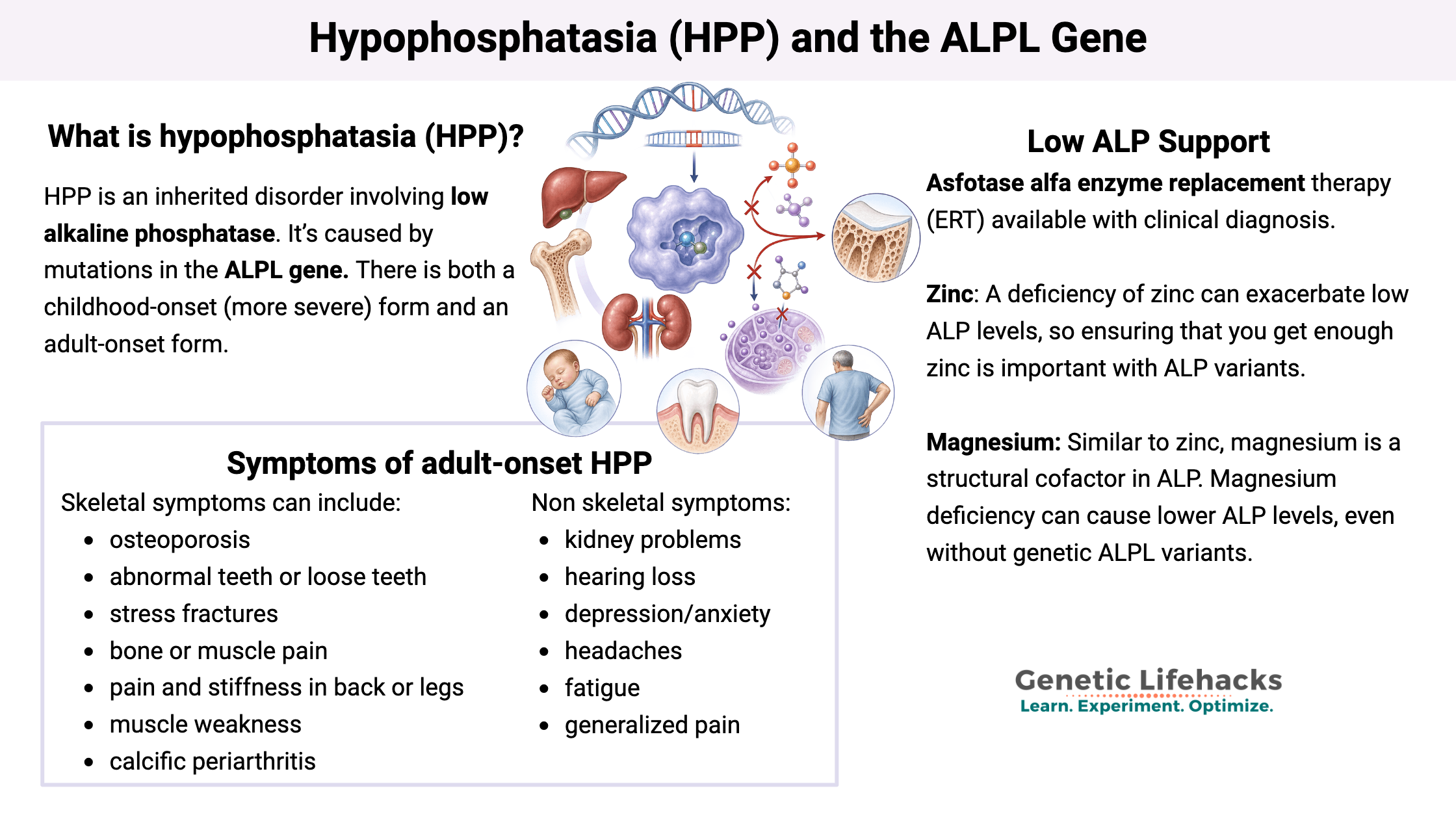
Hypophosphatasia (HPP) is an inherited disorder involving low alkaline phosphatase. It’s caused by mutations in the ALPL gene. There is both a severe form that affects infants and children and a milder, adult-onset form.
The ALPL gene encodes the tissue-nonspecific isoenzyme of alkaline phosphatase, abbreviated TNAP.
Alkaline phosphatase (ALP) may sound familiar as a marker that is common on standard blood tests. Doctors look at it as a marker of liver health. It’s an enzyme that removes phosphate groups from other molecules in the body. The enzyme contains zinc and magnesium, making these minerals essential for its activity. It also incorporates the active form of vitamin B6, called pyridoxal 5′-phosphate (P5P).
There are multiple ALPs, and the ALPL gene codes for a specific type of alkaline phosphatase called tissue-nonspecific (TNAP). It is found most abundantly in the liver, bone, and kidneys, but is also at low levels throughout the body. In the bone, it is important for remineralization and the incorporation of phosphorus into bones. [ref]
What constitutes low ALP? The standard range for adults is 40 to 130 U/L for males and 35 to 104 U/L for females. Below 35 (females) or 40 (males) U/L is considered low or abnormal on most test ranges. [ref]
Hypophosphatasia: ALPL mutations and low ALP levels
Hypophosphatasia is caused by a lack of tissue non-specific ALP (TNAP).
A lack of ALP allows for the buildup of its substrates – inorganic phosphate (pyrophosphate) and pyridoxal 5′-phosphate (active vitamin B6). An excess of pyrophosphate can inhibit how bones and teeth use phosphorus and calcium for remineralization.[ref]
There are two forms of hypophosphatasia:[ref]
- Childhood onset: more severe forms cause significant problems with bone growth, teeth formation, and even seizures
- Adult-onset: milder form that is associated with low bone mineral density, bone pain, muscle weakness, and dental problems.
Essentially, the problem from low ALP activity is that it leads to the accumulation of inorganic pyrophosphate (PPi), which feeds back to inhibit bone mineralization, and pyridoxal 5′-phosphate. Urinary phosphoethanolamine (PEA) is usually elevated.[ref][ref]
Why high serum B6 levels?
Tissue non-specific ALP (TNAP) normally acts on the active form of vitamin B6, pyridoxal 5′-phosphate, by removing a phosphate group so that it can cross cell membranes. Without enough ALP, the pyridoxal 5’phosphate (P5P) accumulates outside the cells, causing high serum vitamin B6 levels. Cellular levels may still remain normal in some people. One way that doctors can detect HPP is to do a vitamin B6 challenge – giving patients 20mg the regular form of B6 (pyridoxine hydrochloride) for 2 days to see if their serum P5P (active B6) elevates significantly.[ref][ref]
Children with HPP:
Children born with two copies of rare, pathogenic ALPL mutations can develop problems with bone health (rickets) and tooth development from a very early age. An excess of vitamin B6 can also have detrimental effects, including seizures or neurological effects. This is a condition that is usually apparent and diagnosed in early childhood.[ref]
Adult-onset form of HPP: Symptoms and health issues
The severe and significant problems with bone health are easy to see and understand in children with HPP. The adult-onset form is more nuanced.
To be clear, the term ‘adult-onset’ is a bit of a misnomer, in my opinion. This is a condition that develops over years of low ALP and higher levels of inorganic pyrophosphate and P5P, so it is more the case that the changes aren’t fully noticed until adulthood.
In adults, skeletal symptoms can include:[ref][ref][ref]
- osteoporosis
- abnormal teeth or loose teeth
- stress fractures
- bone or muscle pain (often misdiagnosed as fibromyalgia)
- pain and stiffness in back or legs
- muscle weakness
- calcific periarthritis – calcium hydroxyapatite crystal deposits in the soft tissues around a joint
Hypophosphatasia is more than just ‘soft bones’, though.
Non-skeletal symptoms include:[ref]
- kidney problems
- hearing loss
- depression/anxiety
- headaches
- fatigue, generalized pain
Carriers of a single ALPL mutation:
While childhood-onset hypophosphatasia is generally caused by two ALPL mutations, carrying just one mutation often causes few or no readily noticeable symptoms.
However, recent advances in whole-genome sequencing and large genetic databases show that carrying a rare mutation may have some effects.
Researchers used the Vanderbilt University DNA Biobank database to find individuals with hypophosphatasia mutations. They found that out of 25,000+ people in the database, 105 had ALPL mutations. These individuals had low-normal or below-normal ALP levels. Of those identified, about 40% of the men and 62% of the women had documented bone or dental diseases in their health records. In addition, 40% of the women had ovarian or gynecological abnormalities.[ref]
Osteoporosis and ALPL mutations:
People with ALPL mutations may be at a higher risk of osteoporosis. A large study at an osteoporosis center found that 0.5% of the patients had low ALP levels, and most of the low ALP patients also carried single copies of pathogenic ALPL gene mutations.[ref]
While there are many causes of osteoporosis, for some, ALPL mutations may be an uncommon root cause.
Related article: Osteoporosis genes
Fibromyalgia misdiagnosis possible:
The symptoms of adult-onset hypophosphatasia are similar in many ways to fibromyalgia. A study of ~ 600 fibromyalgia patients found that almost 10% had consistently low ALP levels that could indicate HPP, although none had genetic testing or vitamin B6 test results.[ref]
Related article: Fibromyalgia genes
What else – other than an ALPL mutation – can cause low ALP levels?
ALP levels can also be low, usually transiently, due to specific conditions:[ref][ref][ref]
- lung or respiratory infections with Francisella tularensis bacteria cause low ALP levels
- cancer or severe illness
- low magnesium or B6 deficiency
- excess vitamin D
- Celiac disease, malnutrition (check your genes)
- hypoparathyroidism
- Wilson’s disease (check your genes)
- lab errors
Genotype report: ALPL and HPP
ALPL gene: encodes an enzyme called tissue-nonspecific alkaline phosphatase (TNSALP), which acts as a phosphatase, which means that it removes phosphate groups from other molecules.
Access this content:
An active subscription is required to access this content.
Log in below or Join as a member.
Lifehacks:
Think you have adult-onset hypophosphatasia? Talk with your doctor
If you have persistently low ALP levels, talk with your doctor about whether adult hypophosphatasia is a possible diagnosis. Additional tests, such as B6 or urinary PEA levels, may be needed for a definitive diagnosis, along with genetic testing. [ref][ref]
Why is diagnosis important? [ref]
- There is a prescription-only replacement enzyme called Asfotase alfa enzyme replacement therapy (ERT) available.
- In addition, certain medications, such as Bisphosphonates, denosumab, and excess vitamin D, may need to be avoided.
Need to find a doctor or specialist? Soft Bones may be able to help: https://softbones.org/newly-diagnosed/
In addition, talk with your doctor before taking any supplements. While I couldn’t find any information directly related to supplementing with PEA (phosphoethanolamine), it seems like it might be counterindicated with HPP.
Ways to support low ALP levels:
Zinc:
Zinc is a cofactor for tissue non-specific ALP. A deficiency of zinc can exacerbate low ALP levels, so ensuring that you get enough zinc is important with ALP variants.[ref] A case series in adults with hypophosphatasia who were overlooked for a long time showed that zinc supplements were helpful in mitigating the milder symptoms of HPP.[ref]
Magnesium:
Similar to zinc, magnesium is a structural cofactor in ALP. Magnesium deficiency can cause lower ALP levels, even without genetic ALPL variants. If you have HPP, consider testing your magnesium levels and making sure you are getting plenty in your diet.[ref]
Vitamin B6? In adults with HPP, vitamin B6 insufficiency can occur. However, there are a lot of questions about the type and dosage, so this type of supplementation is best done with a doctor’s help and specific testing.[ref]
Drinking water source:
Higher ALP levels are found in children drinking reverse osmosis water compared to non-reverse osmosis sources. Serum phosphorus levels were lower in RO water drinkers than in non-reverse osmosis water drinkers.[ref]
| Gene | RS ID | Your Genotype | Notes for Your Genotype | Effect allele | Effect allele frequency |
|---|---|---|---|---|---|
| ALPL | rs121918007 | — | typicalcarrier of a single ALPL mutation p.E191K (needs second mutation to have childhood onset HPP)two copies of a pathogenic mutation for HPP p.E191K (really rare, check data accuracy) | A | 0.001 |
| ALPL | rs121918002 | — | typicalcarrier of a pathogenic mutation for hypophosphatasia, adult onsettwo copies of a pathogenic mutaiton for hypophosphatasia (rare, check data accuracy) | C | 0.0003 |
| ALPL | rs199590449 | — | typicalcarrier of a pathogenic mutation for hypophosphatasia, adult onsettwo copies of a pathogenic mutaiton for hypophosphatasia (rare, check data accuracy) | T | 0.00006 |
| ALPL | rs121918011 | — | typicalcarrier of a single ALPL mutation p.E191K (needs second mutation to have childhood onset HPP)two copies of a pathogenic mutation for HPP p.E191K (really rare, check data accuracy) | A | 0.0001 |
| ALPL | i5002765 | — | typicalcarrier of a pathogenic mutation for hypophosphatasia, adult onsettwo copies of a pathogenic mutaiton for hypophosphatasia (rare, check data accuracy) | C | 0.00003 |
| ALPL | rs121918010 | — | typicalcarrier of a pathogenic mutation for hypophosphatasia, adult onsettwo copies of a pathogenic mutaiton for hypophosphatasia (rare, check data accuracy) | C | 0.00003 |
| ALPL | i5002756 | — | typicalcarrier of a pathogenic mutation for hypophosphatasia, adult onsettwo copies of a pathogenic mutaiton for hypophosphatasia (rare, check data accuracy) | T | 0.00003 |
| ALPL | rs121918020 | — | typicalcarrier of a pathogenic mutation for hypophosphatasia, adult onsettwo copies of a pathogenic mutaiton for hypophosphatasia (rare, check data accuracy) | T | 0.00003 |
| ALPL | i5002757 | — | typicalcarrier of a pathogenic mutation for hypophosphatasia, adult onsettwo copies of a pathogenic mutaiton for hypophosphatasia (rare, check data accuracy) | A | 0 |
| ALPL | rs121918000 | — | typicalcarrier of a pathogenic mutation for hypophosphatasia, adult onsettwo copies of a pathogenic mutaiton for hypophosphatasia (rare, check data accuracy) | A | 0 |
| ALPL | rs3200254 | — | typicaltypical ALP levelsbenign (does not cause HPP), but usually associated with lower ALP levels | C | 0.13 |
Related articles:
Osteoporosis: Genetic Susceptibility and Prevention Strategies
References: