
Key takeaways:
- Modern technology constantly stimulates our brains, contributing to distraction, anxiety, and low motivation.
- Researchers now believe that some people have an addiction to the dopamine hits produced from using social media, smartphones, or internet gaming.
- Genetics plays a significant role in susceptibility to addictive behavior, including internet and smartphone addiction.
Members will see their genotype report below, plus additional solutions in the Lifehacks section. Join today.
Can smartphones and internet usage be an addiction?
Can people truly be addicted to smartphones or to being constantly connected to technology? Researchers paint a pretty compelling picture that this behavior can lead to addiction for some people.[ref]
There are thousands of studies looking into the problem, which is referred to by various names:
- smartphone use disorder (SUD)
- internet usage disorder (IUD)
- internet addiction disorder (IAD)
- digital dependency/addiction
- problematic smartphone use and dependence (PSU)
- internet gaming disorder
- social media addiction
A 2022 review study found that digital addiction is a global problem with a significant prevalence. The results, combining data from 504 studies involving over 2 million participants, showed 27% for smartphone addiction, 17% for social media addiction, 14% for internet addiction, 8% for cybersex addiction, and 6% for game addiction.[ref]
Internet gaming disorder was included as a condition warranting further study in the DSM-5 (American Psychiatric Association, 2013), and gaming disorder was formally recognized in ICD-11 (World Health Organization, 2019).
What research shows on smartphone use disorder:
A recent meta-analysis that combined the data from several studies came up with some eye-opening results. The analysis included over 42,000 adolescents and college-age young adults, and the results showed that 25% met the definition of ‘problematic smartphone use’.[ref]
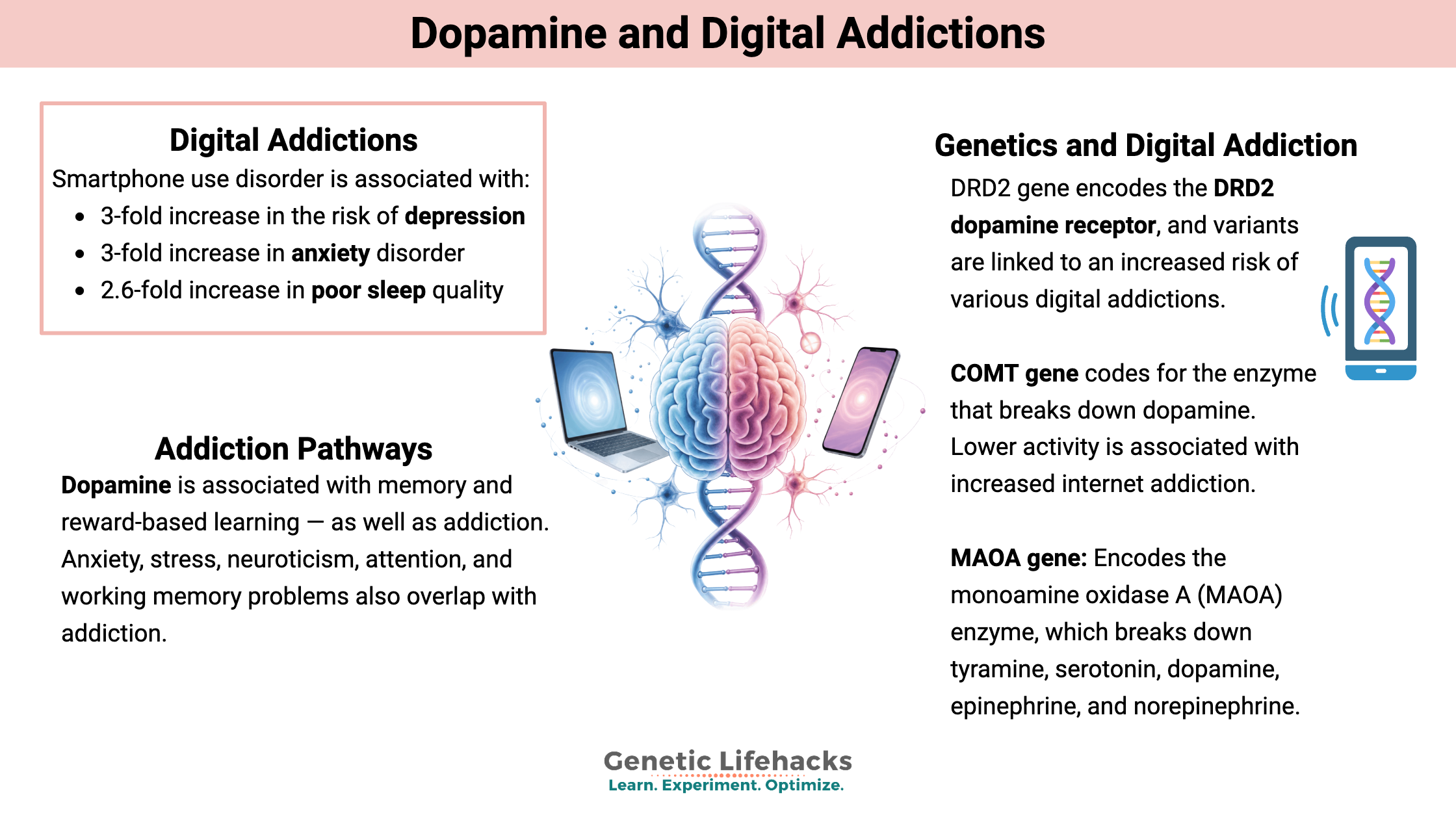
The susceptibility to digital addiction overlaps with other mental health issues. In the meta-analysis, smartphone use disorder was associated with:[ref]
- a threefold increase in the risk of depression
- a threefold increase in anxiety disorder
- a 2.6-fold increase in poor sleep quality
Smartphone addiction is still an evolving subject that is continuing to be defined by researchers. Part of the definition of addiction includes the behavior or substance that needs to cause preoccupation, neglect of other activities, sadness when not available, and continued use despite evidence of harm.
Is digital addiction genetic?
Twin studies and sibling studies are commonly used to show whether genetic factors contribute to a trait or condition. Twin studies on digital addiction show that it is at least partly due to genetic susceptibility.
In a 2016 study using data from 5,247 monozygotic and dizygotic adolescent twins in the Netherlands Twin Register, the results showed that 48% of individual differences in compulsive internet use were attributable to genetic factors, with the remaining 52% explained by non-shared environmental influences. Interestingly, shared factors such as family socioeconomic background and parenting style did not significantly contribute to the variance in compulsive internet use.[ref]
Another study of 825 Chinese adolescent twin pairs yielded even higher heritability estimates: genetic factors explained 58–66% of the variance in problematic internet use. A German twin study of 784 adult twins found that heritability estimates for specific facets of internet addiction ranged from 21% to 44%.[ref][ref]
Overall, heritability estimates (44-66%) are comparable to the heritability of substance addictions, pointing to digital and substance addictions sharing genetic underpinnings.
Personality traits and smartphone use disorder:
Researchers have applied psychological profiling methods to the problems of smartphone and internet use disorder. An emerging field called psychoinformatics applies psychology techniques to big data sets such as social networking data and phone usage data.[ref]
One study looked at users on WhatsApp and was able to statistically determine psychologically defined personality traits from the data. For example, higher Extraversion scores were associated with more frequent WhatsApp use, whereas higher Conscientiousness scores were associated with shorter usage times.[ref]
Another study found that internet and smartphone use disorder is linked with high Neuroticism scores, along with low Conscientiousness and Agreeableness scores. Additionally, internet and smartphone use disorders were linked to higher levels of social anxiety disorder and impulsivity.[ref] Other studies link smartphone use disorder to decreased ‘life satisfaction’ and reduced empathy for other people.[ref]
Social media addiction is another component of digital addiction studied by researchers. A 2025 study showed a significant link between social media addiction and mental health issues in college students.[ref]
Which pathways are involved in addiction?
Dopamine is a neurotransmitter, sending signals between dopaminergic neurons in the brain. These neurons are important for motor control (moving your body), memory, arousal, and reward. Too little dopamine in specific brain regions contributes to the rigidity and tremor seen in Parkinson’s disease, whereas excessive dopaminergic activity has been linked to psychosis.
Dopamine is associated with memory and reward-based learning — as well as addiction. Think of Pavlov’s dogs and how they became trained based on a reward and a stimulus. In general, this reward-based learning system is important for survival – it is vital to remember where good food sources can be found, where water is to slake your thirst, etc. Taking this to the extreme, drugs like cocaine cause rapid dopamine release and quickly condition the brain to seek and crave the drug.[ref]
Genetic variants in the dopaminergic system have been implicated in digital addictions. The DRD2 gene encodes a dopamine receptor, and variants are linked to an increased risk of various digital addictions. The COMT gene, which controls the rate of breakdown of dopamine, is also associated with problematic internet use. (See the genotype report below for your variants.)
GWAS studies and neurodivergent overlap:
A genome-wide association study (GWAS) on internet addiction disorder identified 24 genes that were associated with increased susceptibility. Most of the genetic variants identified were previously linked to other disorders, including autism spectrum disorder, bipolar disorder, and schizophrenia. There were also connections to anxiety, stress, neuroticism, attention, and working memory problems.[ref]
Another recent GWAS study on gaming addiction showed that there was a strong genetic overlap with ADHD genetic pathways.[ref]
A 2025 genetic study of ‘screen behaviors’ (TV, gaming, sitting with a screen device, or using social media) showed that there was a significant genetic overlap with psychiatric disorders, but that higher educational attainment was associated with a decreased risk of screen time.[ref]
Note that the elevated risk for digital addiction in neurodivergent populations doesn’t mean that digital media is uniformly harmful, just that there are overlapping biological pathways at play.
Epigenetic changes:
Emerging research suggests that epigenetic mechanisms may also contribute to digital addiction. A 2024 study showed that PER3 gene DNA methylation moderated the association between problematic mobile phone use and chronotype among young adults. PER3 is a core circadian clock gene that regulates the 24-hour internal clock. Variants in PER3 are also associated with bipolar disorder and seasonal depression.
Digital Addiction Susceptibility: Genotype Report
Again, studies using twins show that there is a large ‘heritability’ or genetic component of problematic internet use. Researchers estimate that it is 48-66% genetic. Obviously, this is a genetic link that is dependent on the environment and access to the internet and smartphones.[ref][ref][ref] To give you a frame of reference for what ‘heritability’ means, a person’s height is considered to be about 80% heritable, with the rest of the variation due to nutrition and other environmental factors.[ref]
When it comes to talking about addiction and genes, it’s important to note that these variants modestly shift risk at the population level and do not deterministically cause addiction.
Dopamine-Related Genetic Variants:
The DRD2 dopamine receptor is found abundantly in the brain, and the variants are linked with alterations to memory and addictive behavior. (Gene name ANKK1, referred to in studies as DRD2).
Access this content:
An active subscription is required to access this content.
Log in below or Join as a member.
Lifehacks:
Below are multiple research-backed ways to help reduce digital addictions.
Dopamine fasting:
If you recognize that your phone and internet usage is excessive, check out the articles by Dr. Sepah on dopamine fasting. His recommendations, such as setting limits and taking a break from electronics for a few hours each night, seem practical and beneficial for all of us.
What can you do during a phone or laptop break? If you’re scratching your head and unsure where to start, here are a few suggestions:
Access this content:
An active subscription is required to access this content.
Log in below or Join as a member.
Related Genes and Topics:
Dopamine Receptor SNPs: Addiction, Mood, ADHD, and Schizophrenia
References: