
Last fact-checked and updated: | Published:
Key takeaways:
- Arginine is a conditionally essential amino acid used to make nitric oxide (NO), creatine precursors, and to clear ammonia.
- When arginine availability is low, nitric oxide production, blood-vessel tone, immune signaling (including HLA antigen presentation and T-cell function), and wound healing can be affected
- In the tumor microenvironment and some chronic infections, local arginine levels can be depleted, which causes T cells to not function well.
- Genetic variants in ARG1 and ARG2 are linked to differences in circulating arginine, arginase activity, blood pressure–related traits, and asthma.
- L-citrulline and arginine-rich foods can raise arginine levels, but there are situations where you may not want to do that.
What is Arginine?
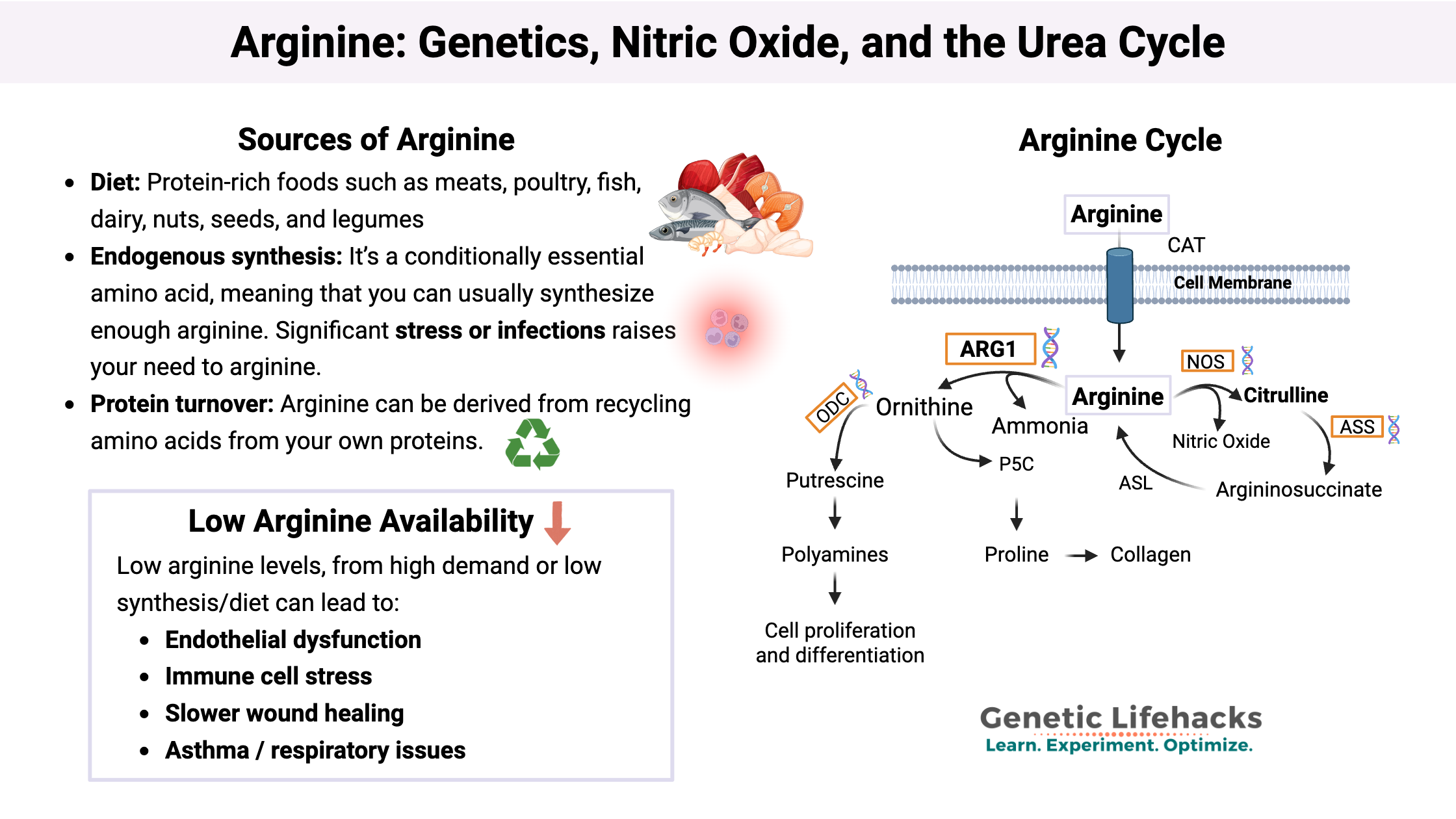
Arginine (L-arginine) is an amino acid your body incorporates into proteins and as a substrate for several important pathways, like nitric oxide and creatine synthesis. It’s a conditionally essential (or semi-essential) amino acid, meaning that you can usually synthesize enough arginine for day-to-day needs as an adult. During situations causing physiological stress, such as a critical illness, trauma, or significant infection, your body may not be able to synthesize enough to meet the need, and thus you would need to get L-arginine from foods or supplements under some conditions.[ref]
We get dietary arginine from protein-rich foods, including beef, chicken, pork, nuts, peanuts, and seeds. Arginine is also synthesized in the kidneys from citrulline, which is an amino acid produced in the small intestine. This makes both kidney health and gut health important in your arginine levels.[ref]
Let’s dig into the biology first, and then move into the genetic variants that influence your need for arginine.
Pathways utilizing arginine
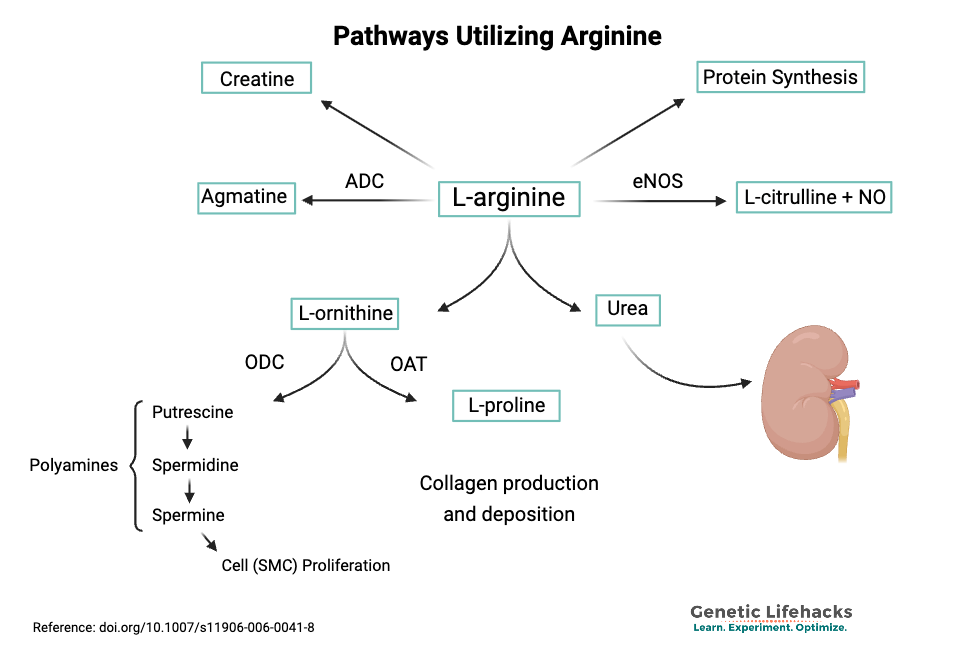
Arginine is used as a substrate for making several important substances in the body, and it is also involved in getting rid of ammonia from the body.
Nitric oxide (NO) production:
Nitric oxide synthase enzymes convert arginine into nitric oxide plus citrulline (another amino acid). NO helps blood vessels relax, influences platelet stickiness, and is involved in immune signaling.[ref]
Related articles: Nitric Oxide Synthase (NOS3) | BH4: Tetrahydrobiopterin
Urea cycle (ammonia detoxification, arginine balance):
In the liver, the enzyme arginase-1 (ARG1 gene) splits arginine into ornithine + urea. This is the final step in the urea cycle, which clears out nitrogen waste so ammonia doesn’t build up. Arginase is a manganese-containing enzyme, tying this step to manganese levels as well. In addition to clearing out ammonia, which is toxic, this pathway helps to maintain optimal levels of arginine so that it isn’t in excess.[ref]
Related article: Manganese genes
Polyamines, proline, and creatine precursors:
I mentioned ornithine above as coming from the urea cycle and ammonia disposal. Ornithine from arginase is used for the synthesis of polyamines and proline (another amino acid). Arginine also contributes to creatine synthesis pathways that support muscle energy handling.[ref]
Related article: Creatine genes
Agmatine is one biogenic amine that is synthesized directly from arginine. Agmatine is a neuromodulator with neuroprotective effects, and it also plays a role in insulin release. As a neuromodulator, it interacts with several receptors, including NMDA, α2-adrenoceptors, and imidazoline receptors. [ref][ref]
Related article: Agmatine
T cell function:
Arginine is also important in T-cell signaling, macrophage responses, and the way that antigens are presented to cytotoxic T cells. Arginine depletion, which can happen when arginase is upregulated in inflammation, tumors, or infection, can impair these important immune system responses.[ref][ref]
Related article: T Cell Exhaustion in Long COVID, ME/CFS, and Cancer: Mechanisms and Solutions
Immune support:
A 2026 study showed that arginine restriction, or not enough dietary arginine, can directly impact the way that cells present antigens to alert the immune system that a response is needed. Without sufficient arginine, cells have a harder time with MHC class I presentation of antigens. This means that an infected cell may not be able to present the antigen – such as a piece of a virus – to alert circulating white blood cells that it is infected. Similarly, without enough arginine, a cell can’t send the signal that something has gone wrong in a way that causes cancer.[ref] More on this below…
Balance of arginine by arginase:
Nitric oxide synthase (for NO production) and arginase compete for the same arginine pool. When arginase activity rises, which happens during inflammation, in some airway diseases, or with certain genetic tendencies, less arginine may be available for NO.[ref]
Where does arginine come from?
You get arginine from:
- Diet: Protein-rich foods such as meats, poultry, fish, dairy, nuts, seeds, and legumes provide dietary arginine. Watermelon contains a lot of citrulline, which the body can convert to arginine.[ref]
- Endogenous synthesis in the gut: Citrulline is synthesized in the cells lining the intestines from glutamate, proline, and glutamine. Then the kidneys (primarily) can convert citrulline to arginine.[ref][ref]
- Protein turnover: When cells are broken down, arginine can be derived from recycling amino acids from your own proteins.
It’s important to note here that most arginine comes from the diet and from recycling proteins in the body. Only a minority of circulating arginine normally comes from endogenous synthesis.[ref]
ARG1 vs ARG2: two arginase enzymes
Humans have two forms of the arginase enzymes, which play different roles in the body.
| Enzyme name | Gene | Main location (tissue) | Primary function |
|---|---|---|---|
| Arginase-1 | ARG1 | liver (primarily) and spleen[ref] | Last step in the urea cycle; also inducible in immune system/airway responsiveness contexts |
| Arginase-2 | ARG2 | Mitochondria; kidney and other tissues | Local arginine/ornithine balance; can influence NO substrate availability outside the liver |
Both ARG1 and ARG2 convert arginine to ornithine + urea, so both can compete with nitric oxide synthase (NOS) when they’re active in the same tissue.[ref]
Rare mutations in ARG1 can cause arginase deficiency, which causes ammonia to build up in the blood, leading to seizures, spasticity, and developmental delays.
What happens when ARG1 is overactive? Variants in ARG1 that increase arginase activity leave the body without enough L-arginine to meet the needs for nitric oxide synthase, which can impair blood vessel function.
What Happens When You Don’t Have Enough Arginine?
There are several ways that arginine can be low – either through diet, rare mutations, or through too much breakdown of arginine due to high arginase (such as in tumors).
Conditional low arginine availability
When arginine demand is high, dietary intake is low, or synthesis is limited, you can have a period when arginine levels are insufficient to meet demand. This can result in several different problems, depending on what is going on in your body:
- Endothelial dysfunction and less effective NO-dependent vasodilation of blood vessels. This can affect blood pressure [ref]
- Immune cell stress, including impaired T-cell receptor signaling, reduced T-cell function (especially in cancer), and weaker MHC class I antigen presentation when arginine is insufficient. [ref][ref]
- Worse outcomes in some critical-illness or trauma settings, where arginine becomes more essential.[ref]
Symptoms of arginine deficiency aren’t the same for everyone. You may have blood pressure or circulation issues, slower wound healing, erectile dysfunction, or less resilience in inflammatory illnesses where arginase is upregulated. None of these are specific to arginine insufficiency, but all can be caused by it.
Inflammation can create a local arginine deficiency
Even if your plasma arginine looks normal, upregulated arginase in specific tissues, such as in lung diseases or in tumors, can locally deplete arginine and at the same time raise ornithine. Ornithine and arginine also use the same cationic amino acid transporters (SLC7A1), so high ornithine intake can interfere with arginine uptake into cells.[ref]
A local arginine deficiency isn’t always a negative, though. While nitric oxide can be beneficial in the endothelium for relaxing blood vessels, under other conditions, nitric oxide can form reactive nitrogen species that are detrimental. One example is in spinal cord injury, where arginine increases neuroinflammation, while at the same time being beneficial in certain ways.[ref]
HLA types: Arginine interacts with how cells present threats to T cells
Here’s a newer piece of the puzzle that connects dietary arginine levels to how your immune system reacts to antigens.
MHC class I proteins, which are encoded by HLA genes, are found on the membrane of almost all cells and present snippets of proteins to CD8+ T cells. These protein snippets can be part of a virus, bacteria, or tumor – and tell the immune system that something is wrong with the cell. If MHC-I protein levels drop, those T cells get a weaker “something’s wrong here” signal.
In a 2026 Cell study, researchers found that low extracellular arginine levels deplete specific arginine tRNAs, so ribosomes stall at arginine-rich codons on MHC class I transcripts. This results in less MHC-I protein being made and weaker antigen presentation on the cell surface. So even though the MHC-I genes are still being transcribed, they aren’t being made in sufficient levels to really signal when there’s a problem in the cell.[ref]
This is a problem for a couple of reasons. In mice, the researchers found that:
- Dietary arginine restriction worsened colon tumor growth. It also impaired antiviral immunity to influenza and SARS-CoV-2 viruses.
- Raising arginine availability, either through diet or through reducing arginase breakdown of arginine, resulted in more MHC-I for antigen presentation, reduced colon tumors, and improved viral infection outcomes.
Again, this was research done in animals and cell lines, so it needs more testing to know the exact role that dietary arginine plays in both colon cancer prevention and in respiratory infections.
Note that some viruses need arginine to replicate, so in certain infections (like shingles and cold sores), you may be better off if you are slightly deficient in arginine.
T cells need arginine
T cells are a type of white blood cell that are part of the body’s adaptive immune response – fighting off pathogens and also destroying your own cells if they are cancerous or damaged.
When activated by an antigen, T cells use a lot of arginine, as well as glucose and fatty acids, to proliferate to fight off the infection.
T cells are also important in preventing or fighting off cancer. In the tumor microenvironment (TME), arginine is often deficient because macrophages produce a lot of arginase, depleting local arginine. This then blocks antigen-specific T cell response.[ref][ref]
T cell exhaustion occurs when T cells are chronically exposed to an antigen – like in a persistent, low-level infection, an mRNA that doesn’t shut off, or during cancer immunotherapy. Checkpoints on the T cells put the T cells in an inactive state, allowing the T cells to survive but not effectively respond to the antigen.
A number of studies show that low arginine levels can play a substantial role in T cell exhaustion. Supplemental arginine can rescue T cell exhaustion in certain settings.[ref][ref]
Chronic infection can also increase arginase-expressing myeloid cells and cause low arginine bioavailability. This happens in several persistent infections, such as HIV and hepatitis B and C, as well as in chronic-inflammation settings.[ref]
Arginine in asthma
Arginine interacts with asthma in a couple of ways that can be confusing. First, some people with asthma have higher levels of exhaled nitric oxide. Rather than pointing to an excess of arginine, research shows that the reactive, inducible nitric oxide is upregulated, which then causes a relative deficiency of arginine in the lungs and lung blood vessels. Endothelial NO is then lacking, which causes bronchoconstriction and hyperreactivity. Higher arginine availability levels are associated with fewer exacerbations in asthma, but a trial of supplemental L-arginine showed no statistical effect.[ref] Genetic variants in the ARG1 and ARG2 genes are associated with susceptibility to asthma.
Related article: Asthma Genes: Understanding your genetic pathways
Arginine in bone health and osteoporosis
A study in mice showed an interesting connection between arginine, the gut microbiome, and bone health. The researchers looked at how mice responded to mechanical loading (exercise) for bone density. They found that mice with gut bacteria that produce more L-citrulline benefited from the exercise with stronger bones. Through a series of experiments, they determined that arginine (converted from citrulline) was the key. L-arginine was enhancing a positive feedback loop in the bone with nitric oxide and calcium signaling in the osteocytes, which promoted stronger bones.[ref]
Related article: Osteoporosis genes
Oral microbiome:
One interesting thing about arginine is that certain types of bacteria can use it for growth, and in the oral microbiome, adding more arginine seems to boost the good bacteria while decreasing the cavity-promoting bacteria. A clinical trial using toothpaste containing arginine compared to toothpaste without arginine showed that the arginine helped to decrease the acid-producing, cavity-promoting bacteria.[ref]
When arginine becomes a limiting factor
As explained above, arginine is conditionally essential, meaning that there are situations in which dietary arginine is needed to meet the body’s needs.
Here are some of the situations in which more arginine may be needed.
| Setting | What’s going on |
|---|---|
| Cancer / Tumor Microenvironment | Tumor arginase depletes arginine in some types of tumors (fuels tumors, depletes body); MHC-I translation can also decrease when arginine is low[ref] |
| Respiratory viral infection | Low dietary arginine worsened flu and SARS-CoV-2 outcomes; restoring arginine in the lungs helped with antigen presentation [ref] |
| Asthma and airway inflammation | Human asthma cohorts show lower arginine bioavailability and higher serum arginase; animal work supports arginase as a therapeutic target[ref] |
| Trauma, surgery, burns | Severe burns or major injury uses up arginine quickly.[ref[ref] |
| Sepsis / critical illness | Arginine depletion is associated with circulation and immune problems, but supplementing arginine in septic shock is not always good since excess NO can worsen vasodilation.[ref |
| Wound healing | Supplemental arginine improved wound healing and collagen deposition[ref |
Wound healing, circulation, and other research angles
Arginine also acts as a collagen precursor, which makes it essential in wound healing. A clinical trial involving healing from surgery showed that supplemental L-arginine significantly improved healing time. The study involved women undergoing mastectomy. The L-arginine group (5 g/day) had complete healing by a median of 22 days, while the placebo group had a median healing time of 35 days. In addition, the L-arginine group had significantly fewer long-lasting complications.[ref] Note that not all chronic wounds or surgeries show arginine to be helpful, so this is a ‘talk to your doctor’ situation.[ref]
You’ll also see arginine and citrulline discussed for erectile dysfunction because NO is central to that vascular pathway. Genetics of arginase expression has even been studied in erectile dysfunction cohorts alongside ARG1/ARG2 SNPs.
Rare genetic arginase-1 deficiency (argininemia)
What happens when you don’t have enough arginase to break down arginine (or, in other words, what happens with too much arginine)?
Arginase deficiency is caused by rare ARG1 loss-of-function mutations that block the last step of the urea cycle. Arginine accumulates (hyperargininemia), and in untreated children, ammonia can also rise to detrimental levels. This can cause muscle spasticity, slowed development, and even neurological problems.[ref] Treatment is a specialized diet with protein restriction and other management under a doctor’s care.
Note that rare mutations in a DTC test, such as from 23andMe or Ancestry, can be false positives, so always talk with a doctor and get a clinical-grade test to confirm.
Common SNPs in ARG1 and ARG2 won’t usually create a urea-cycle emergency with high ammonia.
What they may do is slightly alter circulating arginine levels and increase the relative risk of either lung problems or cardiovascular problems tied to nitric oxide. So let’s take a look at how your genes affect your arginine levels.
Genotype Report: Arginine-Related Variants
ARG1 gene: encodes arginase-1, which is primarily found in the liver for the urea-cycle use of arginine for ammonia detoxification. It is also inducible elsewhere, including in the lungs and in cancer.
ARG2 gene: encodes arginase-2, which is a mitochondrial arginase that is found in the airways and is involved in preeclampsia.
Access this content:
An active subscription is required to access this content.
Log in below or Join as a member.
Lifehacks: Optimizing Arginine Levels
Let’s take a look at sources of arginine, types of supplements, what clinical trials show, and where you may want to use caution with arginine.
Dietary sources of arginine
High-arginine foods include turkey, chicken, beef, pork, fish, dairy, peanuts and other nuts, pumpkin seeds, chocolate, soybeans, and legumes. The average diet provides around 4-5g/day of arginine.[ref][ref]
Watermelon is a great source of citrulline, which can raise arginine indirectly.[ref]
If you don’t eat much animal protein, you can still get arginine from nuts, seeds, and legumes, but just know that your total intake may be lower. You could track it for a few days or a week using a free dietary tracker like cronometer.com (arginine isn’t turned on by default, so you’ll need to go into the settings to show it).
Supplementing with L-arginine vs L-citrulline
Citrulline is readily absorbed in the intestines and then is converted in the kidneys to arginine, which is released into the bloodstream.[ref]
Oral supplemental L-arginine is often broken down by intestinal and liver arginase. This makes L-citrulline a slightly better option because it skips getting broken down in the liver and then converts to arginine in the kidney and other tissues. In a randomized crossover study in healthy adults, L-citrulline at 3g twice a day was more efficient at raising arginine levels than a 1.6g dose of L-arginine. There were a couple of ratios that showed L-citrulline may be a little more efficient.[ref]
Practical take: If the goal is higher circulating arginine, many researchers lean toward citrulline rather than arginine alone. This may be particularly true for someone with an ARG1 variant that increases arginase levels.[ref] If you don’t have good kidney function, though, arginine may be a better option. (If you have chronic kidney disease, definitely talk with your doctor before supplementing with any amino acid or changing your diet.)
Absorption and half-life: Studies show that we only end up absorbing about half of the arginine from food because part of it is converted using arginase in the intestines. In addition, about 5–15% of circulating L-arginine comes from endogenous synthesis from citrulline. Studies using a 6g dose of arginine found that the maximum concentration in the bloodstream is reached about 2 hours after ingestion, and that the half-life was about 1.5 to 2 hours.[ref] The somewhat quick half-life means that taking arginine in divided doses, such as twice a day, may be more effective for maintaining higher levels.
Maximum dose? A 2018 safety study involving healthy adults looked at the effects of different doses of arginine for 90 days. The results showed that there were no significant adverse effects from doses up to 30g/day.[ref] Note that this was in healthy adults – there are some other situations noted below to talk with your doctor about before supplementing.
Gut microbiome and arginine
Several animal studies show that the gut microbiome can contribute to arginine production, but it is complicated because some gut microbes also consume arginine. In a study involving a mouse model of fatty liver disease (NAFLD/NASH), researchers found that the probiotic L. plantarum significantly increased arginine levels in the gut microbiome and in circulation. [ref] It’s not clear, though, whether there’s a clinically significant change to arginine levels from probiotics in humans. I wanted to include this to once again highlight the role of the gut microbiome in producing metabolites that we can use and benefit from.
Clinical trials and studies on arginine and citrulline
Here are some of the clinical trials on arginine to give you an example of the wide range of doses and effect sizes.
Blood pressure (L-arginine meta-analysis):
A meta-analysis pooled the data from 11 randomized, double-blind, placebo-controlled trials. In the trials, oral L-arginine doses ranged from 4–24 g/day (median 9 g/day) and reduced systolic BP by about 5.4 mmHg and diastolic BP by about 2.7 mmHg versus placebo.[ref]
Blood pressure (L-citrulline):
A meta-analysis showed modest systolic BP reductions, but diastolic blood pressure had a clearer reduction at higher intakes (often discussed around ≥6 g/day in reviews).[ref]
COPD and lung function:
A clinical trial compared oral arginine + vitamin C supplementation vs placebo in people with COPD. The results showed a statistically significant improvement in symptoms. The trial used 1.66 g of arginine twice a day plus liposomal vitamin C (500 mg) for 4 weeks.[ref]
Respiratory virus recovery time:
A clinical trial in hospitalized Covid patients showed that oral L-arginine decreased hospitalization days (22 days vs. 36 days) and improved respiratory function more quickly, compared to a placebo.[ref]
Long Covid:
A placebo-controlled clinical trial involving L-arginine (1.66 g twice a day) plus vitamin C showed improvements in fatigue, strength, endothelial function, and walk time after 28 days.[ref]
Exercise-induced blood pressure decrease:
A single dose of 8 g of arginine taken two hours before exercise promoted lower blood pressure after exercise in older adults who normally had hypertension.[ref]
Reduced tooth sensitivity:
A clinical trial involving periodontal disease patients with root sensitivity found that an arginine-based compound in toothpaste significantly reduced sensitivity.[ref]
Vascular dementia:
A small trial in Japanese dementia patients showed that 1.6g/day improved cognitive test scores.[ref] However, there wasn’t a control group for the trial, so it’s a study that needs to be replicated…
No effect on bicep curls:
A study in healthy young men showed that arginine (3-9g/day) for four days did not improve performance on bicep curls.[ref]
Safety levels:
Short-term studies show that supplemental arginine of up to 20g/day is likely safe, but gastrointestinal side effects are more likely at higher doses. Many studies use divided doses twice a day.[ref] Keep in mind that most studies are for weeks or months.
Side effects and possible precautions
Herpes (cold sores / genital HSV):
HSV replication uses arginine in cell models, and the amino acid lysine can antagonize that. However, human studies for lysine prevention in cold sores show mixed results. Still, many clinicians advise avoiding arginine supplements during active outbreaks.[ref][ref]
Blood pressure medications or PDE-5 inhibitors (e.g., sildenafil):
Extra arginine could theoretically increase endothelial NO and amplify vasodilation and hypotension risk. Talk with your doctor to see if there is any risk for your case.
Kidney disease:
Amino acid supplements are something to talk with your doctor about if you have CKD. Studies show that citrulline and arginine handling changes when kidneys are impaired. [ref]
GI side effects:
Nausea, cramping, and diarrhea are sometimes reported with large doses of L-arginine.
Access this content:
An active subscription is required to access this content.
Log in below or Join as a member.
Related Articles and Topics
BH4: Tetrahydrobiopterin Synthesis, Recycling, and Genetic SNPs
Nitric Oxide Synthase (NOS3): Heart Health, Blood Pressure, and Healthy Aging
References
Al-Ghunmieen, E. M., Shatanawi, A., Al-Akhras, F. M., Al Oweidat, K., & Alzayadneh, E. M. (2025). Effect of ARG1 gene (RS2781666) polymorphism on plasma arginase activity and bronchial asthma prevalence and severity. Journal of Asthma and Allergy, 18, 1023–1040. PubMed. https://doi.org/10.2147/JAA.S505962
and, E., Health, & and, F. (2018, June 29). Disease-induced deficiency and conditionally essential nutrients in disease. National Academies Press (US). Nih.Gov. https://www.ncbi.nlm.nih.gov/books/NBK525313/
Borges, C. C., Alves da Silva, W., de Sá Filho, A. S., Aprigliano, V., Inacio, P. A., Silveira, M., & Ferrari, G. (2025). Effect of arginine supplementation on vasodilation and muscular performance in young men: A randomized, double-blind, crossover study. International Journal of Sport Nutrition and Exercise Metabolism, 36(1), 1–12. PubMed. https://doi.org/10.1123/ijsnem.2025-0125
Caldwell, R. W., Rodriguez, P. C., Toque, H. A., Narayanan, S. P., & Caldwell, R. B. (2018). Arginase: A multifaceted enzyme important in health and disease. Physiological Reviews, 98(2), 641–665. https://doi.org/10.1152/physrev.00037.2016
Casonatto, J., & Cavalari, J. V. (2023). A single dosage of l-Arginine oral supplementation induced post-aerobic exercise hypotension in hypertensive patients. Journal of Dietary Supplements, 20(5), 735–748. PubMed. https://doi.org/10.1080/19390211.2022.2106006
Champaiboon, C., Ongphichetmetha, N., & Lertpimonchai, A. (2024). Bioactive glass and arginine dentifrices reduce root sensitivity during daily activities following non-surgical periodontal therapy: A randomized controlled trial. Journal of Periodontology, 95(2), 135–145. https://doi.org/10.1002/JPER.23-0197
Curis, E., Crenn, P., & Cynober, L. (2007). Citrulline and the gut. Current Opinion in Clinical Nutrition and Metabolic Care, 10(5), 620–626. https://doi.org/10.1097/mco.0b013e32829fb38d
Dong, J.-Y., Qin, L.-Q., Zhang, Z., Zhao, Y., Wang, J., Arigoni, F., & Zhang, W. (2011). Effect of oral l-arginine supplementation on blood pressure: A meta-analysis of randomized, double-blind, placebo-controlled trials. American Heart Journal, 162(6), 959–965. https://doi.org/10.1016/j.ahj.2011.09.012
Erens, C., Van Broeckhoven, J., Bronckaers, A., Lemmens, S., & Hendrix, S. (2023). The dark side of an essential amino acid: L-arginine in spinal cord injury. Journal of Neurotrauma, 40(9–10), 820–832. https://doi.org/10.1089/neu.2022.0271
Geiger, R., Rieckmann, J. C., Wolf, T., Basso, C., Feng, Y., Fuhrer, T., Kogadeeva, M., Picotti, P., Meissner, F., Mann, M., Zamboni, N., Sallusto, F., & Lanzavecchia, A. (2016). L-arginine modulates T cell metabolism and enhances survival and anti-tumor activity. Cell, 167(3), 829–842.e13. PubMed Central. https://doi.org/10.1016/j.cell.2016.09.031
Griffith, R. S., DeLong, D. C., & Nelson, J. D. (1981). Relation of arginine-lysine antagonism to herpes simplex growth in tissue culture. Chemotherapy, 27(3), 209–213. https://doi.org/10.1159/000237979
Hannemann, J., Rendant-Gantzberg, L., Zummack, J., Hillig, J., Eilermann, I., & Böger, R. (2021). Single nucleotide polymorphisms in the arginase 1 and 2 genes are differentially associated with circulating l-Arginine concentration in unsupplemented and l-Arginine-Supplemented adults. The Journal of Nutrition, 151(4), 763–771. PubMed. https://doi.org/10.1093/jn/nxaa325
Kabata, P., Marano, L., Cop, N., Sokołowski, D., Kycler, W., & Połom, K. (2026). Perioperative arginine supplementation in mastectomy patients undergoing immediate breast reconstruction. Clinical Nutrition ESPEN, 75, 103632. https://doi.org/10.1016/j.clnesp.2026.103632
Lacchini, R., Muniz, J. J., Nobre, Y. T. D. A., Cologna, A. J., Martins, A. C. P., & Tanus-Santos, J. E. (2015). Relationship between Arginase 1 and Arginase 2 levels and genetic polymorphisms with erectile dysfunction. Nitric Oxide : Biology and Chemistry, 51, 36–42. PubMed. https://doi.org/10.1016/j.niox.2015.10.003
Lacchini, R., Muniz, J. J., Nobre, Y. T. D. A., Cologna, A. J., Martins, A. C. P., & Tanus-Santos, J. E. (2018). Influence of arginase polymorphisms and arginase levels/activity on the response to erectile dysfunction therapy with sildenafil. The Pharmacogenomics Journal, 18(2), 238–244. PubMed. https://doi.org/10.1038/tpj.2017.2
Li, C., Wang, L., Li, Y., Feng, Z., Wang, Q., & Luo, W. (2020). Common variants in the ARG1 gene contribute to the risk of dilated cardiomyopathy in the han Chinese population. Genetic Testing and Molecular Biomarkers, 24(9), 584–591. PubMed. https://doi.org/10.1089/gtmb.2020.0080
Liao, S.-Y., Showalter, M. R., Linderholm, A. L., Franzi, L., Kivler, C., Li, Y., Sa, M. R., Kons, Z. A., Fiehn, O., Qi, L., Zeki, A. A., & Kenyon, N. J. (2020). l-Arginine supplementation in severe asthma. JCI Insight, 5(13), e137777. PubMed Central. https://doi.org/10.1172/jci.insight.137777
Litonjua, A. A., Lasky-Su, J., Schneiter, K., Tantisira, K. G., Lazarus, R., Klanderman, B., Lima, J. J., Irvin, C. G., Peters, S. P., Hanrahan, J. P., Liggett, S. B., Hawkins, G. A., Meyers, D. A., Bleecker, E. R., Lange, C., & Weiss, S. T. (2008). ARG1 is a novel bronchodilator response gene: Screening and replication in four asthma cohorts. American Journal of Respiratory and Critical Care Medicine, 178(7), 688–694. PubMed. https://doi.org/10.1164/rccm.200709-1363OC
Mailoo, V. J., & Rampes, S. (2017). Lysine for herpes simplex prophylaxis: A review of the evidence. Integrative Medicine (Encinitas, Calif.), 16(3), 42–46. https://pubmed.ncbi.nlm.nih.gov/30881246/
Marin, V. B., Rodriguez-Osiac, L., Schlessinger, L., Villegas, J., Lopez, M., & Castillo-Duran, C. (2006). Controlled study of enteral arginine supplementation in burned children: Impact on immunologic and metabolic status. Nutrition, 22(7), 705–712. https://doi.org/10.1016/j.nut.2006.03.009
McNeal, C. J., Meininger, C. J., Reddy, D., Wilborn, C. D, & Wu, G. (2016). Safety and Effectiveness of Arginine in Adults123. The Journal of Nutrition, 146(12), 2587S–2593S. https://doi.org/10.3945/jn.116.234740
Morris, C. R., Poljakovic, M., Lavrisha, L., Machado, L., Kuypers, F. A., & Morris, S. M. (2004). Decreased arginine bioavailability and increased serum arginase activity in asthma. American Journal of Respiratory and Critical Care Medicine, 170(2), 148–153. PubMed. https://doi.org/10.1164/rccm.200309-1304OC
Morris, S. M. (2012). Arginases and arginine deficiency syndromes. Current Opinion in Clinical Nutrition and Metabolic Care, 15(1), 64–70. https://doi.org/10.1097/MCO.0b013e32834d1a08
Patel, J. J., Miller, K. R., Rosenthal, C., & Rosenthal, M. D. (2016). When is it appropriate to use arginine in critical illness? Nutrition in Clinical Practice, 31(4), 438–444. https://doi.org/10.1177/0884533616652576
Pinto-Souza, C. C., Coeli-Lacchini, F., Luizon, M. R., Cavalli, R. C., Lacchini, R., & Sandrim, V. C. (2021). Effects of arginase genetic polymorphisms on nitric oxide formation in healthy pregnancy and in preeclampsia. Nitric Oxide : Biology and Chemistry, 109–110, 20–25. PubMed. https://doi.org/10.1016/j.niox.2021.02.003
Radovanovic, D., Signorello, J. C., Fuccia, G., Lazzaroni, G., Danzo, F., Guandalini, G. M., Massaro, F., Tursi, F., & Santus, P. (2025). Impact of L-arginine and liposomal vitamin C supplementation on quality of life and daily life activities in patients with COPD: A randomized, multicenter, single blind, placebo-controlled trial (ILDA study). European Journal of Internal Medicine, 136, 107–116. https://doi.org/10.1016/j.ejim.2025.04.039
Rafi, H., Rafiq, H., & Farhan, M. (2024). Pharmacological profile of agmatine: An in-depth overview. Neuropeptides, 105, 102429. PubMed. https://doi.org/10.1016/j.npep.2024.102429
Ramani, D., De Bandt, J. P., & Cynober, L. (2014). Aliphatic polyamines in physiology and diseases. Clinical Nutrition, 33(1), 14–22. https://doi.org/10.1016/j.clnu.2013.09.019
Razeghian-Jahromi, I., Babanouri, N., Ebrahimi, Z., Najafi, H. Z., Sarbaz, M., & Montazeri-Najafabady, N. (2022). Effect of 8% arginine toothpaste on streptococcus mutans in patients undergoing fixed orthodontic treatment: Randomized controlled trial. Dental Press Journal of Orthodontics, 27(3), e2220322. PubMed Central. https://doi.org/10.1590/2177-6709.27.3.e2220322.oar
Rodriguez, P. C., Quiceno, D. G., Zabaleta, J., Ortiz, B., Zea, A. H., Piazuelo, M. B., Delgado, A., Correa, P., Brayer, J., Sotomayor, E. M., Antonia, S., Ochoa, J. B., & Ochoa, A. C. (2004). Arginase I production in the tumor microenvironment by mature myeloid cells inhibits T-cell receptor expression and antigen-specific T-cell responses. Cancer Research, 64(16), 5839–5849. https://doi.org/10.1158/0008-5472.can-04-0465
RS2246012. (2024, September 3). Nih.Gov. https://www.ncbi.nlm.nih.gov/snp/rs2246012
Salam, M. T., Bastain, T. M., Rappaport, E. B., Islam, T., Berhane, K., Gauderman, W. J., & Gilliland, F. D. (2011). Genetic variations in nitric oxide synthase and arginase influence exhaled nitric oxide levels in children. Allergy, 66(3), 412–419. PubMed Central. https://doi.org/10.1111/j.1398-9995.2010.02492.x
Savelieva, O. N., Karunas, A. S., Fedorova, Y. Y., Murzina, R. R., Savelieva, A. N., Gatiyatullin, R. F., Etkina, E. I., & Khusnutdinova, E. K. (2020). The role of polymorphic variants of arginase genes (ARG1, ARG2) involved in beta-2-agonist metabolism in the development and course of asthma. Vavilovskii Zhurnal Genetiki I Selektsii, 24(4), 391–398. PubMed Central. https://doi.org/10.18699/VJ20.631
Schwedhelm, E., Maas, R., Freese, R., Jung, D., Lukacs, Z., Jambrecina, A., Spickler, W., Schulze, F., & Böger, R. H. (2008). Pharmacokinetic and pharmacodynamic properties of oral L-citrulline and L-arginine: Impact on nitric oxide metabolism. British Journal of Clinical Pharmacology, 65(1), 51–59. https://doi.org/10.1111/j.1365-2125.2007.02990.x
Shah, S. F. A., Akram, S., Iqbal, T., Nawaz, S., Rafiq, M. A., & Hussain, S. (2019). Association analysis between ARG1 gene polymorphisms and idiopathic dilated cardiomyopathy. Medicine, 98(47), e17694. PubMed Central. https://doi.org/10.1097/MD.0000000000017694
Shah, S. F. A., Iqbal, T., Qamar, R., Rafiq, M. A., & Hussain, S. (2018). ARG1 gene polymorphisms and their association in individuals with essential hypertension: A case-control study. DNA and Cell Biology, 37(7), 609–616. PubMed. https://doi.org/10.1089/dna.2018.4222
Tissue expression of ARG1 – summary. (2021). Proteinatlas.Org. https://www.proteinatlas.org/ENSG00000118520-ARG1/tissue
Trimarco, V., Izzo, R., Lombardi, A., Coppola, A., Fiorentino, G., & Santulli, G. (2023). Beneficial effects of L-arginine in patients hospitalized for COVID-19: New insights from a randomized clinical trial. Pharmacological Research, 191, 106702. https://doi.org/10.1016/j.phrs.2023.106702
Wang, D., Cai, J., Pei, Q., Yan, Z., Zhu, F., Zhao, Z., Liu, R., Guo, X., Sun, T., Liu, J., Tian, Y., Liu, H., Shao, X., Huang, J., Hao, X., Chang, Q., Luo, Z., & Jing, Da. (2024). Gut microbial alterations in arginine metabolism determine bone mechanical adaptation. Cell Metabolism, 36(6), 1252–1268.e8. https://doi.org/10.1016/j.cmet.2024.04.004
Wetzel, T. J., Erfan, S. C., Figueroa, L. D., Wheeler, L. M., & Ananieva, E. A. (2023). Crosstalk between arginine, glutamine, and the branched chain amino acid metabolism in the tumor microenvironment. Frontiers in Oncology, 13. https://doi.org/10.3389/fonc.2023.1186539
Wu, G., Bazer, F. W., Davis, T. A., Kim, S. W., Li, P., Marc Rhoads, J., Carey Satterfield, M., Smith, S. B., Spencer, T. E., & Yin, Y. (2008). Arginine metabolism and nutrition in growth, health and disease. Amino Acids, 37(1), 153–168. https://doi.org/10.1007/s00726-008-0210-y
Wu, Q., Seydlitz, L. M., Iakimov, V., Hsu, D. J., Habibzadeh, P., Hoffmann, H. H., Paty, P. B., Rice, C. M., & Tavazoie, S. F. (2026). Dietary arginine drives codon-dependent MHC class I translation and improves immunity in colon tumorigenesis and respiratory viral infection. Cell, 189(19), 6012–6023.e5. https://doi.org/10.1016/j.cell.2026.07.020
Zheng, K., Zheng, X., & Yang, W. (2022). The role of metabolic dysfunction in T-cell exhaustion during chronic viral infection. Frontiers in Immunology, 13, 843242. https://doi.org/10.3389/fimmu.2022.843242