
Last fact-checked and updated: | Published:
Key takeaways:
- The ABCC4 (MRP4) gene encodes an efflux transporter that moves certain medications, toxins, and natural signaling molecules out of cells.
- ABCC4 genetic variants can alter transporter activity, which is associated with altered levels and side effects for certain medications, including chemotherapy drugs.
- Environmental toxins, medications, inflammation, and natural supplements can all interact with ABCC4 and potentially change how it transports drugs out of cells.
What does ABCC4 (MRP4) do?
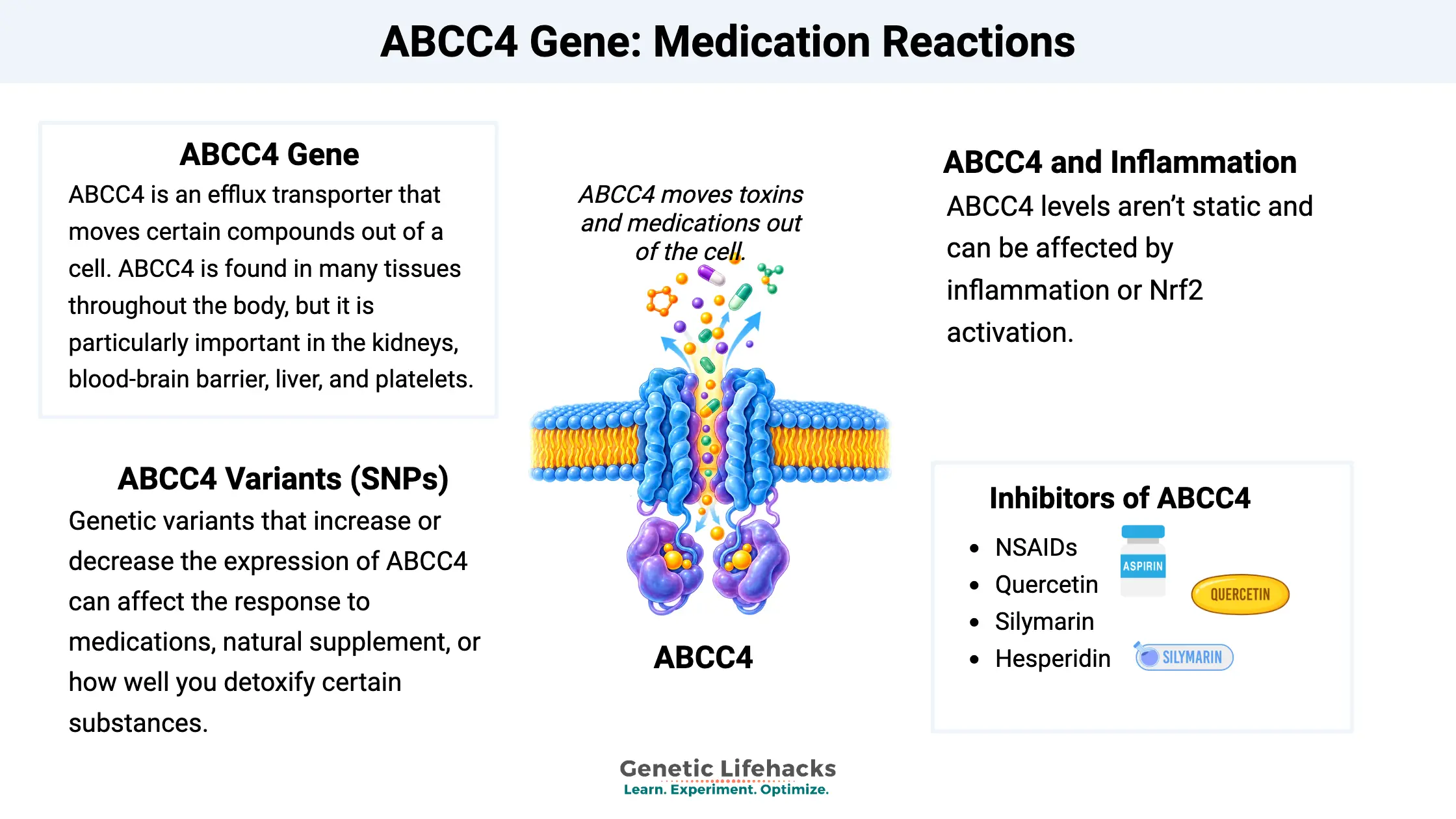
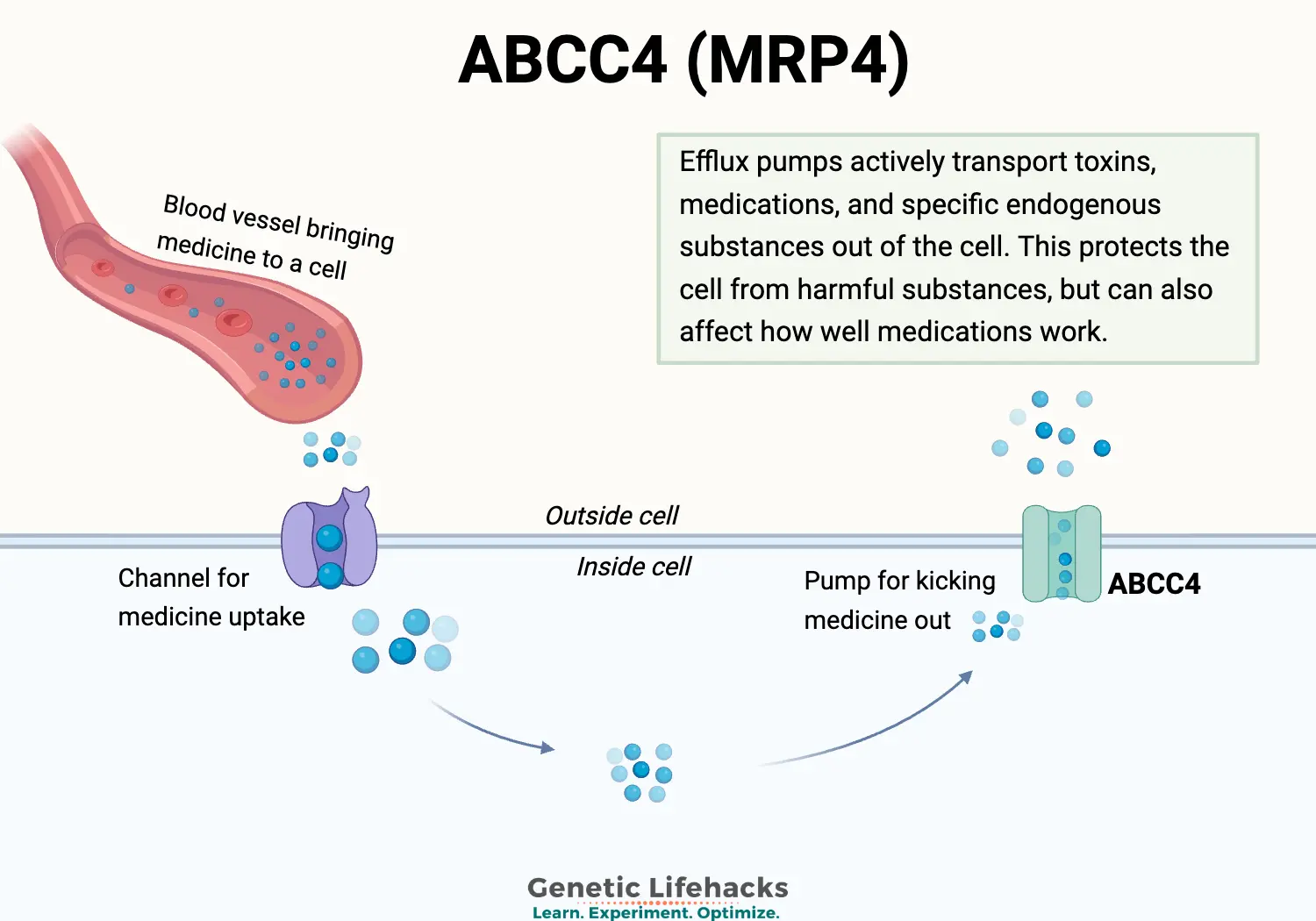
ABCC4 is an efflux transporter that moves certain compounds out of a cell. The ABCC4 transporter was originally called the multi-drug resistance protein 4 (MRP4) because it actively pumps compounds, including many medications, out of a cell, which is called cellular efflux.
ABCC4 is found in many tissues throughout the body, but it is particularly important in the kidneys, blood-brain barrier, liver, and platelets. It moves substances made in the body (endogenous substances), including prostaglandins, cAMP, urate, and certain estrogen metabolites, out of the cell. ABCC4 contributes to the way that cells can get rid of toxins and medications.
Transporter genes: The last step in clearance
Let’s put ABCC4 into context before going into the details on medications, toxins, and signaling molecules.
Phase I and Phase II detoxification enzymes change a drug, hormone, or environmental chemical. Transporter proteins then determine where that compound goes next—into the liver for processing, back into blood, into bile or urine for elimination, or away from protected tissues such as the brain. There are a bunch of transporter proteins, including ABCB1 (pumps out selected drugs and toxins), SLCO1B1 (moves statins into liver cells), and ABCG2 (promotes excretion of certain compounds including statins).
It’s important to note that someone can have normal CYP or Phase II enzyme activity but still have altered drug levels if a transporter gene variant changes absorption, tissue entry, or elimination.
ABCC4: Drug and toxin efflux from cells
A lot of genetic research focuses on common variants in ABCC4 that affect how well specific medications work and whether you are likely to get side effects.
Drugs that are moved out of cells by ABCC4:[ref] [ref][ref][ref][ref][ref]
- Antiviral nucleoside/nucleotide analogs: tenofovir, ganciclovir, valganciclovir, PMEA, and adefovir.
- Anticancer/cytostatic drugs: methotrexate, leucovorin, thiopurine metabolites, 6-mercaptopurine, 6-thioguanine, cytarabine, and topotecan-related or nucleotide-based chemotherapies.
- Antibiotics: fluoroquinolones like ciprofloxacin.
- Cardiovascular and diuretic agents: furosemide, hydrochlorothiazide
Natural supplements moved out of cells by ABCC4:[ref]
- Ginsenoside compound K from ginseng
- quercetin
Drugs and supplements that can inhibit ABCC4:[ref][ref][ref][ref]
- NSAIDs (ibuprofen, diclofenac, celecoxib, naproxen)
- sildenafil
- montelukast
- dipyridamole
- losartan
- salicylate
Environmental toxins:
Genetic variants that increase or decrease the expression of ABCC4 are fairly common and can affect the response to medications, how a natural supplement works, or how well you detoxify certain substances at a tissue level. For example, variants in ABCC4 affect arsenic transport and elimination.[ref]
Endogenous substances: cAMP, cGMP and ABCC4
cAMP and cGMP are what are called second messengers – signaling molecules that are involved in sending the signal inside the cell when something activates a cell membrane receptor. cAMP commonly activates protein kinase A in cells to regulate metabolism, synaptic transmission, and adrenaline response. cGMP activates protein kinase G and ion channels, helping relax muscles or control vision.[ref] These two second messengers act in many different cell types and, well, trigger a bunch of different cellular actions.
ABCC4 moves cAMP and cGMP out of cells as a way to regulate the intracellular concentration. Essentially, ABCC4 helps to modulate the signaling inside of a cell by moving any excess cAMP or cGMP out of the cell.[ref]
ABCC4 and platelet aggregation:
Platelet aggregation is the process by which platelets clump together to form a blood clot. ABCC4 is found on the plasma membrane of platelets, where it acts to export cyclic nucleotides like cAMP. By pumping out cAMP, it prevents an excess of cAMP in the cell, which then modulates platelet activation and aggregation.[ref]
A recent study showed that inhibiting ABCC4 in platelets can reduce the size of a clot by about 40% on average in models. This indicates that ABCC4 is playing a fairly important role in platelet aggregation.[ref] Another connection betweenABCC4 and platelet aggregation is that the beneficial effects of aspirin therapy can be reduced in patients who overexpress ABCC4.[ref]
ABCC4 and prostaglandin E2:
Prostaglandins are lipid mediators that are synthesized from arachidonic acid and secreted by cells as a primarily pro-inflammatory signal. Prostaglandin E2 acts like a hormone that signals for inflammation, increased blood flow, fever, and swelling. It is also the signal released during childbirth to soften the cervix and start contractions.
Studies show that ABCC4 is the primary efflux transporter for moving prostaglandin E2 (PGE2) out of cells, and it’s thus involved in regulating the levels of extracellular prostaglandin E2. Interestingly, NSAIDs can inhibit ABCC4, causing less prostaglandin E2 to be moved from cells into circulation. This may be one way that NSAIDs reduce inflammation, but more research is needed here.[ref][ref]
What regulates ABCC4?
The expression of ABCC4 on cell membranes can be influenced – increased or decreased – by other factors in the cell.
- Nrf2 activation: ABCC4 expression can be upregulated by activation of Nrf2 in response to polyphenols, toxins, or environmental pollutants. [ref]
- Interleukin 13 (IL13): Studies involving lymphoma patients show that IL-13 promotes the expression of ABCC4, which in turn causes resistance to some chemotherapy drugs in NK/T-cell lymphoma cells. [ref]
- Interleukin 1B (IL1B): Another study showed that in lung tissue, inflammation and increased IL1B cause an increase in ABCC4 expression in the lungs. This could affect inhaled medication efficacy.[ref]
- MicroRNAs: MicroRNAs are short strands of RNA that block mRNA from being translated into its corresponding protein. This is one way that gene expression is controlled in cells. microRNA-124a and microRNA-506 decrease ABCC4 protein expression by up to 50%.[ref]
- TNF-alpha: In a study involving patients with obstructive cholestasis (blocked liver bile), the researchers found elevated ABCC4 levels. Further experiments showed that TNF-alpha, an inflammatory cytokine, causes ABCC4 expression to increase.[ref]
- Sp1 transcription factor: The ubiquitous transcription factor Sp1 is responsible for the baseline expression of ABCC4. Sp1 is kind of a general regulator, but it can be upregulated (and thus increase ABCC4) in cancer or inflammation.[ref]
To sum up here: ABCC4 levels aren’t static and can be affected by inflammation or Nrf2 activation. Thus, the levels of ABCC4 dynamically change in times of inflammation or due to interactions with toxins and drugs. This is in addition to inherited changes in how your ABCC4 gene works at a base level.
Let’s switch gears and take a look at your genotypes for ABCC4 variants:
Genotype report: ABCC4
The following variants have been shown in studies to have an effect on medication levels or side effects from medication in clinical trials. Keep in mind that these variants could interact with environmental factors, other drugs, or other genetic variants. So it isn’t as straightforward as being able to say that a single SNP will cause the same effect on a medication for everyone. Instead, take this as a ‘heads up’ to talk with your doctor about the possible effects on medications or chemotherapy.
Access this content:
An active subscription is required to access this content.
Log in below or Join as a member.
Lifehacks: Modulating ABCC4
Note that drug metabolism and the response to medications are complex topics that depend on more than just a single gene or single SNP. In addition, some of the studies on ABCC4 and medications are dependent on the concentration of the drug.[ref]
Age influences ABCC4: A 2025 study on the blood-brain barrier showed that ABCC4 levels are higher in aging. The authors of the studies noted that the increase in aging may be why methotrexate neurotoxic side effects are more common in younger people than in older people.[ref]
Talk with your doctor and pharmacist for help with prescription medications. The list of inhibitors and inducers below will give you a starting point for asking questions.
Common inhibitors of ABCC4:
Keep in mind that inhibiting ABCC4 can increase the levels of medications within the cell, possibly leading to increased side effects. The inhibitory effects here are likely dependent on dosage, and most of these are based on animal studies or cell studies. So take this information more as a possible inhibitory effect rather than substances that will significantly affect drug metabolism.
- NSAIDs – non-steroidal pain medications such as indomethacin, sulindac, ibuprofen, or naproxen – can inhibit ABCC4. [ref]
- Quercetin is a moderate inhibitor of ABCC4 (as well as a couple of other drug efflux transporters).[ref]
- Silymarin (milk thistle) inhibits ABCC4 and other drug efflux transporters.[ref]
- Hesperidin inhibits ABCC4 and other drug efflux transporters.[ref]
Increasing ABCC4 efflux:
- Sulforaphane is an Nrf2 activator that increases the expression of ABCC4.[ref]
- Glycyrrhetinic Acid (licorice) increases MRP4 expression in the liver (animal study), likely due to Nrf2 activation.[ref]
- Panax ginseng increases MRP4 expression, again likely due to Nrf2 activation (animal study).[ref]
- Forskolin acts as a direct activator of adenylyl cyclase, raising intracellular cyclic AMP (cAMP) levels, which in turn promotes ABCC4 (MRP4)-mediated cellular efflux of cAMP and signaling regulation. [ref]
Access this content:
An active subscription is required to access this content.
Log in below or Join as a member.
Related articles and topics:
ABCB1 (P-glycoprotein): Response to Medications, HRT, and Environmental Toxins
Nrf2 Pathway: Increasing the Body’s Ability to Get Rid of Toxins
References:
Adema, A. D, Floor, K., Smid, K., Honeywell, R. J., Scheffer, G. L., Jansen, G., & Peters, G. J. (2014). Overexpression of MRP4 (ABCC4) and MRP5 (ABCC5) confer resistance to the nucleoside analogs cytarabine and troxacitabine, but not Gemcitabine. SpringerPlus, 3(1). https://doi.org/10.1186/2193-1801-3-732
Banerjee, M., Marensi, V., Conseil, G., Le, X. C., Cole, S. P. C., & Leslie, E. M. (2016). Polymorphic variants of MRP4/ABCC4 differentially modulate the transport of methylated arsenic metabolites and physiological organic anions. Biochemical Pharmacology, 120, 72–82. PubMed. https://doi.org/10.1016/j.bcp.2016.09.016
Boydens, C., Pauwels, B., Vanden Daele, L., & Van de Voorde, J. (2017). Inhibition of cyclic GMP export by multidrug resistance protein 4: A new strategy to treat erectile dysfunction? The Journal of Sexual Medicine, 14(4), 502–509. PubMed. https://doi.org/10.1016/j.jsxm.2017.02.005
Cheepala, S. B., Pitre, A., Fukuda, Y., Takenaka, K., Zhang, Y., Wang, Y., Frase, S., Pestina, T., Gartner, T. K., Jackson, C., & Schuetz, J. D. (2015). The ABCC4 membrane transporter modulates platelet aggregation. Blood, 126(20), 2307–2319. PubMed Central. https://doi.org/10.1182/blood-2014-08-595942
Chen, Z.-S., Lee, K., Walther, S., Raftogianis, R. B., Kuwano, M., Zeng, H., & Kruh, G. D. (2002). Analysis of methotrexate and folate transport by multidrug resistance protein 4 (ABCC4): MRP4 is a component of the methotrexate efflux system. Cancer Research, 62(11), 3144–3150. PubMed. https://pubmed.ncbi.nlm.nih.gov/12036927/
Duman, R. S., & Nestler, E. J. (1999). Functional roles for cAMP and cGMP. Basic Neurochemistry: Molecular, Cellular and Medical Aspects. 6th Edition. https://www.ncbi.nlm.nih.gov/books/NBK27915/
El-Sheikh, A. A. K., van den Heuvel, J. J. M. W., Koenderink, J. B., & Russel, F. G. M. (2007). Interaction of nonsteroidal anti-inflammatory drugs with multidrug resistance protein (MRP) 2/ABCC2- and MRP4/ABCC4-mediated methotrexate transport. The Journal of Pharmacology and Experimental Therapeutics, 320(1), 229–235. PubMed. https://doi.org/10.1124/jpet.106.110379
El-Sheikh, A. A. K., van den Heuvel, J. J. M. W., Koenderink, J. B., & Russel, F. G. M. (2008). Effect of hypouricaemic and hyperuricaemic drugs on the renal urate efflux transporter, multidrug resistance protein 4. British Journal of Pharmacology, 155(7), 1066–1075. PubMed Central. https://doi.org/10.1038/bjp.2008.343
Esther, C. R., Fallon, J. K., Cholon, D. M., Boyles, S. E., Williams, A. B., Murano, H., Okuda, K., Tiley, J. B., Tan, M.-L., Zhao, L., Mikami, Y., Smith, P. C., Rao, G., & Gentzsch, M. (2026). Influence of inflammation on drug transporter expression in human airway epithelia: Implications for inhaled drug pharmacokinetics. Drug Metabolism and Disposition: The Biological Fate of Chemicals, 54(5), 100287. PubMed Central. https://doi.org/10.1016/j.dmd.2026.100287
Fernandes, M. R., Rodrigues, J. C. G., Dobbin, E. A. F., Pastana, L. F., da Costa, D. F., Barra, W. F., Modesto, A. A. C., de Assumpção, P. B., da Costa Silva, A. L., Dos Santos, S. E. B., Burbano, R. M. R., de Assumpção, P. P., & Dos Santos, N. P. C. (2021). Influence of fpgs, ABCC4, SLC29A1, and MTHFR genes on the pharmacogenomics of fluoropyrimidines in patients with gastrointestinal cancer from the Brazilian Amazon. Cancer Chemotherapy and Pharmacology, 88(5), 837–844. PubMed. https://doi.org/10.1007/s00280-021-04327-w
Hamdani, S., Hamijoyo, L., Amalia, R., & Barliana, M. I. (2025). Gene polymorphisms associated with immunosuppressant adverse effects in systemic lupus erythematosus: A narrative review. Frontiers in Genetics, 16, 1594648. PubMed Central. https://doi.org/10.3389/fgene.2025.1594648
Huynh, T., Norris, M. D., Haber, M., & Henderson, M. J. (2012). ABCC4/MRP4: A MYCN-regulated transporter and potential therapeutic target in neuroblastoma. Frontiers in Oncology, 2. https://doi.org/10.3389/fonc.2012.00178
Ibbotson, K., Yell, J., & Ronaldson, P. T. (2017). Nrf2 signaling increases expression of ATP-binding cassette subfamily C mRNA transcripts at the blood-brain barrier following hypoxia-reoxygenation stress. Fluids and Barriers of the CNS, 14(1), 6. PubMed. https://doi.org/10.1186/s12987-017-0055-4
Jiang, Z., Wu, Z., Liu, R., Du, Q., Fu, X., Li, M., Kuang, Y., Lin, S., Wu, J., Xie, W., Shi, G., Peng, Y., & Zheng, F. (2023). Effect of polymorphisms in drug metabolism and transportation on plasma concentration of atorvastatin and its metabolites in patients with chronic kidney disease. Frontiers in Pharmacology, 14, 1102810. https://doi.org/10.3389/fphar.2023.1102810
Kanamitsu, K., Kusuhara, H., Schuetz, J. D, Takeuchi, K., & Sugiyama, Y. (2017). Investigation of the importance of multidrug resistance-associated protein 4 (Mrp4/Abcc4) in the active efflux of anionic drugs across the blood-brain barrier. Journal of Pharmaceutical Sciences, 106(9), 2566–2575. PubMed Central. https://doi.org/10.1016/j.xphs.2017.04.040
Kochel, T. J., Reader, J. C., Ma, X., Kundu, N., & Fulton, A. M. (2016). Multiple drug resistance-associated protein (MRP4) exports prostaglandin E2 (PGE2) and contributes to metastasis in basal/triple negative breast cancer. Oncotarget, 8(4), 6540–6554. https://doi.org/10.18632/oncotarget.14145
Krishnamurthy, P., Schwab, M., Takenaka, K., Nachagari, D., Morgan, J., Leslie, M., Du, W., Boyd, K., Cheok, M., Nakauchi, H., Marzolini, C., Kim, R. B., Poonkuzhali, B., Schuetz, E., Evans, W., Relling, M., & Schuetz, J. D. (2008). Transporter-mediated protection against thiopurine-induced hematopoietic toxicity. Cancer Research, 68(13), 4983–4989. PubMed Central. https://doi.org/10.1158/0008-5472.CAN-07-6790
Leggas, M., Adachi, M., Scheffer, G. L., Sun, D., Wielinga, P., Du, G., Mercer, K. E., Zhuang, Y., Panetta, J. C., Johnston, B., Scheper, R. J., Stewart, C. F., & Schuetz, J. D. (2004). Mrp4 confers resistance to topotecan and protects the brain from chemotherapy. Molecular and Cellular Biology, 24(17), 7612–7621. PubMed. https://doi.org/10.1128/MCB.24.17.7612-7621.2004
Lian, W., Liu, X., & Chen, W. (2019). TNFα induces multidrug resistance-associated protein 4 expression through p38-E2F1-Nrf2 signaling in obstructive cholestasis. Yonsei Medical Journal, 60(11), 1045–1053. PubMed. https://doi.org/10.3349/ymj.2019.60.11.1045
Low, S.-K., Kiyotani, K., Mushiroda, T., Daigo, Y., Nakamura, Y., & Zembutsu, H. (2009). Association study of genetic polymorphism in ABCC4 with cyclophosphamide-induced adverse drug reactions in breast cancer patients. Journal of Human Genetics, 54(10), 564–571. PubMed. https://doi.org/10.1038/jhg.2009.79
Mandolini, C., Massimi, I., Copponi, G., Pulcinelli, F., Crea, F., & Biasucci, L. (2015). MRP4 expression in platelet of patients under chronic aspirin treatment is influenced by microrna modulation. Atherosclerosis, 241(1), e83. https://doi.org/10.1016/j.atherosclerosis.2015.04.291
Ni, M., Qin, B., Xie, L., Zhang, X., Yang, J., Lv, H., Yang, M., & Zhang, M. (2018). IL-13 contributes to drug resistance of NK/T-cell lymphoma cells by regulating ABCC4. BioMed Research International, 2018, 2606834. PubMed Central. https://doi.org/10.1155/2018/2606834
Ning, C., Gao, X., Wang, C., Kong, Y., Liu, Z., Sun, H., Sun, P., Huo, X., Ma, X., Meng, Q., & Liu, K. (2018). Ginsenoside Rg1 protects against acetaminophen-induced liver injury via activating Nrf2 signaling pathway in vivo and in vitro. Regulatory Toxicology and Pharmacology : RTP, 98, 58–68. PubMed. https://doi.org/10.1016/j.yrtph.2018.07.012
Reid, G., Wielinga, P., Zelcer, N., van der Heijden, I., Kuil, A., de Haas, M., Wijnholds, J., & Borst, P. (2003). The human multidrug resistance protein MRP4 functions as a prostaglandin efflux transporter and is inhibited by nonsteroidal antiinflammatory drugs. Proceedings of the National Academy of Sciences, 100(16), 9244–9249. https://doi.org/10.1073/pnas.1033060100
RS1751034. (2024, September 3). Nih.Gov. https://www.ncbi.nlm.nih.gov/snp/rs1751034
Singer, D., Kragl, A., Ziems, K., Glaubitz, J., Grammbauer, S., Hildebrandt, S., Tzvetkov, M. V., & Jedlitschky, G. (2026). Identifying transcription factors controlling the basal expression of human MRP4 highlights a substantial role for Sp1. FEBS Open Bio, 16(9), 1825–1839. PubMed Central. https://doi.org/10.1002/2211-5463.70245
Tsukamoto, M., Yamashita, M., Nishi, T., & Nakagawa, H. (2019). A human ABC transporter ABCC4 gene SNP (RS11568658, 559 g > T, G187W) reduces ABCC4-Dependent drug resistance. Cells, 8(1), 39. PubMed Central. https://doi.org/10.3390/cells8010039
Van Aubel, R. A. M. H., Smeets, P. H. E., van den Heuvel, J. J. M. W., & Russel, F. G. M. (2005). Human organic anion transporter MRP4 (ABCC4) is an efflux pump for the purine end metabolite urate with multiple allosteric substrate binding sites. American Journal of Physiology-Renal Physiology, 288(2), F327–F333. https://doi.org/10.1152/ajprenal.00133.2004
Wang, Y., Xu, Y., Huang, P., Che, Di, Wang, Z., Huang, X., Xie, X., Li, W., Zhang, L., & Gu, X. (2021). Homozygous of MRP4 gene RS1751034 C allele is related to increased risk of intravenous immunoglobulin resistance in Kawasaki disease. Frontiers in Genetics, 12, 510350. PubMed Central. https://doi.org/10.3389/fgene.2021.510350
Wen, X., Si, K., Zhu, D., Zhang, A., Guo, C., Li, M., & Tian, W. (2025). Structural basis of human ABCC4 recognition of cAMP and ligand recognition flexibility. Cell & Bioscience, 15(1), 39. PubMed Central. https://doi.org/10.1186/s13578-025-01377-y
Wu, C.-P., Calcagno, A. M., Hladky, S. B., Ambudkar, S. V., & Barrand, M. A. (2005). Modulatory effects of plant phenols on human multidrug-resistance proteins 1, 4 and 5 (ABCC1, 4 and 5). The FEBS Journal, 272(18), 4725–4740. PubMed Central. https://doi.org/10.1111/j.1742-4658.2005.04888.x
Yan, M., Guo, L., Yang, Y., Zhang, B., Hou, Z., Gao, Y., Gu, H., & Gong, H. (2021). Glycyrrhetinic acid protects α-Naphthylisothiocyanate- induced cholestasis through regulating transporters, inflammation and apoptosis. Frontiers in Pharmacology, 12, 701240. PubMed Central. https://doi.org/10.3389/fphar.2021.701240
Yu, T.-W., Chen, I.-C., Lin, G.-C., Kao, C.-M., Chen, Y.-J., & Chen, Y.-M. (2026). Genetic polymorphisms associated with therapeutic response and adverse effects to methotrexate in Taiwanese patients with rheumatoid arthritis: A real-world, hospital-based study. Scientific Reports, 16(1), 26274. PubMed Central. https://doi.org/10.1038/s41598-026-54386-3
Zhou, L., Chen, L., Wang, Y., Huang, J., Yang, G., Tan, Z., Wang, Y., Liao, J., Zhou, G., Hu, K., Li, Z., & Ouyang, D. (2019). Impact of NR1I2, adenosine triphosphate-binding cassette transporters genetic polymorphisms on the pharmacokinetics of ginsenoside compound K in healthy Chinese volunteers. Journal of Ginseng Research, 43(3), 460–474. PubMed Central. https://doi.org/10.1016/j.jgr.2018.04.003
Zhu, J., & Pagala, V. R. (2025). Protein kinase A and assembly of an ABCC4 protein network. Nature Communications. https://doi.org/10.1038/s41467-025-66877-4
Zhou, Xujia, et al. “Proteomic Profiling Reveals Age-Related Changes in Transporter Proteins in the Human Blood–Brain Barrier.” Scientific Reports, vol. 16, no. 1, Dec. 2025, p. 1698. www.nature.com, https://doi.org/10.1038/s41598-025-31224-6.