Have you ever thought, “If I just exercised a little more, I could lose that extra 20 pounds!”
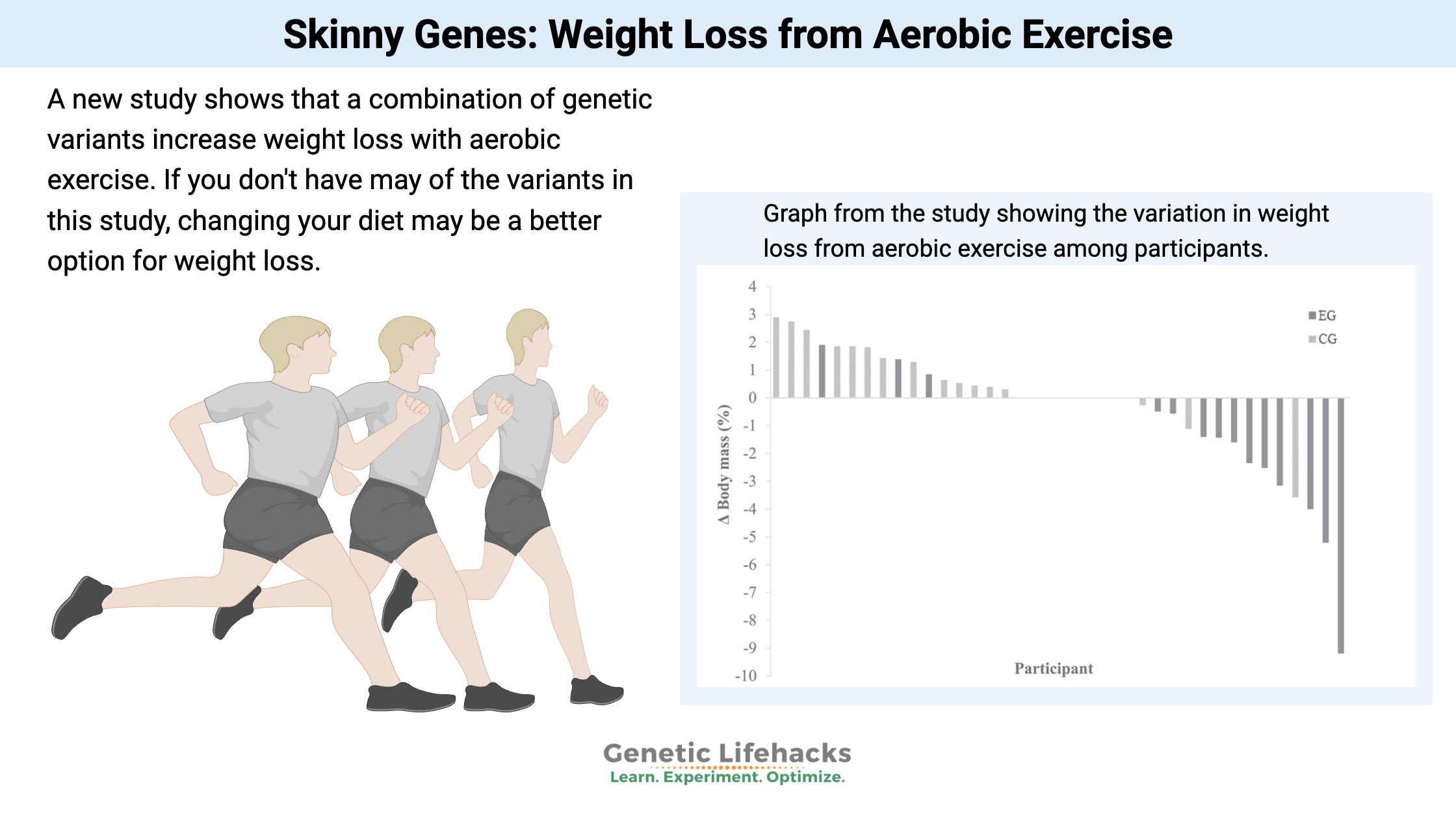
A new study published in September 2024 looked at the relationship between weight loss, aerobic exercise, and genetics. It attempts to answer the question, “Who loses weight and why?
Losers and gainers:
Studies of exercise for weight loss show mixed results. For some people, exercise is a great way to lose weight, but for others, it doesn’t seem to have much of an effect. When you look at the results of studies on exercise and weight loss, most show a modest positive benefit. But what is hidden in these results is that some people lose a lot of weight with exercise, and others gain a little. The average weight of all study participants usually shows a decrease, but genetic variants probably play a role in who loses a lot of weight compared to the few who gain a little.
Previous studies show that aerobic exercise usually produces modest weight loss, on average for the group of participants. Here are a couple of examples:
A study of one hour of aerobic exercise 3-5 days/week showed an average weight loss of just 1 kg compared to a control group after 12 weeks.[ref]
Another study involving women in a 12-week aerobic exercise program broke the results down by who lost and who gained, rather than just showing the group average. The study found that about three-quarters of the participants lost weight, while one-quarter of the group gained a little.[ref]
Access this content:
An active subscription is required to access this content.
Cardoso, Glêbia Alexa, et al. “Pro12Ala Polymorphism on the PPARγ2 Gene and Weight Loss After Aerobic Training: A Randomized Controlled Trial.” Frontiers in Physiology, vol. 11, May 2020. Frontiers, https://doi.org/10.3389/fphys.2020.00385.
Chung, Henry C., et al. “Genotypic Variations Associated with Changes in Body Mass in Response to Endurance Training.” Research Quarterly for Exercise and Sport, vol. 96, no. 2, Apr. 2025, pp. 298–308. DOI.org (Crossref), https://doi.org/10.1080/02701367.2024.2404981.
Leońska-Duniec, Agata, et al. “Individual Responsiveness to Exercise-Induced Fat Loss and Improvement of Metabolic Profile in Young Women Is Associated with Polymorphisms of Adrenergic Receptor Genes.” Journal of Sports Science & Medicine, vol. 17, no. 1, Mar. 2018, pp. 134–44. PubMed Central, https://www.ncbi.nlm.nih.gov/pmc/articles/PMC5844200/.
About the Author: Debbie Moon is a biologist, engineer, author, and the founder of Genetic Lifehacks where she has helped thousands of members understand how to apply genetics to their diet, lifestyle, and health decisions. With more than 10 years of experience translating complex genetic research into practical health strategies, Debbie holds a BS in engineering from Colorado School of Mines and an MSc in biological sciences from Clemson University. She combines an engineering mindset with a biological systems approach to explain how genetic differences impact your optimal health.