
Key takeaways:
- High blood pressure increases the risk of cardiovascular mortality.
- Multiple pathways and various root causes contribute to high blood pressure. Understanding your genetic variants can help you to focus on your root cause.
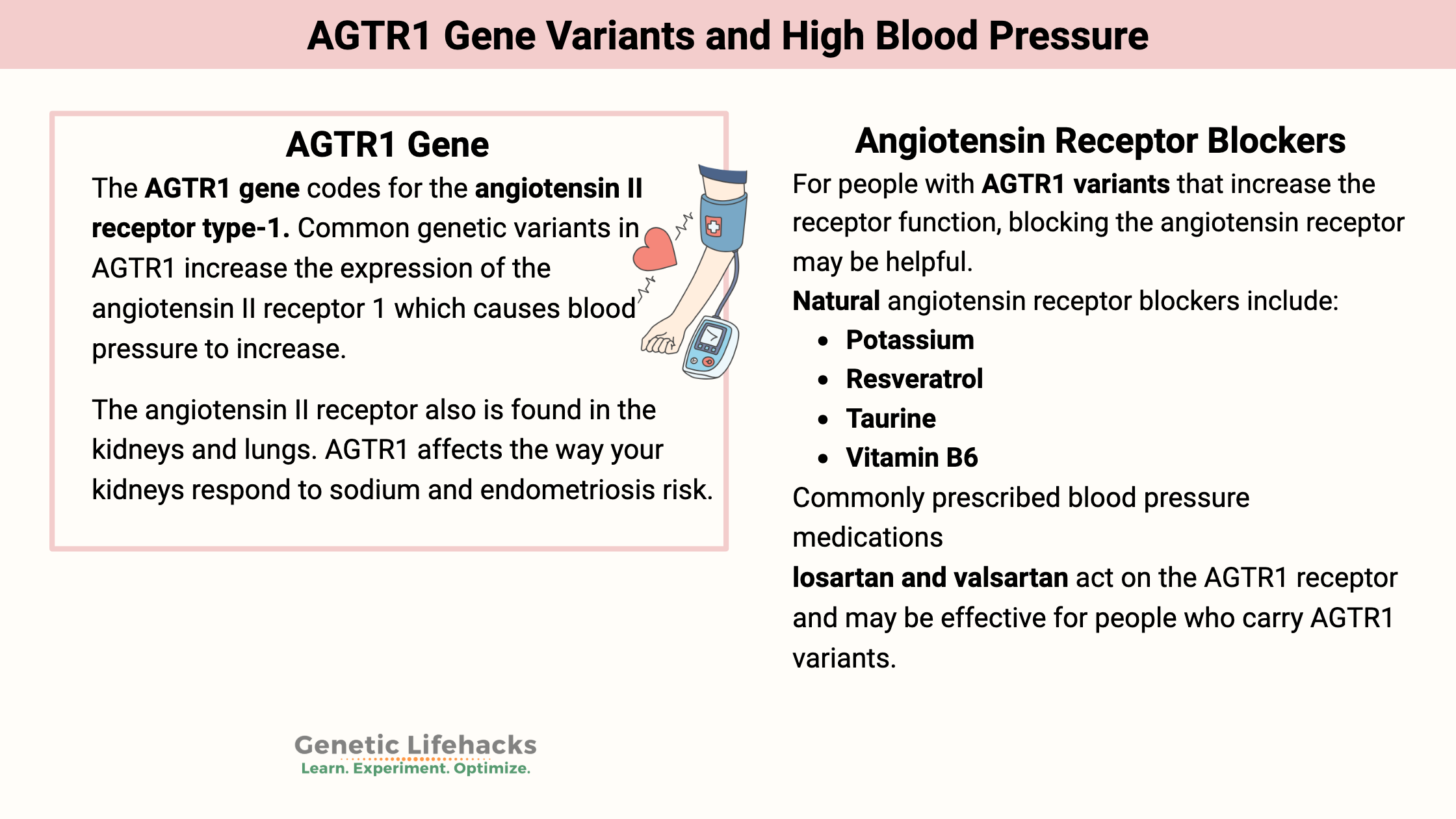
- The AGTR1 gene codes for the angiotensin II receptor type-1.
- Genetic variants in AGTR1 can cause high blood pressure when combined with high angiotensin II levels.
Members will see their genotype report below and the solutions in the Lifehacks section. Consider joining today.High blood pressure:
Blood pressure may not be something that you think much about – unless your doctor is harping about it being high or low. The CDC statistics, though, make a pretty compelling argument that a lot of us should be thinking about blood pressure. It is estimated that ~ 1/3 of US adults have high blood pressure, which contributes to more than 410,000 deaths each in the US in a year.[ref]
Genetics combine with diet and lifestyle factors to cause high blood pressure. While there are quite a few genes that influence blood pressure, this quick article only focuses in on one (impactful) gene, AGTR1 (angiotensin II receptors).
Defining high blood pressure:
Researchers, doctors, public health officials, etc., all seem to have different ways of defining high blood pressure (hypertension). In general, the following blood pressure ranges are what is used in most studies for adults.Systolic Pressure (top number) Diastolic Pressure (bottom number) Interpretation < 120 mmHg < 80 mmHg Optimal 120–139 mmHg 80–89 mmHg High normal (prehypertensive) ≥ 140 mmHg ≥ 90 mmHg Hypertension (high blood pressure) Your body’s blood pressure is a tightly regulated system that depends on a lot of factors. The Mayo Clinic explains that high blood pressure can be due to the amount of blood pumped and the amount of resistance – or constriction – in the arteries.[ref]
Angiotensin II – a vasoconstrictor:
Angiotensin is a hormone in the renin-angiotensin-aldosterone system (RAAS), which regulates blood pressure. To increase blood pressure, angiotensin II causes the blood vessels to constrict, thus increasing the pressure.
Angiotensin I is a precursor hormone that is converted into angiotensin II by the ACE enzyme (angiotensin-converting enzyme). Stopping the conversion of angiotensin I into II by blocking the ACE enzyme decreases blood pressure. ACE inhibitors are a commonly used type of blood pressure medication. (See article on ACE gene variants)
For angiotensin II to constrict blood vessels (and increase blood pressure), it must bind to its receptor, logically called the angiotensin II receptor type-1.
The AGTR1 gene codes for the angiotensin II receptor type-1.
Common genetic variants in AGTR1 increase the expression of the angiotensin II receptor 1 — thus causing blood pressure to increase when there is abundant angiotensin II in your system.
Angiotensin receptor blockers (ARBs), a class of blood pressure medication, act on AGTR1. Common medications here include losartan and valsartan.
AGTR1: Beyond Blood Pressure
In addition to blood vessels, the angiotensin II receptor is found in the kidneys and lungs. AGTR1 affects the way your kidneys respond to sodium and affects the changes that occur in kidney disease due to diabetes.[ref]
Cancer needs lots of nutrients via blood vessels for growth, and AGTR1 genetic variants are also tied to cancer risk. Additionally, endometriosis, which is an overgrowth of endometrial tissues, is linked to AGTR1 variants.[ref][ref]
AGTR1 Genotype Report
Access this content:
An active subscription is required to access this content.
Log in below or Join as a member.
Lifehacks:
Dietary interactions for blood pressure with AGTR1 variants:
- Low-fat diet: May diminish the BP-raising effect of rs5186 variants.
- Sodium intake: No strong gene interaction identified.
Here’s the details…
Low-fat diet:
Studies suggest that a high-fat diet, in part, increases the rs5186 impact on blood pressure.[ref][ref] If you have high blood pressure and carry the risk allele for rs5186, try experimenting with a lower-fat diet to see if it decreases your blood pressure.Sodium intake:
You may be assuming that salt consumption would interact with this genetic variant. However, I could only find one research study that looked at salt sensitivity and the AGTR1 gene. It showed no interaction.[ref]Related articles: Salt-sensitive blood pressure genetic variants
Blood pressure medication interaction:
The commonly prescribed blood pressure medications losartan and valsartan act on the AGTR1 receptor, as do other angiotensin receptor blockers (ARBs). These may be effective for people with AGTR1 variants who also have high blood pressure.[ref]
6 Natural angiotensin-receptor-blocking supplements:
Always consult your doctor before combining supplements with prescription medication.
Access this content:
An active subscription is required to access this content.
Log in below or Join as a member.
Related Articles and Topics:
PCSK9 Gene: Understanding the variants that cause high or low LDL cholesterol
References:
Alexander, Walter. “Hypertension: Is It Time to Replace Drugs With Nutrition and Nutraceuticals?” Pharmacy and Therapeutics, vol. 39, no. 4, Apr. 2014, pp. 291–95. PubMed Central, https://www.ncbi.nlm.nih.gov/pmc/articles/PMC3989080/.CDC. “High Blood Pressure Facts.” High Blood Pressure, 10 July 2025, https://www.cdc.gov/high-blood-pressure/data-research/facts-stats/index.html.Chandra, Sudhir, et al. “Association of Angiotensin II Type 1 Receptor (A1166C) Gene Polymorphism and Its Increased Expression in Essential Hypertension: A Case-Control Study.” PloS One, vol. 9, no. 7, 2014, p. e101502. PubMed, https://doi.org/10.1371/journal.pone.0101502.Charoen, Pimphen, et al. “Contribution of Four Polymorphisms in Renin-Angiotensin-Aldosterone-Related Genes to Hypertension in a Thai Population.” International Journal of Hypertension, vol. 2019, 2019, p. 4861081. PubMed, https://doi.org/10.1155/2019/4861081.de Ligt, Marlies, et al. “Resveratrol Supplementation Reduces ACE2 Expression in Human Adipose Tissue.” Adipocyte, vol. 10, no. 1, Dec. 2021, pp. 408–11. PubMed, https://doi.org/10.1080/21623945.2021.1965315.Deckers, Ivette A., et al. “Polymorphisms in Genes of the Renin-Angiotensin-Aldosterone System and Renal Cell Cancer Risk: Interplay with Hypertension and Intakes of Sodium, Potassium and Fluid.” International Journal of Cancer, vol. 136, no. 5, Mar. 2015, pp. 1104–16. PubMed, https://doi.org/10.1002/ijc.29060.Exner, Samantha, et al. “AGTR1 Is Overexpressed in Neuroendocrine Neoplasms, Regulates Secretion and May Potentially Serve as a Target for Molecular Imaging and Therapy.” Cancers, vol. 12, no. 11, Oct. 2020, p. 3138. PubMed Central, https://doi.org/10.3390/cancers12113138.“High Blood Pressure (Hypertension): Controlling This Common Health Problem-High Blood Pressure (Hypertension) – Symptoms & Causes.” Mayo Clinic, https://www.mayoclinic.org/diseases-conditions/high-blood-pressure/symptoms-causes/syc-20373410. Accessed 23 Feb. 2026.Imaizumi, Takahiro, et al. “Association of Interactions between Dietary Salt Consumption and Hypertension-Susceptibility Genetic Polymorphisms with Blood Pressure among Japanese Male Workers.” Clinical and Experimental Nephrology, vol. 21, no. 3, June 2017, pp. 457–64. PubMed, https://doi.org/10.1007/s10157-016-1315-3.Liu, Yang, et al. “AGTR1 Rs3772622 Gene Polymorphism Increase the Risk of Nonalcoholic Fatty Liver Disease Patients Suffer Coronary Artery Disease in Northern Chinese Han Population.” Lipids in Health and Disease, vol. 15, June 2016, p. 113. PubMed Central, https://doi.org/10.1186/s12944-016-0279-3.Mishra, Avshesh, et al. “Impact of Renin-Angiotensin-Aldosterone System Gene Polymorphisms on Left Ventricular Dysfunction in Coronary Artery Disease Patients.” Disease Markers, vol. 32, no. 1, 2012, pp. 33–41. PubMed Central, https://doi.org/10.3233/DMA-2012-0858.Mulerova, Т. А., et al. “Interrelation of Cardiovascular Risk Factors with High Albuminury among Patients with Arterial Hypertension Living in Mountain Shoriya.” Terapevticheskii Arkhiv, vol. 91, no. 1, Mar. 2019, pp. 71–77. PubMed, https://doi.org/10.26442/00403660.2019.01.000033.Musso, Giovanni, et al. “Angiotensin II Type 1 Receptor Rs5186 Gene Variant Predicts Incident NAFLD and Associated Hypertension: Role of Dietary Fat-Induced Pro-Inflammatory Cell Activation.” The American Journal of Gastroenterology, vol. 114, no. 4, Apr. 2019, pp. 607–19. PubMed, https://doi.org/10.14309/ajg.0000000000000154.———. “Angiotensin II Type 1 Receptor Rs5186 Gene Variant Predicts Incident NAFLD and Associated Hypertension: Role of Dietary Fat-Induced Pro-Inflammatory Cell Activation.” The American Journal of Gastroenterology, vol. 114, no. 4, Apr. 2019, pp. 607–19. PubMed, https://doi.org/10.14309/ajg.0000000000000154.Parchwani, Deepak N., et al. “Analysis of Association of Angiotensin II Type 1 Receptor Gene A1166C Gene Polymorphism with Essential Hypertension.” Indian Journal of Clinical Biochemistry: IJCB, vol. 33, no. 1, Jan. 2018, pp. 53–60. PubMed, https://doi.org/10.1007/s12291-017-0644-7.Poulsen, Søren B., and Robert A. Fenton. “K+ and the Renin-Angiotensin-Aldosterone System: New Insights into Their Role in Blood Pressure Control and Hypertension Treatment.” The Journal of Physiology, vol. 597, no. 17, Sept. 2019, pp. 4451–64. PubMed, https://doi.org/10.1113/JP276844.Smyth, Laura Jane, et al. “Genetic Associations between Genes in the Renin-Angiotensin-Aldosterone System and Renal Disease: A Systematic Review and Meta-Analysis.” BMJ Open, vol. 9, no. 4, May 2019, p. e026777. PubMed, https://doi.org/10.1136/bmjopen-2018-026777.Yako, Yandiswa Y., et al. “Genetic Factors Contributing to Hypertension in African-Based Populations: A Systematic Review and Meta-Analysis.” Journal of Clinical Hypertension (Greenwich, Conn.), vol. 20, no. 3, Mar. 2018, pp. 485–95. PubMed, https://doi.org/10.1111/jch.13225.Yoneda, Masato, et al. “Association between Angiotensin II Type 1 Receptor Polymorphisms and the Occurrence of Nonalcoholic Fatty Liver Disease.” Liver International: Official Journal of the International Association for the Study of the Liver, vol. 29, no. 7, Aug. 2009, pp. 1078–85. PubMed, https://doi.org/10.1111/j.1478-3231.2009.01988.x.Zhang, LuShun, et al. “Angiotensin II Type I Receptor A1166C Polymorphism Increases the Risk of Pregnancy Hypertensive Disorders: Evidence from a Meta-Analysis.” Journal of the Renin-Angiotensin-Aldosterone System: JRAAS, vol. 15, no. 2, June 2014, pp. 131–38. PubMed, https://doi.org/10.1177/1470320312467556.Zhang, Zhimin, et al. “Involvement of Angiotensin II Receptor Type 1/NF-κB Signaling in the Development of Endometriosis.” Experimental and Therapeutic Medicine, vol. 20, no. 4, Oct. 2020, pp. 3269–77. PubMed Central, https://doi.org/10.3892/etm.2020.9071.Zhuang, Yan, et al. “Association between AGTR1 A1166C Polymorphism and the Susceptibility to Diabetic Nephropathy.” Medicine, vol. 97, no. 41, Oct. 2018, p. e07689. PubMed Central, https://doi.org/10.1097/MD.0000000000007689.Zotova, T. Yu, et al. “Distribution of Polymorphisms of the Renin-Angiotensin System Genes (ACE, AGT, and AGTR1), ITGB3, and FTO in Pregnant Patients with Hypertensive Disorders.” Bulletin of Experimental Biology and Medicine, vol. 167, no. 1, May 2019, pp. 74–78. PubMed, https://doi.org/10.1007/s10517-019-04464-6.