
Join Here   |   Log In

Increased Slow Wave Sleep

Key takeaways:
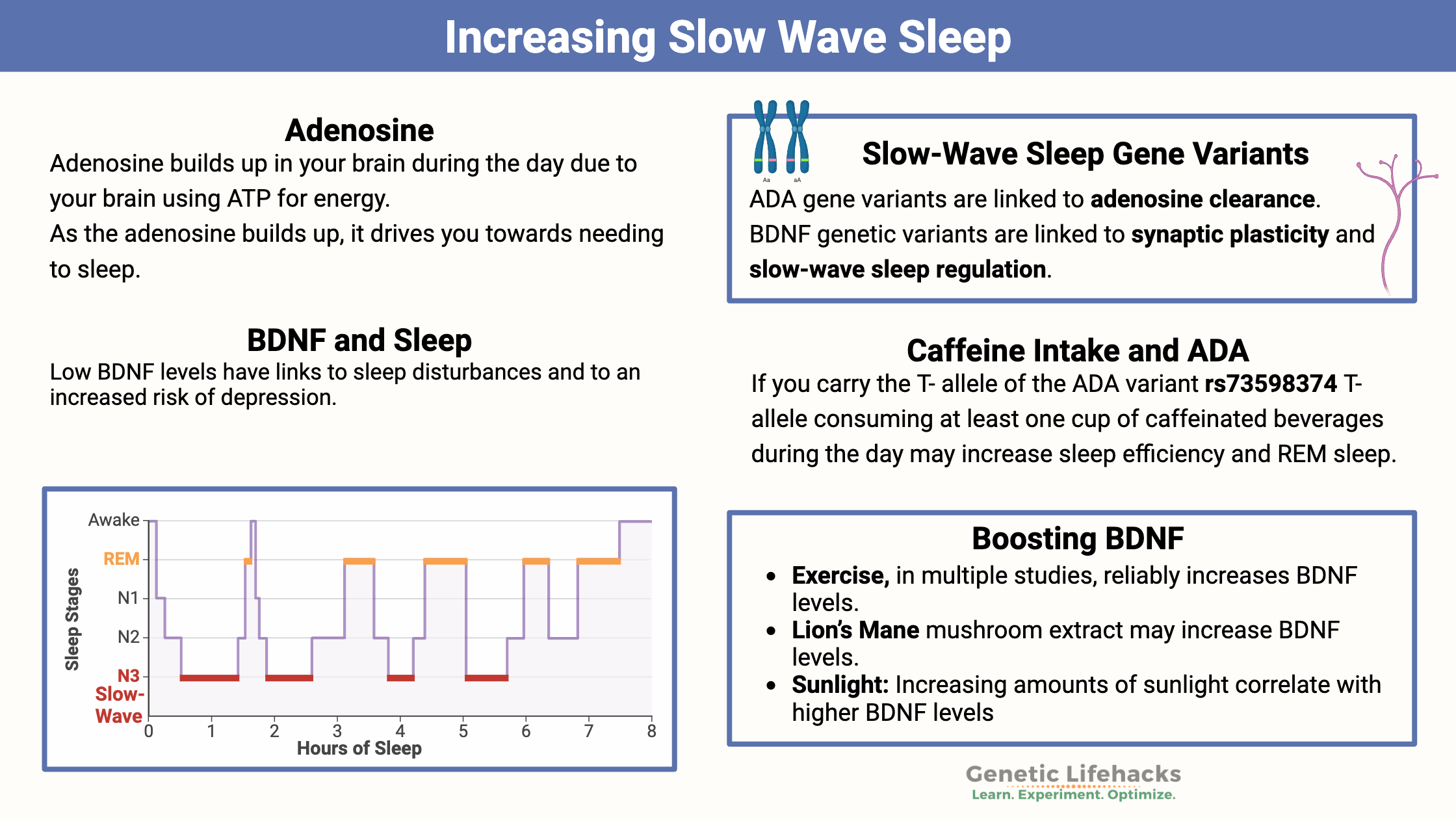
~ Adenosine is key to slow-wave sleep, and the rate at which you break down adenosine impacts your sleep quality.
~ BDNF, a brain-derived neurotrophic factor, is also important here.
~ A variant in the ADA gene (adenosine deaminase) changes the rate at which adenosine is metabolized during sleep.  This affects how much sleep you need each night in order to clear out excess adenosine.

Members will see their genotype report below and the solutions in the Lifehacks section. Consider joining today

Why is slow-wave sleep important?

When you sleep, your brain goes through different electrical wave patterns. Part of the time, you will have REM sleep, which is characterized by rapid eye movement and higher-frequency brain waves. Non-REM sleep cycles include brain activity at lower frequencies.

Non-REM slow-wave sleep is important for memory consolidation. When you are awake, memories are stored temporarily in the hippocampus, but during non-REM slow-wave sleep, those memories are transferred to the neocortex for long-term storage.[ref]

Non-REM sleep has 3 stages:

  • Stage 1 is the beginning of sleep – just when you are drifting off.
  • Stage 2 is a lighter stage of sleep- easy to be woken up
  • Stage 3 is the deep, slow-wave sleep

Adenosine and Slow Wave Sleep:

Sleep is thought to be initiated by two different processes: your circadian rhythm (24-hour, built-in clock) and homeostatic sleep drive.

The homeostatic sleep drive is what makes you feel sleepy, and adenosine is a key player here.

Adenosine builds up in your brain during the day due to your brain using ATP (adenosine triphosphate) for energy. The ATP molecule gives up a phosphate as a way to produce energy from the chemical bond. This then creates ADT (adenosine diphosphate) which can then give up another phosphate to become AMP (adenosine monophosphate). The final step leaves the cell with just adenosine. As the adenosine builds up, it drives you towards needing to sleep.

The adenosine receptor, ADORA2A, is what adenosine attaches to and plays a crucial role in the homeostatic sleep drive. If you block the adenosine receptor, you will feel more alert. This is how caffeine works – it attaches to ADORA2A, blocking adenosine from the receptor.

Adenosine levels drop as you sleep:

One way that the body can control adenosine levels is to convert them to inosine using the enzyme adenosine deaminase (ADA gene). This enzyme helps to metabolize adenosine while you sleep, resulting in lower adenosine levels when you wake.[ref] As the adenosine levels drop over the course of the night, the pressure to sleep also decreases.[ref] Genetic variants that affect the function of the ADA gene are linked to feeling groggy in the morning when not getting sufficient sleep.

While researchers have known for a while that adenosine is important in feeling sleepy, recent animal studies have clearly shown that activation of the adenosine receptor, ADORA2A, by the adenosine molecule, induces slow-wave sleep.[ref]

BDNF and Sleep:

BDNF (brain-derived neurotrophic factor) acts within the brain to potentiate or increase, synaptic connections between neurons. One of the roles of BDNF is to help with neuroplasticity and memory formation.

It turns out that BDNF may also be important in slow-wave sleep. Low BDNF levels have links to sleep disturbances and to an increased risk of depression.[ref]

Genetic variants that affect slow wave sleep:

A common BDNF genetic variant, known as Val 66Met (below), is linked to alterations in slow-wave sleep. A recent study showed that Val/Val carriers average 20 minutes deeper slow-wave sleep than people with a Met allele. Val/Val carriers also have higher average BDNF levels.[ref]

There is a genetic variant in the adenosine deaminase (ADA) gene that decreases the clearance rate of adenosine. People who carry the variant get more slow-wave, deep sleep at night on average. The flip side is that a short night’s sleep may leave them feeling groggy the next day.


Slow Wave Sleep Genotype Report:

Members: Log in to see your data below.
Not a member? Join here.


Access this content:

An active subscription is required to access this content.

Join as a member


Lifehacks:

If you have a way to track your slow-wave sleep, you may want to experiment with some of the options below to see if you can affect the amount of time that you spend in a deep sleep.

Caffeine Intake and ADA:

Access this content:

An active subscription is required to access this content.

Join as a member


Related Articles and Topics:

Problems sleeping? Your genes can point to individualized solutions

Blue-blocking Glasses: Why? Which ones?

Bipolar Disorder, Depression, and Circadian Clock Genes


References:

Bachmann, Valérie, Federica Klaus, et al. “Functional ADA Polymorphism Increases Sleep Depth and Reduces Vigilant Attention in Humans.” Cerebral Cortex (New York, N.Y.: 1991), vol. 22, no. 4, Apr. 2012, pp. 962–70. PubMed, https://doi.org/10.1093/cercor/bhr173.
Bachmann, Valérie, Carina Klein, et al. “The BDNF Val66Met Polymorphism Modulates Sleep Intensity: EEG Frequency- and State-Specificity.” Sleep, vol. 35, no. 3, Mar. 2012, pp. 335–44. PubMed Central, https://doi.org/10.5665/sleep.1690.
Becke, Andreas, et al. “Daily Intermittent Normobaric Hypoxia Over 2 Weeks Reduces BDNF Plasma Levels in Young Adults – A Randomized Controlled Feasibility Study.” Frontiers in Physiology, vol. 9, 2018, p. 1337. PubMed, https://doi.org/10.3389/fphys.2018.01337.
Carletto, Sara, et al. “The Role of Slow Wave Sleep in Memory Pathophysiology: Focus on Post-Traumatic Stress Disorder and Eye Movement Desensitization and Reprocessing.” Frontiers in Psychology, vol. 8, Nov. 2017, p. 2050. PubMed Central, https://doi.org/10.3389/fpsyg.2017.02050.
de Almeida, Raíssa Nóbrega, et al. “Modulation of Serum Brain-Derived Neurotrophic Factor by a Single Dose of Ayahuasca: Observation From a Randomized Controlled Trial.” Frontiers in Psychology, vol. 10, June 2019, p. 1234. PubMed Central, https://doi.org/10.3389/fpsyg.2019.01234.
Deuschle, Michael, et al. “Serum Brain‐derived Neurotrophic Factor ( BDNF ) in Sleep‐disordered Patients: Relation to Sleep Stage N3 and Rapid Eye Movement ( REM ) Sleep across Diagnostic Entities.” Journal of Sleep Research, vol. 27, no. 1, Feb. 2018, pp. 73–77. DOI.org (Crossref), https://doi.org/10.1111/jsr.12577.
Greene, Robert W., et al. “The Adenosine-Mediated, Neuronal-Glial, Homeostatic Sleep Response.” Current Opinion in Neurobiology, vol. 44, June 2017, pp. 236–42. PubMed Central, https://doi.org/10.1016/j.conb.2017.05.015.
Li, I.-Chen, et al. “Neurohealth Properties of Hericium Erinaceus Mycelia Enriched with Erinacines.” Behavioural Neurology, vol. 2018, May 2018, p. 5802634. PubMed Central, https://doi.org/10.1155/2018/5802634.
Lippi, Giuseppe, et al. “Updated Overview on Interplay between Physical Exercise, Neurotrophins, and Cognitive Function in Humans.” Journal of Sport and Health Science, vol. 9, no. 1, Jan. 2020, pp. 74–81. PubMed, https://doi.org/10.1016/j.jshs.2019.07.012.
Mazzotti, Diego Robles, et al. “Adenosine Deaminase Polymorphism Affects Sleep EEG Spectral Power in a Large Epidemiological Sample.” PLOS ONE, vol. 7, no. 8, Aug. 2012, p. e44154. PLoS Journals, https://doi.org/10.1371/journal.pone.0044154.
Molendijk, Marc L., et al. “Serum BDNF Concentrations Show Strong Seasonal Variation and Correlations with the Amount of Ambient Sunlight.” PLoS ONE, vol. 7, no. 11, Nov. 2012, p. e48046. PubMed Central, https://doi.org/10.1371/journal.pone.0048046.
Mrówczyński, Włodzimierz. “Health Benefits of Endurance Training: Implications of the Brain-Derived Neurotrophic Factor—A Systematic Review.” Neural Plasticity, vol. 2019, June 2019, p. 5413067. PubMed Central, https://doi.org/10.1155/2019/5413067.
Navarrete-Opazo, Angela, and Gordon S. Mitchell. “Therapeutic Potential of Intermittent Hypoxia: A Matter of Dose.” American Journal of Physiology – Regulatory, Integrative and Comparative Physiology, vol. 307, no. 10, Nov. 2014, pp. R1181–97. PubMed Central, https://doi.org/10.1152/ajpregu.00208.2014.
Oishi, Yo, et al. “Slow-Wave Sleep Is Controlled by a Subset of Nucleus Accumbens Core Neurons in Mice.” Nature Communications, vol. 8, Sept. 2017, p. 734. PubMed Central, https://doi.org/10.1038/s41467-017-00781-4.
Ozan, Erol, et al. “The Effect of Depression, BDNF Gene Val66met Polymorphism and Gender on Serum BDNF Levels.” Brain Research Bulletin, vol. 81, no. 1, Jan. 2010, pp. 61–65. ScienceDirect, https://doi.org/10.1016/j.brainresbull.2009.06.022.
Phillips, Cristy. “Brain-Derived Neurotrophic Factor, Depression, and Physical Activity: Making the Neuroplastic Connection.” Neural Plasticity, vol. 2017, 2017, p. 7260130. PubMed Central, https://doi.org/10.1155/2017/7260130.
Rendeiro, Catarina, et al. “Dietary Levels of Pure Flavonoids Improve Spatial Memory Performance and Increase Hippocampal Brain-Derived Neurotrophic Factor.” PLoS ONE, vol. 8, no. 5, May 2013, p. e63535. PubMed Central, https://doi.org/10.1371/journal.pone.0063535.
Rétey, J. V., et al. “A Functional Genetic Variation of Adenosine Deaminase Affects the Duration and Intensity of Deep Sleep in Humans.” Proceedings of the National Academy of Sciences of the United States of America, vol. 102, no. 43, Oct. 2005, pp. 15676–81. PubMed Central, https://doi.org/10.1073/pnas.0505414102.
Tartar, Jaime L., et al. “A Functional Adenosine Deaminase Polymorphism Associates with Evening Melatonin Levels and Sleep Quality.” Journal of Circadian Rhythms, vol. 19, p. 5. PubMed Central, https://doi.org/10.5334/jcr.209. Accessed 24 Feb. 2026.

About the Author:
Debbie Moon is a biologist, engineer, author, and the founder of Genetic Lifehacks where she has helped thousands of members understand how to apply genetics to their diet, lifestyle, and health decisions. With more than 10 years of experience translating complex genetic research into practical health strategies, Debbie holds a BS in engineering from Colorado School of Mines and an MSc in biological sciences from Clemson University. She combines an engineering mindset with a biological systems approach to explain how genetic differences impact your optimal health.