
Join Here   |   Log In

Genetic Differences in How we Smell Things

Key takeaways:
~ Odor receptors are proteins located on the cell membrane of specific types of cells that can bind to odorant molecules.
~ Genetic variants in the odor receptor genes mean that individuals can detect odors differently or at different levels.
~ This article looks into the genetic variants in the odor receptor genes and how they influence one’s response to their environment.

Members will see their genotype report below and the solutions in the Lifehacks section. Consider joining today

Odor receptors: More than how things smell

Humans have around 400+ different olfactory receptor proteins coded for by our genes. So far, only a small portion of these receptors have been mapped to specific odors.

Scenario: You are walking through the grocery store aisle, and it seems as if someone has left a trail of perfume. Thick perfume, heavy on the floral scents… You quickly look around for the offender to your olfactory senses.⁠ Before you decide to make a comment to the offender, think about this — any two people may have as much as a 30% difference in their functional ability to detect different specific odors due to genetic variants. [ref]

How do odor receptors work?

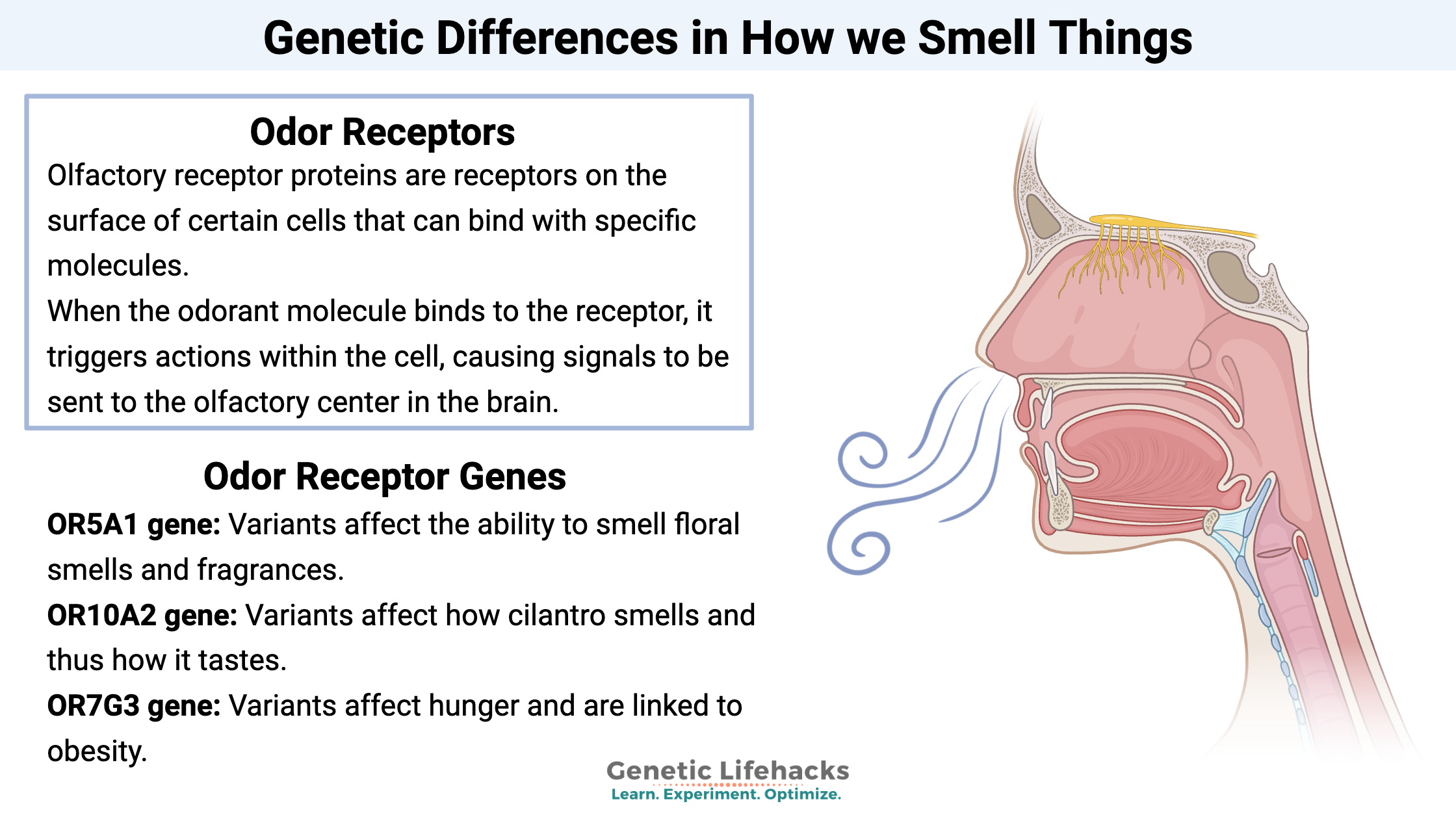
The olfactory receptor proteins are receptors on the surface of certain cells that can bind with specific molecules. When the odorant molecule binds to the receptor, it triggers actions within the cell, causing signals to be sent to the olfactory center in the brain.

These receptor proteins, located in the airway passages such as the nose, let your brain know that you are smelling something. Most odor receptors can bind to multiple different molecules, and how well the molecules bind gives rise to the strength with which you perceive an odor.

As you can imagine, detecting certain odors is vital for determining whether food is edible, whether something is toxic or dangerous, and for sexual preference.

OR7D4 variant:

Take, for example, an OR7D4 variant, rs5020278, which is linked to a person’s ability to smell the sex steroid-derived odorants, androstenone, and androstadienone.

Researchers have studied how the ability to detect androsterone plays a role in whether a person is likely to eat pork from uncastrated male pigs. Some people perceive the meat as smelling very unfavorable to eat, known as ‘boar taint’.[ref][ref] It turns out that the same odor perception variant can also play a role in sociosexual behaviors in women.[ref]

Other studies have linked odor receptor variants to increased BMI. One study found that participants who were less sensitive to smelling oleic acid, a type of fat, were more likely to eat more nuts, seeds, and nut spreads (high in oleic acid) as well as have a higher BMI. Essentially, a decreased ability to taste that specific fat led to eating significantly more fatty foods. Conversely, the ability to smell the fat was linked to a lower BMI.[ref]

Beyond just smelling the flowers…

Recent research shows odor receptors aren’t just limited to the nose. They work as chemical sensors in other parts of the body. For example, sperm cells have at least three different odor receptors on their surface, which may help in chemically detecting the egg cell.[ref]

“Accumulating molecular evidence indicates that the odorant and taste receptors are widely expressed throughout the body and function beyond the oronasal cavity – with roles including nutrient sensing, autophagy, muscle regeneration, regulation of gut motility, protective airway reflexes, bronchodilation, and respiratory disease. Given this expanding array of actions, the restricted perception of these GPCRs as mere mediators of smell and taste is outdated.”[ref]

Odor receptors may also play a role in Parkinson’s and Alzheimer’s diseases. Additionally, the sciatic nerve has odor receptors, which may play a role in pain.[ref][ref]

A recent (June 2020) study found specific olfactory receptor variants have links to eating habits, such as the number of fruits and vegetables eaten or the likely cups of tea people drink.[ref]

HLA typing is also linked to olfactory gene variants. A recent study looked at using smell tests to determine HLA variants.[ref]

One last tidbit for your olfactory knowledge base is that some molecules are transformed in the mucus before reaching the odor receptors. CYP1A2 genetic variants (check yours here) were found to play a role in the conversion of acetophenone (cherry, almond, chicory smell) to methyl salicylate (wintergreen smell) in the nose.[ref]

Asparagus Pee
Asparagus pee smell… half of you know what I’m talking about.

More than half of the people in a study of nearly 7000 were unable to smell asparagus pee. A second study looked into whether it was a lack of ability to smell the odor vs. a lack of producing it. The study found that 8% of the participants’ urine did not have a detectable asparagus odor. The ability to smell the asparagus pee smell is much stronger in those who carry the A allele rs4481887 (see the genotype report below..


Odor Receptor Genotype Report:

Access this content:

An active subscription is required to access this content.

Join as a member


If you think odor receptors are interesting, check out how taste receptors impact everything from food choices to the ability to detect poisons.

More to read:

Access this content:

An active subscription is required to access this content.

Join as a member


Related Articles and Topics:

Nutrigenomics: Use your 23 and Me data

ABCC11 Gene: Ear wax and no body odor

Asparagus Pee: Do You have the Gene Variant to Smell It?

Luteolin: Antihistamine, Memory, and Brain Fog


References:

Asakawa, Masashi, et al. “Modification of the Response of Olfactory Receptors to Acetophenone by CYP1a2.” Scientific Reports, vol. 7, Aug. 2017, p. 10167. PubMed Central, https://doi.org/10.1038/s41598-017-10862-5.
Bienenstock, John, et al. “Disruptive Physiology: Olfaction and the Microbiome-Gut-Brain Axis.” Biological Reviews of the Cambridge Philosophical Society, vol. 93, no. 1, Feb. 2018, pp. 390–403. PubMed, https://doi.org/10.1111/brv.12348.
Choquette, Anne C., et al. “Association between Olfactory Receptor Genes, Eating Behavior Traits and Adiposity: Results from the Quebec Family Study.” Physiology & Behavior, vol. 105, no. 3, Feb. 2012, pp. 772–76. PubMed, https://doi.org/10.1016/j.physbeh.2011.10.015.
Cole, Joanne B., et al. “Comprehensive Genomic Analysis of Dietary Habits in UK Biobank Identifies Hundreds of Genetic Associations.” Nature Communications, vol. 11, Mar. 2020, p. 1467. PubMed Central, https://doi.org/10.1038/s41467-020-15193-0.
de March, Claire A., et al. “Odorant Receptor 7D4 Activation Dynamics.” Angewandte Chemie (International Ed. in English), vol. 57, no. 17, Apr. 2018, pp. 4554–58. PubMed Central, https://doi.org/10.1002/anie.201713065.
Eriksson, Nicholas, et al. “A Genetic Variant near Olfactory Receptor Genes Influences Cilantro Preference.” arXiv:1209.2096, arXiv, 10 Sept. 2012. arXiv.org, https://doi.org/10.48550/arXiv.1209.2096.
Ferrer, Isidro, et al. “Olfactory Receptors in Non-Chemosensory Organs: The Nervous System in Health and Disease.” Frontiers in Aging Neuroscience, vol. 8, July 2016, p. 163. PubMed Central, https://doi.org/10.3389/fnagi.2016.00163.
Foster, Simon R., et al. “Extrasensory Perception: Odorant and Taste Receptors beyond the Nose and Mouth.” Pharmacology & Therapeutics, vol. 142, no. 1, Apr. 2014, pp. 41–61. PubMed, https://doi.org/10.1016/j.pharmthera.2013.11.004.
Garcia-Esparcia, Paula, et al. “Functional Genomics Reveals Dysregulation of Cortical Olfactory Receptors in Parkinson Disease: Novel Putative Chemoreceptors in the Human Brain.” Journal of Neuropathology and Experimental Neurology, vol. 72, no. 6, June 2013, pp. 524–39. PubMed, https://doi.org/10.1097/NEN.0b013e318294fd76.
Henningsson, S., et al. “A Missense Polymorphism in the Putative Pheromone Receptor Gene VN1R1 Is Associated with Sociosexual Behavior.” Translational Psychiatry, vol. 7, no. 4, Apr. 2017, p. e1102. PubMed Central, https://doi.org/10.1038/tp.2017.70.
Hoover, Kara C., et al. “Global Survey of Variation in a Human Olfactory Receptor Gene Reveals Signatures of Non-Neutral Evolution.” Chemical Senses, vol. 40, no. 7, Sept. 2015, pp. 481–88. PubMed, https://doi.org/10.1093/chemse/bjv030.
Jaeger, Sara R., et al. “A Mendelian Trait for Olfactory Sensitivity Affects Odor Experience and Food Selection.” Current Biology: CB, vol. 23, no. 16, Aug. 2013, pp. 1601–05. PubMed, https://doi.org/10.1016/j.cub.2013.07.030.
Jobling, Mark A. “On the Nose: Genetic and Evolutionary Aspects of Smell.” Investigative Genetics, vol. 6, Feb. 2015, p. 2. PubMed Central, https://doi.org/10.1186/s13323-015-0021-3.
Kindleysides, Sophie, et al. “Fat Sensation: Fatty Acid Taste and Olfaction Sensitivity and the Link with Disinhibited Eating Behaviour.” Nutrients, vol. 9, no. 8, Aug. 2017, p. 879. PubMed Central, https://doi.org/10.3390/nu9080879.
Lee, Myoungsook, et al. “Genome-Wide Association Study for the Interaction between BMR and BMI in Obese Korean Women Including Overweight.” Nutrition Research and Practice, vol. 10, no. 1, Feb. 2016, pp. 115–24. PubMed Central, https://doi.org/10.4162/nrp.2016.10.1.115.
Lunde, Kathrine, et al. “Genetic Variation of an Odorant Receptor OR7D4 and Sensory Perception of Cooked Meat Containing Androstenone.” PloS One, vol. 7, no. 5, 2012, p. e35259. PubMed, https://doi.org/10.1371/journal.pone.0035259.
Mainland, Joel D., et al. “The Missense of Smell: Functional Variability in the Human Odorant Receptor Repertoire.” Nature Neuroscience, vol. 17, no. 1, Jan. 2014, pp. 114–20. PubMed Central, https://doi.org/10.1038/nn.3598.
Markt, Sarah C., et al. “Sniffing out Significant ‘Pee Values’: Genome Wide Association Study of Asparagus Anosmia.” BMJ (Clinical Research Ed.), vol. 355, Dec. 2016, p. i6071. PubMed, https://doi.org/10.1136/bmj.i6071.
Milardi, Domenico, et al. “Olfactory Receptors in Semen and in the Male Tract: From Proteome to Proteins.” Frontiers in Endocrinology, vol. 8, 2017, p. 379. PubMed, https://doi.org/10.3389/fendo.2017.00379.
Oh, S. June. “System-Wide Expression and Function of Olfactory Receptors in Mammals.” Genomics & Informatics, vol. 16, no. 1, Mar. 2018, pp. 2–9. PubMed Central, https://doi.org/10.5808/GI.2018.16.1.2.
Pelchat, Marcia Levin, et al. “Excretion and Perception of a Characteristic Odor in Urine after Asparagus Ingestion: A Psychophysical and Genetic Study.” Chemical Senses, vol. 36, no. 1, Jan. 2011, pp. 9–17. PubMed Central, https://doi.org/10.1093/chemse/bjq081.
Secundo, Lavi, et al. “Individual Olfactory Perception Reveals Meaningful Nonolfactory Genetic Information.” Proceedings of the National Academy of Sciences of the United States of America, vol. 112, no. 28, July 2015, pp. 8750–55. PubMed, https://doi.org/10.1073/pnas.1424826112.

About the Author:
Debbie Moon is a biologist, engineer, author, and the founder of Genetic Lifehacks where she has helped thousands of members understand how to apply genetics to their diet, lifestyle, and health decisions. With more than 10 years of experience translating complex genetic research into practical health strategies, Debbie holds a BS in engineering from Colorado School of Mines and an MSc in biological sciences from Clemson University. She combines an engineering mindset with a biological systems approach to explain how genetic differences impact your optimal health.