
Key takeaways:
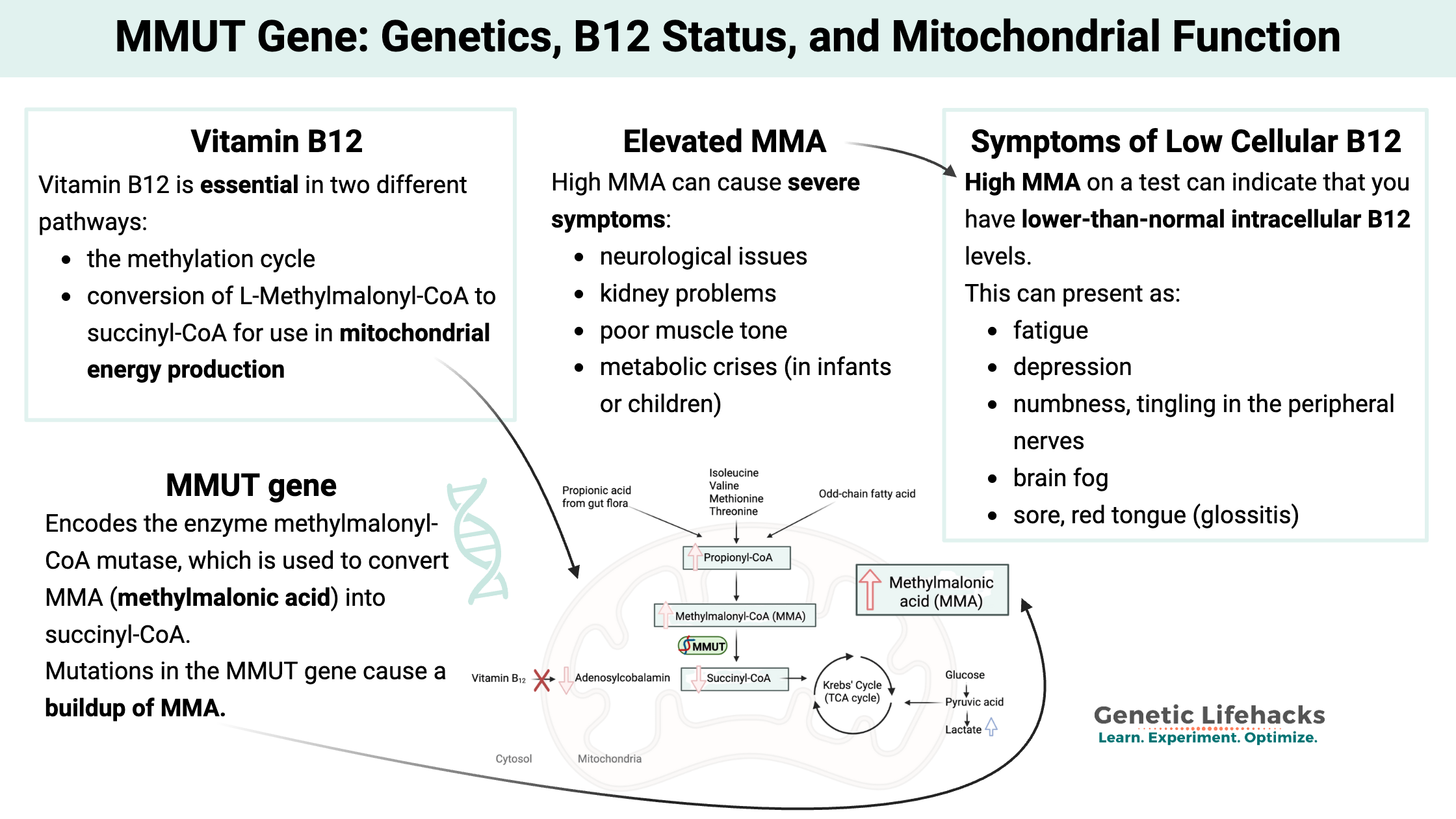
- Your serum B12 levels can be normal while you’re still deficient at the cellular level. MMA (methylmalonic acid) testing can show intracellular B12 status.
- The MMUT gene codes for an enzyme that requires vitamin B12 to convert methylmalonic acid into energy in your mitochondria.
- Adenosylcobalamin is the specific form of B12 that works with the MMUT enzyme.
- Elevated MMA can cause fatigue, brain fog, depression, numbness, and a sore, red tongue.
This article explains how common MMUT gene variants — not just rare mutations — can affect your B12 status and what to do about it.
Members will see their genotype report below and the solutions in the Lifehacks section. Consider joining today.What does the MMUT gene do?
The MMUT enzyme converts methylmalonic acid into energy inside your mitochondria, and it requires adenosylcobalamin (a specific form of vitamin B12) to do this.
Vitamin B12 is essential in two different pathways: the methylation cycle and the conversion of L-Methylmalonyl-CoA to succinyl-CoA for use in mitochondrial energy production. The focus here is on the conversion of L-methylmalonyl-CoA to succinyl-CoA in the Krebs cycle, which is one way that mitochondria create ATP for energy. This process relies on an enzyme called Methylmalonyl-CoA mutase (MMUT gene), which depends on vitamin B12 as a cofactor.
Vitamin B12 comes in multiple forms, including cyanocobalamin (synthetic), methylcobalamin, adenosylcobalamin, and hydroxocobalamin. In the stomach, B12 attaches to intrinsic factor, which then allows for absorption in the intestines.
(Read the details about B12 and the methylation cycle here.)
Mutations in the MMUT gene cause a buildup of methylmalonic acid (MMA), which impacts the brain and kidneys. This genetic condition is called methylmalonic aciduria and is often identified in infancy. However, a smaller increase in MMA can still cause symptoms due to decreased intracellular B12 levels.
Methylmalonic acid (MMA):
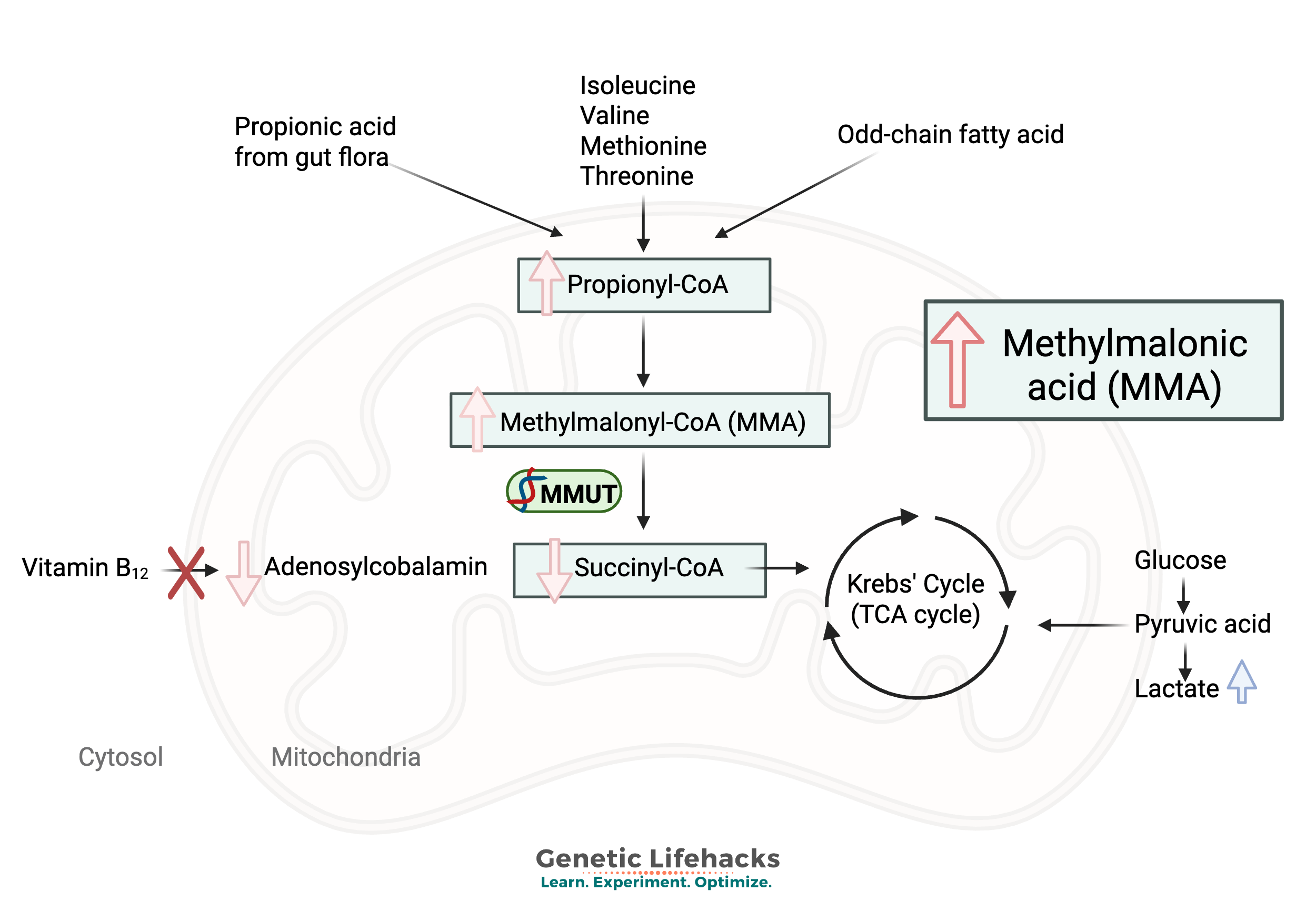
Formation: MMA is derived from propionyl-CoA, which comes from breaking down either odd-chain fatty acids or certain amino acids, including isoleucine, valine, methionine, and threonine. It is then converted to be used for energy production in the mitochondria.
MMUT gene: The MMUT gene encodes the enzyme methylmalonyl-CoA mutase, which is used to convert MMA into succinyl-CoA (used in the mitochondria for ATP production). Older studies refer to the gene as MUT.
Role of Vitamin B12: The methylmalonyl-CoA mutase enzyme requires a specific form of vitamin B12, adenosylcobalamin, as a cofactor in the reaction.
What causes high methylmalonic acid (MMA) levels?
If the body lacks vitamin B12 or has two copies of a mutation in the MUT gene, the conversion process doesn’t happen at the right rate. This leads to a buildup of methylmalonic acid (MMA), called methylmalonic aciduria.
High MMA can cause severe symptoms:
- neurological issues
- kidney problems
- poor muscle tone
- metabolic crises (in infants or children)
Methylmalonic aciduria is often treated with adenosylcobalamin (adenosylB12), along with dietary changes.[ref][ref][ref]
Carnitine is also used for methylmalonic aciduria. It conjugates with the excess propionyl-CoA and methylmalonyl-CoA, which accumulate in the mitochondria. Carnitine binds to these toxic acyl-CoA compounds, forming propionylcarnitine and methylmalonylcarnitine, which are then excreted in the urine. This also frees up CoA and restores the levels back to normal.[ref][ref]
Methylmalonic aciduria is a rare and severe condition caused by two copies of an MMUT mutation (an autosomal recessive condition), but let’s take a look at what milder changes in the MMUT gene may cause.
Can you have normal B12 levels but still be deficient?
Serum vitamin B12 levels don’t necessarily reflect what is going on inside the cell. Testing MMA gives a better picture of how the body is using B12.
High MMA on a test can indicate that you have lower-than-normal intracellular B12 levels. This can occur even when serum B12 tests show that your levels are normal.
This can present as:[ref][ref]
- fatigue
- depression
- numbness, tingling in the peripheral nerves
- brain fog
- sore, red tongue (glossitis)
Kidney disease or insufficiency is also a cause of elevated MMA. Your doctor can help you determine if your intracellular B12 deficiency symptoms are from kidney problems or an MMUT variant.
Genotype report: MMUT
MMUT gene: encodes mitochondrial enzyme methylmalonyl-CoA mutase. Note that older studies may refer to the gene at MUT.
Access this content:
An active subscription is required to access this content.
Check your genetic data for rs4267943 (23andMe v4; AncestryDNA):
- A/A: higher MMA and homocysteine levels, lower B12 levels[ref][ref][ref]
- A/G: higher homocysteine levels, lower B12 levels
- G/G: typical
Members: Your genotype for rs4267943 is —.
Check your genetic data for rs9473555 (23andMe v5; AncestryDNA):
- G/G: typical
- C/G: decreased vitamin B12 levels, likely higher MMA
- C/C: decreased vitamin B12 levels, likely higher MMA[ref][ref]
Members: Your genotype for rs9473555 is —.
Rare mutations:
Carriers for one copy of an MMUT mutation normally do not have the significant problems associated with methylmalonic aciduria (a genetic condition). However, they may be more susceptible to having mild symptoms if they have a restricted diet or if they have a low B12 intake.
Cautions: Genetic raw data from 23andMe, AncestryDNA, and other sources are not guaranteed to be clinically accurate and may have false positives for a rare mutation. Note that this list does not cover all of the possible rare mutations in MMUT.
Check your genetic data for rs564069299 (23andMe v5):
- T/T: Methylmalonic aciduria (predicted)[ref]
- C/T: carrier of a mutation for methylmalonic aciduria
- C/C: typical
Members: Your genotype for rs564069299 is —.
Check your genetic data for rs121918252 (i5000070 23andMe v4)
- A/A: Methylmalonic aciduria (predicted)[ref]
- A/C: Carrier for Methylmalonic aciduria
- C/C: typical
Members: Your genotype for rs121918252 is — or i5000070 is —.
Check your genetic data for rs121918256 (i5000071 23andMe v4 )
- A/A: Methylmalonic aciduria (predicted)[ref]
- A/T: Carrier for Methylmalonic aciduria
- T/T: typical
Members: Your genotype for rs121918256 is — or i5000071 is —.
Check your genetic data for rs121918253 (i5000072 23andMe v4)
- A/A: Methylmalonic aciduria (predicted)[ref]
- A/C: Carrier for Methylmalonic aciduria
- C/C: typical
Members: Your genotype for rs121918253 is — or i5000072 is —.
Check your genetic data for rs121918257 (i5000073 23andMe v4)
- A/A: Methylmalonic aciduria (predicted)[ref]
- A/G: Carrier for Methylmalonic aciduria
- G/G: typical
Members: Your genotype for rs121918257 is — or i5000073 is —.
Check your genetic data for rs121918251 (i5007472 23andMe v4)
- T/T: Methylmalonic aciduria (predicted)[ref]
- C/T: Carrier for Methylmalonic aciduria
- C/C: typical
Members: Your genotype for rs121918251 is — or i5007472 is —.
Check your genetic data for rs879253834 (i700020 23andMe v5)
- A/A: Methylmalonic aciduria (predicted)[ref]
- A/G: Carrier for Methylmalonic aciduria
- G/G: typical
Members: Your genotype for rs879253834 is — or i700020 is —.
Lifehacks:
Talk to your doctor about rare mutations:
Again, full methylmalonic aciduria is a severe condition that is usually detected in infancy. It is treated under a doctor’s supervision with adenosylcobalamin and a specific diet to reduce certain amino acids. Carnitine supplementation is often used as well.[ref]
Being a heterozygous carrier (one copy of an MMUT mutation) is usually considered to be unaffected. However, there may be situations in which supplemental adenosylcobalamin will be helpful.
How do you test methylmalonic acid levels?
An organic acids test, such as from Genova Diagnostics, or a direct test of methylmalonic acid, such as from LabCorp or Quest, will show your MMA levels. If you’re in the US, you may be able to order your own lab tests. Shop around for the best prices.
Normal methylmalonic acid levels are 0.07 to 0.27 micromoles per liter, but that level may vary a bit between labs.[ref]
Can you have normal B12 levels but still be deficient?
If your MMA levels are high, it can indicate low intracellular B12. Symptoms that go along with high MMA / low cellular B12 include neurological issues like numbness, tingling in hands/feet, balance problems (ataxia), memory loss, depression, and impaired breakdown of certain fats and amino acids.
What form of B12 is best for lowering MMA?
Adenosylcobalamin is the form of B12 that directly acts as the cofactor for methylmalonyl-CoA mutase. It is readily available as a supplement online and at health food stores. It may be easier to absorb as a sublingual tablet if you have any issues with gut absorption.
Foods high in B12 include liver, clams, oysters, fish, beef, milk, and cheese. Plant foods do not contain B12, so vegans may need to look at supplemental forms.[ref]
Consider supplementing with carnitine:
As mentioned above, carnitine is often used in methylmalonic aciduria to prevent the buildup of toxic metabolites and to free up coenzyme A for use in ATP production.[ref]
Carnitine is readily available as a supplement, and it is also abundant in foods such as beef, dairy, and chicken. A few plant foods contain carnitine, including avocado and asparagus. [ref]
Related article: Carnitine & Genetic Reasons for Deficiency
Related articles:
References: