
Key takeaways:
~ Colon cancer risk factors include environmental exposure (diet, toxicants, etc.) as well as genetic variants that increase or decrease your susceptibility.
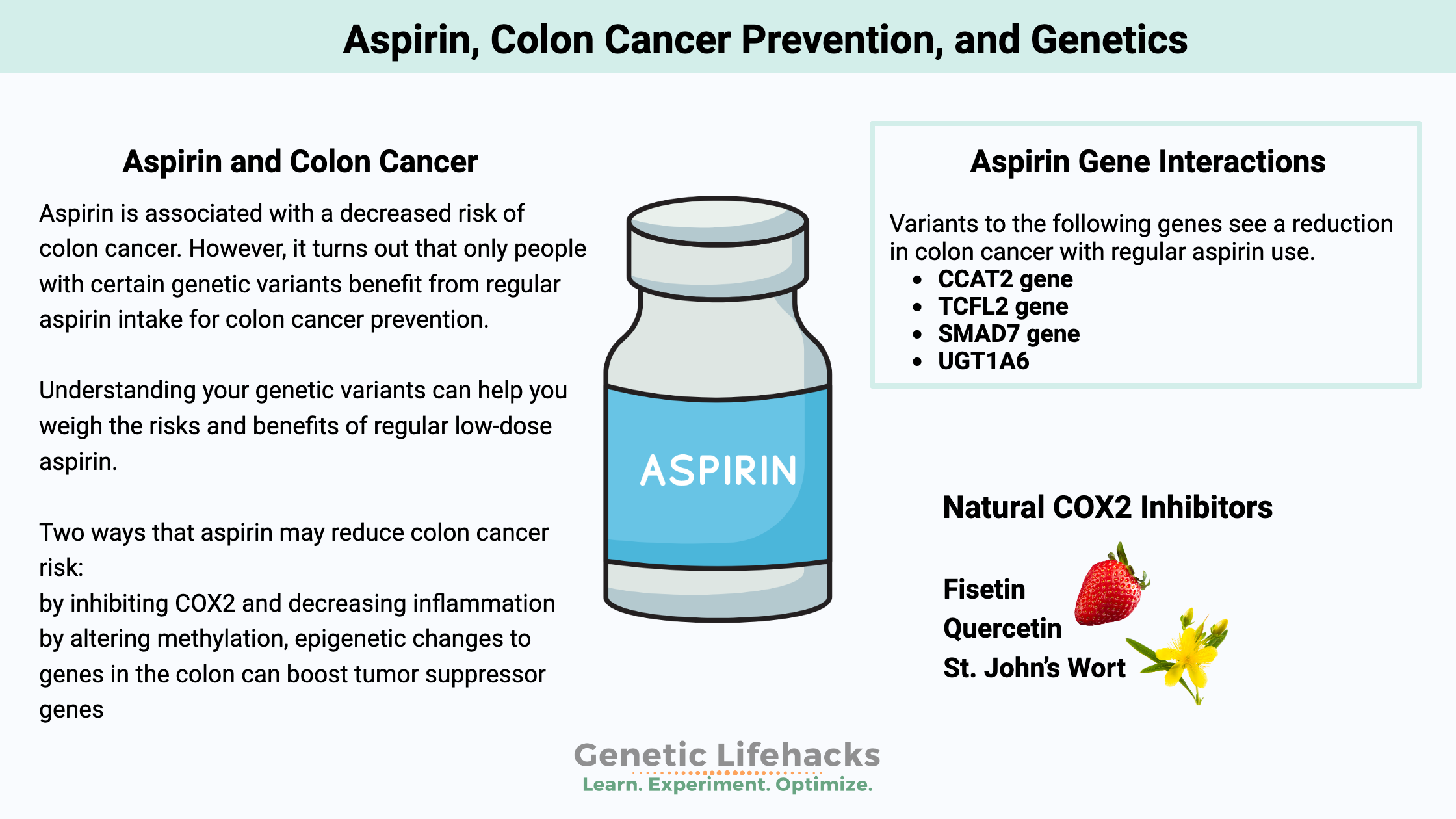
~ Regularly aspirin use also decreases the risk of colon cancer – for people with certain genetic variants.
~ Understanding your genes can help you (and your doctor) determine if low-dose aspirin is a good plan for you.
Should you take aspirin to prevent colon cancer?
Colon cancer is one of the most common forms of cancer, with a lifetime risk of about 5%. The good news is that survival rates are high for those who detect it early. At later stages, though, the mortality risk is high for metastasized colon cancer.[ref]
Aspirin is dirt cheap and has been used for hundreds of years. Recently, it has been in the news as possibly preventing several types of cancer, including colon cancer.
The jury is still out, though, on whether or not to recommend aspirin to everyone as a way to prevent cancer. The American Cancer Society currently only recommends taking low-dose aspirin for colon cancer prevention if you also would benefit from it for heart disease prevention.[ref]
What are the risks of taking aspirin for cancer prevention?
Aspirin is a blood thinner, so frequent use includes bleeding risks. This risk may be a significant detriment for older people who are at a higher risk of colon cancer due to age. For younger people, the risk of gastric bleeding each year is 1 or 2 in a thousand, but this increases to around 7 in 1000 for people over the age of 80.[ref] If you are concerned about the risk of bleeding, you should talk with your doctor and weigh the benefits vs. the risk.
Using genetics to determine the value of aspirin for colon cancer:
It turns out that genetic variants play a significant role in whether aspirin reduces the risk of colon cancer for an individual.
How exactly does aspirin affect colon cancer?
The cyclooxygenase enzymes (COX-1 and COX-2) are involved in inflammatory responses. Inflammation is an important part of the body’s immune response to trauma or pathogens. Problems arise, though, when the inflammatory process doesn’t turn off when it is supposed to. COX inhibitors decrease inflammation and, thus, the pain associated with it. Aspirin is a COX inhibitor, along with NSAID pain relievers such as ibuprofen. Other natural COX inhibitors include Vitamin D, St. John’s Wort, and fish oil.[ref]
Research shows that COX-1 is usually associated with acute inflammation, which occurs with trauma and pathogens. COX-2 is linked to maintaining that inflammatory response.[ref]
Inhibiting COX-2 alone has been shown in studies to reduce colon cancer.[ref] While inhibiting COX-2 may reduce colon cancer, you don’t want to just block COX-2 without also inhibiting COX-1. Drugs inhibiting only COX-2, such as Vioxx, increase the risk of cardiovascular events. (Vioxx was taken off the market in 2004 due to a significant increase in the risk of heart attacks and strokes.)[ref]
Aspirin and other NSAIDs inhibit both COX-1 and COX-2. Studies dating back to the mid-90s have shown that low-dose NSAID use to prevent heart disease also decreases the risk of colon cancer. The benefit ranges from a 21% decrease in risk to a 31% decrease in risk for regular aspirin or other NSAID users.[ref][ref][ref]
Some cancer tumors express increased levels of COX-2. For example, animal studies show that decreasing COX-2 genetically can decrease tumors formed in epithelial cells. Additional research indicates that COX2 inhibition in prostate cancer cells decreases proliferation.[ref][ref]
Proliferation Prevention and Epigenetic Changes:
While research is still ongoing, there are at least two ways that aspirin specifically reduces colon cancer risk:
Aspirin may reduce the ability of cancer cells to proliferate through the anti-platelet pathway. This could help to reduce the activation of the oncogene c-MYC.[ref][ref]
Regular aspirin use (2 or more tablets per week) alters the methylation of DNA in colon cells. DNA methylation blocks genes so that they aren’t transcribed — essentially turning off the gene in the cell. Research shows that regular aspirin use decreased methylation levels in colon cells by 2%. The decreased methylation was specifically noted to decrease the methylation (the turning off) of tumor suppressor genes. Decreasing methylation of tumor suppressor genes theoretically should decrease cancer occurrence.[ref]
Genetic interactions with aspirin in colon cancer prevention:
CCAT2 gene:
The CCAT2 (Colon Cancer-Associated Transcript 2) gene codes for a long non-coding RNA that is important in colon cancer prevention. CCAT2 interacts with and controls the expression of other genes, including TCF7L2. Higher levels of CCAT2 are associated with increasing chromosomal instability and affecting the DNA damage response pathway.[ref]
Several studies show that a specific CCAT2 SNP (rs6983267) increases the risk of colon, prostate, ovarian, and breast cancers. CCAT2 expression is upregulated in colon cancer. [ref] According to a 2013 study, those with the T allele benefitted from aspirin in the prevention of colon cancer. The study results show that T allele carriers who regularly took two or more aspirin in a week had their risk of colon cancer reduced by 40 – 50%.[ref] The T allele also reduces the overall risk of colon cancer[ref]
TCFL2 gene:
The TCFL2 gene codes for transcription factor 7-like 2 (TCF7L2). Variants in the gene have been associated with insulin sensitivity and the risk of diabetes. The gene is also involved in the Wnt/β-catenin signaling pathway, which affects colon cancer risk.[ref]
SMAD7 gene:
The SMAD7 gene codes for a protein involved in inflammation-related pathways. A genome-wide association study found that variants in SMAD7 were important in colon cancer risk, and a follow-up study found that aspirin or NSAID usage also interacts with these variants.[ref]
Aspirin metabolism genes:
Asprin is metabolized by CYP2C9 and UGT1A6. Genetic variants in these genes affect how long aspirin is in your system and how the metabolites are broken down and excreted. Genetic variants in UGT1A6 are linked to the efficacy of aspirin to prevent colon cancer.
Genotype Report:
Access this content:
An active subscription is required to access this content.
Lifehacks:
Dosage and Timing:
Talk with your doctor if you have questions before starting an aspirin regimen.
If you carry the genetic variants above that reduce the risk of colon cancer with aspirin use, it may be helpful to read and understand some of the details in the epidemiological studies. Keep in mind that there may be other genetic variants that also decrease cancer risk with aspirin usage, so you can’t rule out a benefit just from your 23andMe or AncestryDNA data.
- More isn’t always better…Low-dose aspirin (~75 mg) taken 4+ times per week seems to be effective and is less likely to cause gastric bleeding.[ref]
- The studies on NSAID use show that it is repeated usage that decreases cancer risk. This isn’t a one-and-done type of situation. For some studies, the statistical benefit in reduced risk is seen after 6+ years.[ref][ref]
Options other than aspirin:
If aspirin isn’t right for you, there are other natural COX-2 inhibitors.
Access this content:
An active subscription is required to access this content.
Related Articles and Topics:
References: