
Join Here   |   Log In

Osteoporosis: Genetic Susceptibility and Prevention Strategies

Key takeaways:
~ Osteoporosis is a degenerative bone disease that increases the risk of fractures.
~ Genetics plays a key role in osteoporosis with the hereditary component estimated to be 50-80%
~ Understanding your genetic susceptibility can lead you to targeted, personalized solutions for osteoporosis.

Members will see their genotype report below and the solutions in the Lifehacks section. Consider joining today

Osteoporosis, Bone Degeneration, and Aging:

Osteoporosis is a degenerative bone disease facing many of us as we age. Affecting about 54 million people in the US currently, this is a disease that is estimated to affect 50% of women and 25% of men in their lifetime.

Your bones are constantly breaking down and reforming. When the bone cells dissolve the bone matrix, it is called resorption, and the new bone deposits are called formation.

Bone is a dynamic structure, and bone remodeling occurs throughout your life. It is a tightly controlled process where bone is resorbed and then reformed in a balanced way.[ref] Osteoporosis is caused by a chronic excess of bone resorption relative to the formation of new bone. This leads to bone loss and a deterioration of the architecture of the bone.

Here are the types of cells involved in bone formation and breakdown:

  • Osteoclasts are cells in the bone that control the breakdown or resorption of bone.
  • Osteoblasts are the cells that control bone building or formation.
  • Osteocytes are cells encased by mineralized bone that also regulate bone formation.

Both men and women lose bone mass in aging, but the loss is often worse for post-menopausal women due to the decline in estrogen signaling. The loss of bone mass increases the risk of fractures. The risk of fractures – such as breaking a hip – is a real worry with osteoporosis.

Genetics and Osteoporosis:

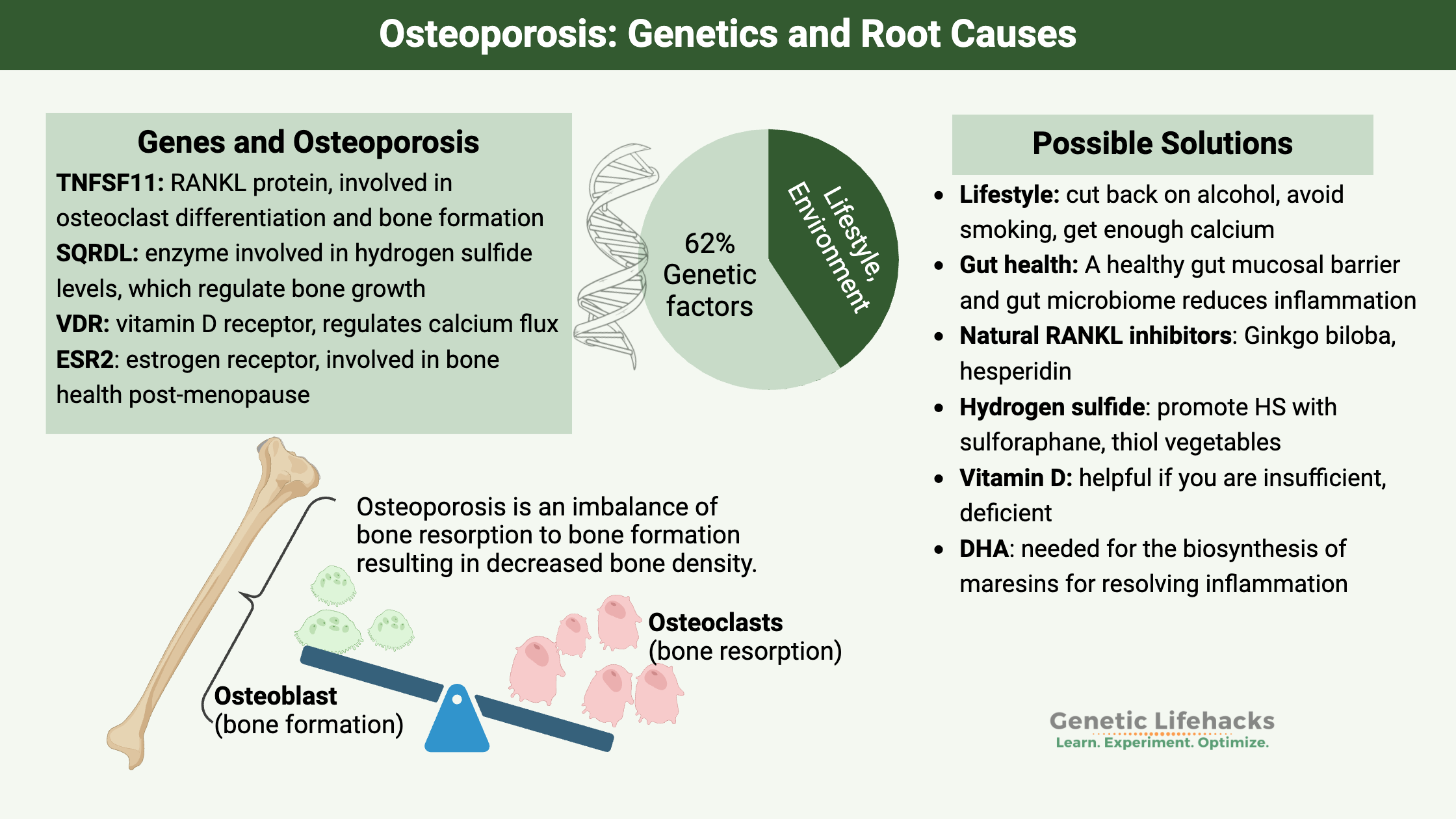
Osteoporosis is caused by a decrease in bone mineral density, and twin studies have shown that the hereditary aspect of bone mineral density (BMD) is between 50 and 80%.[ref] Specifically for osteoporosis, it is estimated that the causes of osteoporosis are about 62% genetic and 38% environmental.[ref] Understanding this genetic risk can help you with targeting the right pathway to prevent osteoporosis.

Within the system of resorption and re-formation of bones lies a balance of the immune response. When you have excess inflammation, the balance is tipped towards having more of the bone resorbed (broken down) by the osteoclasts.

IL-17A (interleukin 17A) and TNF-alpha are proinflammatory cytokines that act to increase bone destruction (pro-resorptive). Chronic, low-grade inflammation is common in aging, and it may be exacerbated by estrogen loss post-menopause.[ref]
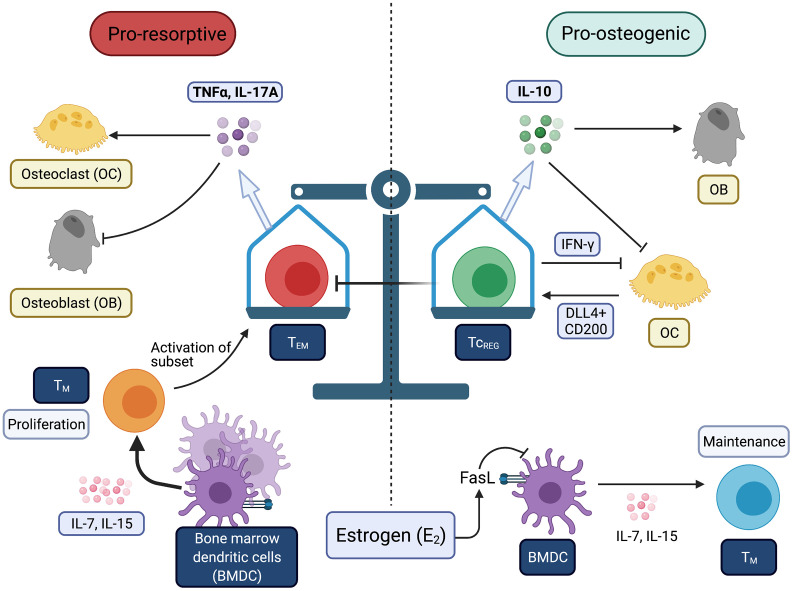
Overview of the balance of immune response in osteoporosis. From PMC8278518 (Wu, et al. 2021)

Microplastics and nanoplastics in the bone:
A 2024 study showed that microplastics can be incorporated into bone stem cells, causing accelerated senescence which leads to excess RANKL production.[ref] While this is an animal study showing the mechanism of action, studies in humans also show microplastics accumulating in the bone marrow.[ref]

Related article: Microplastics Research Roundup

Gut microbiome and osteoporosis:
The gut microbiome can also affect bone health and inflammation in the body. When gut barrier function is impaired, microbes in the gut activate your immune system and increase inflammation in the body.[ref] New research shows that the gut microbiome directly affects bone metabolism and osteoporosis. Animal studies show that probiotics, such as  Lactobacillus rhamnosus GG are protective against bone loss in a post-menopausal animal model. This was due to modulating the immune response and decreasing TNF-alpha and IL-17.[ref][ref][ref]
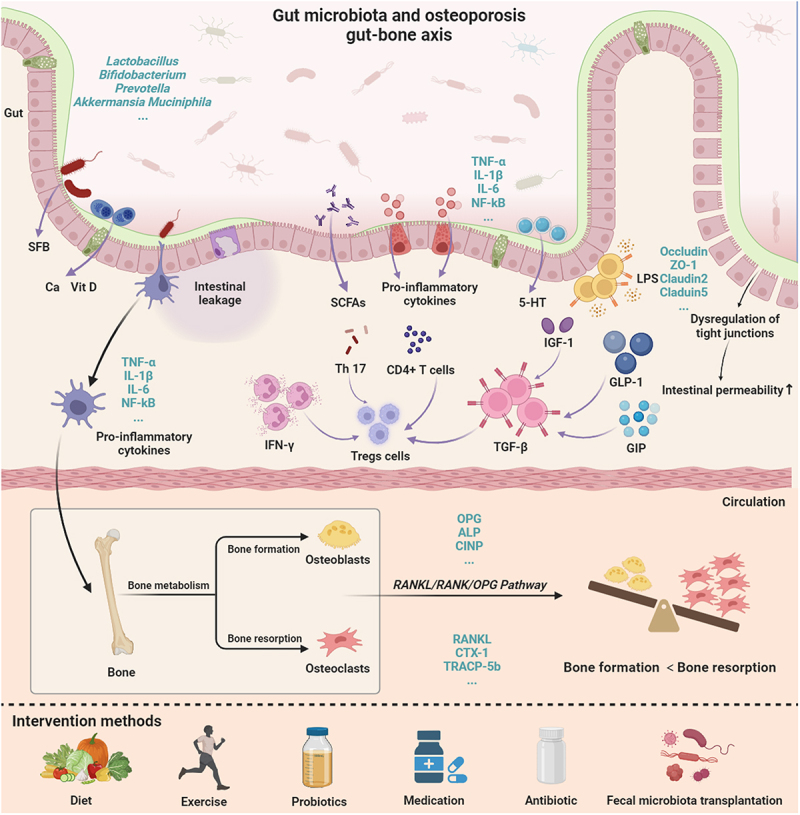
The gut microbiome directly interacts with bone health and inflammation. Please see the full article here (PMC10773645, Zhang, et al. 2024) for an excellent overview of diets and gut interactions with osteoporosis.


What lifestyle factors affect osteoporosis?

In addition to BMD, other risk factors include things like muscle strength, femoral neck geometry, nutrient deficiencies, and age at menopause. Those can also be partially due to genetics as well as caused by lifestyle choices (exercising, foods that you eat, etc.).

Environmental factors, of course, play a role in osteoporosis as well. Some non-genetic risk factors for osteoporosis include alcohol, smoking, age, and poor nutrition.[ref]

Other risk factors include:[ref][ref]

  • taking oral glucocorticoids
  • alcohol intake of 3 units or more a day
  • low body mass index (less than 19)
  • low estrogen in women, low testosterone in men
  • excess thyroid hormones
  • low vitamin D and calcium intake

Genes involved in Osteoporosis:

TNFSF11 gene:
TNFSF11 encodes tumor necrosis factor (ligand) 11, also called RANKL, which is a protein that is involved in immune response, osteoclast differentiation, and bone remodeling. One of the newer pharmaceutical options for osteoporosis is a drug known as a RANKL inhibitor. RANKL is the pathway for bone resorption, so blocking the resorption is thought to build stronger bones.

TNFSF11 is the gene that encodes the RANKL protein. In addition to bone resorption, RANKL plays an immune system role in other tissues such as the thymus, liver, colon, and more. Disruption of this gene in mouse models leads to severe osteoporosis as well as immune system problems.

LRP5:
The LRP5 gene codes for a protein involved in skeletal homeostasis. Several polymorphisms in LRP5 have been associated with lower bone mineral density. There are rare loss-of-function mutations causing severe osteoporosis and other, also rare, gain-of-function mutations that cause very dense bones.[ref]

SQRDL (sulfide quinone reductase-like) gene:
Sulfide quinone reductase is an enzyme that regulates the hydrogen sulfide levels in the cell. This enzyme is important in bone health because the bone marrow mesenchymal stem cells regulate their osteogenic differentiation by producing hydrogen sulfide. Researchers have created mice with low hydrogen sulfide and found that low HS caused osteoporosis. Moreover, giving the mice hydrogen sulfide can reverse bone loss.[ref] Notably, several other recent studies also point to hydrogen sulfide as a regulator of bone formation.[ref]

VDR  gene:
Vitamin D is important in both calcium absorption and in regulating bone cell functions, and the VDR gene encodes the vitamin D receptor.  There are several significant genetic variants in the VDR gene that have been studied for their association with osteoporosis.

ESR2 gene:
Estrogen deficiency is also a risk factor for osteoporosis. A polymorphism in the estrogen receptor 2 gene has also been associated with osteoporosis in postmenopausal women.

TGFB1 (transforming growth factor-beta 1) gene:
The TGFB1 gene codes for a protein that regulates cell growth, maturation, and cell death. A 2015 meta-analysis looked at the association between the TGFB1 polymorphisms and postmenopausal osteoporosis risk. The results showed an increased risk, but only for Asian women and not for Caucasian women.

Specialized pro-resolving lipid mediators (SPMs):

The resolution of inflammation is an active process that utilizes lipid mediators derived from DHA and EPA (omega-3 fatty acids found in fish oil). Specifically, maresin is a lipid mediator that is important in the resolution of inflammation and also in bone health. Decreased maresin 1 levels are associated with an increased risk of osteoporosis.[ref] Genetic variants in the maresin receptor increase the risk of osteoporosis also.


Osteoporosis Genotype Report:

Members: Log in to see your data below.
Not a member? Join here.


Access this content:

An active subscription is required to access this content.

Join as a member


Lifehacks for osteoporosis:

Lifestyle and environmental factors that influence osteoporosis risk that you can control include:

  • cutting back on alcohol
  • never smoking
  • get enough calcium in your diet
  • exercise regularly
  • get vitamin D through supplements or sunshine
  • eating a healthy diet that promotes a healthy gut microbiome[ref]

Natural RANKL Inhibitors

Access this content:

An active subscription is required to access this content.

Join as a member


Need help with reversing or preventing osteoporosis?

Check out what Jana Davis (Genetic Lifehacks PRO member) has to say about osteoporosis. She is a functional nutritionist who specializes in bone health.


Related Articles and Topics:

Serotonin 2A receptor: Psychedelic response and Alzheimer’s disease

Vitamin K: Bone Strength, Blood Clots, Calcification, and Genetics

Top 11 Genes to Check in Your Genetic Raw Data


References:

Abdi, Saba, et al. “Association of Polymorphisms in RANK and RANKL Genes with Osteopenia in Arab Postmenopausal Women.” Disease Markers, vol. 2020, Dec. 2020, p. 1285216. PubMed Central, https://doi.org/10.1155/2020/1285216.
Cai, X., et al. “Genetic Susceptibility of Postmenopausal Osteoporosis on Sulfide Quinone Reductase-like Gene.” Osteoporosis International: A Journal Established as Result of Cooperation between the European Foundation for Osteoporosis and the National Osteoporosis Foundation of the USA, vol. 29, no. 9, Sept. 2018, pp. 2041–47. PubMed, https://doi.org/10.1007/s00198-018-4575-9.
COL1A1 Gene: MedlinePlus Genetics. https://medlineplus.gov/genetics/gene/col1a1/. Accessed 10 Mar. 2026.
Di, Dong-sheng, et al. “Integrative Analysis of LGR5/6 Gene Variants, Gut Microbiota Composition and Osteoporosis Risk in Elderly Population.” Frontiers in Microbiology, vol. 12, Nov. 2021, p. 765008. PubMed Central, https://doi.org/10.3389/fmicb.2021.765008.
Ding, Guoliang, et al. “Allicin Inhibits Oxidative Stress-Induced Mitochondrial Dysfunction and Apoptosis by Promoting PI3K/AKT and CREB/ERK Signaling in Osteoblast Cells.” Experimental and Therapeutic Medicine, vol. 11, no. 6, June 2016, pp. 2553–60. PubMed, https://doi.org/10.3892/etm.2016.3179.
Dong, Shan-Shan, et al. “Association Analyses of RANKL/RANK/OPG Gene Polymorphisms with Femoral Neck Compression Strength Index Variation in Caucasians.” Calcified Tissue International, vol. 85, no. 2, Aug. 2009, pp. 104–12. PubMed Central, https://doi.org/10.1007/s00223-009-9255-5.
El-Desoky, Ahmed H. H., and Sachiko Tsukamoto. “Marine Natural Products That Inhibit Osteoclastogenesis and Promote Osteoblast Differentiation.” Journal of Natural Medicines, vol. 76, no. 3, 2022, pp. 575–83. PubMed Central, https://doi.org/10.1007/s11418-022-01622-5.
Eom, Chun-Sick, et al. “Use of Acid-Suppressive Drugs and Risk of Fracture: A Meta-Analysis of Observational Studies.” Annals of Family Medicine, vol. 9, no. 3, May 2011, pp. 257–67. PubMed Central, https://doi.org/10.1370/afm.1243.
Grant, Struan F. A., et al. “Reduced Bone Density and Osteoporosis Associated with a Polymorphic Sp1 Binding Site in the Collagen Type I α 1 Gene.” Nature Genetics, vol. 14, no. 2, Oct. 1996, pp. 203–05. www.nature.com, https://doi.org/10.1038/ng1096-203.
Grassi, Francesco, Abdul Malik Tyagi, John W Calvert, et al. “Hydrogen Sulfide Is a Novel Regulator of Bone Formation Implicated in the Bone Loss Induced by Estrogen Deficiency.” Journal of Bone and Mineral Research : The Official Journal of the American Society for Bone and Mineral Research, vol. 31, no. 5, May 2016, pp. 949–63. PubMed Central, https://doi.org/10.1002/jbmr.2757.
Grassi, Francesco, Abdul Malik Tyagi, John W. Calvert, et al. “Hydrogen Sulfide Is a Novel Regulator of Bone Formation Implicated in the Bone Loss Induced by Estrogen Deficiency.” Journal of Bone and Mineral Research: The Official Journal of the American Society for Bone and Mineral Research, vol. 31, no. 5, May 2016, pp. 949–63. PubMed, https://doi.org/10.1002/jbmr.2757.
Gu, Qiuhan, et al. “Ginkgo Biloba Extract Promotes Osteogenic Differentiation of Human Bone Marrow Mesenchymal Stem Cells in a Pathway Involving Wnt/β-Catenin Signaling.” Pharmacological Research, vol. 97, July 2015, pp. 70–78. PubMed, https://doi.org/10.1016/j.phrs.2015.04.004.
Guo, Mengyu, et al. “Lactobacillus Rhamnosus GG Ameliorates Osteoporosis in Ovariectomized Rats by Regulating the Th17/Treg Balance and Gut Microbiota Structure.” Gut Microbes, vol. 15, no. 1, 2023, p. 2190304. PubMed, https://doi.org/10.1080/19490976.2023.2190304.
Guo, Xiaoli, et al. “Discovery and Analysis of Microplastics in Human Bone Marrow.” Journal of Hazardous Materials, vol. 477, Sept. 2024, p. 135266. ScienceDirect, https://doi.org/10.1016/j.jhazmat.2024.135266.
Hettiarachchi, Manjula, et al. “Temporal Change in Biomarkers of Bone Turnover Following Late Evening Ingestion of a Calcium-Fortified, Milk-Based Protein Matrix in Postmenopausal Women with Osteopenia.” Nutrients, vol. 11, no. 6, June 2019, p. 1413. PubMed Central, https://doi.org/10.3390/nu11061413.
Huynh, Ngoc, et al. “Association between the Sp1-Binding-Site Polymorphism in the Collagen Type I Alpha 1 (COLIA1) Gene and Bone Phenotypes: The Dubbo Osteoporosis Epidemiology Study.” Journal of Bone and Mineral Metabolism, vol. 43, no. 2, Mar. 2025, pp. 114–22. PubMed, https://doi.org/10.1007/s00774-024-01558-8.
Jeong, Jin-Woo, et al. “Protective Effects of Fermented Oyster Extract against RANKL-Induced Osteoclastogenesis through Scavenging ROS Generation in RAW 264.7 Cells.” International Journal of Molecular Sciences, vol. 20, no. 6, Mar. 2019, p. 1439. PubMed Central, https://doi.org/10.3390/ijms20061439.
Jin, Hyun-Seok, et al. “Association of the I264T Variant in the Sulfide Quinone Reductase-Like (SQRDL) Gene with Osteoporosis in Korean Postmenopausal Women.” PLoS ONE, vol. 10, no. 8, Aug. 2015, p. e0135285. PubMed Central, https://doi.org/10.1371/journal.pone.0135285.
Joe-Sub. https://www.endocrinology-journals.org/joe-sub/content/166/2/235.long. Accessed 10 Mar. 2026.
Liu, Wen-Chun, et al. “Maresin: Macrophage Mediator for Resolving Inflammation and Bridging Tissue Regeneration—A System-Based Preclinical Systematic Review.” International Journal of Molecular Sciences, vol. 24, no. 13, July 2023, p. 11012. PubMed Central, https://doi.org/10.3390/ijms241311012.
Massart, Francesco, et al. “Age-Specific Effects of Estrogen Receptors’ Polymorphisms on the Bone Traits in Healthy Fertile Women: The BONTURNO Study.” Reproductive Biology and Endocrinology: RB&E, vol. 7, Apr. 2009, p. 32. PubMed, https://doi.org/10.1186/1477-7827-7-32.
Melagraki, Georgia, et al. “In Silico Discovery of Plant-Origin Natural Product Inhibitors of Tumor Necrosis Factor (TNF) and Receptor Activator of NF-κB Ligand (RANKL).” Frontiers in Pharmacology, vol. 9, 2018, p. 800. PubMed, https://doi.org/10.3389/fphar.2018.00800.
Mott, A., et al. “Effect of Vitamin K on Bone Mineral Density and Fractures in Adults: An Updated Systematic Review and Meta-Analysis of Randomised Controlled Trials.” Osteoporosis International: A Journal Established as Result of Cooperation between the European Foundation for Osteoporosis and the National Osteoporosis Foundation of the USA, vol. 30, no. 8, Aug. 2019, pp. 1543–59. PubMed, https://doi.org/10.1007/s00198-019-04949-0.
Mozaffari-Khosravi, Hassan, et al. “The Effect of Garlic Tablet on Pro-Inflammatory Cytokines in Postmenopausal Osteoporotic Women: A Randomized Controlled Clinical Trial.” Journal of Dietary Supplements, vol. 9, no. 4, Dec. 2012, pp. 262–71. PubMed, https://doi.org/10.3109/19390211.2012.726703.
Pan, Chun, et al. “Chronic Exposure to Polystyrene Microplastics Triggers Osteoporosis by Breaking the Balance of Osteoblast and Osteoclast Differentiation.” Toxicology, vol. 510, Jan. 2025, p. 154017. ScienceDirect, https://doi.org/10.1016/j.tox.2024.154017.
Piedra, María, et al. “Single Nucleotide Polymorphisms of the OPG/RANKL System Genes in Primary Hyperparathyroidism and Their Relationship with Bone Mineral Density.” BMC Medical Genetics, vol. 12, Dec. 2011, p. 168. PubMed, https://doi.org/10.1186/1471-2350-12-168.
Piriyakhuntorn, Pokpong, et al. “Melatonin Supplementation Alleviates Bone Mineral Density Decline and Circulating Oxidative Stress in Iron-Overloaded Thalassemia Patients.” Journal of Pineal Research, vol. 77, no. 3, Apr. 2025, p. e70055. PubMed, https://doi.org/10.1111/jpi.70055.
Poole, Kenneth E. S., and Juliet E. Compston. “Osteoporosis and Its Management.” BMJ : British Medical Journal, vol. 333, no. 7581, Dec. 2006, pp. 1251–56. PubMed Central, https://doi.org/10.1136/bmj.39050.597350.47.
Pouresmaeili, Farkhondeh, et al. “Association between Vitamin D Receptor Gene BsmI Polymorphism and Bone Mineral Density in A Population of 146 Iranian Women.” Cell Journal, vol. 15, no. 1, 2013, pp. 75–82.
Salamone, L. M., et al. “The Association between Vitamin D Receptor Gene Polymorphisms and Bone Mineral Density at the Spine, Hip and Whole-Body in Premenopausal Women.” Osteoporosis International: A Journal Established as Result of Cooperation between the European Foundation for Osteoporosis and the National Osteoporosis Foundation of the USA, vol. 6, no. 1, 1996, pp. 63–68. PubMed, https://doi.org/10.1007/BF01626540.
Seely, Kevin D., et al. “The Human Gut Microbiota: A Key Mediator of Osteoporosis and Osteogenesis.” International Journal of Molecular Sciences, vol. 22, no. 17, Aug. 2021, p. 9452. PubMed, https://doi.org/10.3390/ijms22179452.
Singh, Monica, et al. “A Haplotype Derived from the Common Variants at the -1997G/T and Sp1 Binding Site of the COL1A1 Gene Influences Risk of Postmenopausal Osteoporosis in India.” Rheumatology International, vol. 33, no. 2, Feb. 2013, pp. 501–06. PubMed, https://doi.org/10.1007/s00296-011-2192-4.
Sun, Jiajia, et al. “The Transforming Growth Factor-Β1 (TGF-Β1) Gene Polymorphisms (TGF-Β1 T869C and TGF-Β1 T29C) and Susceptibility to Postmenopausal Osteoporosis: A Meta-Analysis.” Medicine, vol. 94, no. 4, Jan. 2015, p. e461. PubMed, https://doi.org/10.1097/MD.0000000000000461.
Tao, Huaqiang, et al. “Urolithin A Suppresses RANKL-Induced Osteoclastogenesis and Postmenopausal Osteoporosis by, Suppresses Inflammation and Downstream NF-κB Activated Pyroptosis Pathways.” Pharmacological Research, vol. 174, Dec. 2021, p. 105967. PubMed, https://doi.org/10.1016/j.phrs.2021.105967.
Thaler, Roman, et al. “Anabolic and Antiresorptive Modulation of Bone Homeostasis by the Epigenetic Modulator Sulforaphane, a Naturally Occurring Isothiocyanate.” The Journal of Biological Chemistry, vol. 291, no. 13, Mar. 2016, pp. 6754–71. PubMed, https://doi.org/10.1074/jbc.M115.678235.
Tu, P., et al. “Polymorphisms in Genes in the RANKL/RANK/OPG Pathway Are Associated with Bone Mineral Density at Different Skeletal Sites in Post-Menopausal Women.” Osteoporosis International: A Journal Established as Result of Cooperation between the European Foundation for Osteoporosis and the National Osteoporosis Foundation of the USA, vol. 26, no. 1, Jan. 2015, pp. 179–85. PubMed, https://doi.org/10.1007/s00198-014-2854-7.
van Meurs, Joyce B. J., et al. “Large-Scale Analysis of Association Between LRP5 and LRP6 Variants and Osteoporosis.” Jama, vol. 299, no. 11, Mar. 2008, pp. 1277–90. PubMed Central, https://doi.org/10.1001/jama.299.11.1277.
Weaver, C. M., et al. “Calcium plus Vitamin D Supplementation and Risk of Fractures: An Updated Meta-Analysis from the National Osteoporosis Foundation.” Osteoporosis International: A Journal Established as Result of Cooperation between the European Foundation for Osteoporosis and the National Osteoporosis Foundation of the USA, vol. 27, no. 1, Jan. 2016, pp. 367–76. PubMed, https://doi.org/10.1007/s00198-015-3386-5.
Wong, Rachel Hx, et al. “Regular Supplementation With Resveratrol Improves Bone Mineral Density in Postmenopausal Women: A Randomized, Placebo-Controlled Trial.” Journal of Bone and Mineral Research: The Official Journal of the American Society for Bone and Mineral Research, vol. 35, no. 11, Nov. 2020, pp. 2121–31. PubMed, https://doi.org/10.1002/jbmr.4115.
Wu, Di, et al. “T-Cell Mediated Inflammation in Postmenopausal Osteoporosis.” Frontiers in Immunology, vol. 12, June 2021, p. 687551. PubMed Central, https://doi.org/10.3389/fimmu.2021.687551.
Wu, Jing, et al. “Decreased Serum Maresin 1 Concentration Is Associated With Postmenopausal Osteoporosis: A Cross-Sectional Study.” Frontiers in Medicine, vol. 8, Jan. 2022, p. 759825. PubMed Central, https://doi.org/10.3389/fmed.2021.759825.
Zhang, Li-Qin, et al. “Relation of JAGGED 1 and Collagen Type 1 Alpha 1 Polymorphisms with Bone Mineral Density in Chinese Postmenopausal Women.” International Journal of Clinical and Experimental Pathology, vol. 7, no. 10, 2014, pp. 7142–47.
Zhang, Qiang, et al. “Hesperetin Prevents Bone Resorption by Inhibiting RANKL-Induced Osteoclastogenesis and Jnk Mediated Irf-3/c-Jun Activation.” Frontiers in Pharmacology, vol. 9, Sept. 2018, p. 1028. PubMed Central, https://doi.org/10.3389/fphar.2018.01028.
Zhang, Yuan-Wei, et al. “Diets Intervene Osteoporosis via Gut-Bone Axis.” Gut Microbes, vol. 16, no. 1, p. 2295432. PubMed Central, https://doi.org/10.1080/19490976.2023.2295432. Accessed 10 Mar. 2026.

About the Author:
Debbie Moon is a biologist, engineer, author, and the founder of Genetic Lifehacks where she has helped thousands of members understand how to apply genetics to their diet, lifestyle, and health decisions. With more than 10 years of experience translating complex genetic research into practical health strategies, Debbie holds a BS in engineering from Colorado School of Mines and an MSc in biological sciences from Clemson University. She combines an engineering mindset with a biological systems approach to explain how genetic differences impact your optimal health.