
Key takeaways:
- An avalanche of research now shows that microplastics and nanoplastics are likely a real problem for many chronic health issues.
- Understanding your genetic susceptibility – along with your microplastic exposure – can help you prioritize diet or lifestyle changes for optimal health.
- Simple, inexpensive changes can reduce your exposure.
What are microplastics, and how do they interact with genetics?
Genetic susceptibility to a condition is exacerbated by diet, lifestyle, and environmental factors. I say that over and over in Genetic Lifehacks articles.
The latest research shows that microplastics are being absorbed into the body. This is an “environmental factor” that can combine with genetic susceptibility in multiple ways. This is a significant problem that increases chronic disease and decreases quality of life.
Microplastics or nanoplastics are small bits of plastic, microscopic in size. The particles in the <5 μm range, often referred to as nanoplastics, can easily be absorbed into the intestines, circulate through the bloodstream, and be taken up into cells in different organs.
These foreign particles can both activate inflammation and also leach endocrine-disrupting chemicals.
Below you’ll find a roundup of the articles on Genetic Lifehacks with research tied to microplastics. My hope is that this will help you dial in where your genetic susceptibility to the negative effects of microplastics lies.
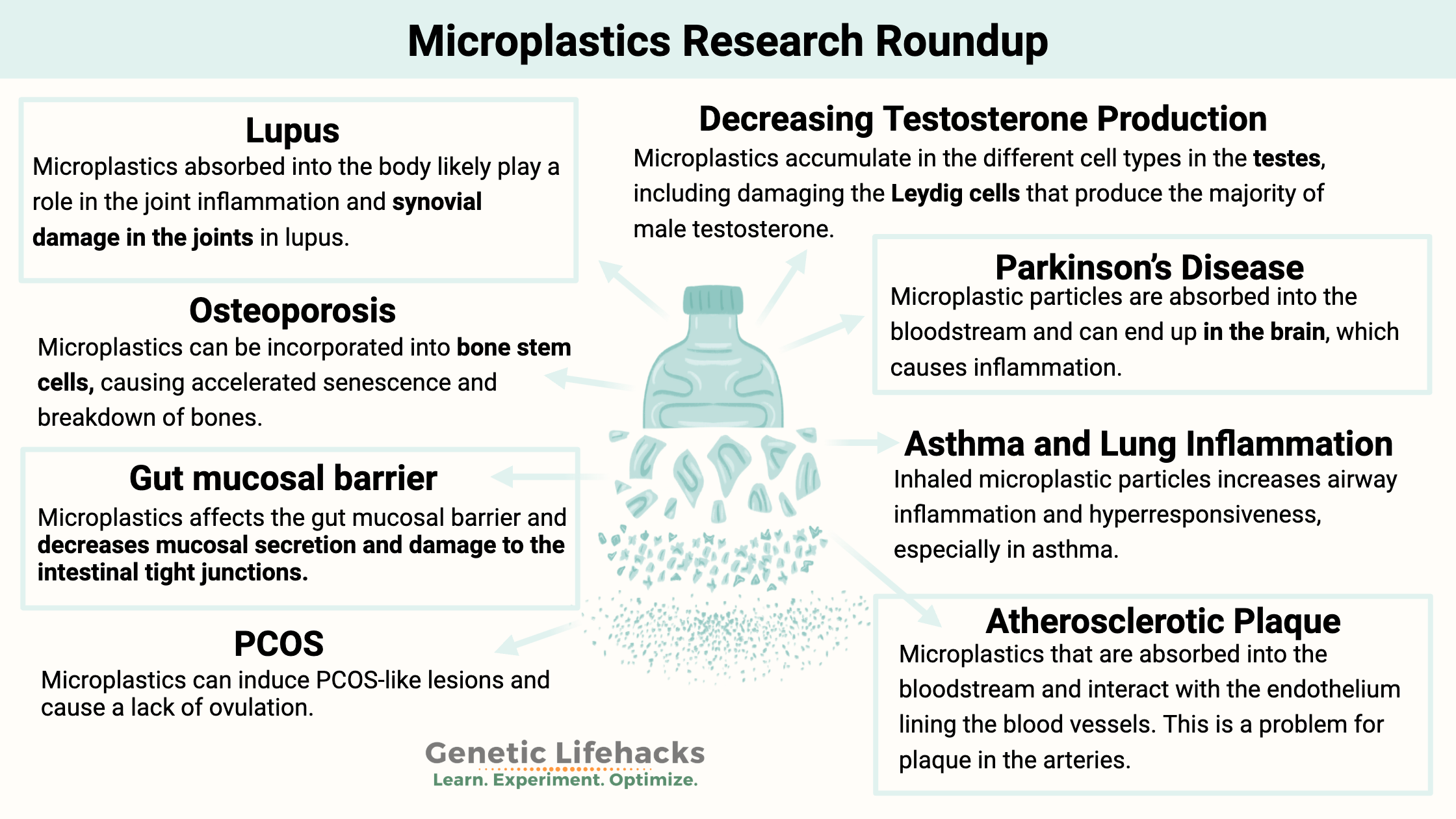
Overview Table: Microplastics: Health Effects by Organ/System
| Organ/System | Microplastic Effect(s) | Key Findings |
|---|---|---|
| Joints | Inflammation, synovial damage, lupus exacerbation | Increased oxidative stress, NF-kB signaling, joint structure disruption |
| Bones | Incorporated into bone marrow, accelerates stem cell aging, bone breakdown | Animal and human studies show accumulation and osteoporosis risk |
| Gut | Damages mucosal barrier, increases inflammation | Decreased mucosal secretion, tight junction damage |
| Brain | Crosses blood-brain barrier, activates glial cells, promotes amyloidosis | Links to Parkinson’s via alpha-synuclein binding |
| Lungs | Increases airway inflammation, worsens asthma | Higher IL-4, IL-5, eosinophils; phthalates worsen effect |
| Heart | Found in atherosclerotic plaques, increases inflammation | Higher microplastic levels in acute coronary syndrome patients |
| Testes | Accumulates, damages Leydig cells, lowers testosterone | Reduces enzyme expression for testosterone production |
| Immune System | Triggers TNF-alpha, IL-6 release via TLR activation | Inflammatory response in vascular cells |
| Ovaries/Uterus | Induces PCOS-like lesions, found in uterine fibroids | Reduces oocyte maturation, alters hormone levels, accumulates in fibroids |
Keep in mind that while microplastics have been around for decades, research is just now being published on their vast effects. There will be more to come in terms of research, genetic connections, and mitigation.
In the joints: Inflammation, lupus
Animal studies show that microplastics or nanoplastics that are absorbed into the body likely play a role in the joint inflammation in lupus. Researchers added microplastics to the animal’s water and found that they ended up causing synovial damage in the joints in a mouse model of lupus. Essentially, the microplastics increased oxidative stress and NF-kB signaling in the joints, which disrupted the structure and function.[ref]
Osteoporosis: Microplastics and nanoplastics incorporated into bone marrow
A 2024 study showed that microplastics can be incorporated into bone stem cells, causing accelerated senescence, which leads to excess RANKL production and breakdown of bones.[ref] While this is an animal study showing the mechanism of action, studies in humans also show microplastics accumulating in the bone marrow.[ref]
Osteoporosis: Genetic Susceptibility and Prevention Strategies
Gut mucosal barrier: thinning from microplastics and nanoplastics in food and water
A study in animals showed that exposure to microscopic bits of polypropylene plastic (< 10 μm) affects the gut mucosal barrier. The study showed decreased mucosal secretion and damage to the intestinal tight junctions, which then caused inflammation.[ref]
In the brain: Parkinson’s Disease
A growing number of studies now show that microplastic and nanoplastic particles are absorbed into the bloodstream (inhalation or ingestion) and can end up in the brain. These microscopic particles can cross the blood-brain barrier or enter the brain through the olfactory bulb. In the brain, microplastics activate glial cells and cause an inflammatory response.[ref] Specifically, researchers have found that polystyrene microplastics bind with alpha-synuclein and promote amyloidosis.[ref]
In the lungs: Exacerbating inflammation and asthma
Inhalation of microplastics and nanoplastics is a major route of exposure in humans. Animal studies show that inhaled microplastic particles, or plastic pollution derivatives, increase airway inflammation and hyperresponsiveness, especially in asthma. Adding phthalates to the mix made it worse. The studies show increased IL-4, IL-5, and eosinophils.[ref][ref]
In the heart: Atherosclerotic plaque containing microplastics
Microplastics are absorbed into the bloodstream and interact with the endothelium lining the blood vessels. This is a problem with plaque in the arteries.
A 2024 study looked at 17 artery samples from surgery and found microplastics in all of the atherosclerotic plaque samples.[ref] Another 2024 study found that acute coronary syndrome patients had elevated microplastic concentrations compared to a control group. There was a significant relationship between higher levels of microplastics and increased inflammation (IL-6, B cells, and natural killer cells).[ref]
Coronary Artery Disease: Genetic Susceptibility to Heart Disease
Accumulating in the Testes and Decreasing Testosterone Production:
One place where the microscopic particles end up is in the testes. Studies show that they can accumulate in different cell types, including damaging the Leydig cells that produce the majority of male testosterone.[ref][ref][ref][ref]
Microplastics and nanoplastics can also leach endocrine-disrupting chemicals, such as BPA and phthalates, into the body. A recent study showed that microplastics can reduce the expression of the enzymes needed for testosterone production. Another study showed that under inflammatory conditions, the polystyrene microplastics had an even stronger negative effect on testosterone production.[ref][ref][ref]
Testosterone: Genetic Variants that Impact Testosterone Levels
Microplastics cause TNF-alpha to be released:
An ever-growing amount of research shows that microplastics and nanoplastics are absorbed into the body and cause inflammatory effects. A study on polystyrene microplastics shows that they activate toll-like receptors (TLR4 and TLR2), which increases TNF-alpha. Studies using vascular smooth muscle cells show that they release TNF-alpha and IL-6 when cultured with microplastics.[ref][ref]
TNF-alpha: Inflammation, Chronic Diseases, and Genetic Susceptibility
PCOS and Microplastics:
Access this content:
An active subscription is required to access this content.
Log in below or Join as a member.