
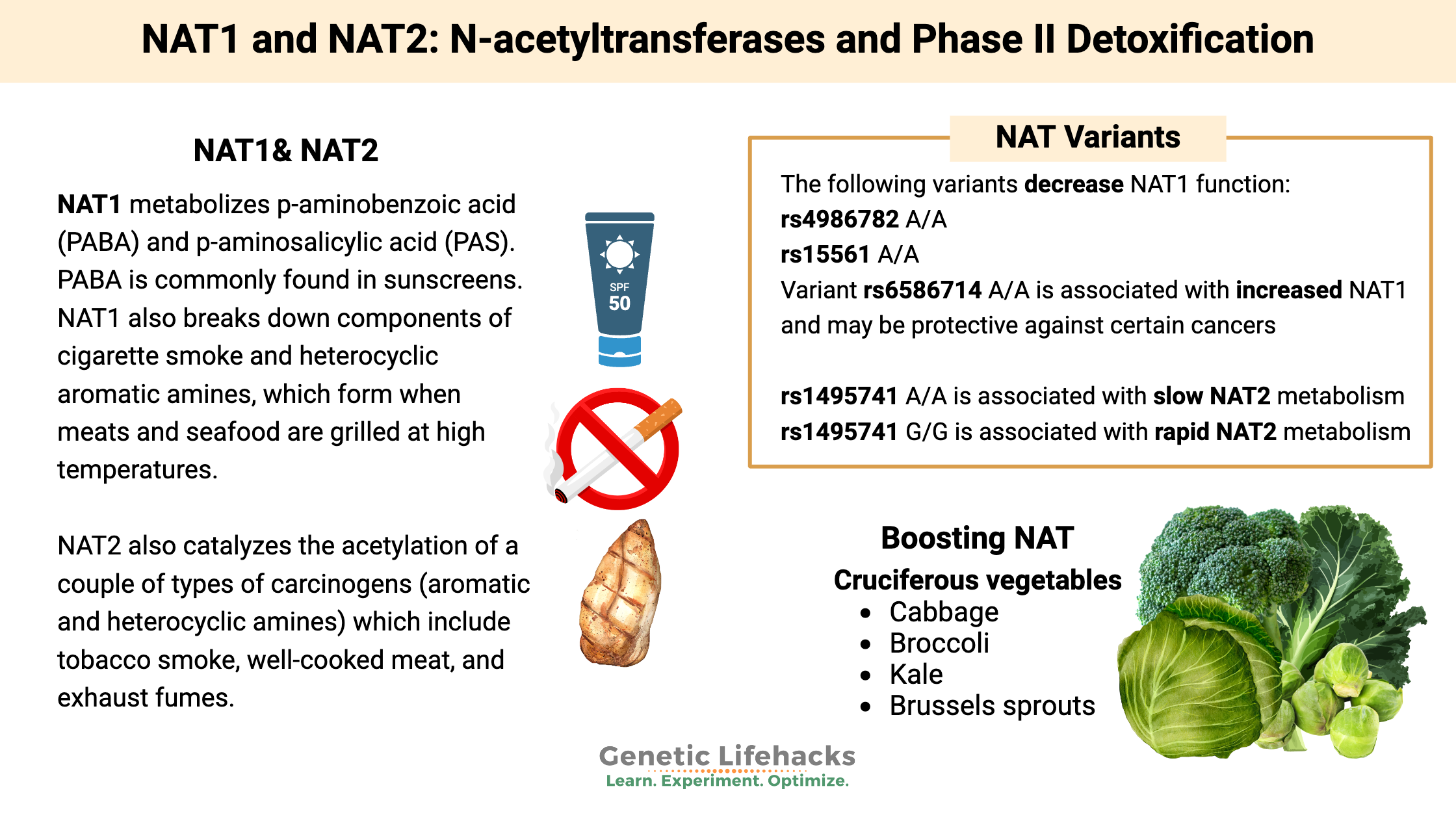
Key Takeaways:
- NAT1 and NAT2 are phase II detoxification enzymes that help your body process certain toxins, drugs, and carcinogens by making them easier to excrete.
- NAT2 acetylator status can influence how the body handles smoke, grilled meats, and some medications, with slow acetylators often having a greater risk in high-exposure situations.
- Lifestyle choices such as not smoking and eating more cruciferous vegetables can make a meaningful difference regardless of genotype.
NATs: N-acetyltransferases
N-acetyltransferases are phase II detoxification enzymes used by the body to eliminate a couple of types of specific toxins and carcinogens. These enzymes help your body eliminate aromatic amines, drugs, cigarette smoke, and carcinogens. They make specific toxins more water-soluble so that they can be excreted through a process called acetylation.
There are two enzymes in this family: NAT1 and NAT2
| NAT1 | NAT2 | |
|---|---|---|
| Main location | Many tissues throughout the body | Primarily liver and intestines |
| Main role | Acetylates PABA, PAS, and some aromatic/heterocyclic amines | Acetylates many arylamines and hydrazine drugs and carcinogens |
| Key relevance | Cancer risk, folate/methylation, response to specific drugs | Drug side effects, cancer risk with smoke/grilled meats |
There are several common genetic variants that can classify a person as a slow, intermediate, or rapid acetylator. The rapid acetylator phenotype is considered to be the ancestral type and is the most common type in Asian and African populations; Caucasian people are actually slightly more likely to be intermediate or slow acetylators.[ref]
Geneticists think that the slow NAT acetylation genotypes arose around 10,000 years ago with the shift to farming and herding. Population groups that are traditionally more hunter/gatherers are more likely to have fast NAT2.[ref]
Historically, N-acetyltransferase was first recognized in the 1950s to play a role in the metabolism of tuberculosis drugs. A significant percentage of people were found to be poor acetylators, resulting in deleterious side effects of the classic tuberculosis drug isoniazid.
Let’s look at each enzyme in more detail…
NAT1 (N-acetyltransferase 1) enzyme:
NAT1 is a phase II detoxification enzyme that helps to move certain toxins out of the body.
NAT1 is involved in the metabolism of:[ref]
- P-aminobenzoic acid (PABA), which is commonly found in sunscreens
- P-aminosalicylic acid (PAS), which is used as an antibiotic for tuberculosis
- Components of cigarette smoke
- Heterocyclic aromatic amines, which are carcinogens that form when meats and seafood are grilled at high temperatures
Increased cancer risk: Studies link NAT1 genetic variants that alter the enzyme function to an increased risk of bladder, colon, breast, lung, prostate, and pancreatic cancers.[ref]
Smoking is not good for anyone, but it is even riskier for those with NAT1 slow acetylator variants. NAT1 slow and intermediate acetylators have been shown to have a significantly higher risk for esophageal cancer and lung cancer in smokers.[ref]
Interaction with grilled meat: Research shows that NAT1 slow acetylators have more DNA adducts formed with heterocyclic aromatic amines (carcinogens from meat being cooked at high temps). DNA adducts are segments of DNA that are bound to a carcinogen and are often a precursor for cancerous cells.[ref] Another study shows that red meat consumption for slow and intermediate acetylators increases the risk of esophageal cancer.[ref]
Folate metabolism: NAT1 is also involved in folate metabolism[ref]. Rs15561 -A/A (below in genotype report) has been associated with cleft lip, especially if the mother smokes, and spina bifida, which are classic signs of folate deficiency. Note that it is the baby’s genotype, not the mother’s, that is being studied, so this is another really good reason not to smoke when pregnant, regardless of your own genotype.[ref] This links NAT1 to folate metabolism and the methylation cycle.
In the presence of folate, NAT1 also acts to hydrolyze the conversion of acetyl coenzyme A to coenzyme A. This is separate from its acetyltransferase activity. Note that other enzymes can also hydrolyze acetyl CoA — NAT1 is not the primary enzyme here, just a backup route used in regulating cellular CoA levels.[ref]
Temperature dependence: NAT1 is a temperature-sensitive enzyme for its acetyltransferase activity, with higher body temperature (fever) causing a decrease in acetyltransferase activity. On the other hand, the hydrolase activity is increased by a rise in temperature. [ref]
NAT2 (N-acetyltransferase 2) enzyme:
NAT2 also catalyzes the acetylation of a couple of types of carcinogens (aromatic and heterocyclic amines), which include tobacco smoke, well-cooked meat, and exhaust fumes. NAT2 has been studied extensively and is thought to play a role in the risk of several types of cancers.
NAT2 is found mainly in the liver and intestines, in contrast with NAT1, which is found throughout the body.[ref]
What does NAT2 slow acetylator mean?
Low NAT2 function due to genetic variants causes a slow acetylator phenotype. NAT2 is important in the detoxification of xenobiotics, which are chemicals that come into your body, such as acrylamide or particulates from smoke or smog. This is important when exposed to carcinogens, but it also may play a role in the metabolism and side effects of certain drugs. Many of these studies on drug interactions with NAT2 are on tuberculosis drugs. In addition, for transplant patients on immunosuppressants, there can be significant drug interactions with certain antibiotics.[ref][ref]
Genotype Report: NAT1 & NAT2
Genes covered here:
NAT1 gene: encodes arylamine N-acetyltransferase 1 enzyme, which adds an acetyl group to various carcinogens, environmental toxins, and certain medications, making them easy to excrete.
NAT2 gene: encodes arylamine N-acetyltransferase 2 enzyme, which adds an acetyl group to arylamine and hydrazine drugs and carcinogens, making them easy to excrete.
| Gene | Role in detoxification | Typical genotype patterns | What this usually means | Key exposures to consider |
|---|---|---|---|---|
| NAT1 | Phase II enzyme that acetylates aromatic amines and some heterocyclic amines in many tissues, helping convert them into more water‑soluble forms for excretion. | Common variants can slightly increase or decrease NAT1 activity, but large functional shifts are less well characterized than for NAT2. | Genotype patterns may modestly influence how efficiently certain environmental carcinogens and drugs are processed, but clinical implications are still being clarified in research. | Aromatic amines and heterocyclic amines from cigarette smoke, air pollution, and high‑temperature cooked meats. |
| NAT2 | Phase II enzyme that acetylates many arylamines and hydrazine drugs, especially in liver and intestinal tissues, as part of drug and toxin clearance. | Well‑studied haplotypes define slow, intermediate, and rapid “acetylator” phenotypes based on combinations of NAT2 variants. | Slow acetylators tend to clear some drugs and arylamine carcinogens more slowly, while rapid acetylators often clear them more quickly. This can affect side‑effect risk and cancer susceptibility in specific exposure contexts. | Tobacco smoke, exhaust, industrial arylamines, and heterocyclic amines in well‑done meats, and certain medications (e.g., isoniazid and related hydrazine drugs). |
The SNPs below show the specific NAT1 and NAT2 variants that contribute to your acetylator status and how common each variant is in the population.
Access this content:
An active subscription is required to access this content.
Lifehacks for NAT1 and NAT2:
Stop smoking:
If you need a reason not to smoke, being a slow or intermediate acetylator is a really good reason never to pick up a cigarette. Cigarette smoke contains various carcinogens, including aromatic and heterocyclic amines. When inhaled, these carcinogens can undergo metabolic activation by NAT1 and NAT2 enzymes, potentially leading to the formation of DNA adducts and increased cancer risk.
Many studies over the past two decades have shown an interaction between cigarette smokers with low NAT2 activity and bladder cancer. The increased risk ranges from 2 to 6-fold, depending on the study population group.[ref][ref]
Related article: Nicotine addiction and CYP2A6
Multiplicative risk: The risk of bladder cancer increases even more for people with GSTM1 null genotypes. Smokers who were GSTM1 null and low NAT2 were at a 20-fold increased risk of bladder cancer.[ref]
GSTM1 gene: (Full GST article for more details)
Check your genetic data for rs366631 (23andMe v4 only):
- A/A: deletion (null) GSTM1 gene. 2x increased risk of breast cancer[ref], increased susceptibility to lung cancer in smokers[ref], increased risk of prostate cancer in Caucasians[ref] (common genotype in many population groups)
- A/G: GSTM1 present
- G/G: GSTM1 present
Members: Your genotype for rs366631 is —.
Breast cancer risk is also increased in people who have low NAT2 activity genotypes. The increased risk includes both smokers and women exposed to secondhand smoke.[ref][ref] Again, the risk is even higher in women with both low NAT2 and GSTM1 null genotypes. For these women, long-term smoking increased the risk of breast cancer by 6-fold.[ref]
Lung cancer risk is also increased in people with low or intermediate NAT status who also smoke.[ref]
Talk with your doctor: If you are a slow acetylator and a current smoker, talk with your doctor about whether you may need more frequent screenings for bladder or breast cancer.
Diet and grilled meat:
Fast acetylators may also want to consider their diet, with a focus on how much charred or grilled meat they eat. Grilled meat is linked to an increase in specific types of colon cancer (p53 mutations) in people with fast acetylation genotypes.[ref] Overall, though, there is an increased colon cancer risk from grilled meat regardless of NAT2 status, so everyone may want to consider limiting charred meat.[ref]
Eating more cruciferous vegetables:
Eating more cruciferous vegetables (cabbage, broccoli, kale, Brussels sprouts) decreases the risk of bladder cancer, regardless of NAT2 status in smokers. Cruciferous vegetables contain isothiocyanate, which has been shown to decrease cancer risk.[ref] Isothiocyanate (ITC) is also available as a supplement if you dislike eating cruciferous vegetables.
Access this content:
An active subscription is required to access this content.
Related Articles and Topics:
CYP2C19: How Genetic Variants Affect SSRIs, Blood Thinners, and Toxins
References: