
Last fact-checked and updated: | Published:
Key takeaways:
- CYP2C19 metabolizes many common medications, including proton‑pump inhibitors (omeprazole, lansoprazole), clopidogrel, diazepam, oral progesterone, several anti‑epileptics, and SSRIs such as citalopram, escitalopram, and sertraline.
- Variants in the gene can increase or decrease your enzyme function, making you an ultra-rapid or poor CYP2C19 metabolizer.
- Your CYP2C19 genotype also affects how you process some environmental toxins and hormones, and it can interact with supplements (quercetin, berberine, citrus oils).
This article is part of the Detoxification and Medication Genetic Lifehacks Hub.
Members will see their genotype report below and the solutions in the Lifehacks section. Consider joining today.CYP2C19: Important for SSRIs, blood thinners
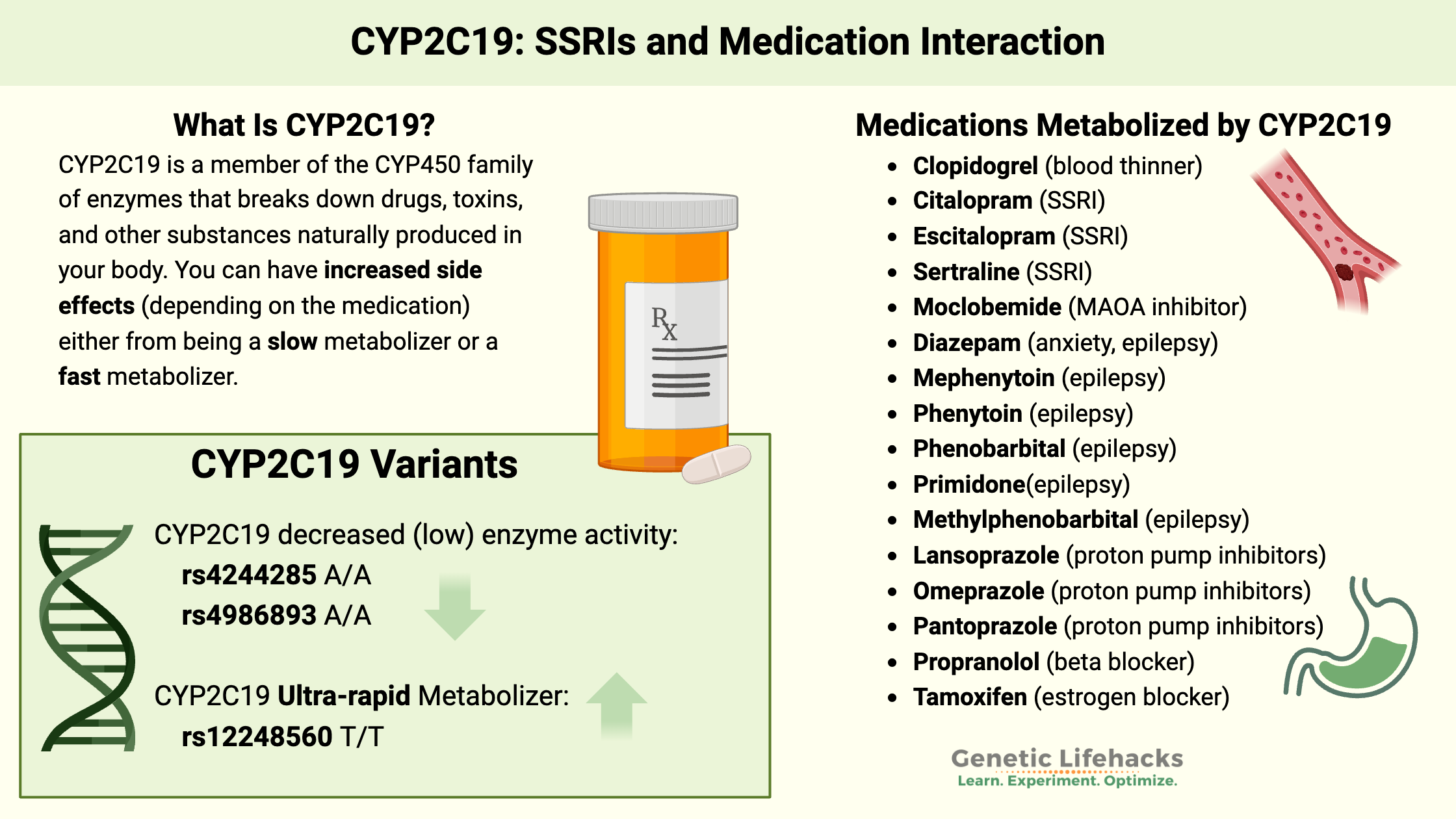
CYP2C19 is one of the core phase I detoxification enzymes that determines how you respond to a surprisingly wide range of medications and environmental compounds. CYP2C19 is a member of the CYP450 family of enzymes that breaks down drugs, toxins, and other substances naturally produced in your body.
The CYP2C19 enzyme is responsible for the breakdown (also called metabolism) of several popular drugs, including proton pump inhibitors (omeprazole, esomeprazole, lansoprazole), certain anti-epileptics, and an antiplatelet drug (clopidogrel). Differences in CYP2C19 activity help explain why standard doses of omeprazole, SSRIs, or clopidogrel may be too strong, too weak, or simply not work for some people. These genetic differences can also affect your response to oral progesterone.
Several important CYP2C19 genetic variants impact how drugs break down, causing some people to be poor metabolizers and others to be rapid metabolizers.
Clinically, these genetic differences are usually grouped into metabolizer “types,” which describe how quickly your CYP2C19 enzyme works. Here’s an overview of the terminology:
| CYP2C19 metabolizer type | Enzyme activity | General drug metabolism pattern | Common description |
|---|---|---|---|
| Normal metabolizer | Typical/expected activity | Drugs are metabolized at the expected rate | Average CYP2C19 function |
| Intermediate metabolizer | Reduced activity | Drugs are metabolized more slowly than normal | Partially decreased function |
| Poor metabolizer | Little to no activity | Drugs are metabolized much more slowly than normal | Minimal or absent function |
| Rapid metabolizer | Increased activity | Drugs are metabolized faster than normal | Higher-than-normal function |
| Ultrarapid metabolizer | Greatly increased activity | Drugs are metabolized very quickly | Strongest CYP2C19 activity |
You can have increased side effects (depending on the medication), either from being a slow metabolizer or a fast metabolizer, because the drug may stay in your system too long or be cleared too quickly. Some medications, called prodrugs, need to break down into their metabolites for the drug to be effective — essentially, the metabolite is the drug. Other drugs clear your system through the use of the CYP enzymes. Thus, the effect of a CYP2C19 variant depends on the specific medication.
One important example of a prodrug is clopidogrel (Plavix), a blood thinner, of the activation of a prodrug by the CYP2C19 enzyme. Without a functioning CYP2C19 enzyme, the active thiol form of clopidogrel won’t be formed, and blood clots will still be able to form. For someone relying on clopidogrel to prevent blood clots, such as after getting a stent put in, the lack of CYP2C19 enzyme function significantly increases the risk of fatal blood clots.
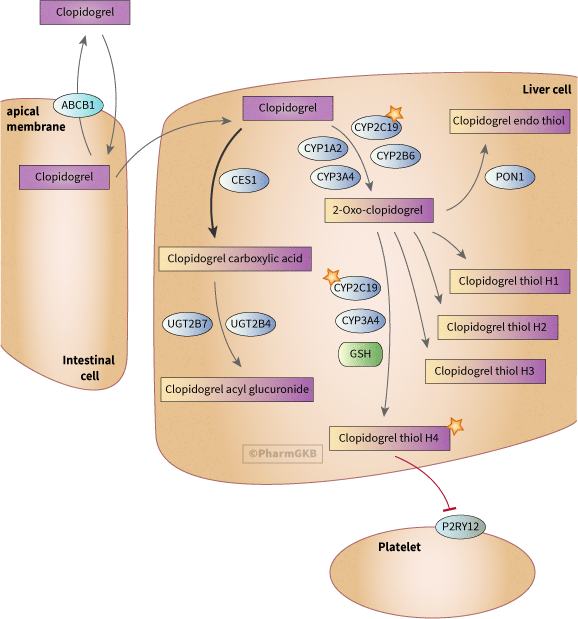
Together, these differences in activation and clearance show up clearly in clinical trials, where CYP2C19 variants change how people respond to common medications.
CYP2C19 medication interaction examples
Clinical trials clearly show that genetic variants (SNPs) in CYP2C19 can affect how people react to different medications. Here are some examples so that you can see the extent of different outcomes:
- A CYP2C19 fast metabolizer taking omeprazole to treat Helicobacter pylori may have an insufficient response because the drug may not remain active in the body long enough.[ref]
- Prodrugs, such as clopidogrel, convert into their active drug state through CYP2C19. If you are a poor metabolizer, clopidogrel (an anticoagulant) isn’t activated enough, and you wouldn’t be protected from blood clots.[ref]
- Diazepam is another common drug metabolized partly by CYP2C19 (along with the CYP3A4 enzyme). Currently, there are no official recommendations to physicians as to reducing the dosages for poor metabolizers, but there is a box warning about CYP2C19, showing that genetics may still impact side effects and sedation.[ref]
- Some SSRIs, including citalopram, sertraline, and escitalopram, also metabolize mainly through CYP2C19.[ref] A 2021 study showed that the average dose of citalopram is not as effective as an antidepressant for people with one copy of a non-functioning CYP2C19 variant (rs4244285).[ref]
- Progesterone, both oral and vaginal, is affected by CYP2C19 rapid or poor metabolism. Poor metabolizers have increased progesterone levels, possibly leading to side effects from excess, while rapid metabolizers have lower levels and may not see the expected benefits from progesterone treatment.
CYP2C19 Poor Metabolizers
You can use your genetic data below to see if you are likely to be a poor metabolizer or have reduced CYP2C19 function. Globally, the frequency of poor metabolizers varies quite a bit by ancestry group:
- Approx. 10 – 20% of Asians are poor metabolizers, as are 2 – 5% of people of Caucasian descent.
- Up to 20-30% of Caucasians are fast metabolizers, but less than 5% of Asians are.
These ancestry differences explain why some populations have higher rates of non‑response or side effects at standard doses for certain drugs. However, knowing your actual CYP2C19 genotype is more accurate than just guessing based on ancestry.
Medications metabolized by CYP2C19
Many different medications are metabolized at least in part by CYP2C19. The most important interaction is with clopidogrel (Plavix). People who have non-functioning CYP2C19 variants aren’t able to turn the pro-drug into the active form that acts as a blood thinner. This is a problem after heart surgery when someone depends on clopidogrel to block the formation of blood clots. CPIC Guidelines for Clopidogrel
CYP2C19 also contributes to the metabolism of several commonly prescribed drugs, including:[ref]
- voriconazole (antifungal) – CPIC guidelines for CYP2C19
- citalopram (SSRI)
- escitalopram (SSRI)
- sertraline (SSRI)
- moclobemide (MAOA inhibitor)
- diazepam (anxiety, epilepsy)
- mephenytoin (epilepsy)
- phenytoin (epilepsy)
- phenobarbital (epilepsy)
- primidone(epilepsy)
- methylphenobarbital (epilepsy)
- lansoprazole (proton pump inhibitors)
- omeprazole (proton pump inhibitors)
- pantoprazole (proton pump inhibitors)
- propranolol (beta blocker)
- tamoxifen (estrogen blocker)
- progesterone (oral)
You can check for less common gene X drug interactions on DrugBank Online.
While common SSRIs are included in the list above, the clinical effect of CYP2C19 variants is not always clear. For example, a 2026 study in patients with post-stroke depression found that CYP2C19 variants did not affect how well escitalopram worked for depression.[ref]
Natural supplements that interact with CYP2C19
Because these same pathways handle both medications and toxins, changes in CYP2C19 activity from genetics, smoking, or supplements can have a compounding effect. The following natural supplements interact with CYP2C19.
- limonene, found in citrus essential oil (inhibitor of CYP2C19)[ref]
- artemisinin (induces CYP2C19)
- quercetin (weak inhibitor)[ref]
Related article: Quercetin: Scientific Studies + Genetic Connections
- resveratrol (weak inhibitor)[ref]
Related article: Resveratrol: Genetic Interactions and Bioavailability
- berberine (weak inhibitor)[ref][ref]
Related article: Berberine: Research, Benefits, Absorption, and Genetics
Environmental toxins broken down by CYP2C19
CYP2C19 is also involved in the metabolism of certain environmental toxins, including some pesticides. When CYP enzymes break down toxins, the metabolite formed is often also toxic and needs to be quickly eliminated using phase II detoxification
Organophosphates: Diazinon is an organophosphate pesticide bioactivated by CYP2C19.[ref] People with low CYP2C19 activity alongside higher CYP2B6 activity are more likely to have AChE activity inhibition with exposure to organophosphate pesticides (chlorpyrifos).[ref]
Endogenous substances metabolized by CYP2C19
While we often focus on the interactions with drug metabolism, the CYP2C19 enzyme is found naturally in the body to break down several hormones that are endogenously produced.
- CYP2C19 helps to activate and break down some hormones, such as progesterone.[ref]
- It is involved (minor) in metabolizing melatonin[ref]
- It is also involved in the metabolism of estradiol.[ref]
Note that CYP2C19 is not the only route for metabolizing these hormones, just one of the pathways the body can use to break them down. This means your overall hormone levels depend on multiple enzymes, not CYP2C19 alone.
CYP2C19 Genotype Report
Earlier, we looked at CYP2C19 “metabolizer types” based on enzyme activity. Below is your CYP2C19 genotype report, showing whether you carry variants that make you a poor or ultra‑rapid metabolizer and how this may affect your response to medications and toxins.
| CYP2C19 metabolizer type | Enzyme activity | General drug metabolism pattern | Genotype |
|---|---|---|---|
| Normal metabolizer | Typical/expected activity | CYP2C19 substrates are metabolized at the expected rate | typical for all (no variants highlighted) |
| Intermediate metabolizer | Reduced activity | CYP2C19 substrates are metabolized more slowly than normal, prodrugs not converted as quickly | 1 copy of CYP2C19*2 or *3 |
| Poor metabolizer | Little to no activity | CYP2C19 substrates are metabolized much more slowly than normal, prodrugs not converted to the active drug | 2 copies of CYP2C19*2 or *3 |
| Rapid metabolizer | Increased activity | CYP2C19 substrates are metabolized faster than normal, prodrugs are converted more quickly to the active drug | 1 copy of CYP2C19*17 |
| Ultrarapid metabolizer | Greatly increased activity | CYP2C19 substrates are metabolized very quickly, prodrugs are converted more quickly to the active drug | 2 copies of CYP2C19*17 |
Access this content:
An active subscription is required to access this content.
Log in below or Join as a member.
Lifehacks: Considerations and Supplement Interactions
Understanding your CYP2C19 phenotype can help you dial in lifestyle factors and decide whether you may benefit from additional testing for medication responses.
Lifestyle interactions
Stop smoking
If you are a CYP2C19 poor metabolizer and also a smoker, you have a 5x increased risk of lung cancer[ref] and a 17x increased risk of laryngeal cancer or esophageal cancer.[ref][ref]
Pickled vegetable consumption (N-nitroso)
Studies show that CYP2C19 poor metabolizers are more likely to have esophageal cancer with higher pickled vegetable consumption. These studies involve traditional, salt‑fermented vegetables common in Asia that are high in N‑nitroso compounds, so the findings may not apply equally to all types of pickled foods (e.g. vinegar pickles).[ref]
Pharmacogenetic testing for antidepressants
If you are trying to figure out whether an antidepressant will work for you, consider pharmacogenetic testing, which is a clinical test specifically looking for gene-drug interactions. Your doctor can likely order it for you, or you can order it on your own from some testing places. Your raw data file may not contain every possible mutation that the pharmacogenomics testing will show.
CYP2C19: Interactions with supplements
If you regularly use certain supplements or over‑the‑counter medications, it is worth considering how they might interact with your CYP2C19 genotype.
D-limonene
The metabolism of D-limonene, a component of citrus essential oils, also occurs through CYP2C19. If you are a poor metabolizer and taking a medication metabolized through CYP2C19, you may not want to take supplements or use essential oils with d-limonene at the same time as the medication.
Aspirin
Inducers of CYP2C19 include low-dose aspirin.[ref] If you are taking low-dose aspirin on a daily basis, talk with your doctor to see if it could interact with medications metabolized by CYP2C19 – especially if you are a rapid metabolizer.
Common supplements that are inhibitors
A number of commonly taken natural supplements partly inhibit CYP2C19 and could interfere with the medications that you are taking. [ref][ref]
- Quercetin
- Berberine
- Caffeic acid
- Resveratrol
Because these compounds can inhibit CYP2C19, it is important to talk with your doctor or pharmacist about any supplements if you are also taking medications that rely on CYP2C19 for activation or clearance.
Access this content:
An active subscription is required to access this content.
Log in below or Join as a member.
Related Articles and Topics
References: