
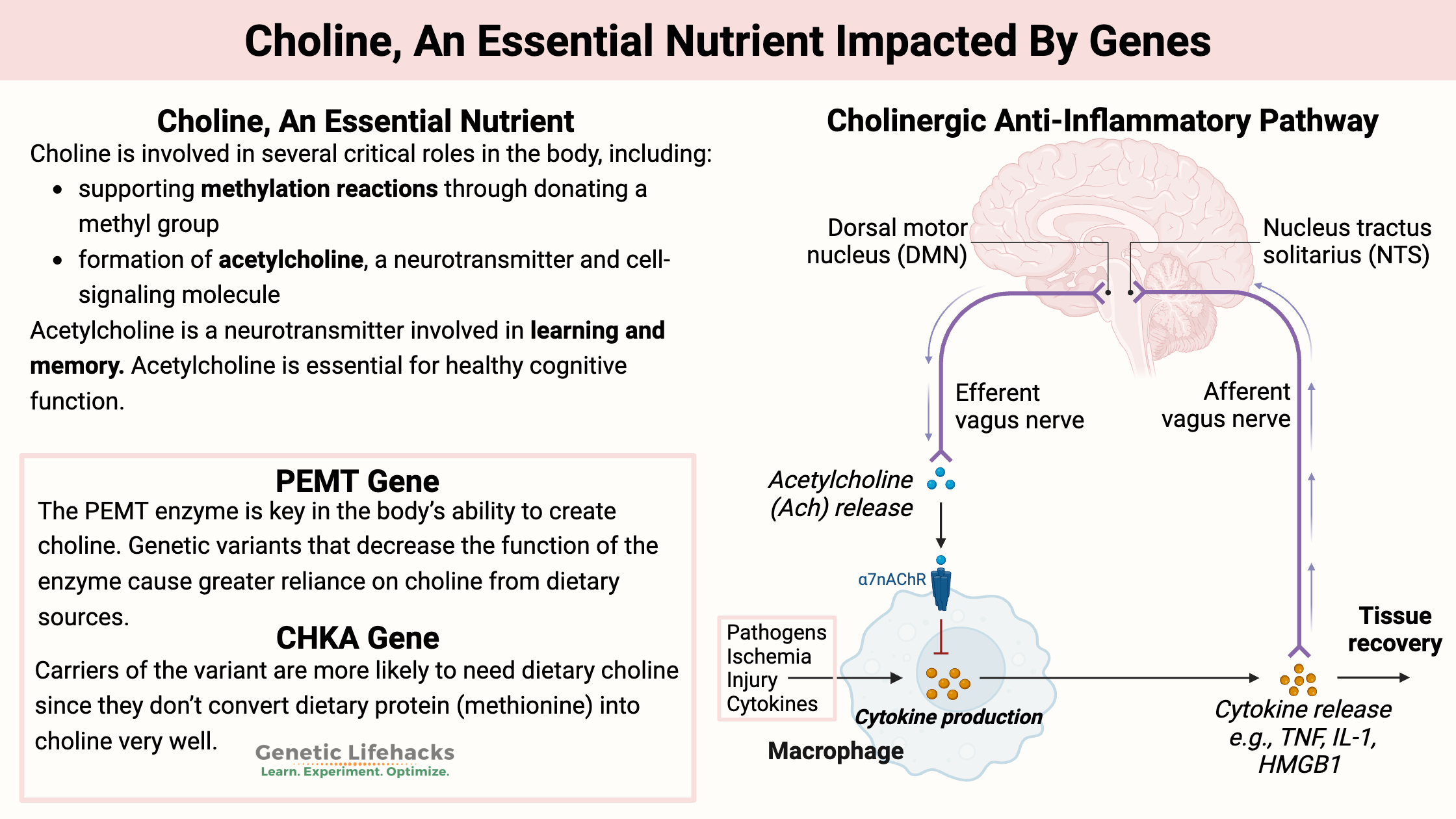
Choline is an essential nutrient that a lot of us don’t get enough of. In fact, the majority of the US population doesn’t get enough choline on a daily basis. Insufficient choline can impact mental sharpness, heart health, fatty liver disease, and more.[ref]
This article digs into the research on the various forms of choline and how genetic variants impact our need for choline. Genetics plays a big role in how well your body creates and uses choline. Members will see their genotype report below, plus additional solutions in the Lifehacks section. Join today.
Why do we need choline?
Choline is involved in several critical roles in the body, including:
- supporting methylation reactions through donating a methyl group
- formation of acetylcholine, a neurotransmitter and cell-signaling molecule
- formation of phosphatidylcholine, which makes up cell membranes[ref]
- muscle function[ref]
- deficiency in choline contributes to non-alcoholic fatty liver disease (NAFLD)[ref]
Recent studies of choline show:
- Academic achievement in 15-year-olds is significantly associated with plasma choline levels.[ref] Wow – I have a hard time wrapping my head around the idea that a nutrient can be that important for academic achievement.
- Choline plus B vitamins may increase neuroplasticity and speed recovery after a stroke.[ref]
- Choline deficiency is correlated to lower bone mineral density.[ref]
Making choline in the body vs. choline from food:
Generally, people can make some choline in their liver. This is not enough choline to meet all the body’s needs, though, so it is essential to also get choline via the diet. Additionally, some people have genetic variants that reduce their ability to make choline, thus increasing their need for choline from food.
The FDA recommends an adequate intake for adults of 425-550 mg/day for choline.[ref]
There are a number of food sources of choline that are easily incorporated into your diet. Check out our Choline-rich foods and recipes article.
Acetylcholine – an important neurotransmitter:
Choline is the precursor to acetylcholine, which is an important neurotransmitter. Acetylcholine is the signaling molecule for neurons that control muscles, heart rhythm, and other functions.
Choline in the methylation cycle:
Your body’s need for choline from the diet will depend partly on how much folate you eat and how well your methylation cycle works. Choline acts as a methyl donor in the methylation cycle, and with low folate or decreased enzyme efficiency in the folate pathways, your choline requirement may increase.
Specifically, choline in the form of betaine (also known as trimethylglycine) acts as a methyl donor within the methylation cycle.[ref]
When choline levels are low, homocysteine levels can increase, which is associated with an increased risk of cardiovascular disease. Increasing levels of betaine in the diet are linked with lower homocysteine levels.[ref]
A study published in the American Journal of Clinical Nutrition found that with just two weeks of supplemental choline (2.6 g/day as phosphatidylcholine), homocysteine levels dropped by 18% compared to placebo.[ref]
Choline for the brain:
Choline is a precursor for acetylcholine, a neurotransmitter involved in learning and memory. Acetylcholine is essential for healthy cognitive function. Simply put, we need choline to think and function well.[ref]
In a mouse model of Alzheimer’s disease, giving the mice choline for most of their lives reduced the Alzheimer’s pathology.[ref] Yes – this is just a mouse study. But the cholinergic system is important in Alzheimer’s disease, and commonly used medications for Alzheimer’s include acetylcholinesterase inhibitors.
Fatty liver disease and choline deficiency:
A study of 57 normal adults investigated the effects of limiting either choline from the diet or folate from the diet for a period of 6 weeks. The study found that 77% of postmenopausal women and 80% of men developed fatty-liver disease in the six weeks of choline deprivation (<50mg/day). No significant changes were found from limiting folate in the diet.[ref]
Choline requirements in pregnancy:
Choline is an essential component of cell membranes, so a developing fetus needs a lot of choline. Women who are pregnant or nursing thus have a greater need for choline. When pregnant, a woman will produce more choline, which is then transported to the developing baby. So despite the increased production of choline, pregnant women end up low in choline. Breast milk is also high in choline, so nursing the baby also depletes the mother of choline.[ref]
Choline Genotype Report:
Access this content:
An active subscription is required to access this content.
Lifehacks: Diet and Supplement Options
Food sources of Choline:
Excellent (egg-cellent :-) sources of choline in foods include: eggs, liver, shitake mushrooms, milk, and various types of meat.[ref]
| Food | Mg per serving |
Percent DV |
|---|---|---|
| Beef liver, pan-fried, 3 ounces | 356 | 65 |
| Egg, hard-boiled, 1 large egg | 147 | 27 |
| Beef top round, separable lean only, braised, 3 ounces | 117 | 21 |
| Soybeans, roasted, ½ cup | 107 | 19 |
| Chicken breast, roasted, 3 ounces | 72 | 13 |
| Beef, ground, 93% lean meat, broiled, 3 ounces | 72 | 13 |
| Fish, cod, Atlantic, cooked, dry heat, 3 ounces | 71 | 13 |
| Mushrooms, shiitake, cooked, ½ cup pieces | 58 | 11 |
| Potatoes, red, baked, flesh and skin, 1 large potato | 57 | 10 |
| Wheat germ, toasted, 1 ounce | 51 | 9 |
| Beans, kidney, canned, ½ cup | 45 | 8 |
| Quinoa, cooked, 1 cup | 43 | 8 |
| Milk, 1% fat, 1 cup | 43 | 8 |
| Yogurt, vanilla, nonfat, 1 cup | 38 | 7 |
Meat and eggs are the most abundant sources of choline — but even so, a serving of chicken breast gives you 13% of the recommended daily value.
In short, if you want to know how much choline you normally get in your diet, you should track what you eat for a week or so. The free online app, cronometer.com, includes the choline content of foods. Choline content isn’t enabled by default, so you will need to go into the settings and turn on ‘choline’.
There are a number of food sources of choline that are easily incorporated into your diet. Check out our Choline-rich foods and recipes article.
Supplement Options:
Access this content:
An active subscription is required to access this content.
Related Articles and Topics:
Alzheimer’s Gene: Find your APOE type from your genetic raw data
MTHFR Gene Explained: C677T and A1298C Variants, Testing, and Solutions
References: