
Join Here   |   Log In

Getting the Lead Out: Genetics and Lead Exposure

Key takeaways:
~ Lead exposure increases oxidative stress, and lead can take the place of other ions in the cell.
~ At higher levels, lead is toxic for everyone, but that tipping point isn’t the same for everyone.
~ Genetic variants can increase your susceptibility to health problems from lead at lower levels.

Members will see their genotype report below and the solutions in the Lifehacks section. Consider joining today

How do your genes affect lead exposure?

Lead is a toxic heavy metal that can be found in various environmental sources. It can cause a number of adverse health effects, even at low levels of exposure.

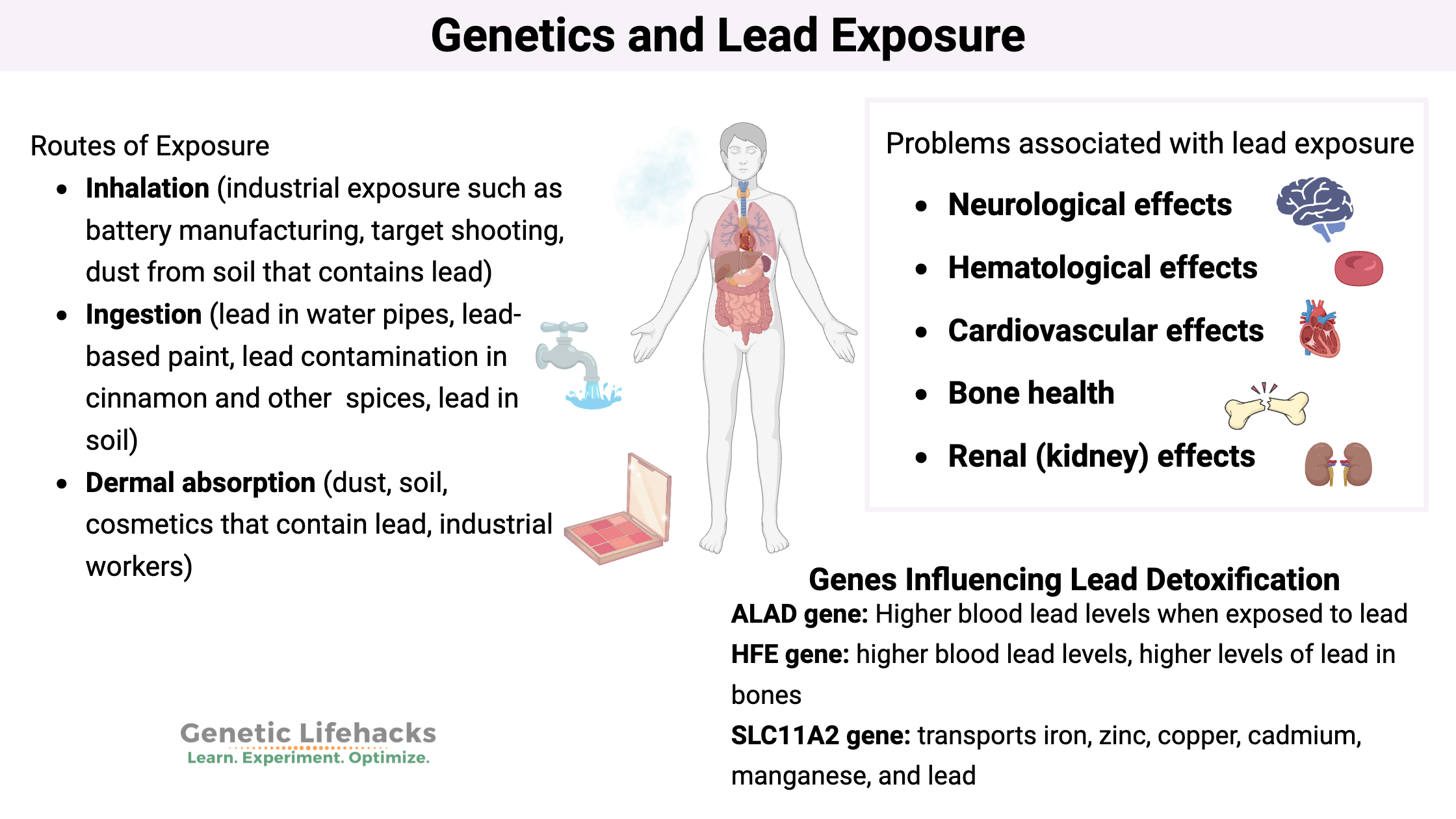
Problems associated with lead exposure include:

Neurological effects:
Lead can damage the nervous system, especially in children, leading to learning difficulties, behavioral problems, and lowered IQ. In adults, lead exposure has been linked to memory loss, mood disorders, and peripheral neuropathy.[ref]

Hematological effects:
Red blood cells are formed in the bone marrow. Lead directly interferes with the production of red blood cells, leading to anemia. Genetic variants in the heme system increase the likelihood of hematologic effects at lower levels.[ref]

Cardiovascular effects:
Lead exposure has been associated with an increased risk of high blood pressure, coronary heart disease, and stroke in adults. However, studies on lead levels in adults do have conflicting results as far as how much of an effect lead has on blood pressure. What is clearer is that lead is also associated with longer QT intervals in some people with certain genetic variants.[ref][ref][ref]

Bone health:
Lead can accumulate in the bones and remain there for decades. During periods of increased bone turnover, such as pregnancy and menopause, lead can be released back into the bloodstream, causing further health problems. Additionally, lead directly reduces bone mineral density, in animal studies, and causes the formation of poor-quality bones.[ref][ref]

Renal (kidney) effects:
A number of epidemiological studies show that chronic lead exposure can cause kidney damage and lead to chronic kidney disease.[ref]

Reproductive effects:
Lead can affect both the male and female reproductive systems, leading to reduced fertility, increased risk of miscarriage, and adverse pregnancy outcomes.[ref]

Mechanism of action: Why is lead bad?

Lead interferes with and affects many different cellular pathways.  Lead can replace other ions, including calcium, magnesium, iron, and sodium, which interfere with intracellular signaling, protein and enzyme formation, and apoptosis.[ref]

Lead can also replace zinc ions in certain proteins, which can cause the proteins to misfold. For example, a class of proteins called zinc finger proteins is important as transcription regulators and for RNA packaging, which means that lead replacing zinc can impact the transcription of a bunch of different genes.[ref]

Another particularly harmful aspect of lead in the body is that it can induce oxidative stress by decreasing a cell’s ability to produce antioxidants.[ref]

Children are most vulnerable to the effects of lead because their developing bodies absorb lead more readily, and their nervous systems are more sensitive to its toxic effects. Even low levels of lead exposure in children have been linked to reduced cognitive function, academic performance, and social or behavioral problems.

Sources of Lead Exposure:

Heavy metal contamination is prevalent in many areas of the world, and lead exposure can happen through multiple routes.

Here are some sources of lead in the environment:[ref]

  • Sewage sludge, which is often used as a biosolids fertilizer, may contain higher concentrations of lead
  • Leafy greens grown in lead-contaminated soils
  • Glazed ceramic and crystal dishes and glasses can contain lead
  • Working in industries such as battery manufacturing or paint removal (lead paint)
  • Lead shot and lead fishing weights contribute to groundwater and soil lead contamination
  • Target shooting, especially indoors[ref][ref]

Note that lead is no longer allowed in hair dyes, and the FDA claims that  99% of tested cosmetics are below the 10 ppm limit on lead.[ref]

Sources of lead in foods:

Fiber supplements: ConsumerLab.com, in testing psyllium fiber supplements, found that some contain up to the daily value of lead in one serving. For example, one type of Metamucil was right at the limit for lead, so taking more than a single serving would exceed the daily limit.[ref] I’m mentioning this specifically because a lot of people take a fiber supplement daily, and it was a surprising source of lead contamination.

Cinnamon: Lead is sometimes added to cinnamon to make it darker. For example, in March 2024, La Fiesta Foods cinnamon was recalled by the FDA due to lead contamination.[ref] The CDC recently issued a warning that certain brands of fruit puree marketed to children, such as cinnamon applesauce, are high in lead. There were multiple reports of children with lead toxicity from them. Here’s a list of what was recalled.

Seaweed: ConsumerLab also tested cinnamon, seaweed, and green supplements for lead content. Of the cinnamon brands tested, the only product that didn’t pass was Badia Cinnamon Powder.[ref] Several seaweed snacks also tested above the Canadian and California Prop 65 limit for lead, as did Dr. Mercola Fermented Greens supplements and Zazzee Organics spirulina powder.[ref][ref] (Algae and chlorella take up heavy metals rapidly[ref])

Vintage dishes: Older ceramic dishes can also contain lead. Researchers tested dinnerware from the 50s or earlier from antique shops and flea markets, putting in a slightly acidic liquid (similar to tomato sauce), and microwaving it for 2-5 minutes. They found that up to 5 mg of lead was leached per dish, which is a very significant amount. The dishes with uranium-coating glazes, copper-containing glasses, and floral decals all had unsafe lead concentrations. [ref]

Table: Common Sources of Lead Exposure

Source Category Examples/Notes
Food Leafy greens grown in contaminated soil, cinnamon, seaweed snacks, fiber supplements21
Water Lead pipes, plumbing fixtures
Household Items Vintage ceramic dishes, glazed cookware
Occupation/Hobbies Battery manufacturing, paint removal, and target shooting
Environment Soil, dust, sewage sludge, fertilizers
Supplements Some green powders, spirulina, and certain vitamins

Lead Absorption:

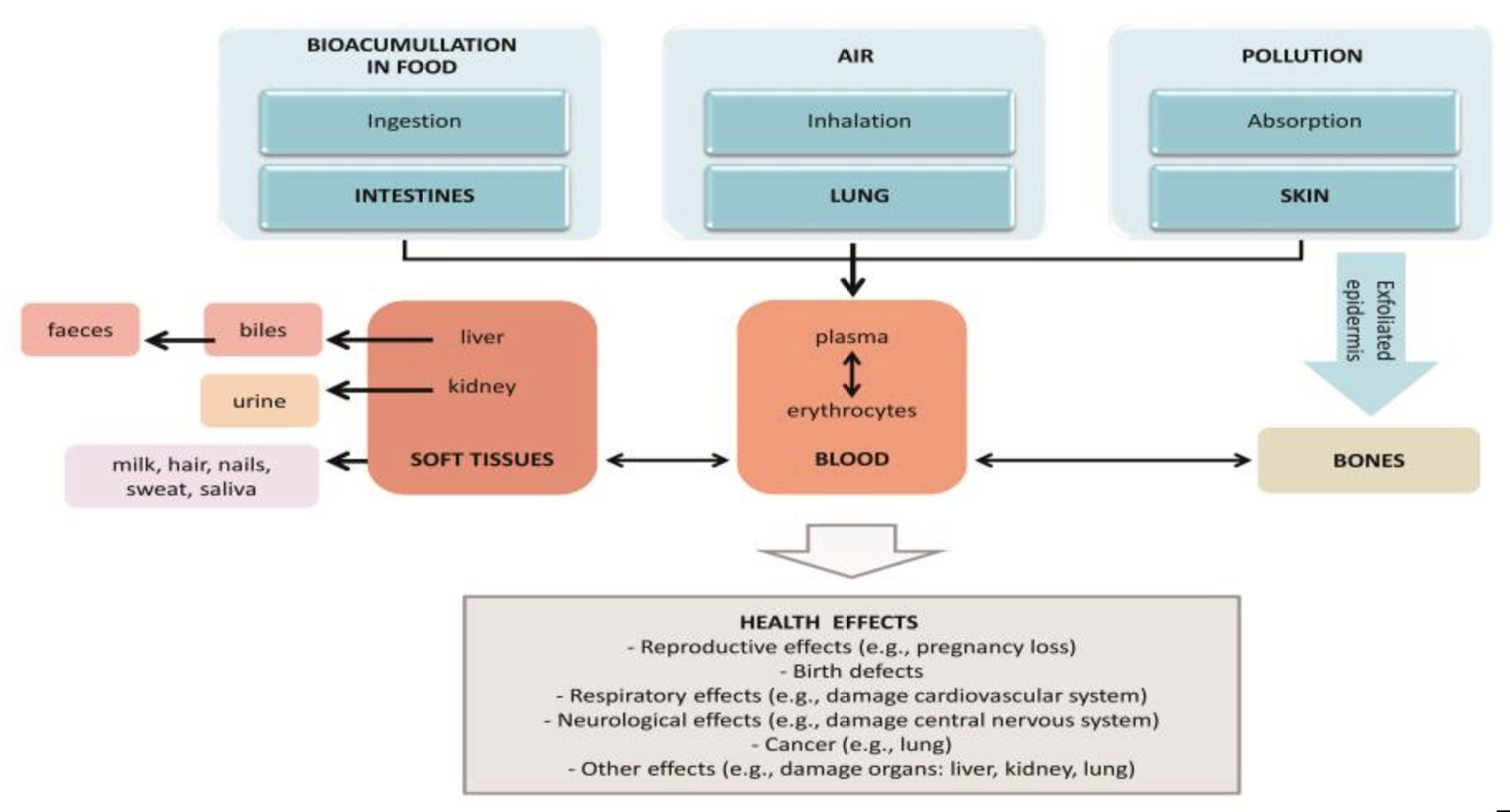
Lead can enter the body through various routes:

  • Inhalation (industrial exposure such as battery manufacturing, target shooting, car exhaust in countries with leaded gas, dust from soil that contains lead)
  • Ingestion (lead in water pipes, lead-based paint, lead contamination in cinnamon and other  spices, lead in soil)
  • Dermal absorption (dust, soil, cosmetics that contain lead, industrial workers, target shooting)

Once absorbed, lead is distributed throughout the body, primarily accumulating in the bones and teeth.

The absorption of lead is influenced by factors such as age, nutritional status, and genetic variations.

The problem of lead exposure is compounded by the fact that lead can persist in the environment for a long time, and the effects of lead toxicity may not be immediately apparent. This means that even if lead exposure is reduced or eliminated, the health consequences may continue to manifest for years to come.
CC image from https://www.ncbi.nlm.nih.gov/pmc/articles/PMC7345175/

Genes Influencing Lead Detoxification:

ALAD (δ-Aminolevulinic Acid Dehydratase):
ALAD is an enzyme involved in the heme biosynthesis pathway. Heme is an iron-containing compound that is part of hemoglobin, which is how blood is able to carry oxygen through the body.

Polymorphisms in the ALAD gene, particularly the ALAD-2 allele (see the genotype report below), have been associated with increased blood lead levels. The ALAD-2 allele is thought to enhance the binding of lead to the enzyme, reducing its activity and leading to higher blood lead concentrations.[ref]

GSTM1 and GSTT1 (Glutathione S-Transferases):
The GST enzymes are involved in the detoxification of various xenobiotics, including lead. Null genotypes of GSTM1 and GSTT1, resulting from gene deletions, have been associated with higher blood lead levels. The absence of these enzymes may impair the body’s ability to eliminate lead efficiently.

HFE (Hemochromatosis Gene):
Lead uptake also affects iron metabolism. Mutations in the HFE gene, particularly the C282Y and H63D variants, have been linked to increased blood lead levels. These mutations are associated with hereditary hemochromatosis, a disorder characterized by excessive iron absorption. The relationship between HFE mutations and lead levels may be due to the shared absorption pathways of iron and lead in the body.[ref]

SLC11A2 (Solute Carrier Family 11 Member 2):
SLC11A2, also known as DMT1 (Divalent Metal Transporter 1), is involved in the transport of divalent metals, including lead, across cell membranes. SNPs in the SLC11A2 gene have been associated with variations in blood lead levels, possibly by altering the absorption and distribution of lead in the body.

It’s important to note that the influence of genetic polymorphisms on blood lead levels is complex and can be modulated by various environmental and lifestyle factors. Even without the genetic variants, exposure to higher levels of lead is a problem for everyone. Additionally, the interactions between different genes and their combined effects on lead toxicity are still being explored.

Quick Recap:
~ Lead exposure increases oxidative stress and can disrupt essential cellular processes.
~ Toxicity thresholds vary due to genetic differences.
~ Certain gene variants (e.g., ALAD, GSTM1, HFE, SLC11A2) increase susceptibility to lead’s harmful effects.
~ Lead exposure sources include contaminated food, water, soil, vintage dishes, shooting sports, and certain supplements.

Genotype report: Lead

Members: Log in to see your data below.
Not a member? Join here.


Access this content:

An active subscription is required to access this content.

Join as a member


Lifehacks:

Let’s look at what you can do if you are at a higher risk of health problems from lead:

  • Testing your levels
  • Finding the source
  • Getting the lead out

Testing your lead levels:

The only way to know what your lead levels currently are is to do a blood test. If it isn’t an option to get a lead blood test through your healthcare provider, here are a couple of options (to get you started on your search): Walk in lab, Ulta Lab (poke around on the Ulta Lab site and they will usually pop up a coupon code). The cost is around $40.

What is a high level?
The average lead level in adults is less than 1 µg/dL. OSHA puts the level at which you can’t work in a lead-exposure industry at 40 ug/dL, while the state of California puts that level at ≥20 – 30 μg/dL. Research studies use a cutoff of 15 – 20 µg/dL as high.[ref][ref] That’s a big range.

Talk with your doctor if your blood lead level comes back marked as “high”. They can help you put it into context and figure out the next steps. For someone dealing with significant lead poisoning, there are chelation drugs. However, prescription chelation drugs come with side effects and drawbacks. [ref]

Figure out the source of lead exposure:

If your blood lead levels are high, figure out the source (or sources) of your exposure. Are you in an area with lead in the water pipes? Are you eating a lot of contaminated cinnamon or fiber supplements? Are your dishes full of lead? If you are a target shooter, are you shooting at an indoor range or reloading your own cartridges? Do you work in an industry with lead exposure?

Lab-tested foods & supplements:

The problem of lead in food is one that is ongoing. A number of organizations and individuals have done independent testing of off-the-shelf foods to determine lead levels.

  • Tamara Rubin, the Lead Safe Mama, does third-party testing of off-the-shelf foods and supplements to check for lead, cadmium, mercury, and arsenic. Check out Lead Safe Mama here. For example, you can find out if your prenatal vitamin or your kid’s vitamin contains lead (oh no!) or take a look at your favorite breakfast cereal. The site is free to browse the results, and they take donations to test more products for lead.
  • As You Sow has tested a bunch of brands of chocolate.
  • The FDA also tests some food products in the US. You can find out more about the FDA results for all heavy metals.
  • Ground Truth Lab has also tested products for lead. They have a $6/mo. subscription to view the results.
  • ConsumerLab.com also tests supplements and chocolate for lead and other heavy metals.
  • Medallion Labs is an independent lab that will test a sample for lead for $75.
  • Natural Baby Mama has done leach testing of her cookware for lead as well as other kitchen items.
  • In October 2025, ConsumerReports found that over two-thirds of 23 protein powders they tested contained unsafe amounts of lead. However, of the protein powder products ConsumerLabs tested, only one failed due to high lead content.

Natural supplements and dietary strategies to reduce lead:

The rest of this section contains research studies on natural ways to chelate lead and reduce toxicity from lead. This is for informational purposes — talk with your doctor to get solid advice specific to your own situation. There are prescription chelation therapies available.

Vitamin C: Antioxidant and Chelation
Ascorbic acid is both a direct antioxidant and able to chelate metal ions. In the body, ascorbic acid becomes a monovalent anion, ascorbate, which can act as a direct antioxidant to scavenge free radicals. Animal studies also show that ascorbic acid can chelate lead by increasing its excretion through urine and by reducing intestinal absorption.[ref][ref]

Studies in men aged 49+ showed that higher vitamin C intake correlated to lower overall blood lead levels. For example, men with the highest quintile of vitamin C (>339mg/day) had average blood lead levels that were 1.7ug/dL lower than men with the lowest vitamin C intake.[ref]

Another study in automobile workers showed that supplemental vitamin C (500 mg/day) reduced lead levels.[ref]

Excellent food sources of vitamin C include oranges, grapefruit, kiwi, strawberries, tomatoes, and red peppers.

Related articleVitamin C genes

Thiamine:

Access this content:

An active subscription is required to access this content.

Join as a member


Related articles and topics:

Mercury Detoxification: Genomics and Solutions

Building Up Iron: Hemochromatosis mutations


References:

Affairs, Office of Regulatory. La Fiesta Food Products Recalls Cinnamon Ground Because of Possible Health Risk. 8 Mar. 2024, https://www.fda.gov/safety/recalls-market-withdrawals-safety-alerts/la-fiesta-food-products-recalls-cinnamon-ground-because-possible-health-risk.
Ahamed, M., and M. K. J. Siddiqui. “Low Level Lead Exposure and Oxidative Stress: Current Opinions.” Clinica Chimica Acta, vol. 383, no. 1, Aug. 2007, pp. 57–64. ScienceDirect, https://doi.org/10.1016/j.cca.2007.04.024.
Ahmad, Faraz, and Ping Liu. “(Ascorb)Ing Pb Neurotoxicity in the Developing Brain.” Antioxidants, vol. 9, no. 12, Dec. 2020, p. 1311. PubMed Central, https://doi.org/10.3390/antiox9121311.
Alhusaini, Ahlam, et al. “Curcumin Ameliorates Lead-Induced Hepatotoxicity by Suppressing Oxidative Stress and Inflammation, and Modulating Akt/GSK-3β Signaling Pathway.” Biomolecules, vol. 9, no. 11, Nov. 2019, p. 703. PubMed, https://doi.org/10.3390/biom9110703.
Bhatti, Parveen, et al. “Lead Exposure, Polymorphisms in Genes Related to Oxidative Stress and Risk of Adult Brain Tumors.” Cancer Epidemiology, Biomarkers & Prevention : A Publication of the American Association for Cancer Research, Cosponsored by the American Society of Preventive Oncology, vol. 18, no. 6, June 2009, pp. 1841–48. PubMed Central, https://doi.org/10.1158/1055-9965.EPI-09-0197.
Cangelosi, Virginia, et al. “Lead(II) Binding in Natural and Artificial Proteins.” Metal Ions in Life Sciences, vol. 17, Apr. 2017, p. /books/9783110434330/9783110434330-010/9783110434330-010.xml. PubMed Central, https://doi.org/10.1515/9783110434330-010.
Chang, Chia-Ching, et al. “Effects of Lead and Zinc Exposure on Uptake and Exudation Levels, Chlorophyll-a, and Phycobiliproteins in Sarcodia Suiae.” International Journal of Environmental Research and Public Health, vol. 20, no. 4, Feb. 2023, p. 2821. PubMed Central, https://doi.org/10.3390/ijerph20042821.
Charkiewicz, Angelika Edyta, and Jeffrey R. Backstrand. “Lead Toxicity and Pollution in Poland.” International Journal of Environmental Research and Public Health, vol. 17, no. 12, June 2020, p. 4385. PubMed Central, https://doi.org/10.3390/ijerph17124385.
Chen, Tzu-Hua, et al. “The Association of Serum TNF-α Levels and Blood Multi-Elements Modified by TNF-α Gene Polymorphisms in Metal Industrial Workers.” International Journal of Environmental Research and Public Health, vol. 16, no. 21, Oct. 2019, p. 4079. PubMed, https://doi.org/10.3390/ijerph16214079.
Cheng, Y., et al. “Relation of Nutrition to Bone Lead and Blood Lead Levels in Middle-Aged to Elderly Men. The Normative Aging Study.” American Journal of Epidemiology, vol. 147, no. 12, June 1998, pp. 1162–74. PubMed, https://doi.org/10.1093/oxfordjournals.aje.a009415.
Chia, S. E., et al. “Association of Renal Function and Delta-Aminolevulinic Acid Dehydratase Polymorphism among Vietnamese and Singapore Workers Exposed to Inorganic Lead.” Occupational and Environmental Medicine, vol. 63, no. 3, Mar. 2006, pp. 180–86. PubMed, https://doi.org/10.1136/oem.2005.021154.
Commissioner, Office of the. “Lead in Cosmetics.” FDA, Aug. 2024. www.fda.gov, https://www.fda.gov/cosmetics/potential-contaminants-cosmetics/lead-cosmetics.
Cuomo, Danila, et al. “Systemic Review of Genetic and Epigenetic Factors Underlying Differential Toxicity to Environmental Lead (Pb) Exposure.” Environmental Science and Pollution Research International, vol. 29, no. 24, May 2022, pp. 35583–98. PubMed Central, https://doi.org/10.1007/s11356-022-19333-5.
Ding, Cheng, et al. “TNF-α Gene Promoter Polymorphisms Contribute to Periodontitis Susceptibility: Evidence from 46 Studies.” Journal of Clinical Periodontology, vol. 41, no. 8, Aug. 2014, pp. 748–59. PubMed, https://doi.org/10.1111/jcpe.12279.
Feng, Bo, et al. “Association of Tumor Necrosis Factor α -308G/A and Interleukin-6 -174G/C Gene Polymorphism with Pneumonia-Induced Sepsis.” Journal of Critical Care, vol. 30, no. 5, Oct. 2015, pp. 920–23. PubMed, https://doi.org/10.1016/j.jcrc.2015.04.123.
Gelberg, Kitty H., and Ronald Depersis. “Lead Exposure among Target Shooters.” Archives of Environmental & Occupational Health, vol. 64, no. 2, 2009, pp. 115–20. PubMed, https://doi.org/10.3200/AEOH.64.2.115-120.
GSTM1 Glutathione S-Transferase Mu 1 [Homo Sapiens (Human)] – Gene – NCBI. https://www.ncbi.nlm.nih.gov/gene?cmd=Retrieve&dopt=full_report&list_uids=2944. Accessed 20 Feb. 2026.
Jaramillo-Rangel, G., et al. “Polymorphisms in GSTM1, GSTT1, GSTP1, and GSTM3 Genes and Breast Cancer Risk in Northeastern Mexico.” Genetics and Molecular Research: GMR, vol. 14, no. 2, June 2015, pp. 6465–71. PubMed, https://doi.org/10.4238/2015.June.11.22.
KATABA, Andrew, et al. “Effects of Zinc on Tissue Uptake and Toxicity of Lead in Sprague Dawley Rat.” The Journal of Veterinary Medical Science, vol. 83, no. 11, Nov. 2021, pp. 1674–85. PubMed Central, https://doi.org/10.1292/jvms.20-0684.
Kim, Jin Hee, et al. “GSTM1 and TNF-Alpha Gene Polymorphisms and Relations between Blood Lead and Inflammatory Markers in a Non-Occupational Population.” Mutation Research, vol. 629, no. 1, Apr. 2007, pp. 32–39. PubMed, https://doi.org/10.1016/j.mrgentox.2007.01.004.
Kumar, Sunil. “Occupational and Environmental Exposure to Lead and Reproductive Health Impairment: An Overview.” Indian Journal of Occupational and Environmental Medicine, vol. 22, no. 3, 2018, pp. 128–37. PubMed Central, https://doi.org/10.4103/ijoem.IJOEM_126_18.
Laidlaw, Mark A. S., et al. “Lead Exposure at Firing Ranges-a Review.” Environmental Health: A Global Access Science Source, vol. 16, no. 1, Apr. 2017, p. 34. PubMed, https://doi.org/10.1186/s12940-017-0246-0.
“Lead Blood Test.” Ulta Lab Tests, https://www.ultalabtests.com/partners/geneticlifehacks/test/lead-blood. Accessed 20 Feb. 2026.
“Lead Blood Test.” Walk-In Lab, https://www.walkinlab.com/products/view/lead-blood-test. Accessed 20 Feb. 2026.
“Lead (Pb) Testing for Food Products & Ingredients | ICP-MS.” Medallion Labs, https://www.medallionlabs.com/tests/lead/. Accessed 20 Feb. 2026.
Lihm, Hoseob, et al. “Vitamin C Modulates Lead Excretion in Rats.” Anatomy & Cell Biology, vol. 46, no. 4, Dec. 2013, pp. 239–45. PubMed Central, https://doi.org/10.5115/acb.2013.46.4.239.
MacIntyre, Elaina A., et al. “GSTP1 and TNF Gene Variants and Associations between Air Pollution and Incident Childhood Asthma: The Traffic, Asthma and Genetics (TAG) Study.” Environmental Health Perspectives, vol. 122, no. 4, Apr. 2014, pp. 418–24. PubMed, https://doi.org/10.1289/ehp.1307459.
Majumder, Poulami, et al. “Association of Tumor Necrosis Factor-α (TNF-α) Gene Promoter Polymorphisms with Aggressive and Chronic Periodontitis in the Eastern Indian Population.” Bioscience Reports, vol. 38, no. 4, Aug. 2018, p. BSR20171212. PubMed, https://doi.org/10.1042/BSR20171212.
Mani, Monica Shirley, et al. “Evaluation of Divalent Metal Transporter 1 (DMT1) (Rs224589) Polymorphism on Blood Lead Levels of Occupationally Exposed Individuals.” Toxicology Letters, vol. 353, Dec. 2021, pp. 13–19. PubMed, https://doi.org/10.1016/j.toxlet.2021.10.002.
Menke, Andy, et al. “Blood Lead Below 0.48 Μmol/L (10 Μg/dL) and Mortality Among US Adults.” Circulation, vol. 114, no. 13, Sept. 2006, pp. 1388–94. DOI.org (Crossref), https://doi.org/10.1161/CIRCULATIONAHA.106.628321.
Menon, Archita Venugopal, et al. “Mechanisms of Divalent Metal Toxicity in Affective Disorders.” Toxicology, vol. 339, Jan. 2016, pp. 58–72. PubMed Central, https://doi.org/10.1016/j.tox.2015.11.001.
Nast, Condé. “SELF: Health, Fitness, Nutrition, Beauty, Love, and Culture.” SELF, https://www.self.com/. Accessed 20 Feb. 2026.
Nock, Nora L., et al. “Polymorphisms in Glutathione S-Transferase Genes Increase Risk of Prostate Cancer Biochemical Recurrence Differentially by Ethnicity and Disease Severity.” Cancer Causes & Control, vol. 20, no. 10, 2009, pp. 1915–26. PubMed Central, https://doi.org/10.1007/s10552-009-9385-0.
Nourian, Mahyar, et al. “Evaluation of Tumor Necrosis Factor (TNF)-α mRNA Expression Level and the Rs1799964 Polymorphism of the TNF-α Gene in Peripheral Mononuclear Cells of Patients with Inflammatory Bowel Diseases.” Biomedical Reports, vol. 6, no. 6, June 2017, pp. 698–702. PubMed, https://doi.org/10.3892/br.2017.908.
Park, Sung Kyun, et al. “Iron Metabolism Genes, Low-Level Lead Exposure, and QT Interval.” Environmental Health Perspectives, vol. 117, no. 1, Jan. 2009, pp. 80–85. PubMed Central, https://doi.org/10.1289/ehp.11559.
Park, Yoonjin, and Jungjin Han. “Blood Lead Levels and Cardiovascular Disease Risk: Results from the Korean National Health and Nutrition Examination Survey.” International Journal of Environmental Research and Public Health, vol. 18, no. 19, Sept. 2021, p. 10315. PubMed Central, https://doi.org/10.3390/ijerph181910315.
Powrózek, Tomasz, et al. “Relationship between TNF-α -1031T/C Gene Polymorphism, Plasma Level of TNF-α, and Risk of Cachexia in Head and Neck Cancer Patients.” Journal of Cancer Research and Clinical Oncology, vol. 144, no. 8, Aug. 2018, pp. 1423–34. PubMed, https://doi.org/10.1007/s00432-018-2679-4.
Program, Human Foods. “Investigation of Elevated Lead & Chromium Levels: Cinnamon Applesauce Pouches (November 2023).” FDA, Mar. 2025. www.fda.gov, https://www.fda.gov/food/outbreaks-foodborne-illness/investigation-elevated-lead-chromium-levels-cinnamon-applesauce-pouches-november-2023.
———. “Testing Results for Arsenic, Lead, Cadmium and Mercury.” FDA, Jan. 2025. www.fda.gov, https://www.fda.gov/food/environmental-contaminants-food/testing-results-arsenic-lead-cadmium-and-mercury.
“Protein Powders and Shakes Contain High Levels of Lead.” Consumer Reports, 8 Jan. 2026, https://www.consumerreports.org/lead/protein-powders-and-shakes-contain-high-levels-of-lead-a4206364640/.
Reddy, Srinivasa Y., et al. “Thiamine Reduces Tissue Lead Levels in Rats: Mechanism of Interaction.” Biometals: An International Journal on the Role of Metal Ions in Biology, Biochemistry, and Medicine, vol. 23, no. 2, Apr. 2010, pp. 247–53. PubMed, https://doi.org/10.1007/s10534-009-9282-8.
Shaik, A. P., and K. Jamil. “A Study on the ALAD Gene Polymorphisms Associated with Lead Exposure.” Toxicology and Industrial Health, vol. 24, no. 7, Aug. 2008, pp. 501–06. PubMed, https://doi.org/10.1177/0748233708095770.
Shannon. “Leach Testing My Cookware for Heavy Metals.” Natural Baby Mama, 28 Mar. 2017, https://naturalbabymama.com/leach-testing-cookware-heavy-metals/.
———. “Testing My Stuff For Lead Part 2.” Natural Baby Mama, 26 Jan. 2017, https://naturalbabymama.com/testing-my-stuff-for-lead-part-3/.
Sheets, Ralph W., et al. “Effect of Microwave Heating on Leaching of Lead from Old Ceramic Dinnerware.” Science of The Total Environment, vol. 182, no. 1, Apr. 1996, pp. 187–91. ScienceDirect, https://doi.org/10.1016/0048-9697(95)05053-1.
Shen, X. M., et al. “Delta-Aminolevulinate Dehydratase Polymorphism and Blood Lead Levels in Chinese Children.” Environmental Research, vol. 85, no. 3, Mar. 2001, pp. 185–90. PubMed, https://doi.org/10.1006/enrs.2000.4230.
Sirivarasai, Jintana, et al. “Association between Inflammatory Marker, Environmental Lead Exposure, and Glutathione S-Transferase Gene.” BioMed Research International, vol. 2013, 2013, p. 474963. PubMed, https://doi.org/10.1155/2013/474963.
Tamara. “Lead Safe Mama, LLC’s Laboratory Testing Landing Page.” Lead Safe Mama, 21 May 2024, https://tamararubin.com/2024/05/food-articles/.
Tavares, M., et al. “Tumour Necrosis Factor-Alpha (-308G/A) Promoter Polymorphism Is Associated with Ulcerative Colitis in Brazilian Patients.” International Journal of Immunogenetics, vol. 43, no. 6, Dec. 2016, pp. 376–82. PubMed, https://doi.org/10.1111/iji.12289.
Téllez-López, Miguel Ángel, et al. “EVALUATION OF THE CHELATING EFFECT OF METHANOLIC EXTRACT OF CORIANDRUM SATIVUM AND ITS FRACTIONS ON WISTAR RATS POISONED WITH LEAD ACETATE.” African Journal of Traditional, Complementary, and Alternative Medicines: AJTCAM, vol. 14, no. 2, 2017, pp. 92–102. PubMed, https://doi.org/10.21010/ajtcam.v14i2.11.
“Toxic Chocolate.” As You Sow, https://www.asyousow.org/environmental-health/toxic-enforcement/toxic-chocolate. Accessed 20 Feb. 2026.
Turbiville, Donald, et al. “Iron Overload in an HFE Heterozygous Carrier: A Case Report and Literature Review.” Laboratory Medicine, vol. 50, no. 2, Apr. 2019, pp. 212–17. PubMed, https://doi.org/10.1093/labmed/lmy065.
Weaver, Virginia M., et al. “Associations of Renal Function with Polymorphisms in the Delta-Aminolevulinic Acid Dehydratase, Vitamin D Receptor, and Nitric Oxide Synthase Genes in Korean Lead Workers.” Environmental Health Perspectives, vol. 111, no. 13, Oct. 2003, pp. 1613–19. PubMed Central, https://doi.org/10.1289/ehp.6116.
Yang, Haiyan, et al. “The Association of GSTM1 Deletion Polymorphism with Lung Cancer Risk in Chinese Population: Evidence from an Updated Meta-Analysis.” Scientific Reports, vol. 5, Mar. 2015, p. 9392. PubMed, https://doi.org/10.1038/srep09392.
Yucesoy, Berran, et al. “Genetic Variants in TNFα, TGFB1, PTGS1 and PTGS2 Genes Are Associated with Diisocyanate-Induced Asthma.” Journal of Immunotoxicology, vol. 13, no. 1, 2016, pp. 119–26. PubMed, https://doi.org/10.3109/1547691X.2015.1017061.
Zhai, Qixiao, et al. “Dietary Strategies for the Treatment of Cadmium and Lead Toxicity.” Nutrients, vol. 7, no. 1, Jan. 2014, pp. 552–71. PubMed Central, https://doi.org/10.3390/nu7010552.

About the Author:
Debbie Moon is a biologist, engineer, author, and the founder of Genetic Lifehacks where she has helped thousands of members understand how to apply genetics to their diet, lifestyle, and health decisions. With more than 10 years of experience translating complex genetic research into practical health strategies, Debbie holds a BS in engineering from Colorado School of Mines and an MSc in biological sciences from Clemson University. She combines an engineering mindset with a biological systems approach to explain how genetic differences impact your optimal health.