
Join Here   |   Log In

CYP2A6: Breaking down nicotine and other medications

Key takeaways:
~ CYP2A6 is an enzyme that breaks down nicotine as well as several important chemotherapy drugs.
~ Genetic variants in CYP2A6 can impact how well the enzyme functions, how certain chemo drugs work, and how hard it is to quit smoking.

Members will see their genotype report below, plus additional solutions in the Lifehacks section. Join today

What is CYP2A6?

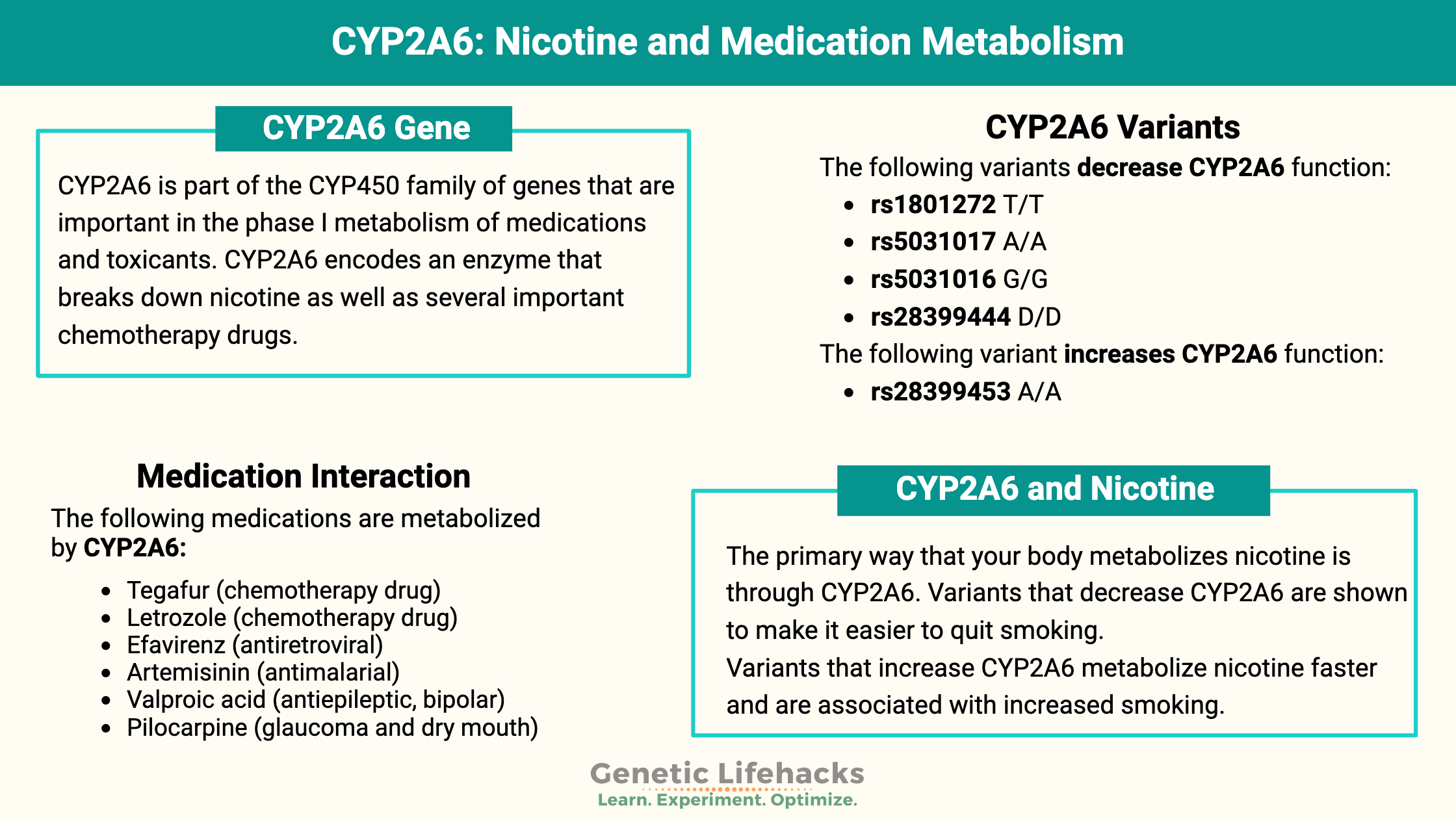
CYP2A6 is part of the CYP450 family of genes that are important in the phase I metabolism of medications and toxicants. Learn more about other detoxification genes here.

CYP2A6 is involved in the breakdown (metabolism) of:

  • Nicotine
  • Tegafur (chemotherapy drug)
  • Letrozole (chemotherapy drug)
  • Efavirenz (antiretroviral)
  • Artemisinin (antimalarial)
  • Valproic acid (antiepileptic, bipolar, migraine med)
  • Pilocarpine (glaucoma and dry mouth)

Note that some drugs are metabolized through more than one CYP enzyme, so CYP2A6 may not be the only enzyme involved.

Endogenous substances metabolized by CYP2A6:

The CYP2A6 enzyme does more than just metabolize nicotine and certain medications. It also interacts with substances made naturally in the body.

CYP2A6 enzyme also breaks down:[ref]

  • retinoic acid (from vitamin A)
  • some steroid compounds

Estradiol, a form of estrogen, causes higher CYP2A6 activity. Thus, women usually have a somewhat higher overall activity of this enzyme.[ref]

Nicotine metabolism:

While other enzymes can also break down nicotine, the primary way that your body metabolizes it (breaks it down) is through hepatic CYP2A6 (70–80%). Also important to note is that the major metabolite of nicotine, called cotinine, is exclusively metabolized by the CYP2A6 enzyme.[ref] So, the CYP2A6 enzyme is responsible for two steps in the body’s process of getting rid of nicotine.

Quitting Smoking:
When it comes to smoking, the CYP2A6 genetic variants impact the speed at which nicotine is metabolized.

Researchers link genetic variants of CYP2A6 that cause decreased enzyme activity with a lower level of dependence in smokers, making it easier for them to quit. Basically, the slower CYP2A6 variants make the effects of nicotine last longer, thus reducing the number of cigarettes smoked.

On the other hand, people with increased CYP2A6 enzyme activity have an enhanced metabolism of nicotine and are likely to smoke more cigarettes per day.[ref]


CYP2A6: Genotype Report

Members: Log in to see your data below.
Not a member? Join here.


Access this content:

An active subscription is required to access this content.

Join as a member


Lifehacks:

Grapefruit juice:

Grapefruit juice contains a substance that inhibits CYP2A6 enzyme activity. So be careful – especially if you have a slow variant of the gene – with combining grapefruit juice with any drug that is metabolized by CYP2A6.[ref]

Access this content:

An active subscription is required to access this content.

Join as a member


Related Articles and Topics:

CYP2C9: Genetic Variants and Drug Metabolism

Will statins give you muscle pain? SLCOB1 and ABCG2

CYP1A1: Detoxifying Cigarette Smoke and Estrogen


References:

Chan, Jeannine, et al. “Inactivation of CYP2A6 by the Dietary Phenylpropanoid Trans-Cinnamic Aldehyde (Cinnamaldehyde) and Estimation of Interactions with Nicotine and Letrozole.” Drug Metabolism and Disposition, vol. 44, no. 4, Apr. 2016, pp. 534–43. PubMed Central, https://doi.org/10.1124/dmd.115.067942.
Chenoweth, Meghan J., Jennifer O’Loughlin, et al. “CYP2A6 Slow Nicotine Metabolism Is Associated with Increased Quitting by Adolescent Smokers.” Pharmacogenetics and Genomics, vol. 23, no. 4, Apr. 2013, pp. 232–35. PubMed, https://doi.org/10.1097/FPC.0b013e32835f834d.
Chenoweth, Meghan J., Andy Z. X. Zhu, et al. “Variation in P450 Oxidoreductase (POR) A503V and Flavin-Containing Monooxygenase (FMO)-3 E158K Is Associated with Minor Alterations in Nicotine Metabolism, but Does Not Alter Cigarette Consumption.” Pharmacogenetics and Genomics, vol. 24, no. 3, Mar. 2014, pp. 172–76. PubMed, https://doi.org/10.1097/FPC.0000000000000031.
“ClinPGx.” ClinPGx, https://www.clinpgx.org/gene/PA121?tabType=tabVip. Accessed 17 Feb. 2026.
Desta, Z., et al. “Plasma Letrozole Concentrations in Postmenopausal Women With Breast Cancer Are Associated With CYP2A6 Genetic Variants, Body Mass Index, and Age.” Clinical Pharmacology and Therapeutics, vol. 90, no. 5, Nov. 2011, pp. 693–700. PubMed Central, https://doi.org/10.1038/clpt.2011.174.
Di, Yuan Ming, et al. “Structure, Function, Regulation and Polymorphism of Human Cytochrome P450 2A6.” Current Drug Metabolism, vol. 10, no. 7, Sept. 2009, pp. 754–80. PubMed, https://doi.org/10.2174/138920009789895507.
Hanley, Michael J., et al. “The Effect of Grapefruit Juice on Drug Disposition.” Expert Opinion on Drug Metabolism & Toxicology, vol. 7, no. 3, Mar. 2011, pp. 267–86. PubMed Central, https://doi.org/10.1517/17425255.2011.553189.
López-Flores, Luis A., et al. “Distribution of Polymorphic Variants of CYP2A6 and Their Involvement in Nicotine Addiction.” EXCLI Journal, vol. 16, Mar. 2017, pp. 174–96. PubMed Central, https://doi.org/10.17179/excli2016-847.
Malaiyandi, V., et al. “Impact of CYP2A6 Genotype on Pretreatment Smoking Behaviour and Nicotine Levels from and Usage of Nicotine Replacement Therapy.” Molecular Psychiatry, vol. 11, no. 4, Apr. 2006, pp. 400–09. PubMed, https://doi.org/10.1038/sj.mp.4001794.
Tanner, Julie-Anne, and Rachel F. Tyndale. “Variation in CYP2A6 Activity and Personalized Medicine.” Journal of Personalized Medicine, vol. 7, no. 4, Dec. 2017, p. 18. PubMed Central, https://doi.org/10.3390/jpm7040018.

About the Author:
Debbie Moon is a biologist, engineer, author, and the founder of Genetic Lifehacks where she has helped thousands of members understand how to apply genetics to their diet, lifestyle, and health decisions. With more than 10 years of experience translating complex genetic research into practical health strategies, Debbie holds a BS in engineering from Colorado School of Mines and an MSc in biological sciences from Clemson University. She combines an engineering mindset with a biological systems approach to explain how genetic differences impact your optimal health.