
Published:
Key takeaways:
- Are methylated B vitamins better? It depends on which B vitamin you mean, what outcome you care about, and whether a conversion step is actually your bottleneck.
- Methylfolate (L-5-MTHF) can raise blood folate efficiently and avoids unmetabolized folic acid. However, folic acid still has strong studies for preventing neural-tube defects in pregnancy, and people with common MTHFR variants can usually utilize low amounts of folic acid.
- Supplemental methylcobalamin (methylB2) gets the methyl group stripped off when it is moved into the cell. Then the coenzyme forms, methylB12 and hydroxyB12, are rebuilt when needed in the cell.
- Riboflavin (as FAD) is the built-in cofactor for MTHFR and may help with high homocysteine.
- The active form of B6, called P5P, may be a little better for people with specific variants, but for the most part, all forms of B6 can increase levels. Caution is needed with high doses.
Are Methylated B Vitamins Better?
If you’ve walked into a supplement aisle, or opened a DNA report from another company, and been told you “need methylated B vitamins” because of MTHFR, well, you’re not alone. The marketing story often says that some people can’t activate B vitamins, so they should buy the pre-activated bottle.
The honest answer, though, is that it depends.
- For folate (B9), the methylated form is methylfolate (also called L-5-methyltetrahydrofolate or 5-MTHF), and it has real pharmacokinetic advantages for some people and at specific doses. However, studies don’t show that it is automatically better for every outcome.
- For vitamin B12, methylated (methylcobalamin, methylB12) does not come into play with the methyl group for DNA or neurotransmitter methylation. All forms of B12 are converted to cobalamin inside the cell.
- For vitamin B6, people often say P5P when they are talking about the active form. Most people can convert the pyridoxal form to P5P, but there are a couple of genetic variants that can influence your ability to activate B6.
- For riboflavin (B2), the big picture for many MTHFR 677TT carriers is not that they need a methylated form of B2(that doesn’t exist). Instead, it’s that getting enough riboflavin is important so that MTHFR’s FAD cofactor is available.
Let’s dig into the biochemistry first, then the genetic variants and lifehacks.
Related deep dives on Genetic Lifehacks: MTHFR | Folic acid & DHFR | Vitamin B12 / MTR & MTRR | Riboflavin | Homocysteine | Methylation cycle
What “Methylated” Means on a Supplement Label
In biochemistry, methylation means attaching a one-carbon methyl group (−CH₃). In the methylation cycle, methyl groups are moved through folate- and B12-dependent enzymes in order to remethylate homocysteine to methionine. Methionine is utilized for synthesis of S-adenosylmethionine (SAMe), the cell’s primary methyl donor.
If you’re looking at a supplement bottle, “methylated B vitamins” usually means some mix of:
| Vitamin | Called “Methylated/active” | Common non-methylated or precursor form |
|---|---|---|
| Folate (B9) | L-5-MTHF, methylfolate, Metafolin®, Quatrefolic® | Food folates; folinic acid (5-formyl-THF), folic acid (synthetic) |
| B12 | Methylcobalamin | Hydroxocobalamin, adenosylcobalamin, or cyanocobalamin (synthetic) |
| B6 | Pyridoxal-5′-phosphate (P5P) – phosphorylated, not methylated | Pyridoxine HCl |
| B2 (Riboflavin) | Riboflavin-5′-phosphate (R5P, FMN) – not a methylated form | Riboflavin |
To be clear, P5P and FMN are not methylated vitamins. They’re phosphorylated coenzyme forms, so when you see them listed as part of “methylated B complex” it can be confusing.
Folate: Folic Acid vs Methylfolate (5-MTHF)
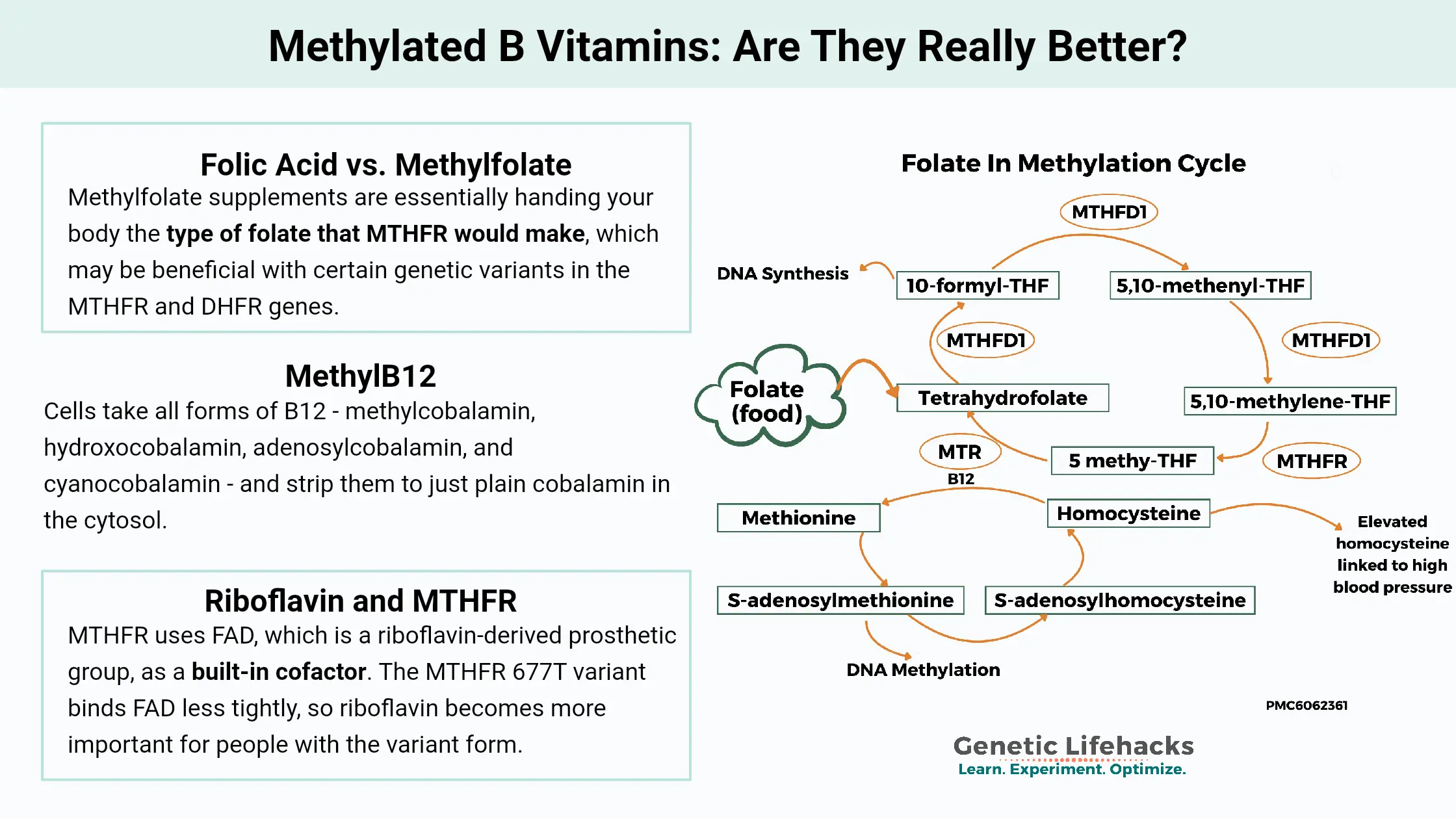
The folate pathway: Natural food folates and supplemental folic acid both have to be converted into tetrahydrofolate (THF) forms that the methylation cycle can use. The MTHFR (methylenetetrahydrofolate reductase) enzyme then helps produce 5-MTHF (methylfolate), which is the main circulating folate that donates a methyl group in the methionine synthase (MTR/MTRR) reaction—together with vitamin B12.
So methylfolate supplements are essentially handing your body the type of folate that MTHFR would make, which may be beneficial with certain genetic variants in the MTHFR and DHFR genes.
In some countries, including the US and Canada, foods made with wheat or white rice are usually fortified with folic acid, the synthetic form of folate. This policy has been in effect in the US since the mid 1990s.
What the trials actually show about bioavailability
Randomized trials comparing equimolar doses find that methylfolate often raises plasma folate faster and higher than folic acid – – regardless of MTHFR status. This also resulted in lower circulating unmetabolized folic acid with methylfolate supplements (study participants still got folic acid in fortified foods).[ref]
In a 24-week double-blind, randomized, placebo-controlled intervention trial in women of childbearing age, red blood cell folate levels rose more with methylfolate than with folic acid.[ref] Other trials show both forms lower homocysteine levels.[ref]
In a nutshell: Methylfolate is a good way to raise folate status, but studies don’t necessarily show it to be superior to folic acid for lowering homocysteine or for preventing birth defects.
Unmetabolized folic acid and DHFR capacity
Synthetic folic acid must be reduced by the dihydrofolate reductase (DHFR) enzyme. Human liver DHFR is surprisingly variable, so higher folic acid intakes can leave unmetabolized folic acid that can be detected in the bloodstream.[ref] Whether unmetabolized folic acid causes clinical harm at the levels seen from supplements and fortified foods is not entirely clear. Variants in the DHFR gene affect how likely you are to have circulating unmetabolized folic acid after supplementing with it (or eating it in fortified foods).
Related article: DHFR and folic acid supplementation.
MTHFR C677T: Lower function for the final step of methylfolate
The common MTHFR C677T variant (rs1801133) produces a thermolabile enzyme, meaning that the enzyme breaks down faster at normal body temperatures. People with one copy of the variant have a ~30-40% reduction in enzyme function, and those with two copies of the variant have about a 70% reduction in function. [ref] This reduction in enzyme function matters most when folate and riboflavin (B2) status is low. This causes homocysteine to tend to run higher and increases the risk for multiple chronic conditions, including heart disease.
A 2024 review of neural tube defect (NTD) prevention concludes that while methylfolate has several theoretical advantages (bypass of DHFR/MTHFR, less UMFA), only folic acid has current clinical outcome evidence for NTD prevention. Published trials have not looked at methylfolate for NTD.[ref] In idiopathic recurrent miscarriage, a randomized, controlled trial comparing 1 mg 5-MTHF (methylfolate) vs 1 mg folic acid found no significant difference in preventing miscarriage. However, serum folate rose more with 5-MTHF.[ref]
Folate can mask B12 deficiency anemia
High folate intake (any form) can correct the megaloblastic anemia of B12 deficiency, but this is while neurologic injury progresses. Checking your vitamin B12 status before high doses of folate is recommended by the NIH.[ref]
Your MTHFR genotype report (full article here):
MTHFR C677T:
Research & references
MTHFR A1298C:
Research & references
If your data shows the MTHFR C677T variant (or the combination of C677T plus A1298C), it makes it more important to make sure that you are getting sufficient folate – from food or supplements.
Other genes to also consider before supplementing with methylfolate: COMT
Be sure to also look at your COMT variants below for precautions about possible side effects with slow COMT and methylfolate. Some people report irritability, anxiety, or wired feelings when taking methylfolate due to slow COMT function. If this describes you, several alternatives are explained below.
How much folate is recommended?
The US RDA for folate is 400 mcg/day, and the recommended upper limit is 1,000 mcg/day DFE.
Folinic acid:
Folinic acid, also known as leucovorin, is a synthetic form of folate that can enter the folate cycle without needing reduction by dihydrofolate reductase (DHFR). Several clinical trials have shown that high-dose folinic acid can help to reduce autism symptoms, with a small study showing that children with MTHFR C677T or A1298C variants were more likely to benefit from folinic acid.[ref]
Vitamin B12 Supplements: Methylcobalamin vs Hydroxycobalamin or Adenosylcobalamin
This is where methylated B vitamins marketing can be confusing. There are four commonly available forms of vitamin B12: cyanocobalamin, methylcobalamin, hydroxycobalamin, and adenosylcobalamin. The word cobalamin is the technical term for B12, and it refers to the cobalt within the compound.
Note that the inexpensive cyanocobalamin form contains a cyanide molecule, which the body has to detoxify. For healthy individuals, it’s likely not a big problem to detoxify the tiny amount of cyanide in cyanocobalamin, but many prefer not to ingest cyanide at any level.
What your cells actually do with supplemental B12
A detailed 2017 review explains the way that cells use the different forms of vitamin B12, including methylcobalamin, adenosylcobalamin, hydroxocobalamin, and cyanocobalamin.[ref]
Key points from that review (and elsewhere) include that:
- All of the vitamin B12 forms are processed inside the cell to the cobalamin form.
- Cells then make the two coenzyme forms they need: Methylcobalamin, used in the methylation cycle for methionine synthase (MTR gene) in the cytosol, and Adenosylcobalamin, used for methylmalonyl-CoA mutase in mitochondria.
- The methyl group that arrives on supplemental methylcobalamin is cleaved and is not directly used as a methyl donor for your methylation reactions. Therefore, having an MTHFR variant does not create a special requirement for methylcobalamin compared to other forms of B12.
To be clear: Vitamin B12 is integral to the methylation cycle, and within the methylation cycle, the MTR and MTRR enzymes shuttle methylcobalamin. But it doesn’t matter whether the B12 came into the body in the form of methylcobalamin, hydroxycobalamin, or adenosylcobalamin, since they are all converted to cobalamin in the cytosol of the cell.[ref]
In addition, people with MTHFR C677T homozygous variants are more likely to have B12 deficiency. One study found that C677T homozygous individuals were 4-fold more likely to also have B12 deficiency, making it important to get plenty of B12 in any form.[ref]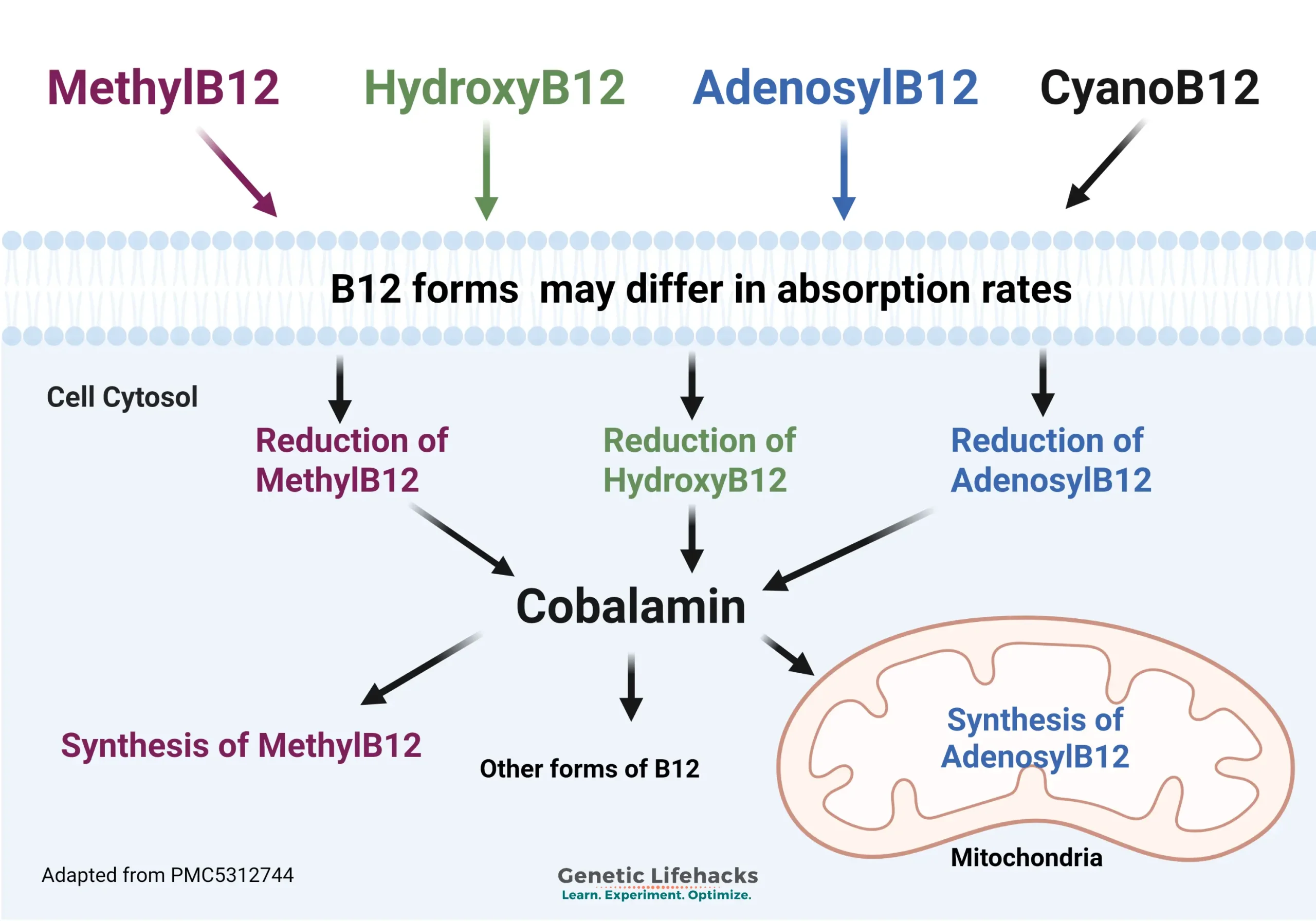
NIH’s professional fact sheet states that for healthy people: “No evidence indicates that absorption rates of vitamin B12 in supplements vary by form.”[ref]
So which form is best?
This is a question that honestly may have an answer of ‘any form’ works equally well for most healthy adults. Again, many people prefer to avoid cyanocobalamin because of the cyanide molecule in it, and a study in CKD patients on dialysis showed that hydroxocobalamin raised B12 levels better than cyanocobalamin. If you have a B12-related condition, such as pernicious anemia or lack of intrinsic factor, talk with your doctor. Often an injectable form may be used, and the ‘what’s best’ question may be more about what is available. Clinicians may also want to avoid cyanocobalamin with chronic kidney disease or certain hereditary eye disorders. For example, certain rare inherited conditions may require hydroxocobalamin. [ref][ref][ref]
| Form | Practical notes: |
|---|---|
| Cyanocobalamin | Stable, inexpensive, widely studied; body removes the cyanide (trace amounts). |
| Methylcobalamin | Bioidentical coenzyme form; useful and popular; does not uniquely donate methyl group to SAMe pathways from the supplement. |
| Hydroxocobalamin | Common injectable in many countries; useful clinically; preferred in some inherited cobalamin disorders at high parenteral doses. |
| Adenosylcobalamin | Mitochondrial coenzyme form; less clinical trial data as a solo oral supplement. |
Dietary vitamin B12 is only found in animal-based foods, like meat. Plant-based foods don’t contain B12, so vegans and vegetarians may need to consider supplementing. While B12 is a ‘water-soluble’ vitamin, this doesn’t mean that you need to ingest it constantly or lose it all immediately if you don’t take it. Your liver stores quite a bit of vitamin B12, and researchers estimate that a healthy person has three or more years’ worth stored. Vitamin B12 is essential in the production of red blood cells, and anemia can occur without it.[ref]
Access this content:
An active subscription is required to access this content.
Log in below or Join as a member.
How much B12 is recommended?
The RDA for vitamin B12 is 2.4 mcg per day. However, it can be hard to know how much your body is getting from diet and supplements, especially in aging or with malabsorption disorders. Intrinsic factor production often decreases with aging. For older adults, especially if their diet is limited, supplemental B12 is usually recommended.[ref]
Vitamin B6: Pyridoxine vs P5P
Vitamin B6 comes in two forms: Pyridoxal-5′-phosphate and pyridoxine HCL. Pyridoxal-5′-phosphate (P5P) is the main coenzyme form of B6, and supplements will usually label P5P as the “active” alternative to pyridoxine HCl.
Oral P5P can be dephosphorylated in the gut and then reconverted in tissues, so the P5P form doesn’t necessarily make it straight into every cell.
However, high-dose pyridoxine is the form that is most clearly tied to an increased risk of peripheral neuropathy with long-term high-dose use. This is something that is a little more nebulous in research studies, with not a lot of research clearly showing that P5P is clinically safer (or more effective) than a moderate dose of pyridoxine for most users.[ref ][ref]
Which form is best?
The PNPO gene is responsible for converting pyridoxine into the active P5P version. If you have PNPO variants below, you may find that P5P is the better supplement form. This is more theoretical than proven in human trials, though.
Access this content:
An active subscription is required to access this content.
Log in below or Join as a member.
How much is recommended for vitamin B6?
The US RDA for vitamin B6 is 1.3 to 1.7 mg/day for adults. Adults over 50 may need more B6 (1.7mg/day).[ref] The recommended upper limit of B6 is 50-100 mg/day in the US and Australia, but the EFSA in Europe has recently changed the upper limit to 12.5 mg/day out of concerns about neuropathy with longer-term use of supplemental B6. [ref]
Riboflavin (B2): Important for MTHFR
The MTHFR enzyme uses FAD, which is a riboflavin-derived prosthetic group, as a built-in cofactor. The MTHFR 677T variant binds the FAD cofactor less tightly, so having sufficient riboflavin becomes more important for people with the variant.
Clinical trials show that:
- Riboflavin lowered homocysteine specifically in MTHFR 677TT individuals.[ref]
- Riboflavin lowered blood pressure in heart disease patients with the TT genotype.ref
- In treated high blood pressure in people with 677TT, riboflavin further improved blood pressure.[ref]
Everyone needs riboflavin, since it is used in every cell for energy production as well as for MTHFR and other enzymes. Genetic variants may show whether someone is more likely to be susceptible to problems with marginal riboflavin intake. In other words, some people may be fine with just the minimum for riboflavin, but others, such as people with variant in the genes below, may find it beneficial to supplement periodically.
Access this content:
An active subscription is required to access this content.
Log in below or Join as a member.
How much riboflavin?
The US RDA is 1.3 mg/day for men and 1/1mg/day for women, and the majority of people eating a varied diet are estimated to meet this level. Riboflavin is found in dairy products, eggs, liver, enriched flour, and in minor amounts in other foods. There is no upper limit set for riboflavin, and clinical trials for migraines use 200 – 400 mg/day. Excess riboflavin will be eliminated in the urine (and it will be very neon yellow).
Overmethylation, Anxiety, and Who Doesn’t Need Methylated Forms
“Methylated B vitamins overmethylate me” and slow COM
Some people feel jittery, anxious, insomnia-prone, or irritable (angry) after starting methylfolate or a high-dose methylated B complex. This is something that doesn’t have a lot of randomized, placebo-controlled trials backing it up, but it is reported by many people and shouldn’t be dismissed.
The slow COMT genotype, rs4680 Met/Met (A/A below), can fairly reliably predict who is likely to feel good and then swing to irritable or anxious with methylfolate. This may be due to more catecholamine neurotransmitter synthesis supported by folate pathways, while at the same time the slow COMT ends up metabolizing dopamine and adrenaline less quickly. Or it may be direct methyl-donor overload.
Access this content:
An active subscription is required to access this content.
Log in below or Join as a member.
The practical approach here is that if you feel worse or your family and friends notice your irritability after starting methylfolate, consider stopping (or talk to your doctor if you are under a doctor’s orders).
Alternative ways to support your methylation cycle that avoid the big influx of methyl donors with methylfolate supplementation:
- Supplemental creatine. About 40% of methyl groups go toward creatine synthesis, and supplementing with creatine can take the strain off the methylation cycle (and lower homocysteine, according to studies). Read more about creatine here.
- Increase your intake of folate-rich foods. Legumes, leafy greens, and liver are excellent folate sources.
- Folinic acid may work for you, but going slow to start may be a good idea.
- Increase the amount of choline that you get in your diet, such as through eating eggs or other choline-rich foods.
Start low, go slow. If you don’t have slow COMT and you still notice jitteriness or even headaches from B vitamins, consider starting with a very low dose. So many supplements on the market today are pushing large doses of B vitamins. The RDA for folate is 400 mcg/day DFE (dietary folate equivalent). You may find that a methylfolate supplement with 200 mcg or less is a better fit, supplying a more appropriate dose alongside dietary folate.
Do you even need to supplement?
If you have an adequate diet, normal labs, and no pregnancy or fortification special case, then you may not need to supplement with B vitamins. Leafy greens, legumes, liver, eggs, dairy, meat/fish (B12), and even some fortified foods meet the dietary needs for the majority of people.
For most healthy people, just because you have a genetic variant, such as MTHFR, doesn’t mean that you need to take a daily folate supplement for the rest of your life. Talk with your doctor if you have questions about what is right for you. If you’re supplementing because you have fatigue or brain fog, be sure to talk with your doctor and check your iron, thyroid, B12/folate levels, sleep apnea, etc. There are a lot of reasons for fatigue and brain fog, so be sure to rule out serious issues before just assuming it is a vitamin deficiency.
How long are B vitamins stored in the body?
B vitamins are water-soluble, which can lead to the conclusion that they are washed out of the body every day. There’s a common saying about taking vitamins as being just a way to have expensive urine, and that adds to the confusion here.
Studies show that you store quite a bit of folate, B12, B6, and riboflavin in the body. This makes sense — our ancestors had to survive long periods without fresh vegetables in the winter and often went without meat for a time between hunts.
Folate: Your body stores folate (primarily in the liver), and it takes 4 months to a year to completely deplete your folate stores to the point of anemia. After being folate deficient, it can take several months to fully replete your stores.[ref]
Vitamin B12: Your liver stores up quite a bit of B12. It takes about 2-4 years on a vegan diet, which lacks B12 completely, for a healthy adult to become severely B12 deficient and develop anemia. However, symptoms of B12 deficiency can start much sooner than that. [ref]
Vitamin B6: The half-life of B6 in the body is estimated to be around 25 days. Mild vitamin B6 deficiency can occur within weeks to a few months, without adequate intake. Animal studies show that B6 is mainly stored in the skeletal muscles.[ref][ref]
Riboflavin (B2): Unlike the prior B vitamins, riboflavin is not stored in large amounts and theoretically can be depleted in a matter of days. The good news is that riboflavin is found in a wide variety of foods and is also produced in small amounts in the gut microbiome.[ref][ref]
Is increasing dietary folate enough with MTHFR C677T?
Yes, according to several studies. For example, a recent study showed that simply increasing folate-rich foods reduced homocysteine levels and inflammatory markers in women with the MTHFR C677T variant.[ref]
Related Articles
- MTHFR Gene Explained: C677T/A1298C deep dive and solutions
- DHFR and MTHFR: Folic Acid Metabolism: folic acid conversion genetics
- Vitamin B12, MTR & MTRR: B12 status genetics
- MTR and MTRR Genes: methionine synthase pair
- Riboflavin (Vitamin B2), MTHFR: FAD cofactor and Ulster-style interventions
- Homocysteine: marker that ties folate/B12/B6/B2 together
- COMT and Supplement Interactions: methyl donors and catecholamines
- FUT2 Secretor Status: why serum B12 can look high
- FOLR1 and FOLR2: getting folate into cells
- Methylation Cycle: pathway map
- Vitamins & Minerals hub: category index
References:
Alsabah, Almaha, et al. “Investigating Factors Involved in Post Laparoscopic Sleeve Gastrectomy (LSG) Neuropathy.” Obesity Surgery, vol. 27, no. 5, May 2017, pp. 1271–1276. PubMed, https://doi.org/10.1007/s11695-016-2466-8.
Bailey, Steven W., and June E. Ayling. “The Extremely Slow and Variable Activity of Dihydrofolate Reductase in Human Liver and Its Implications for High Folic Acid Intake.” Proceedings of the National Academy of Sciences of the United States of America, vol. 106, no. 36, Aug. 2009, pp. 15424–9. PubMed Central, https://doi.org/10.1073/pnas.0902072106.
Dricot, Caroline E. M. K., et al. “Riboflavin for Women’s Health and Emerging Microbiome Strategies.” NPJ Biofilms and Microbiomes, vol. 10, no. 1, Oct. 2024, p. 107. PubMed Central, https://doi.org/10.1038/s41522-024-00579-5.
Fohr, Iris P., et al. “5,10-Methylenetetrahydrofolate Reductase Genotype Determines the Plasma Homocysteine-Lowering Effect of Supplementation with 5-methyltetrahydrofolate or Folic Acid in Healthy Young Women.” The American Journal of Clinical Nutrition, vol. 75, no. 2, Feb. 2002, pp. 275–82. PubMed, https://doi.org/10.1093/ajcn/75.2.275.
Frosst, P., et al. “A Candidate Genetic Risk Factor for Vascular Disease: A Common Mutation in Methylenetetrahydrofolate Reductase.” Nature Genetics, vol. 10, no. 1, May 1995, pp. 111–3. PubMed, https://doi.org/10.1038/ng0595-111.
Golding, Paul Henry. “Severe Experimental Folate Deficiency in a Human Subject – a Longitudinal Study of Biochemical and Haematological Responses as Megaloblastic Anaemia Develops.” SpringerPlus, vol. 3, Sept. 2014, p. 442. PubMed Central, https://doi.org/10.1186/2193-1801-3-442.
Hekmatdoost, Azita, et al. “Methyltetrahydrofolate vs Folic Acid Supplementation in Idiopathic Recurrent Miscarriage with Respect to Methylenetetrahydrofolate Reductase C677T and A1298C Polymorphisms: A Randomized Controlled Trial.” PloS One, vol. 10, no. 12, Dec. 2015, p. e0143569. PubMed Central, https://doi.org/10.1371/journal.pone.0143569.
Hemminger A, Wills BK. Vitamin B6 Toxicity. [Updated 2023 Feb 7]. In: StatPearls [Internet]. Treasure Island (FL): StatPearls Publishing; 2023 Jan-. Available from: https://www.ncbi.nlm.nih.gov/books/NBK554500/
Hoffer L, Djahangirian O, Bourgouin P … Comparative effects of hydroxocobalamin and cyanocobalamin on plasma homocysteine concentrations in end-stage renal disease Metabolism – Clinical and Experimental, 54, 1362-1367
Horigan, Geraldine, et al. “Riboflavin Lowers Blood Pressure in Cardiovascular Disease Patients Homozygous for the 677C–>T Polymorphism in MTHFR.” Journal of Hypertension, vol. 28, no. 3, Mar. 2010, pp. 478–86. PubMed, https://doi.org/10.1097/HJH.0b013e328334c126.
Institute of Medicine (US) Standing Committee on the Scientific Evaluation of Dietary Reference Intakes and its Panel on Folate, Other B Vitamins, and Choline. Dietary Reference Intakes for Thiamin, Riboflavin, Niacin, Vitamin B6, Folate, Vitamin B12, Pantothenic Acid, Biotin, and Choline. Washington (DC): National Academies Press (US); 1998. 7, Vitamin B6. Available from: https://www.ncbi.nlm.nih.gov/books/NBK114313/
Lamers, Yvonne, et al. “Red Blood Cell Folate Concentrations Increase More After Supplementation with [6S]-5-methyltetrahydrofolate than with Folic Acid in Women of Childbearing Age.” The American Journal of Clinical Nutrition, vol. 84, no. 1, July 2006, pp. 156–61. PubMed, https://doi.org/10.1093/ajcn/84.1.156.
Lisboa, Jéssica Vanessa de Carvalho, et al. “Food Intervention with Folate Reduces TNF-α and Interleukin Levels in Overweight and Obese Women with theC677T Polymorphism: A Randomized Trial.” Nutrients, vol. 12, no. 2, Jan. 2020. PubMed Central, https://doi.org/10.3390/nu12020361.
McNulty, Helene, et al. “Riboflavin Lowers Homocysteine in Individuals Homozygous for the MTHFR 677C->T Polymorphism.” Circulation, vol. 113, no. 1, Dec. 2005, pp. 74–80. PubMed, https://doi.org/10.1161/CIRCULATIONAHA.105.580332.
Obeid, Rima, et al. “Cobalamin Coenzyme Forms Are Not Likely to Be Superior to Cyano- and Hydroxyl-Cobalamin in Prevention or Treatment of Cobalamin Deficiency.” Molecular Nutrition & Food Research, vol. 59, no. 7, May 2015, pp. 1364–72. PubMed Central, https://doi.org/10.1002/mnfr.201500019.
Orhan Kiliç, Betül, et al. “Sublingual Methylcobalamin Treatment Is as Effective as Intramuscular and Peroral Cyanocobalamin in Children Age 0-3 Years.” Hematology (Amsterdam, Netherlands), vol. 26, no. 1, Dec. 2021, pp. 1013–1017. PubMed, https://doi.org/10.1080/16078454.2021.2010877.
Paul, Cristiana, and David M. Brady. “Comparative Bioavailability and Utilization of Particular Forms of BSupplements with Potential to Mitigate B-Related Genetic Polymorphisms.” Integrative Medicine (Encinitas, Calif.), vol. 16, no. 1, Feb. 2017, pp. 42–49. PubMed Central, https://pubmed.ncbi.nlm.nih.gov/28223907/.
Powers, Hilary J. “Riboflavin (Vitamin B-2) and Health.” The American Journal of Clinical Nutrition, vol. 77, no. 6, June 2003, pp. 1352–60. PubMed, https://doi.org/10.1093/ajcn/77.6.1352.
Prinz-Langenohl, R., et al. “[6S]-5-methyltetrahydrofolate Increases Plasma Folate More Effectively than Folic Acid in Women with the Homozygous or Wild-Type 677C–>T Polymorphism of Methylenetetrahydrofolate Reductase.” British Journal of Pharmacology, vol. 158, no. 8, Dec. 2009, pp. 2014–21. PubMed Central, https://doi.org/10.1111/j.1476-5381.2009.00492.x.
Samaniego-Vaesken, María de Lourdes, et al. “Supplementation with Folic Acid or 5-Methyltetrahydrofolate and Prevention of Neural Tube Defects: An Evidence-Based Narrative Review.” Nutrients, vol. 16, no. 18, Sept. 2024. PubMed Central, https://doi.org/10.3390/nu16183154.
Sobczyńska-Malefora, Agata, et al. “Vitamin Bstatus in Health and Disease: A Critical Review. Diagnosis of Deficiency and Insufficiency – Clinical and Laboratory Pitfalls.” Critical Reviews in Clinical Laboratory Sciences, vol. 58, no. 6, Apr. 2021, pp. 399–429. PubMed, https://doi.org/10.1080/10408363.2021.1885339.
“Vitamin B12 Deficiency – Nutrition.” Merck Manual Consumer Version, https://www.merckmanuals.com/home/disorders-of-nutrition/vitamins/vitamin-b12-deficiency. Accessed 10 Nov. 2026.
“Vitamin B12 or Folate Deficiency Anaemia Symptoms and Treatments.” NHS Inform, https://www.nhsinform.scot/illnesses-and-conditions/nutritional/vitamin-b12-deficiency/. Accessed 10 Nov. 2026.
Yue Zhao, Xiaoli Liu, Rubing Li, Han Xiao, Tianyu Zhao, Vitamin B6 nutrition, metabolism, and the relationship of diseases: current concepts and future research, Journal of Future Foods, Volume 6, Issue 5, 2026, Pages 765-779, ISSN 2772-5669, https://doi.org/10.1016/j.jfutfo.2024.12.007
Zhang, Caiyun, et al. “Safety and Efficacy of High-Dose Folinic Acid in Children with Autism: The Impact of Folate Metabolism Gene Polymorphisms.” Nutrients, vol. 17, no. 9, May 2025. PubMed Central, https://doi.org/10.3390/nu17091602.
Zittan, E., et al. “High Frequency of Vitamin B12 Deficiency in Asymptomatic Individuals Homozygous to MTHFR C677T Mutation Is Associated with Endothelial Dysfunction and Homocysteinemia.” American Journal of Physiology. Heart and Circulatory Physiology, vol. 293, no. 1, Apr. 2007, pp. H860–5. PubMed, https://doi.org/10.1152/ajpheart.01189.2006.