
Key takeaways:
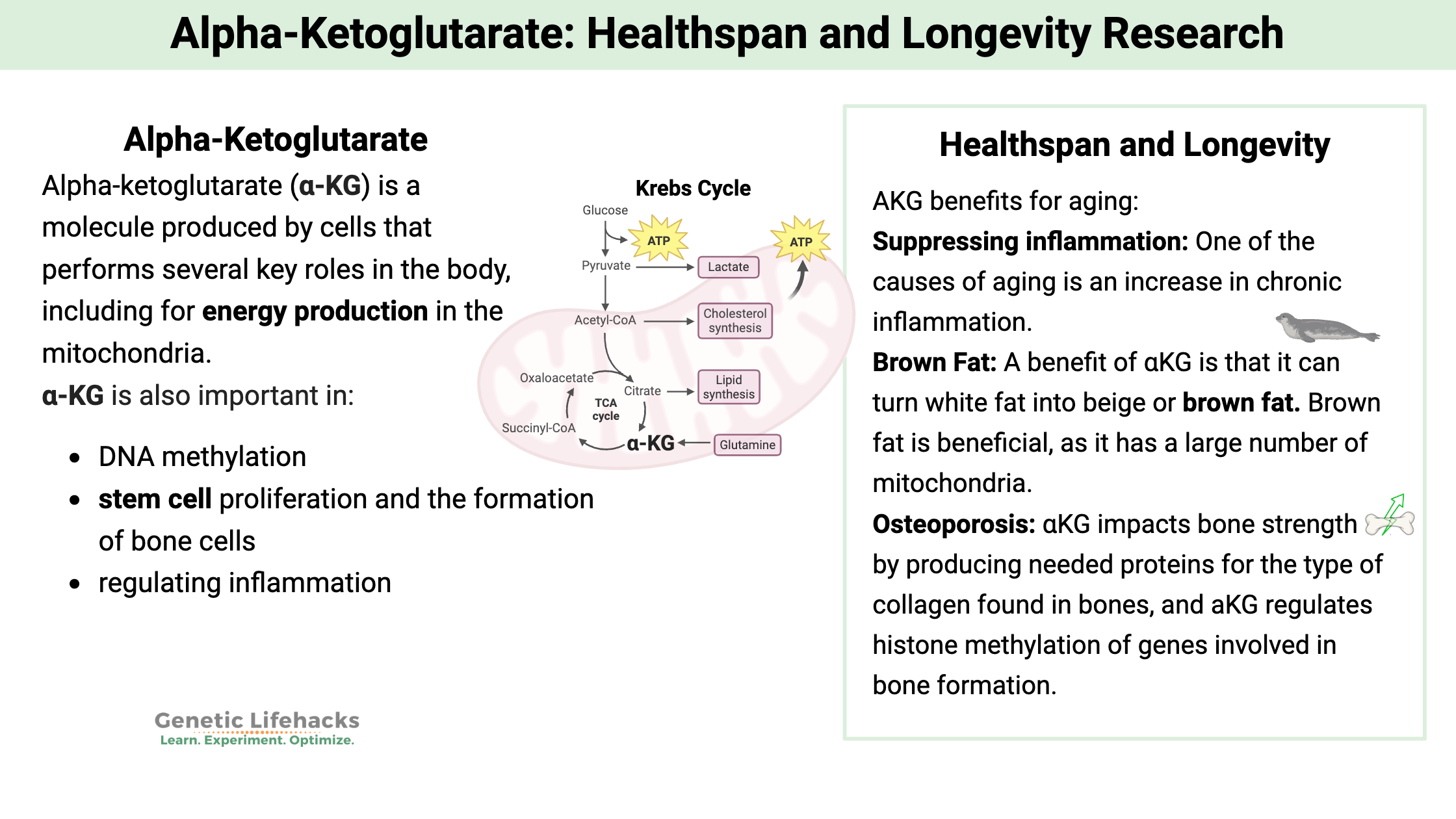
- Alpha-ketoglutarate (αKG) plays an important role in energy production, epigenetic regulation, stem cell proliferation, and inflammation regulation.
- Energy, inflammation, and cell renewal are essential for avoiding age-related diseases.
- Levels of alpha-ketoglutarate decline in aging.
- Supplemental alpha-ketoglutarate studies show intriguing results for improving healthspan.
What is alpha-ketoglutarate (AKG)?
Alpha-ketoglutarate (abbreviated AKG or αKG) is a molecule produced by all of your cells. It has several key roles in the body, including:[ref]
- It is involved in the Krebs cycle for energy production in the mitochondria
- αKG is important in the epigenetic regulation of the production of other molecules in the cells
- It is involved in stem cell proliferation and the formation of bone cells
- αKG is important in regulating inflammation
These factors are essential for avoiding age-related diseases.
Notably, αKG (alpha-ketoglutarate) levels are decreased in aging. In fact, there is a 10-fold decrease in αKG between ages 40 and 80.[ref]
Let’s look at why AKG is so important for your cellular health, and then at clinical trials on supplemental alpha-ketoglutarate.
ΑKG in Energy Production via the Krebs Cycle:
The Krebs cycle is part of the process that creates cellular energy in the mitochondria.
Quick background: Mitochondria are organelles within cells that produce ATP from either sugar or fats. Depending on the cell’s energy needs, there can be hundreds to thousands of mitochondria. ATP (adenosine triphosphate) is the molecule that stores energy. Its bonds can be easily broken to release energy when and where it is needed in cells. Without ATP, there is no energy and, thus, no life.
Important to note is that the alpha-ketoglutarate produced in the Krebs cycle can be used for ATP production – or – it can cross out of the mitochondria and be used for other purposes. For example, cells can use alpha-ketoglutarate to create glutamine, which can then be used as a neurotransmitter.[ref]
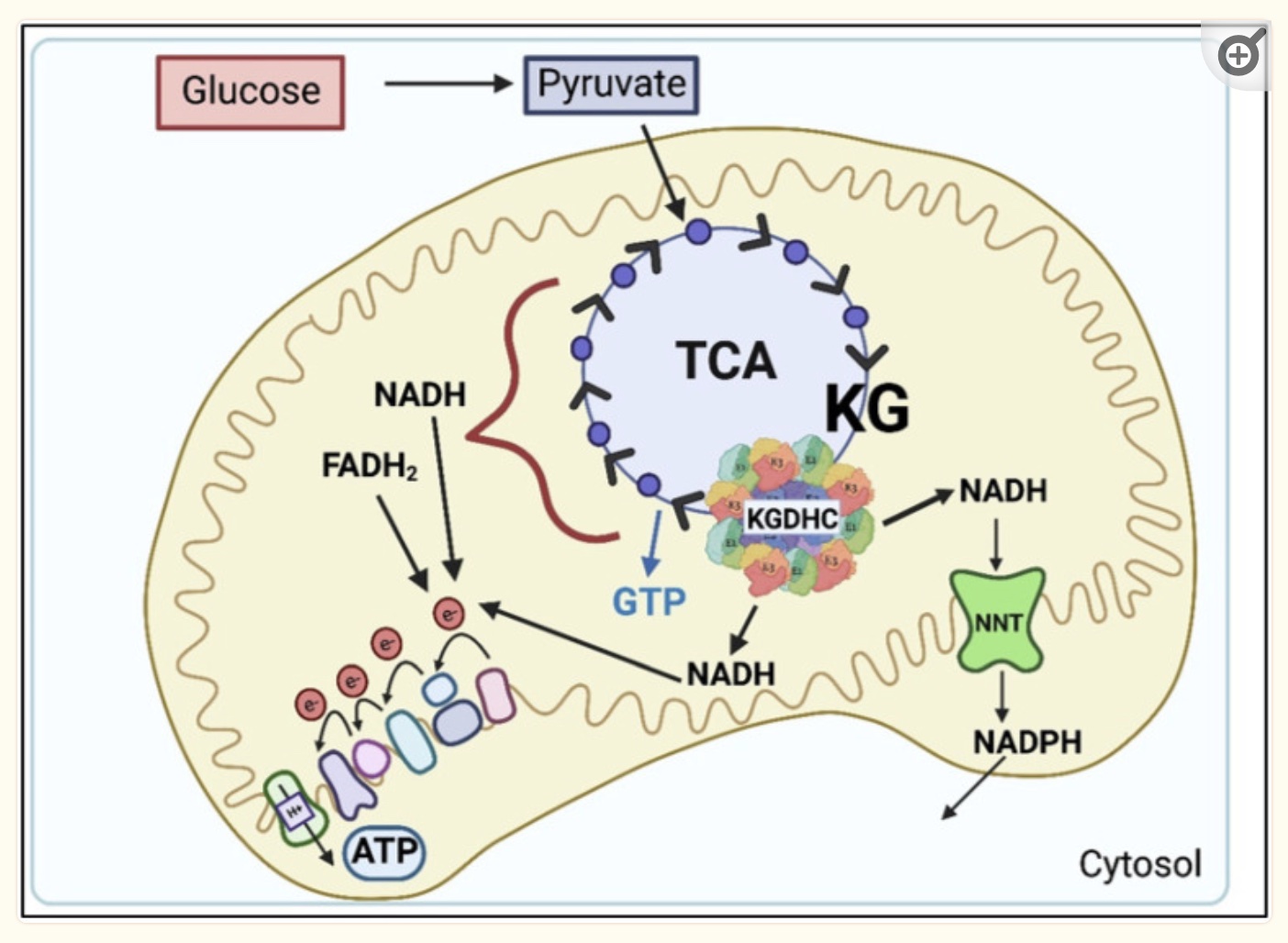 Image from: https://www.ncbi.nlm.nih.gov/pmc/articles/PMC9603878/
When alpha-ketoglutarate is limited, there is a tradeoff between using it for energy production and other cellular purposes.
Epigenetics: Alpha-ketoglutarate and DNA methylation
In studies of people over age 100, researchers find that centenarians have differences in their DNA methylation, which is one of the ways that cells can turn genes off or on. To reduce oxidative damage, the processes that need to be kept active in aging are sirtuins, DNA repair enzymes, insulin signaling pathways, FOXO genes, telomere extension, and cellular antioxidants.
Alpha-ketoglutarate levels directly affect the transcription of FOXO genes. This is the same pathway that calorie restriction affects to extend lifespan. Additionally, αKG is a cofactor for DNA and histone demethylation enzymes.[ref]
Genetic variants that affect AKG levels:
I wanted to take a moment here to explain that there aren’t any common genetic variants, or SNPs, that affect AKG levels significantly. AKG is essential for life due to its integral role in ATP production, and variants that affect AKG levels aren’t tolerated. Rare mutations in the OGDHL gene that cause partial alpha-ketoglutarate dehydrogenase deficiency are diagnosed in infancy. [ref]
Studies on alpha-ketoglutarate
OK, so αKG is vital for cellular energy production – and – it is necessary for DNA methylation regulation. Additionally, αKG levels decrease as we age.
What happens if we correct the decrease in αKG that naturally occurs with aging?
Researchers have looked into the effects of supplementing with alpha-ketoglutarate:
Supplemental alpha-ketoglutarate increases lifespan in animals, such as mice and worms. Researchers using C. elegans (a worm used in research) found that increasing αKG extended the animal’s lifespan.[ref]
A recent study in mice revealed that alpha-ketoglutarate extended lifespan by approximately 10%. Even more importantly, it significantly improved healthspan. Healthspan is the years that you remain healthy in aging. The last few years of life are often plagued with frailty, dementia, and severe chronic disease — healthspan is the time during aging when someone remains healthy. The trial showed that the mice had less time when they were frail or had diseases of aging at the end of life.[ref]
In patients with melanoma, immunotherapy promotes T cells to attack the cancer. However, T cell exhaustion due to checkpoints, such as PD-1, can limit the effectiveness. A recent study showed that alpha-ketoglutarate can help checkpoint inhibitors function more effectively in melanoma.[ref]
How does alpha-ketoglutarate increase healthspan?
Supplementing with αKG, starting at mid-life and beyond, may increase energy production in the mitochondria and positively impact DNA methylation.
- Animal research shows αKG supplementation prevents the increase in cytokine levels that are normally associated with aging in female mice.[ref]
- αKG reduces the senescent cell inflammatory signaling, which is the problem with cellular senescence in aging.
- Supplemental αKG induces the browning of fat in mice.
- A positive effect on macrophages and shifting towards an anti-inflammatory type was noted with αKG.
- Giving female animals αKG during their reproductive years preserves ovarian function.
Here is some of the research detailing the AKG benefits:
Suppressing inflammation:
One of the causes of aging is an increase in chronic inflammation. Research on αKG in mice showed that female T-cells produce higher IL-10 (an anti-inflammatory molecule) with supplementation. The researchers theorize this could be a primary factor in reducing animal frailty.[ref]
Reducing senescent phenotypes:
αKG may not eliminate senescent cells, but it reduces inflammation, a common side effect of cellular senescence.[ref]
Brain health, memory, and mood:
One recent finding about alpha-ketoglutarate is its role as an “exercise factor” — a molecule released into the bloodstream during physical activity that carries some of the brain benefits of exercise.
It’s well established that exercise improves memory and helps protect against depression. Researchers have been identifying the specific molecules, called exerkines or exercise factors, that circulate in the blood after a workout and act on the brain. A 2025 study found alpha-ketoglutarate as one of these key exercise factors. In mice, exercise increases AKG and boosts learning and memory. Giving sedentary mice supplemental AKG without exercise showed the same cognitive benefits.[ref]
Brown fat increases, burning more fat for energy:
One reason for increased inflammation in aging is alterations to adipocytes (fat tissue). With age, fat cell turnover decreases, and existing fat cells become less functional and release inflammatory cytokines.[ref]
A benefit of αKG is that it can turn white fat into beige or brown fat. Brown fat is beneficial, as it has a large number of mitochondria, which give it a brown color under a microscope. These mitochondria produce heat, helping to burn off excess fat.
Mouse studies show that increasing αKG through supplementation increases the “beige-ing” or browning of fat.[ref] In aging, DNA methylation is involved in the reduction of brown fat. Thus, αKG may be impacting fat storage, energy production, and inflammation via the positive methylation changes.
Macrophages and inflammation:
Macrophages are a type of cell that is part of the immune system. They can be either pro-inflammatory (M1) or anti-inflammatory (M2). Higher levels of inflammatory cytokines, such as TNF-alpha or interferon-gamma, cause macrophages to become M1 (inflammatory). On the other hand, higher levels of alpha-ketoglutarate promote the M2 anti-inflammatory type of macrophage.[ref]
Reproductive years extended:
Animal research indicates that αKG extends the animals’ fertility period. This is due to αKG’s ability to prevent telomeres from shortening in the ovaries.[ref]
Why would this be important in aging? For women, many of the deleterious effects of aging occur with the decrease in estrogen after menopause. Extending reproductive years, therefore, extends the period of higher estrogen production.
Alzheimer’s (in mice):
Animal models of Alzheimer’s show that supplementation of calcium alpha-ketoglutarate helps to rescue the synaptic dysfunction in the brain from Alzheimer’s.[ref]
Osteoporosis and alpha-ketoglutarate:
αKG promotes bone development in animal studies and in a study of postmenopausal women. One way that αKG impacts bone strength is by producing needed proteins for the type of collagen found in bones. Another way is via regulating histone methylation of genes involved in bone formation.[ref]
In dental implants, regenerating the bone is important before the implant is placed. A study (in mice) showed that alpha-ketoglutarate helped to promote bone regrowth for dental implants in mice with osteoporosis. [ref]
Osteoarthritis:
While αKG’s benefits for bone density have been studied for some time, recent research (2024-2025) has uncovered a promising role for alpha-ketoglutarate in osteoarthritis. Osteoarthritis involves the breakdown of cartilage in joints, and is closely linked to the chronic inflammation and oxidative stress that increase with age — the same processes that αKG helps regulate elsewhere in the body.
A 2024 study identified α-ketoglutarate as a key metabolite associated with joint health. The researchers demonstrated that αKG significantly reduced cartilage cell damage, decreased reactive oxygen species (ROS) and markers of oxidative damage, and increased protective antioxidant levels.[ref]
A 2025 review identified multiple mechanisms through which AKG may protect joints by promoting autophagy, modulating the gut microbiota, reducing cellular senescence in joint tissues, and inhibiting ferroptosis.[ref][ref]
Human clinical trials on alpha-ketoglutarate supplements
While the animal research referenced above is excellent for finding an effect on longevity in short-lived animals, it doesn’t always correlate to the same effect in humans. And honestly, who cares if mice live longer…
Here’s what the human clinical trials show:
Male athletes training with low oxygen, such as at high altitudes, were given alpha-ketoglutarate as a supplement. The supplement did not affect athletic performance, but it did increase blood oxygen levels.[ref]
Male athletes aged 30-50 were given three doses of arginine alpha-ketoglutarate supplement per day, totaling 12 g/day. The results showed an improvement in certain exercises, such as the bench press. Notably, it was well-tolerated and safe.[ref]
In a study looking at aging biomarkers such as DNA methylation, researchers found that alpha-ketoglutarate rolled back the biological age clock by an average of 8 years. The study was conducted on 42 adults with an average age of 64. They took an alpha-ketoglutarate supplement for about seven months. The biological age at baseline averaged 61, and after seven months, biological age tests averaged 53.[ref] This is one study I would love to see replicated with a placebo control group.
A double-blind, placebo-controlled clinical trial, called ABLE, is
Supplementing with αKG
The first question on a supplement is always, “Is it safe?” Talk to your doctor if you have medical questions, but the FDA considers alpha-ketoglutarate as “GRAS” or generally regarded as safe.
When considering supplements for longevity, I always consider whether they can promote cancer growth. Alpha-ketoglutarate has several anti-cancer properties, such as blocking the formation of new blood vessels for tumors.[ref]
αKG is not readily available in the diet, at least not at significant levels. Thus, the effects seen in clinical trials are at levels found in supplements.
Types and dosing:
One confusing thing about shopping for an alpha-ketoglutarate supplement is that it comes in several different forms. Bioavailability of AKG is limited, so the form may matter.
Calcium alpha-ketoglutarate (Ca-AKG) is the form used in longevity research. It’s the form in the Rejuvant study that showed an average 8-year reduction in biological age, the form used in the ongoing ABLE placebo-controlled trial (1 g/day sustained-release).[ref] It’s also the form used in the Chinese RCT evaluating effects on PhenoAge and bone density (2 g/day).[ref]
The calcium salt form is thought to improve the stability and absorption of AKG compared to free alpha-ketoglutaric acid.[ref] Note that most of the available Ca-AKG supplements aren’t sustained release, like those used in the aging trials.
Arginine plus alpha-ketoglutarate (AAKG) is the form found for bodybuilding and sports nutrition supplements. It is available in powdered form, which is more cost-effective for larger doses. Arginine increases nitric oxide levels, potentially enhancing workouts (though research is limited). It has a mild flavor and mixes easily into drinks or smoothies. AAKG combines AKG with the amino acid L-arginine in a salt form.
AAKG is typically dosed much higher than Ca-AKG — in the range of 3–12 g/day in studies. For example, an 8-week randomized, double-blind, placebo-controlled study in trained men taking 12 g/day of AAKG found significant improvements in bench press and peak power compared to placebo.[ref]
Ornithine alpha-ketoglutarate (OKG) is a salt formed of two molecules of the amino acid ornithine and one molecule of alpha-ketoglutarate. OKG is studied almost entirely in the context of wound healing, burn recovery, and surgery rehabilitation. For example, in a double-blind RCT of 47 severe burn patients, OKG supplementation (20 g/day) significantly shortened wound healing time.[ref]
Diet and drugs that increase αKG
There are a few diet and lifestyle hacks that can increase your endogenous production of alpha-ketoglutarate:
- Ketogenic diet increases AKG [ref]
- Metformin, a commonly used diabetes drug, increases alpha-ketoglutarate in clinical trials[ref]
Side effects of αKG, supplement interactions
Blood pressure reduction:
Supplements that contain arginine plus αKG may decrease your blood pressure. Be sure to check the interaction with blood pressure medications. Be sure to also check for interactions with blood thinners, erectile dysfunction, nitrates, anticoagulants, and diabetes medications.
Related Articles and Topics:
Nicotinamide Riboside and NMN: Boosting NAD+ in Aging with Supplements
Nicotinamide Riboside and NMN: Boosting NAD+ in Aging with Supplements
References:
α-Ketoglutarate Attenuates Oxidative Stress-Induced Neuronal Aging via Modulation of the mTOR Pathway. Nutrients, 2025. PubMed Central, PMC12388979.