
Join Here   |   Log In

CYP1A1: Detoxifying Cigarette Smoke and Estrogen

Key takeaways:
~ The CYP1A1 enzyme metabolizes several toxins as well as naturally produced hormones.
~ It is also involved in the immune response in the intestines.
~ CYP1A1 genetic variants impact your detoxification of certain substances.


Members will see their genotype report below, plus additional solutions in the Lifehacks section. Join today 

CYP1A1 and Metabolism of Estrogen, Cigarette Smoke, and More

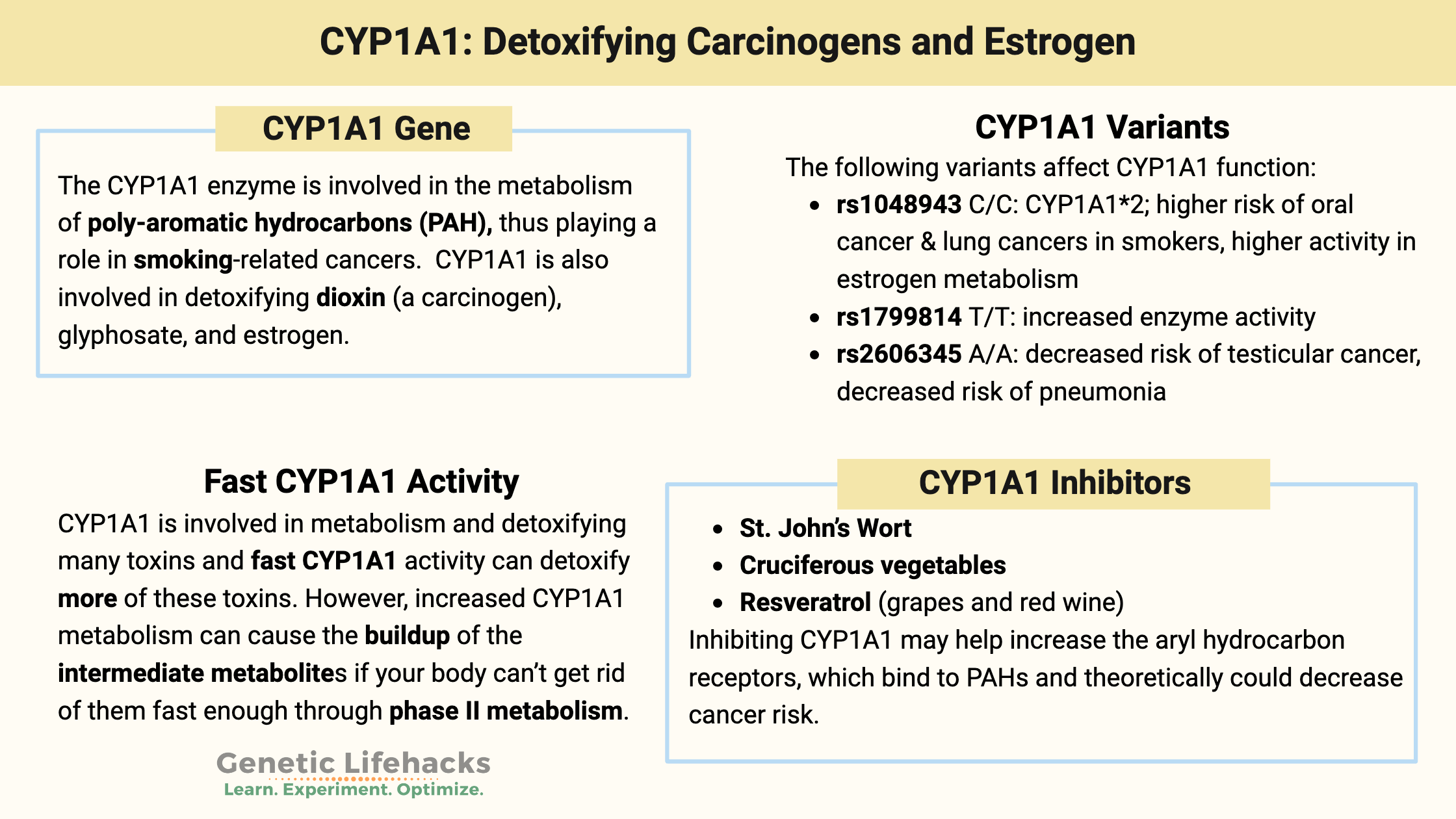
Genetic variants in the CYP1A1 gene are linked to a number of different health conditions, including an increased risk for estrogen-related cancers and an increased risk for lung cancer in smokers.

A quick overview of phase I detoxification :

Everything you eat or take (like medication) is absorbed in the intestines and taken to the liver.

  • This allows the liver to detoxify anything harmful that you’ve eaten, and it also transforms nutrients into forms that you need.
  • Fat-soluble toxins are made water-soluble.
  • Then the toxin can be transformed and eliminated (mainly through the kidneys).

Related article: Overview of Phase I and Phase II detoxification

CYP1A1: What does it do?

The CYP450 (cytochrome P450) family of enzymes metabolizes or breaks down thousands of different compounds. CYP1A1 is one member of the CYP family of enzymes that are involved in metabolizing lots of different toxins as well as substances the body makes.

Toxins metabolized by CYP1A1:

The CYP1A1 enzyme is involved in the metabolism of poly-aromatic hydrocarbons (PAH) in the intestines, thus playing a role in smoking-related cancers from the activation of the aromatic hydrocarbons. In addition to cigarette smoke, aromatic hydrocarbons are also found in wood smoke, vehicle exhausts, asphalt, and charred meats.

CYP1A1 is also involved in detoxifying dioxin, which is a persistent organic pollutant that is carcinogenic.[ref]

A study on workers in China showed that those with CYP1A1 variants had lower acetylcholinesterase levels due to glyphosate (RoundUp ingredient) exposure. Lower acetylcholinesterase was assumed to be a marker of liver damage.[ref]

Endogenous substances metabolized by CYP1A1:

CYP1A1 is also involved in the metabolism of estrogen, specifically 17β-estradiol, as well as arachidonic acid and DHA (polyunsaturated fatty acids).

CYP1A1 is also utilized in the metabolism of melatonin.[ref]

New research points to a role in immune homeostasis in the intestines.[ref] Toll-like receptor 2 (TLR2) is part of the immune system that is active in the intestines and interacts with the gut microbiome. TLR2 activation increases CYP1A1 activity in the intestines, which then in turn can help with detoxification of ingested toxicants.[ref]

Medications metabolized using the CYP1A1 enzyme:

  • Olanzapine[ref]
  • Granisetron

Fast and slow CYP1A1 metabolism:

There are several genetic variants of CYP1A1 that can change the speed at which your body will metabolize substances.

  • Increased CYP1A1 metabolism can cause the buildup of the intermediate metabolites if your body can’t get rid of them fast enough through phase II metabolism.
  • Increased CYP1A1 activity can also increase the degradation of the aryl hydrocarbon receptor, which is an important mechanism for binding poly-aromatic hydrocarbons.[ref]

CYP1A1 Genotype Report

Members: Log in to see your data below.
Not a member? Join here.


Access this content:

An active subscription is required to access this content.

Join as a member


Lifehacks:

Higher CYP1A1 activity is going to be detrimental when exposed to PAHs (such as in cigarette smoke and smog). But, higher CYP1A1 activity is going to break down estradiol faster, which may be beneficial in estrogen metabolism, depending on your other estrogen-related genes.

Stop smoking:
People with the CYP1A1*2 allele are at a higher risk for lung cancer and definitely, should avoid cigarette smoke. So if you need yet another reason to stop smoking, this would be a big one.

Eat your veggies:
One study found that people who carried the CYP1A1*2 variant had a greater reduction in colon cancer risk with a diet high in polyphenols (found in veggies and fruit) than those without the variant.[ref]

Grapefruit juice also inhibits CYP1A1.[ref]

Supplements and CYP1A1:

Access this content:

An active subscription is required to access this content.

Join as a member


Related Articles and Topics:

CYP2C9: Genetic Variants and Drug Metabolism

CYP2D6: Medication Interactions, Natural Inhibitors, and Anxiety Traits


References:

Boyapati, Sonia M., et al. “Polymorphisms in CYP1A1 and Breast Carcinoma Risk in a Population-Based Case-Control Study of Chinese Women.” Cancer, vol. 103, no. 11, June 2005, pp. 2228–35. PubMed, https://doi.org/10.1002/cncr.21056.
Cai, Wenyan, et al. “Correlation between CYP1A1 Polymorphisms and Susceptibility to Glyphosate-Induced Reduction of Serum Cholinesterase: A Case-Control Study of a Chinese Population.” Pesticide Biochemistry and Physiology, vol. 162, Jan. 2020, pp. 23–28. ScienceDirect, https://doi.org/10.1016/j.pestbp.2019.07.006.
Cho, Young Ae, et al. “Dietary Flavonoids, CYP1A1 Genetic Variants, and the Risk of Colorectal Cancer in a Korean Population.” Scientific Reports, vol. 7, no. 1, Mar. 2017, p. 128. PubMed, https://doi.org/10.1038/s41598-017-00117-8.
“ClinPGx.” ClinPGx, https://www.clinpgx.org/gene/PA27092/clinicalAnnotation. Accessed 17 Feb. 2026.
Coelho, N. R., et al. “Pharmacological Blockage of the AHR-CYP1A1 Axis: A Call for in Vivo Evidence.” Journal of Molecular Medicine (Berlin, Germany), vol. 100, no. 2, 2022, pp. 215–43. PubMed Central, https://doi.org/10.1007/s00109-021-02163-2.
Do, Khoa Nguyen, et al. “TLR2 Controls Intestinal Carcinogen Detoxication by CYP1A1.” PLoS ONE, vol. 7, no. 3, Mar. 2012, p. e32309. PubMed Central, https://doi.org/10.1371/journal.pone.0032309.
Figueroa, Jonine D., et al. “Genetic Variation in Hormone Metabolizing Genes and Risk of Testicular Germ Cell Tumors.” Cancer Causes & Control: CCC, vol. 19, no. 9, Nov. 2008, pp. 917–29. PubMed, https://doi.org/10.1007/s10552-008-9153-6.
Korashy, Hesham M., et al. “Camel Milk Modulates the Expression of Aryl Hydrocarbon Receptor-Regulated Genes, Cyp1a1, Nqo1, and Gsta1, in Murine Hepatoma Hepa 1c1c7 Cells.” Journal of Biomedicine & Biotechnology, vol. 2012, 2012, p. 782642. PubMed, https://doi.org/10.1155/2012/782642.
Manzella, Christopher R., et al. “Serotonin Modulates AhR Activation by Interfering with CYP1A1-Mediated Clearance of AhR Ligands.” Cellular Physiology and Biochemistry : International Journal of Experimental Cellular Physiology, Biochemistry, and Pharmacology, vol. 54, no. 1, Feb. 2020, pp. 126–41. PubMed Central, https://doi.org/10.33594/000000209.
Mokkawes, Thirakorn, et al. “Mechanism of Melatonin Metabolism by CYP1A1: What Determines the Bifurcation Pathways of Hydroxylation versus Deformylation?” The Journal of Physical Chemistry. B, vol. 126, no. 46, Nov. 2022, pp. 9591–606. PubMed, https://doi.org/10.1021/acs.jpcb.2c07200.
Salnikova, Lyubov E., et al. “Functional Polymorphisms in the CYP1A1, ACE, and IL-6 Genes Contribute to Susceptibility to Community-Acquired and Nosocomial Pneumonia.” International Journal of Infectious Diseases, Focus on Bacterial Resistance, vol. 17, no. 6, June 2013, pp. e433–42. ScienceDirect, https://doi.org/10.1016/j.ijid.2013.01.005.
San Jose, Carmen, et al. “CYP1A1gene Polymorphisms Increase Lung Cancer Risk in a High-Incidence Region of Spain: A Case Control Study.” BMC Cancer, vol. 10, no. 1, Aug. 2010, p. 463. Springer Link, https://doi.org/10.1186/1471-2407-10-463.
Santes-Palacios, Rebeca, et al. “Inhibition of Human and Rat CYP1A1 Enzyme by Grapefruit Juice Compounds.” Toxicology Letters, vol. 258, Sept. 2016, pp. 267–75. PubMed, https://doi.org/10.1016/j.toxlet.2016.07.023.
Schwarz, Dieter, et al. “Inhibition of 17β-Estradiol Activation by CYP1A1: Genotype- and Regioselective Inhibition by St. John’s Wort and Several Natural Polyphenols.” Biochimica Et Biophysica Acta, vol. 1814, no. 1, Jan. 2011, pp. 168–74. PubMed, https://doi.org/10.1016/j.bbapap.2010.09.014.
———. “Inhibition of 17β-Estradiol Activation by CYP1A1: Genotype- and Regioselective Inhibition by St. John’s Wort and Several Natural Polyphenols.” Biochimica Et Biophysica Acta, vol. 1814, no. 1, Jan. 2011, pp. 168–74. PubMed, https://doi.org/10.1016/j.bbapap.2010.09.014.
Sulem, Patrick, et al. “Sequence Variants at CYP1A1-CYP1A2 and AHR Associate with Coffee Consumption.” Human Molecular Genetics, vol. 20, no. 10, May 2011, pp. 2071–77. PubMed, https://doi.org/10.1093/hmg/ddr086.
Wright, C. M., et al. “Genetic Association Study of CYP1A1 Polymorphisms Identifies Risk Haplotypes in Nonsmall Cell Lung Cancer.” The European Respiratory Journal, vol. 35, no. 1, Jan. 2010, pp. 152–59. PubMed, https://doi.org/10.1183/09031936.00120808.
Yang, Xiao-Lei, et al. “Association between CYP1A1 Ile462Val Polymorphism and Oral Squamous Cell Carcinoma Susceptibility: Evidence from 13 Investigations.” Journal of Cancer, vol. 6, no. 4, 2015, pp. 302–09. PubMed, https://doi.org/10.7150/jca.11036.
Yu, Kai-Tao, et al. “CYP1A1 Polymorphism Interactions with Smoking Status in Oral Cancer Risk: Evidence from Epidemiological Studies.” Tumour Biology: The Journal of the International Society for Oncodevelopmental Biology and Medicine, vol. 35, no. 11, Nov. 2014, pp. 11183–91. PubMed, https://doi.org/10.1007/s13277-014-2422-y.
Zamaratskaia, Galia, et al. “Co-Treatment with Indole-3-Carbinol and Resveratrol Modify Porcine CYP1A and CYP3A Activities and Expression.” Xenobiotica; the Fate of Foreign Compounds in Biological Systems, vol. 48, no. 3, Mar. 2018, pp. 232–40. PubMed, https://doi.org/10.1080/00498254.2017.1300708.
https://cancerres.aacrjournals.org/content/65/7/2972.long. Accessed 17 Feb. 2026.
https://cebp.aacrjournals.org/content/25/4/700.long. Accessed 17 Feb. 2026.

About the Author:
Debbie Moon is a biologist, engineer, author, and the founder of Genetic Lifehacks where she has helped thousands of members understand how to apply genetics to their diet, lifestyle, and health decisions. With more than 10 years of experience translating complex genetic research into practical health strategies, Debbie holds a BS in engineering from Colorado School of Mines and an MSc in biological sciences from Clemson University. She combines an engineering mindset with a biological systems approach to explain how genetic differences impact your optimal health.