
Key takeaways:
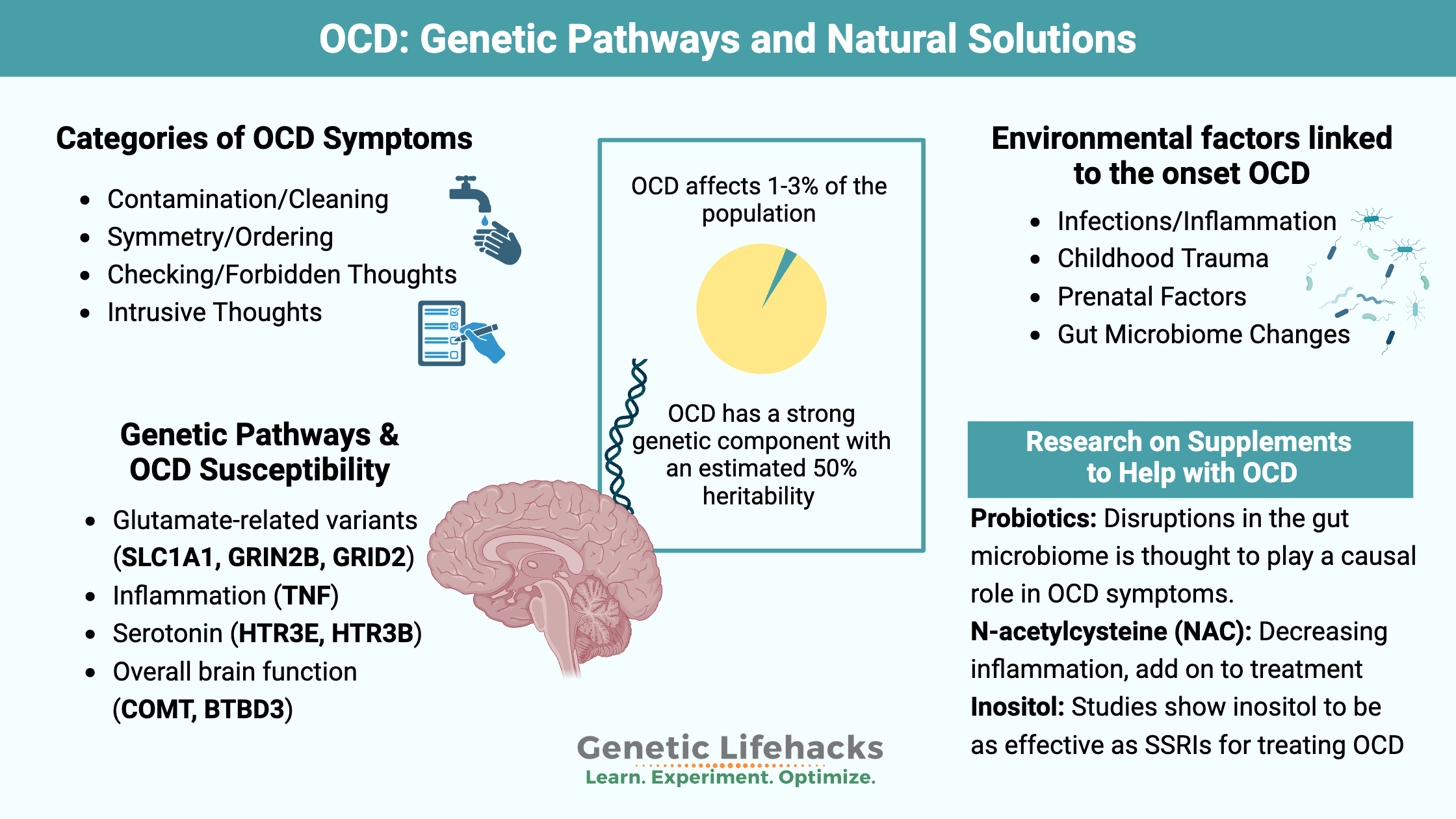
- Obsessive-compulsive disorder is a psychiatric disorder that includes both genetic and environmental factors.
- Alterations in glutamate, GABA, and other neurotransmitter levels are seen in specific brain regions in OCD.
- Genetic variants in glutamate receptors, inflammatory cytokines, and serotonin pathways are linked to increased susceptibility to OCD.
Members will see their genotype report below and the solutions in the Lifehacks section. Consider joining today.What is OCD?
Obsessive-compulsive disorder (OCD) is considered a multi-symptom psychiatric disorder. It affects 2-3% of the population worldwide. Genetic studies show that it is strongly heritable, involving both common and rare genetic variants. Heritability studies in twins show that OCD is ~50% heritable with monozygotic twins having a concordance rate of 50-87%[ref][ref]
OCD often has an early onset in life, with about 50% of people now diagnosed in adolescence or childhood.[ref]
Symptoms of OCD:Symptoms of OCD vary greatly from person to person, but generally consist of intrusive obsessions and then compulsions that are both distressing and time-consuming.[ref]
- Obsessions can be thoughts, urges, or mental images that are intrusive and associated with anxiety or distress. Common obsessions include worries about being a bad person, hurting others, or contaminating oneself.
- Compulsions are repetitive behaviors that relieve the stress or anxiety caused by the obsession. Examples include checking for safety, repetitive counting, ordering things, or frequent hand washing.
Obsession –> Worry or anxiety –> Compulsive action –> Relief from worry
As an example: An obsessive fear of contamination leads to ritual hand washing, which temporarily reduces the anxiety. [ref]
Four broad categories of OCD symptoms include:[ref]
- Contamination and cleaning
- Symmetry, repetition, organizing, and counting
- Checking and forbidden thoughts (sex, religion, aggression)
- General obtrusive thoughts
However, these general categories may not tell the whole story. There is now a spectrum of related disorders grouped with OCD, such as hoarding, skin picking, tics, and body dysmorphia.[ref]
Obsessive-compulsive disorder often overlaps genetically and functionally with other disorders, such as Tourette’s syndrome (tics), anorexia nervosa, bulimia, orthorexia, depression, schizophrenia, and autism spectrum disorder. One study found that 25% of schizophrenia patients also have OCD symptoms.[ref][ref][ref]
Related article: Schizophrenia genes
What happens in the brain in OCD?
Researchers and doctors are still trying to figure out exactly what happens in OCD. Brain imaging studies show that people with OCD have altered brain connectivity and activity in certain regions.[ref] Another study involving over 2,500 children with OCD symptoms found that they had a larger thalamus.[ref]
Let’s look at some of the known physiological changes in OCD.
GABA and glutamate balance:
Glutamate acts as an excitatory neurotransmitter for glutamatergic neurons. Glutamate levels, or more specifically the balance of glutamate in certain regions of the brain, are also thought to play a role in OCD.Studies show that people with OCD are likely to have higher levels of glutamate in their cerebrospinal fluid (CSF).[ref] Other studies show lower levels of glutamate in the prefrontal cortex in people with OCD, showing that it is tissue-dependent alterations of glutamate rather than an overall increase or decrease.[ref]
GABA is the inhibitory neurotransmitter that keeps neurons from becoming overexcited, like the “off” switch for an excitatory neuron. GABA is synthesized from glutamate in the brain.
A recent study used new techniques to look at glutamate and GABA in the brains of people with OCD compared to healthy controls. They found that people with OCD had higher levels of glutamate and lower levels of GABA in the anterior cingulate cortex.[ref] The anterior cingulate cortex is the brain region that connects the frontal cortex to the thalamus and amygdala. It plays a role in motivation, cognition, emotion, decision-making, and impulse control.
A study of brain GABA levels using MRI found that levels in the prefrontal cortex were decreased in OCD patients.[ref]
It’s not as simple as too much glutamate and not enough GABA. Instead, the imbalances seem to be specific to different regions of the brain. For example, another study found lower glutamatergic (excitatory) gene expression in the orbitofrontal cortex and striatum in people with OCD.[ref]
Related articles: Glutatamate genes & GABA genes
Dopamine:
Dopamine modulates behavior and is involved in learning, memory, and reward. Animal studies suggest a role for the dopaminergic system in OCD-like behaviors. As a neurotransmitter, dopamine acts on dopamine receptors to send a signal from one neuron to the next.[ref]Drugs that increase dopamine can cause OCD symptoms, such as in people taking dopaminergic drugs for Parkinson’s disease. In animal studies, dopamine receptor agonists (drugs that bind to the D2 receptor) can cause OCD-like behaviors.[ref] Overactivation of the D1 receptor has also been implicated in OCD in animals.[ref]
Serotonin:
The conventional treatment for OCD is serotonin reuptake inhibitors (antidepressants, SSRIs), suggesting either a role for serotonin in OCD or an alteration in the immune system. SSRIs increase serotonin levels in the brain and also affect the immune response in the brain. However, studies show that nearly two-thirds of people with OCD still have symptoms when treated with antidepressants.[ref][ref]Related articles: Dopamine Synthesis & Dopamine Receptor Genes
Stress hormones and immune response:
Cortisol, a hormone released during stress, is elevated in people with OCD.[ref] Cortisol also modulates immune response, with high cortisol levels initially acting to suppress the immune system but long-term elevations leading to increased inflammation.Related article: Cortisol and the HPA Axis
Neuroinflammation:
An autoimmune or inflammatory component is thought to underlie the onset of OCD for many people. In children, PANS (pediatric acute neuropsychiatric syndrome) is thought to be caused by strep A infection or other pathogens such as Mycoplasma pneumoniae, Borrelia burgdorferi, Borna disease virus, and Toxoplasmosis gondii.Autoimmune causes of OCD are also possible, and covid infections are also being investigated. A study in Sweden found that people with OCD are at a 43% increased relative risk of other autoimmune disorders.[ref]
Inflammatory cytokine levels are often elevated in people with OCD. One study found that serum IL-1B and IL-6 levels were elevated compared to a control group.[ref] Another study in children found that cytokine levels (IL-1B, IL-6, and TNF-alpha) were predictive of the severity of symptoms.[ref][ref]
What triggers OCD to start?
OCD tends to start either in pre-adolescence (between the ages of 7 and 12) or in early adulthood (early 20s). However, the research on this is not completely clear because the age of diagnosis, such as in the early 20s, could include a childhood onset that is not diagnosed until early adulthood. Having routines or rituals is common and normal in children, as is collecting things and magical thinking. So determining when OCD began can be difficult, and it is often not formally diagnosed until adulthood, even if it began at an earlier age.[ref]
There are several known risk factors that precede the onset of OCD symptoms, including neuroinflammation, viral or bacterial infections, or other childhood trauma.
Infection, neuroinflammation, or trauma during childhood:[ref][ref][ref][ref]
- An autoimmune response to infection may lead to early-onset OCD. This is called pediatric autoimmune neuropsychiatric syndrome (PANS) – or PANDAS when referring specifically to a Strep A infection.
- Childhood stress is also a risk factor for OCD
- Some studies suggest a role for neuroinflammation.
- Influenza and hepatitis A vaccinations are associated with an increased risk of subsequent OCD diagnosis within the next 3-12 months.[ref][ref]
- People with OCD are more likely to have experienced childhood trauma.
Prenatal environment:
Maternal factors and the prenatal environment may also play a role in susceptibility. A recent study also showed that children with OCD or tics were more likely to have mothers with autoimmune diseases.[ref] Maternal illness during pregnancy and maternal smoking are also risk factors.[ref][ref]Gut microbiome:
Both animal and human studies show that changes in the gut microbiome may be involved in OCD. For example, a 2020 study found that people with OCD have a reduced microbiome richness and lower abundance of butyrate-producing bacteria.[ref] Butyrate is a short-chain fatty acid that is produced by certain gut microbes and is important in the gut-brain axis. Butyrate has been shown in studies to act as an HDAC inhibitor, which is one way that gene expression is modified.[ref]Genetics and OCD:
Researchers are looking at both common genetic variants that contribute to susceptibility to OCD, as well as rare mutations that significantly increase risk. Epigenetics and altered gene expression may also be involved.
Common variants:
Genetic variants related to glutamate, inflammation, and overall brain function have been associated with an increased relative risk of OCD. Interestingly, there is genetic overlap with comorbid conditions Tourette’s syndrome, schizophrenia, and anorexia nervosa.[ref][ref]Rare variants:
In addition to the common variants that combine to increase risk, rare mutations have been found in some people with OCD. For example, de novo mutations in CHD8 are associated with altered synaptic transmission and neurogenesis. Again, there was genetic overlap with rare mutations and genes associated with Tourette syndrome and autism spectrum disorder. Copy number variants, which are insertions or deletions of multiple copies of nucleotide bases, are also commonly found in people with OCD.
[ref]Protein expression:
Beyond traditional gene studies, researchers are also looking at how proteins are expressed differently in people with OCD. A study of overlapping genetic pathways found that OCD overlaps with olfactory transduction and herpes simplex virus 1 (HSV1) infection. There were also intersections with other neurological diseases, such as Huntington’s, Parkinson’s, and Alzheimer’s, with gene expression overlap related to the way mitochondria produce energy.[ref]
Genotype report for OCD
Below are common genetic variants that increase susceptibility to OCD. These variants do not cause OCD on their own but rather combine with other environmental factors.
Access this content:
An active subscription is required to access this content.
Log in below or Join as a member.
Lifehacks:
Talk with your doctor about pharmaceutical options for OCD. Cognitive behavioral therapy, exposure response therapy, and NOCD are all options for OCD patients, and your doctor can help you navigate all of the options available.[ref][ref]
If you are taking any medications, please be sure to talk with your doctor and your pharmacist about interactions with supplements.Sleep and Circadian Rhythm:
Circadian rhythm is your body’s natural 24-hour clock that controls fluctuations in hormones such as cortisol and the immune response. Melatonin is released at night in response to the absence of light, and melatonin is important both for reducing inflammation in the brain and for setting the circadian rhythm.
A study of people with obsessive-compulsive disorder showed that almost half of them had severely altered circadian rhythms with delayed melatonin onset. [ref] Another recent study also showed delayed circadian rhythm timing in people with OCD.[ref]
Avoiding electronics and light at night, especially blue light from screens, for two hours before bedtime can help get your circadian rhythm back on track. Exposure to sunlight in the morning can also help set the circadian rhythm and increase melatonin at night. [ref] While this may sound overly simplistic, the effects on the brain — cognitive function, thought patterns, mood — of circadian rhythm disruption are significant and real.
Diet and Nutrition:
The link between the gut microbiome and OCD, as well as the elevation of inflammatory cytokines, makes a healthy diet important. However, OCD symptoms may overlap with orthorexia and other eating disorders. Talk to your doctor or dietitian if you have questions about your diet.
In children and adults with Tourette syndrome or OCD, a gluten-free diet reduced symptoms in a portion of the study participants.[ref] Keep in mind that switching to a gluten-free diet often also decreases exposure to junk food and fast food.
The connection between low butyrate-producing bacteria and OCD points towards a diet higher in fiber and whole foods. However, I cannot find any research studies specifically looking at diet, the gut microbiome, and OCD. One book that may be worth reading on the role of diet and mental health is Brain Energy: A Revolutionary Breakthrough in Understanding Mental Health–and Improving Treatment for Anxiety, Depression, OCD, PTSD, and More by Chris Palmer.
Natural supplement with clinical trials for OCD:
Access this content:
An active subscription is required to access this content.
Log in below or Join as a member.
Related articles:
HPA Axis Dysfunction: Understanding Cortisol and Genetic Interactions
Specialized Pro-resolving Mediators (SPMs): The Resolution of Inflammation
References:
Alonso, Pino, et al. “Association between the NMDA Glutamate Receptor GRIN2B Gene and Obsessive–Compulsive Disorder.” Journal of Psychiatry & Neuroscience : JPN, vol. 37, no. 4, July 2012, pp. 273–81. PubMed Central, https://doi.org/10.1503/jpn.110109.Batistuzzo, Marcelo C., et al. “Lower Ventromedial Prefrontal Cortex Glutamate Levels in Patients With Obsessive–Compulsive Disorder.” Frontiers in Psychiatry, vol. 12, June 2021, p. 668304. PubMed Central, https://doi.org/10.3389/fpsyt.2021.668304.Biria, Marjan, et al. “Cortical Glutamate and GABA Are Related to Compulsive Behaviour in Individuals with Obsessive Compulsive Disorder and Healthy Controls.” Nature Communications, vol. 14, June 2023, p. 3324. PubMed Central, https://doi.org/10.1038/s41467-023-38695-z.Bloch, Michael H., et al. “Meta-Analysis of the Symptom Structure of Obsessive-Compulsive Disorder.” The American Journal of Psychiatry, vol. 165, no. 12, Dec. 2008, pp. 1532–42. PubMed Central, https://doi.org/10.1176/appi.ajp.2008.08020320.Bourassa, Megan W., et al. “Butyrate, Neuroepigenetics and the Gut Microbiome: Can a High Fiber Diet Improve Brain Health?” Neuroscience Letters, vol. 625, June 2016, pp. 56–63. PubMed Central, https://doi.org/10.1016/j.neulet.2016.02.009.“Brain Gamma-Aminobutyric Acid (GABA) Concentration of the Prefrontal Lobe in Unmedicated Patients with Obsessive-Compulsive Disorder: A Research of Magnetic Resonance Spectroscopy.” Shanghai Archives of Psychiatry, vol. 28, no. 5, pp. 263–70. PubMed Central, https://doi.org/10.11919/j.issn.1002-0829.216043. Accessed 4 Mar. 2026.Brander, Gustaf, et al. “Association of Perinatal Risk Factors With Obsessive-Compulsive Disorder: A Population-Based Birth Cohort, Sibling Control Study.” JAMA Psychiatry, vol. 73, no. 11, Nov. 2016, pp. 1135–44. PubMed, https://doi.org/10.1001/jamapsychiatry.2016.2095.Burton, Christie L., et al. “Genome-Wide Association Study of Pediatric Obsessive-Compulsive Traits: Shared Genetic Risk between Traits and Disorder.” Translational Psychiatry, vol. 11, Feb. 2021, p. 91. PubMed Central, https://doi.org/10.1038/s41398-020-01121-9.Cappi, Carolina, et al. “Association Study between Functional Polymorphisms in the TNF-Alpha Gene and Obsessive-Compulsive Disorder.” Arquivos de Neuro-Psiquiatria, vol. 70, no. 2, Feb. 2012, pp. 87–90. PubMed Central, https://doi.org/10.1590/s0004-282×2012000200003.Cederlöf, Martin, et al. “Etiological Overlap between Obsessive-Compulsive Disorder and Anorexia Nervosa: A Longitudinal Cohort, Multigenerational Family and Twin Study.” World Psychiatry, vol. 14, no. 3, Oct. 2015, pp. 333–38. PubMed Central, https://doi.org/10.1002/wps.20251.Chen, Jingshan, et al. “Functional Analysis of Genetic Variation in Catechol-O-Methyltransferase (COMT): Effects on mRNA, Protein, and Enzyme Activity in Postmortem Human Brain.” American Journal of Human Genetics, vol. 75, no. 5, Nov. 2004, pp. 807–21. PubMed Central, https://doi.org/10.1086/425589.Cheng, Yu-Fang, et al. “Risk of Schizophrenia among People with Obsessive-Compulsive Disorder: A Nationwide Population-Based Cohort Study.” Schizophrenia Research, vol. 209, July 2019, pp. 58–63. PubMed, https://doi.org/10.1016/j.schres.2019.05.024.Coles, M. E., et al. “Sleep Duration and Timing in Obsessive-Compulsive Disorder (OCD): Evidence for Circadian Phase Delay.” Sleep Medicine, vol. 72, Aug. 2020, pp. 111–17. PubMed, https://doi.org/10.1016/j.sleep.2020.03.021.Cox, Rebecca C., and Bunmi O. Olatunji. “Delayed Circadian Rhythms and Insomnia Symptoms in Obsessive-Compulsive Disorder.” Journal of Affective Disorders, vol. 318, Dec. 2022, pp. 94–102. PubMed, https://doi.org/10.1016/j.jad.2022.08.118.den Braber, A., et al. “Obsessive–Compulsive Symptoms in a Large Population-Based Twin-Family Sample Are Predicted by Clinically Based Polygenic Scores and by Genome-Wide SNPs.” Translational Psychiatry, vol. 6, no. 2, Feb. 2016, pp. e731–e731. www.nature.com, https://doi.org/10.1038/tp.2015.223.Endres, Dominique, et al. “Immunological Causes of Obsessive-Compulsive Disorder: Is It Time for the Concept of an ‘Autoimmune OCD’ Subtype?” Translational Psychiatry, vol. 12, Jan. 2022, p. 5. PubMed Central, https://doi.org/10.1038/s41398-021-01700-4.Feusner, Jamie D., et al. “Online Video Teletherapy Treatment of Obsessive-Compulsive Disorder Using Exposure and Response Prevention: Clinical Outcomes From a Retrospective Longitudinal Observational Study.” Journal of Medical Internet Research, vol. 24, no. 5, May 2022, p. e36431. www.jmir.org, https://doi.org/10.2196/36431.Fineberg, Naomi A., et al. “Clinical Advances in Obsessive-Compulsive Disorder: A Position Statement by the International College of Obsessive-Compulsive Spectrum Disorders.” International Clinical Psychopharmacology, vol. 35, no. 4, July 2020, pp. 173–93. PubMed Central, https://doi.org/10.1097/YIC.0000000000000314.Fux, Mendel, et al. “Inositol versus Placebo Augmentation of Serotonin Reuptake Inhibitors in the Treatment of Obsessive-Compulsive Disorder: A Double-Blind Cross-over Study.” The International Journal of Neuropsychopharmacology, vol. 2, no. 3, Sept. 1999, pp. 193–95. PubMed, https://doi.org/10.1017/S1461145799001546.Gadow, Kenneth D., et al. “Brief Report: Glutamate Transporter Gene (SLC1A1) Single Nucleotide Polymorphism (Rs301430) and Repetitive Behaviors and Anxiety in Children with Autism Spectrum Disorder.” Journal of Autism and Developmental Disorders, vol. 40, no. 9, Sept. 2010, pp. 1139–45. PubMed Central, https://doi.org/10.1007/s10803-010-0961-7.Geller, Daniel A., Saffron Homayoun, et al. “Developmental Considerations in Obsessive Compulsive Disorder: Comparing Pediatric and Adult-Onset Cases.” Frontiers in Psychiatry, vol. 12, June 2021, p. 678538. PubMed Central, https://doi.org/10.3389/fpsyt.2021.678538.Geller, Daniel A., Natalie Wieland, et al. “Perinatal Factors Affecting Expression of Obsessive Compulsive Disorder in Children and Adolescents.” Journal of Child and Adolescent Psychopharmacology, vol. 18, no. 4, Aug. 2008, pp. 373–79. PubMed Central, https://doi.org/10.1089/cap.2007.0112.Gerentes, Mona, et al. “Obsessive-Compulsive Disorder: Autoimmunity and Neuroinflammation.” Current Psychiatry Reports, vol. 21, no. 8, Aug. 2019, p. 78. PubMed, https://doi.org/10.1007/s11920-019-1062-8.Harvey, Brian H., et al. “Defining the Neuromolecular Action of Myo-Inositol.” Progress in Neuro-Psychopharmacology and Biological Psychiatry, vol. 26, no. 1, Jan. 2002, pp. 21–32. ScienceDirect, https://doi.org/10.1016/S0278-5846(01)00244-5.Hatakama, Hikari, et al. “Amelioration of Obsessive-Compulsive Disorder by Intracellular Acidification of Cortical Neurons with a Proton Pump Inhibitor.” Translational Psychiatry, vol. 14, Jan. 2024, p. 27. PubMed Central, https://doi.org/10.1038/s41398-024-02731-3.Hounie, Ana Gabriela, et al. “TNF-Alpha Polymorphisms Are Associated with Obsessive-Compulsive Disorder.” Neuroscience Letters, vol. 442, no. 2, Sept. 2008, pp. 86–90. PubMed, https://doi.org/10.1016/j.neulet.2008.07.022.Jones, Hannah F., et al. “Maternal Autoimmunity and Inflammation Are Associated with Childhood Tics and Obsessive-Compulsive Disorder: Transcriptomic Data Show Common Enriched Innate Immune Pathways.” Brain, Behavior, and Immunity, vol. 94, May 2021, pp. 308–17. PubMed, https://doi.org/10.1016/j.bbi.2020.12.035.Karthik, Sheshachala, et al. “Investigating the Role of Glutamate in Obsessive-Compulsive Disorder: Current Perspectives.” Neuropsychiatric Disease and Treatment, vol. 16, Apr. 2020, pp. 1003–13. PubMed Central, https://doi.org/10.2147/NDT.S211703.Kim, Hae Won, Jee In Kang, Eun Hee Hwang, et al. “Association between Glutamate Transporter Gene Polymorphisms and Obsessive-Compulsive Disorder/Trait Empathy in a Korean Population.” PLoS ONE, vol. 13, no. 1, Jan. 2018, p. e0190593. PubMed Central, https://doi.org/10.1371/journal.pone.0190593.Kim, Hae Won, Jee In Kang, Sang-Hyuk Lee, et al. “Common Variants of HTR3 Genes Are Associated with Obsessive-Compulsive Disorder and Its Phenotypic Expression.” Scientific Reports, vol. 6, Sept. 2016, p. 32564. PubMed Central, https://doi.org/10.1038/srep32564.Konuk, N., et al. “Plasma Levels of Tumor Necrosis Factor-Alpha and Interleukin-6 in Obsessive Compulsive Disorder.” Mediators of Inflammation, vol. 2007, 2007, p. 65704. PubMed, https://doi.org/10.1155/2007/65704.Lennertz, Leonhard, et al. “5-HT3 Receptor Influences the Washing Phenotype and Visual Organization in Obsessive-Compulsive Disorder Supporting 5-HT3 Receptor Antagonists as Novel Treatment Option.” European Neuropsychopharmacology: The Journal of the European College of Neuropsychopharmacology, vol. 24, no. 1, Jan. 2014, pp. 86–94. PubMed, https://doi.org/10.1016/j.euroneuro.2013.07.003.Leslie, Douglas L., Laura Kozma, et al. “Neuropsychiatric Disorders Associated with Streptococcal Infection: A Case-Control Study among Privately Insured Children.” Journal of the American Academy of Child and Adolescent Psychiatry, vol. 47, no. 10, Oct. 2008, pp. 1166–72. PubMed, https://doi.org/10.1097/CHI.0b013e3181825a3d.Leslie, Douglas L., Robert A. Kobre, et al. “Temporal Association of Certain Neuropsychiatric Disorders Following Vaccination of Children and Adolescents: A Pilot Case-Control Study.” Frontiers in Psychiatry, vol. 8, 2017, p. 3. PubMed, https://doi.org/10.3389/fpsyt.2017.00003.Lisboa, Jéssica Vanessa de Carvalho, et al. “Food Intervention with Folate Reduces TNF-α and Interleukin Levels in Overweight and Obese Women with the MTHFR C677T Polymorphism: A Randomized Trial.” Nutrients, vol. 12, no. 2, Jan. 2020, p. 361. PubMed, https://doi.org/10.3390/nu12020361.Mahjani, Behrang, et al. “Genetics of Obsessive-Compulsive Disorder.” Psychological Medicine, vol. 51, no. 13, pp. 2247–59. PubMed Central, https://doi.org/10.1017/S0033291721001744. Accessed 4 Mar. 2026.Mattheisen, Manuel, et al. “Genome-Wide Association Study in Obsessive-Compulsive Disorder: Results from the OCGAS.” Molecular Psychiatry, vol. 20, no. 3, Mar. 2015, pp. 337–44. PubMed Central, https://doi.org/10.1038/mp.2014.43.Messaoudi, Michaël, et al. “Beneficial Psychological Effects of a Probiotic Formulation ( Lactobacillus Helveticus R0052 and Bifidobacterium Longum R0175) in Healthy Human Volunteers.” Gut Microbes, vol. 2, no. 4, July 2011, pp. 256–61. DOI.org (Crossref), https://doi.org/10.4161/gmic.2.4.16108.Morgado, P., et al. “Perceived Stress in Obsessive–Compulsive Disorder Is Related with Obsessive but Not Compulsive Symptoms.” Frontiers in Psychiatry, vol. 4, Apr. 2013, p. 21. PubMed Central, https://doi.org/10.3389/fpsyt.2013.00021.Nazeer, Ahsan, et al. “Obsessive-Compulsive Disorder in Children and Adolescents: Epidemiology, Diagnosis and Management.” Translational Pediatrics, vol. 9, no. Suppl 1, Feb. 2020, pp. S76–93. PubMed Central, https://doi.org/10.21037/tp.2019.10.02.Oki, Erica, et al. “Polymorphisms of the TNF-α Gene Interact with Plasma Fatty Acids on Inflammatory Biomarker Profile: A Population-Based, Cross-Sectional Study in São Paulo, Brazil.” The British Journal of Nutrition, vol. 117, no. 12, June 2017, pp. 1663–73. PubMed, https://doi.org/10.1017/S0007114517001416.Oliver, Georgina, et al. “N-Acetyl Cysteine in the Treatment of Obsessive Compulsive and Related Disorders: A Systematic Review.” Clinical Psychopharmacology and Neuroscience, vol. 13, no. 1, Apr. 2015, pp. 12–24. PubMed Central, https://doi.org/10.9758/cpn.2015.13.1.12.Piantadosi, Sean C., et al. “Lower Excitatory Synaptic Gene Expression in Orbitofrontal Cortex and Striatum in an Initial Study of Subjects with Obsessive Compulsive Disorder.” Molecular Psychiatry, vol. 26, no. 3, Mar. 2021, pp. 986–98. PubMed, https://doi.org/10.1038/s41380-019-0431-3.Pruneti, Carlo, et al. “A Systematic Review of Clinical Psychophysiology of Obsessive-Compulsive Disorders: Does the Obsession with Diet Also Alter the Autonomic Imbalance of Orthorexic Patients?” Nutrients, vol. 15, no. 3, Feb. 2023, p. 755. PubMed, https://doi.org/10.3390/nu15030755.“Revealing the Complex Genetic Architecture of Obsessive-Compulsive Disorder Using Meta-Analysis.” Molecular Psychiatry, vol. 23, no. 5, May 2018, pp. 1181–88. PubMed Central, https://doi.org/10.1038/mp.2017.154.Rodrigo, Luis, et al. “Efficacy of a Gluten-Free Diet in the Gilles de La Tourette Syndrome: A Pilot Study.” Nutrients, vol. 10, no. 5, May 2018, p. 573. PubMed, https://doi.org/10.3390/nu10050573.Rui, Yehua, et al. “Rosmarinic Acid Suppresses Adipogenesis, Lipolysis in 3T3-L1 Adipocytes, Lipopolysaccharide-Stimulated Tumor Necrosis Factor-α Secretion in Macrophages, and Inflammatory Mediators in 3T3-L1 Adipocytes.” Food & Nutrition Research, vol. 61, no. 1, 2017, p. 1330096. PubMed, https://doi.org/10.1080/16546628.2017.1330096.Saraiva, Leonardo Cardoso, et al. “Cutting-Edge Genetics in Obsessive-Compulsive Disorder.” Faculty Reviews, vol. 9, Dec. 2020, p. 30. PubMed Central, https://doi.org/10.12703/r/9-30.Sarmin, Nisat, et al. “Exploring the Role of Interleukin-1β and Interleukin-6 in the Pathophysiology of Obsessive-Compulsive Disorder.” PloS One, vol. 19, no. 6, 2024, p. e0306125. PubMed, https://doi.org/10.1371/journal.pone.0306125.Sayyah, Mehdi, et al. “Evaluation of Oral Zinc Sulfate Effect on Obsessive-Compulsive Disorder: A Randomized Placebo-Controlled Clinical Trial.” Nutrition (Burbank, Los Angeles County, Calif.), vol. 28, no. 9, Sept. 2012, pp. 892–95. PubMed, https://doi.org/10.1016/j.nut.2011.11.027.Schirmbeck, Frederike, et al. “Polymorphisms in the Glutamate Transporter Gene SLC1A1 and Obsessive-Compulsive Symptoms Induced by Second-Generation Antipsychotic Agents.” Psychiatric Genetics, vol. 22, no. 5, Oct. 2012, pp. 245–52. PubMed, https://doi.org/10.1097/YPG.0b013e328353fbee.Seyedmirzaei, Homa, et al. “Effects of Antidepressants on Brain Structure and Function in Patients with Obsessive-Compulsive Disorder: A Review of Neuroimaging Studies.” Psychiatry Research: Neuroimaging, vol. 342, Aug. 2024, p. 111842. ScienceDirect, https://doi.org/10.1016/j.pscychresns.2024.111842.Shams, Jamal, et al. “Using Caffeine on the Patients as Therapeutic Option against Treatment-Resistant Obsessive-Compulsive Disorder.” Journal of Family Medicine and Primary Care, vol. 8, no. 5, May 2019, pp. 1741–47. PubMed Central, https://doi.org/10.4103/jfmpc.jfmpc_93_19.Shao, Nan, et al. “Curcumin Improves Treatment Outcome of Takayasu Arteritis Patients by Reducing TNF-α: A Randomized Placebo-Controlled Double-Blind Clinical Trial.” Immunologic Research, vol. 65, no. 4, Aug. 2017, pp. 969–74. PubMed, https://doi.org/10.1007/s12026-017-8917-z.Smith, Shad B., et al. “Epistasis Between Polymorphisms in COMT, ESR1, and GCH1 Influences COMT Enzyme Activity and Pain.” Pain, vol. 155, no. 11, Nov. 2014, pp. 2390–99. PubMed Central, https://doi.org/10.1016/j.pain.2014.09.009.Stewart, S. E., et al. “Genome-Wide Association Study of Obsessive-Compulsive Disorder.” Molecular Psychiatry, vol. 18, no. 7, July 2013, pp. 788–98. PubMed, https://doi.org/10.1038/mp.2012.85.Szałach, Łukasz P., et al. “The Influence of Antidepressants on the Immune System.” Archivum Immunologiae et Therapiae Experimentalis, vol. 67, no. 3, June 2019, pp. 143–51. Springer Link, https://doi.org/10.1007/s00005-019-00543-8.Taylor, Steven. “Association between COMT Val158Met and Psychiatric Disorders: A Comprehensive Meta-Analysis.” American Journal of Medical Genetics. Part B, Neuropsychiatric Genetics: The Official Publication of the International Society of Psychiatric Genetics, vol. 177, no. 2, Mar. 2018, pp. 199–210. PubMed, https://doi.org/10.1002/ajmg.b.32556.Thompson, Summer L., et al. “Btbd3 Expression Regulates Compulsive-like and Exploratory Behaviors in Mice.” Translational Psychiatry, vol. 9, Sept. 2019, p. 222. PubMed Central, https://doi.org/10.1038/s41398-019-0558-7.Tsilioni, I., et al. “Children with Autism Spectrum Disorders, Who Improved with a Luteolin-Containing Dietary Formulation, Show Reduced Serum Levels of TNF and IL-6.” Translational Psychiatry, vol. 5, no. 9, Sept. 2015, p. e647. PubMed Central, https://doi.org/10.1038/tp.2015.142.Turna, J., et al. “The Gut Microbiome and Inflammation in Obsessive-Compulsive Disorder Patients Compared to Age- and Sex-Matched Controls: A Pilot Study.” Acta Psychiatrica Scandinavica, vol. 142, no. 4, Oct. 2020, pp. 337–47. PubMed, https://doi.org/10.1111/acps.13175.Vellucci, Licia, et al. “The Neurobiological Underpinnings of Obsessive-Compulsive Symptoms in Psychosis, Translational Issues for Treatment-Resistant Schizophrenia.” Biomolecules, vol. 13, no. 8, Aug. 2023, p. 1220. PubMed Central, https://doi.org/10.3390/biom13081220.Wang, Yanrong, et al. “Informational Analysis and Prediction of Obsessive-Compulsive Disorder Pathogenesis.” Psychiatry Investigation, vol. 21, no. 5, May 2024, pp. 464–74. PubMed Central, https://doi.org/10.30773/pi.2023.0149.Watson, Lauren A., et al. “Increased Sensitivity of the Circadian System to Light in Delayed Sleep-Wake Phase Disorder.” The Journal of Physiology, vol. 596, no. 24, Dec. 2018, pp. 6249–61. PubMed, https://doi.org/10.1113/JP275917.Weeland, Cees J., et al. “Brain Morphology Associated With Obsessive-Compulsive Symptoms in 2,551 Children From the General Population.” Journal of the American Academy of Child and Adolescent Psychiatry, vol. 60, no. 4, Apr. 2021, pp. 470–78. PubMed, https://doi.org/10.1016/j.jaac.2020.03.012.Wendland, Jens R., et al. “A Haplotype Containing Quantitative Trait Loci for SLC1A1 Gene Expression and Its Association With Obsessive-Compulsive Disorder.” Archives of General Psychiatry, vol. 66, no. 4, Apr. 2009, pp. 408–16. PubMed Central, https://doi.org/10.1001/archgenpsychiatry.2009.6.Westwell-Roper, Clara, et al. “Severe Symptoms Predict Salivary Interleukin-6, Interleukin-1β, and Tumor Necrosis Factor-α Levels in Children and Youth with Obsessive-Compulsive Disorder.” Journal of Psychosomatic Research, vol. 155, Apr. 2022, p. 110743. PubMed, https://doi.org/10.1016/j.jpsychores.2022.110743.Xue, Jinwen, et al. “Midbrain Dopamine Neurons Arbiter OCD-like Behavior.” Proceedings of the National Academy of Sciences of the United States of America, vol. 119, no. 46, Nov. 2022, p. e2207545119. PubMed Central, https://doi.org/10.1073/pnas.2207545119.Yari, Zahra, et al. “The Effect of Hesperidin Supplementation on Metabolic Profiles in Patients with Metabolic Syndrome: A Randomized, Double-Blind, Placebo-Controlled Clinical Trial.” European Journal of Nutrition, vol. 59, no. 6, Sept. 2020, pp. 2569–77. PubMed, https://doi.org/10.1007/s00394-019-02105-2.Zhang, Manxue, et al. “Regional Brain Activity and Connectivity Associated with Childhood Trauma in Drug-Naive Patients with Obsessive–Compulsive Disorder.” Scientific Reports, vol. 14, Aug. 2024, p. 18111. PubMed Central, https://doi.org/10.1038/s41598-024-69122-y.