
Join Here   |   Log In

PTPN22 and Autoimmune Diseases

Key takeaways:
~ The PTPN22 gene helps in regulating the immune system, particularly by controlling the activation of T cells and B cells. This helps keep the immune response in check.
~ Genetic variants in the PTPN22 gene are linked to a wide range of autoimmune conditions, such as vitiligo, alopecia areata, thyroid diseases, and juvenile arthritis.
~ Environmental factors and other genetic influences also play important roles.

Members will see their genotype report below and the solutions in the Lifehacks section. Consider joining today

PTPN22: Genetics and Autoimmune Diseases

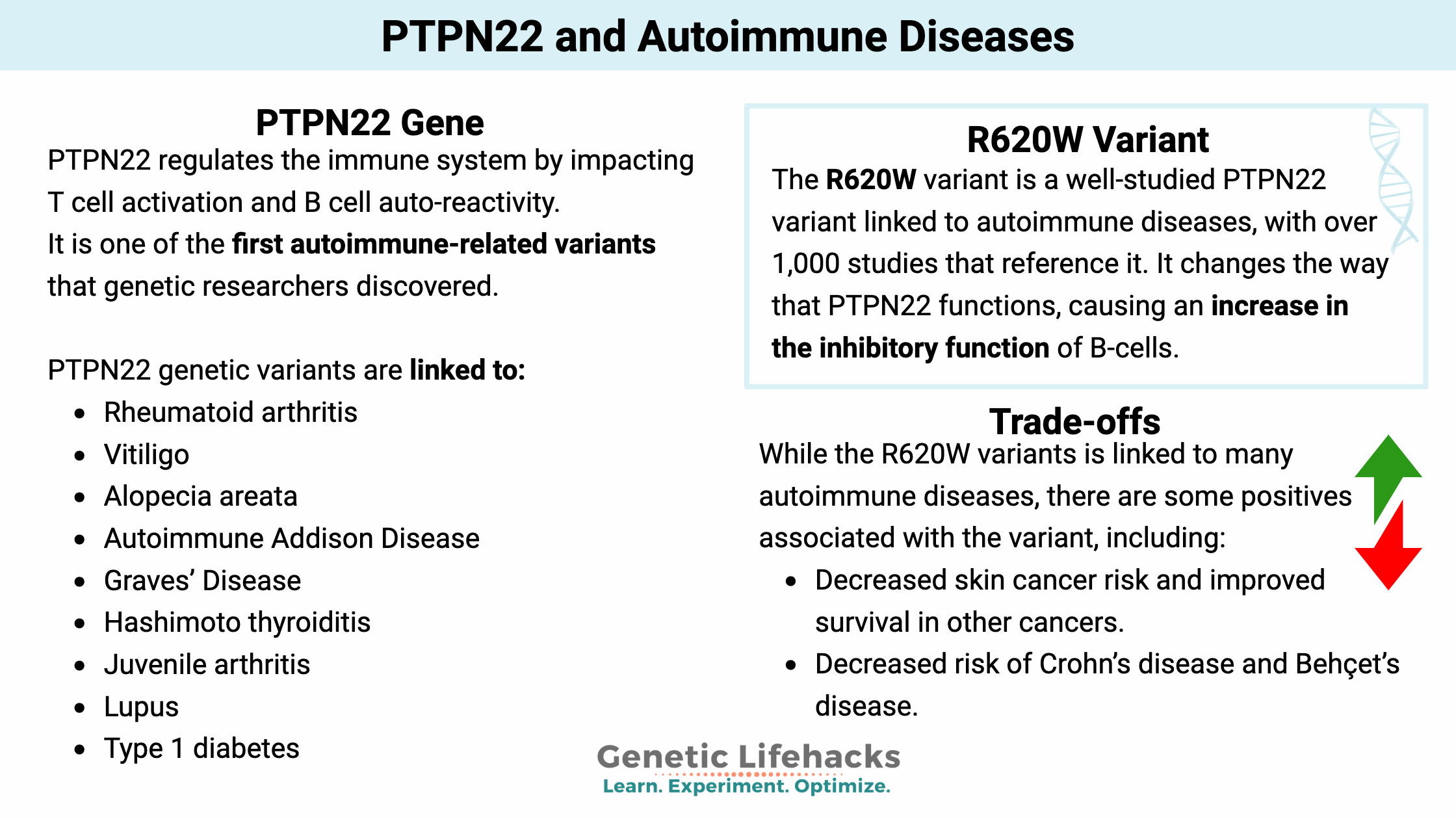
Genome-wide association studies allow researchers to cast a wide net, searching for genetic variations that increase susceptibility to diseases or conditions. One of the first autoimmune-related variants that genetic researchers discovered is in the PTPN22 gene (protein-tyrosine phosphatase nonreceptor 22).

This unexpected discovery left researchers searching for the answer to ‘why PTPN22?'[ref][ref]

Subsequent research shows that PTPN22 regulates the immune system by impacting T cell activation and B cell auto-reactivity. It acts as a negative regulator, dampening T cell activation. Additionally, PTPN22 impacts innate immunity by promoting interferon I production.[ref][ref][ref]

A balancing act between killing invaders and not hurting your own cells.

The body produces T-cells and B-cells as part of the immune system. These are the cell types that recognize danger (e.g., bacteria, viruses) and identify non-danger (e.g., your own cells).

B cells (aka B lymphocytes) are a type of white blood cell that secretes antibodies and also presents antigens. T cells, similarly, are a type of white blood cell that matures in the thymus and controls the immune response. Both B and T cells perform important immune system functions for determining invaders and keeping immune response in check against ‘self’.

Variants in the PTPN22 gene change the way that it functions, causing an increase in the inhibitory function of B-cells.[ref][ref]

The PTPN22 variants are linked to autoimmune diseases that affect connective tissues, the thyroid, joints, muscles, blood, and the pancreas. But the variants don’t seem to increase the risk of autoimmune diseases that target the eyes, gastrointestinal tract, or brain. PTPN22 genetic changes are linked to:[ref][ref][ref]

  • Rheumatoid arthritis
  • Vitiligo
  • Alopecia areata
  • Vasculitis
  • Autoimmune Addison Disease
  • Graves’ Disease
  • Hashimoto thyroiditis
  • Idiopathic inflammatory myopathy
  • Juvenile arthritis
  • Lupus
  • Systemic scleroderma
  • Type 1 diabetes
  • Myasthenia gravis
  • Allergic rhinitis

What if you don’t have an autoimmune disease?

Research shows that even people without autoimmune diseases have a change from the PTPN22 R620W variant. People with even one copy of the variant have increased autoreactive B cells and autoantibodies.[ref]

Trade-offs:

Recent work using transgenic mice points to the PTPN22 variant that increases autoimmune risk by possibly decreasing skin cancer risk and improving survival in other cancers.[ref]

Additionally, research seems to show that people with the PTPN22 variants are at a decreased risk of Crohn’s disease and Behçet’s disease.[ref]

Quick Recap Table: PTPN22 and Autoimmunity

Aspect Key Points
Gene Function PTPN22 regulates immune balance, dampens T cell activation, and impacts B cell reactivity.
Main Variant R620W (and others) increase risk for several autoimmune diseases.
Diseases Linked RA, vitiligo, alopecia areata, lupus, type 1 diabetes, thyroid diseases, more (see below).
Not Linked To Eye, GI tract, or brain autoimmune diseases.
Other Effects May reduce risk of Crohn’s, Behçet’s, and certain cancers.

Making Connections:

PTPN22 plays a role in susceptibility to autoimmune conditions, but it is just part of the picture. Genetic variants in PTPN22 combine with other genetic variants and environmental factors.

Meniere’s Disease causes vertigo and tinnitus. PTPN22 can play a role in susceptibility, but other genes are also important.

Thyroid conditions can have an autoimmune component. Learn more about the genetic variants that increase susceptibility to Hashimoto’s and to Graves’ disease.

Inflammatory bowel diseases (IBD) include Crohn’s and ulcerative colitis. PTPN22 may increase the relative risk along with NOD2 gene mutations.

Psoriasis is another autoimmune disease that includes PTPN22 as just one of the genetic risk factors.

Lupus is a complex autoimmune disease with many different genetic susceptibility variants, including PTPN22.


PTPN22 Genotype Report:

Access this content:

An active subscription is required to access this content.

Join as a member


Related Articles and Genes:

Rheumatoid Arthritis: Genetics, Root Causes, and Treatment Research

IL-17: Chronic Inflammation & Autoimmune Risk with IL17A, IL17F


References:

Adawi, Mohammad, et al. “The Impact of Intermittent Fasting (Ramadan Fasting) on Psoriatic Arthritis Disease Activity, Enthesitis, and Dactylitis: A Multicentre Study.” Nutrients, vol. 11, no. 3, Mar. 2019, p. 601. PubMed Central, https://doi.org/10.3390/nu11030601.
Arechiga, Adrian F., et al. “Cutting Edge: The PTPN22 Allelic Variant Associated with Autoimmunity Impairs B Cell Signaling.” Journal of Immunology (Baltimore, Md. : 1950), vol. 182, no. 6, Mar. 2009, pp. 3343–47. PubMed Central, https://doi.org/10.4049/jimmunol.0713370.
Bin Huraib, Ghaleb, et al. “The Protein Tyrosine Phosphatase Nonreceptor 22 (PTPN22) R620W Functional Polymorphism in Psoriasis.” Clinical Medicine Insights. Arthritis and Musculoskeletal Disorders, vol. 11, 2018, p. 1179544117751434. PubMed, https://doi.org/10.1177/1179544117751434.
Chang, Hui-Hsin, et al. “Utilizing a PTPN22 Gene Signature to Predict Response to Targeted Therapies in Rheumatoid Arthritis.” Journal of Autoimmunity, vol. 101, July 2019, pp. 121–30. PubMed Central, https://doi.org/10.1016/j.jaut.2019.04.012.
Choi, In Young, et al. “A Diet Mimicking Fasting Promotes Regeneration and Reduces Autoimmunity and Multiple Sclerosis Symptoms.” Cell Reports, vol. 15, no. 10, June 2016, pp. 2136–46. PubMed, https://doi.org/10.1016/j.celrep.2016.05.009.
Eriksson, Nicholas, et al. “Novel Associations for Hypothyroidism Include Known Autoimmune Risk Loci.” PloS One, vol. 7, no. 4, 2012, p. e34442. PubMed, https://doi.org/10.1371/journal.pone.0034442.
Galvani, Giuseppe, and Georgia Fousteri. “PTPN22 and Islet-Specific Autoimmunity: What Have the Mouse Models Taught Us?” World Journal of Diabetes, vol. 8, no. 7, July 2017, pp. 330–36. PubMed Central, https://doi.org/10.4239/wjd.v8.i7.330.
Gomez, Luis M., et al. “Genetic Influence of PTPN22 R620W Polymorphism in Tuberculosis.” Human Immunology, vol. 66, no. 12, Dec. 2005, pp. 1242–47. PubMed, https://doi.org/10.1016/j.humimm.2005.11.008.
Huraib, Ghaleb Bin, Fahad Al Harthi, et al. “Association of Functional Polymorphism in Protein Tyrosine Phosphatase Nonreceptor 22 (PTPN22) Gene with Vitiligo.” Biomarker Insights, vol. 15, Jan. 2020, p. 1177271920903038. PubMed Central, https://doi.org/10.1177/1177271920903038.
Huraib, Ghaleb Bin, Fahad Al Harthi, et al. “The Protein Tyrosine Phosphatase Non-Receptor Type 22 (PTPN22) Gene Polymorphism and Susceptibility to Autoimmune Diseases.” The Recent Topics in Genetic Polymorphisms, IntechOpen, 2020. www.intechopen.com, https://doi.org/10.5772/intechopen.90836.
Jia, Xiaocan, et al. “Identification of 67 Pleiotropic Genes Associated With Seven Autoimmune/Autoinflammatory Diseases Using Multivariate Statistical Analysis.” Frontiers in Immunology, vol. 11, Feb. 2020, p. 30. PubMed Central, https://doi.org/10.3389/fimmu.2020.00030.
Oh, Eun Hye, et al. “Rare Variants of Putative Candidate Genes Associated With Sporadic Meniere’s Disease in East Asian Population.” Frontiers in Neurology, vol. 10, Jan. 2020, p. 1424. PubMed Central, https://doi.org/10.3389/fneur.2019.01424.
Pabalan, Noel, et al. “Association of the Protein Tyrosine Phosphatase Non-Receptor 22 Polymorphism (PTPN22) with Endometriosis: A Meta-Analysis.” Einstein (Sao Paulo, Brazil), vol. 15, no. 1, 2017, pp. 105–11. PubMed, https://doi.org/10.1590/S1679-45082017RW3827.
Rana, Sabita, et al. “Ultraviolet B Suppresses Immunity by Inhibiting Effector and Memory T Cells.” The American Journal of Pathology, vol. 172, no. 4, Apr. 2008, pp. 993–1004. PubMed Central, https://doi.org/10.2353/ajpath.2008.070517.
Sadr, Maryam, et al. “Single Nucleotide Polymorphisms of PTPN22 Gene in Iranian Patients with Ulcerative Colitis.” Fetal and Pediatric Pathology, vol. 38, no. 1, Feb. 2019, pp. 8–13. PubMed, https://doi.org/10.1080/15513815.2018.1543371.
Song, Shang Hua, et al. “Association between PTPN22/CTLA-4 Gene Polymorphism and Allergic Rhinitis with Asthma in Children.” Iranian Journal of Allergy, Asthma, and Immunology, vol. 15, no. 5, Oct. 2016, pp. 413–19.
Taniyama, Matsuo, et al. “Association of PTPN22 Haplotypes with Type 1 Diabetes in the Japanese Population.” Human Immunology, vol. 71, no. 8, Aug. 2010, pp. 795–98. PubMed, https://doi.org/10.1016/j.humimm.2010.05.016.
Thompson, Susan D., et al. “The Susceptibility Loci Juvenile Idiopathic Arthritis Shares with Other Autoimmune Diseases Extend to PTPN2, COG6, and ANGPT1.” Arthritis and Rheumatism, vol. 62, no. 11, Nov. 2010, pp. 3265–76. PubMed, https://doi.org/10.1002/art.27688.
Tizaoui, Kalthoum, et al. “Association of PTPN22 1858C/T Polymorphism with Autoimmune Diseases: A Systematic Review and Bayesian Approach.” Journal of Clinical Medicine, vol. 8, no. 3, Mar. 2019, p. 347. PubMed Central, https://doi.org/10.3390/jcm8030347.
Venetsanopoulou, Aliki I., et al. “Fasting Mimicking Diets: A Literature Review of Their Impact on Inflammatory Arthritis.” Mediterranean Journal of Rheumatology, vol. 30, no. 4, Dec. 2019, pp. 201–06. PubMed Central, https://doi.org/10.31138/mjr.30.4.201.
Wang, Honglei, et al. “Identification of PTPN22, ST6GAL1 and JAZF1 as Psoriasis Risk Genes Demonstrates Shared Pathogenesis between Psoriasis and Diabetes.” Experimental Dermatology, vol. 26, no. 11, Nov. 2017, pp. 1112–17. PubMed, https://doi.org/10.1111/exd.13393.
Wu, Dennis J., et al. “Autoimmunity-Associated LYP-W620 Does Not Impair Thymic Negative Selection of Autoreactive T Cells.” PloS One, vol. 9, no. 2, 2014, p. e86677. PubMed, https://doi.org/10.1371/journal.pone.0086677.
Yang, Shen, et al. “PTPN22 Phosphorylation Acts as a Molecular Rheostat for the Inhibition of TCR Signaling.” Science Signaling, vol. 13, no. 623, Mar. 2020, p. eaaw8130. PubMed, https://doi.org/10.1126/scisignal.aaw8130.
Zhebrun, Daria, et al. “Association of PTPN22 1858T/T Genotype with Type 1 Diabetes, Graves’ Disease but Not with Rheumatoid Arthritis in Russian Population.” Aging (Albany NY), vol. 3, no. 4, Apr. 2011, pp. 368–73. PubMed Central, https://doi.org/10.18632/aging.100305.
Zheng, Kewen, et al. “Protective Effect of Pinitol Against Inflammatory Mediators of Rheumatoid Arthritis via Inhibition of Protein Tyrosine Phosphatase Non-Receptor Type 22 (PTPN22).” Medical Science Monitor : International Medical Journal of Experimental and Clinical Research, vol. 23, Apr. 2017, pp. 1923–32. PubMed Central, https://doi.org/10.12659/MSM.903357.

About the Author:
Debbie Moon is a biologist, engineer, author, and the founder of Genetic Lifehacks where she has helped thousands of members understand how to apply genetics to their diet, lifestyle, and health decisions. With more than 10 years of experience translating complex genetic research into practical health strategies, Debbie holds a BS in engineering from Colorado School of Mines and an MSc in biological sciences from Clemson University. She combines an engineering mindset with a biological systems approach to explain how genetic differences impact your optimal health.