
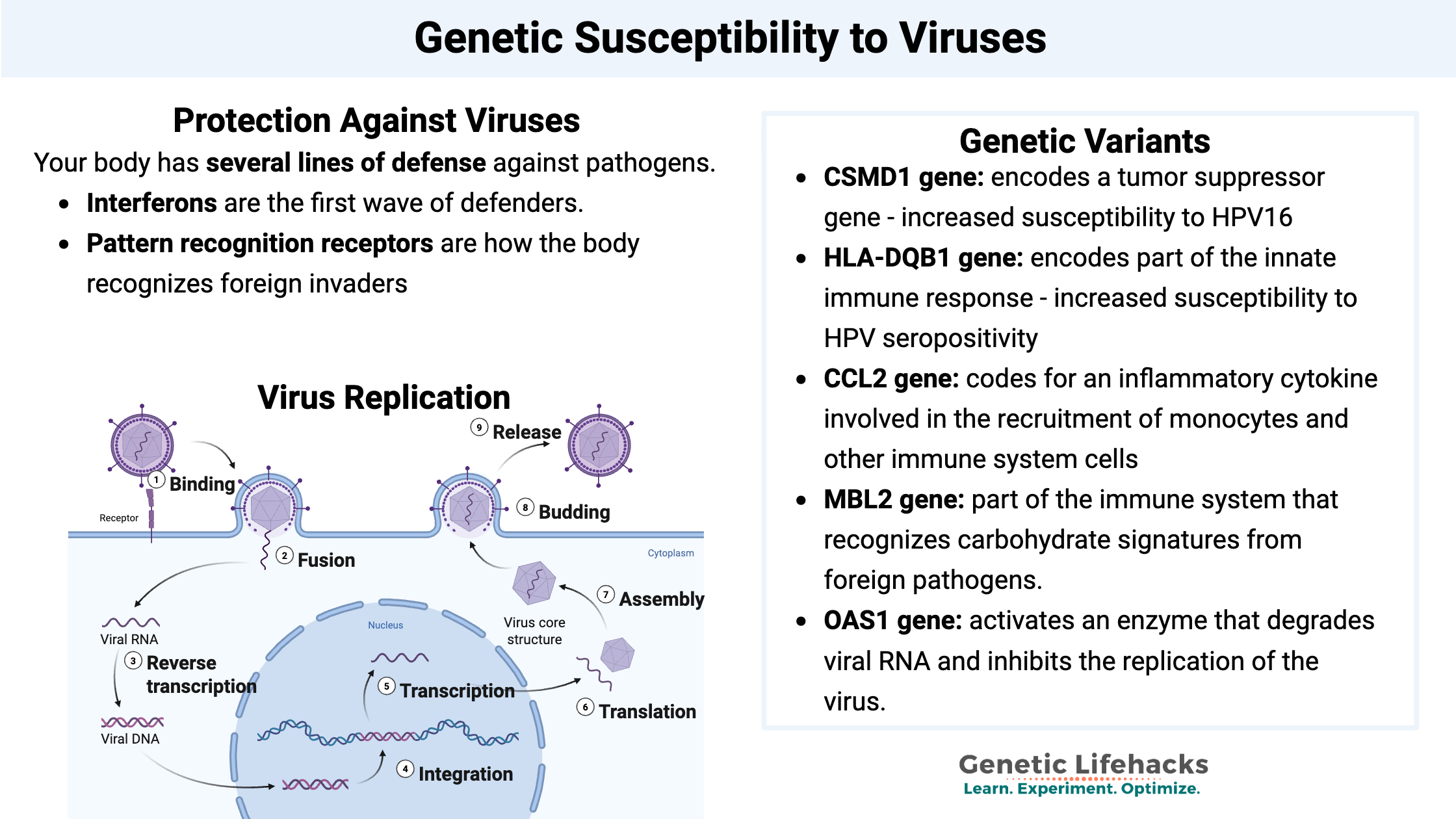
Key takeaways:
- We humans have lots of variation in the genes that protect against viral infections.
- Genetic variants can make you more susceptible to certain pathogens while protecting you from others.
Genetics and Susceptibility to Viral Infections
Our genome is shaped by the pathogens that our ancestors survived. This is pretty cool – you carry specific genetic variants passed down to you from ancestors who lived through diseases and epidemics.
Throughout history, humanity’s biggest threats to survival have been the microscopic pathogens that we now battle successfully with antibiotics, antifungals, vaccines, clean water, etc. All of the genetic variants that gave your ancestors a survival advantage in ages past are still written in your genome today. Pretty cool to think about!
Let me give you a few examples:
- People who carry a sickle-cell anemia mutation are likely to have an ancestor who survived malaria.
- One copy of a cystic fibrosis mutation could have protected your ancestors from dying from a cholera outbreak.
- The CCR5Δ32 variant is protective against HIV / AIDS. It is theorized that it may also have protected against the black death in the Middle Ages.
- About 20% of the population carries a variant that prevents them from secreting their blood type – and this also protects them from getting the norovirus and the rotavirus (aka the stomach flu).[ref] Think of this one as a superpower that you would want to have if stuck aboard a cruise ship where everyone is sick!
How does the body protect against viruses?
Viruses are not considered to be living organisms because they don’t have a cellular structure. Instead, they have to get inside a cellular organism in order to reproduce. Biologists define viruses as small, infectious agents. They can infect your cells and then hijack your own cellular processes to replicate themselves. After replication, they spread to other cells, causing more replication and cell death.
Your body has several lines of defense against pathogens – multiple ways to go to battle, defending the body from out-of-control viral or bacterial invaders. Just like the military has multiple branches (Army, Navy, Air Force, Marines) and specialized groups within those branches, your immune system has several ways of detecting, isolating, killing, and defending against pathogens.
First, the virus must enter the cell. Some viruses need a cell entry receptor to bind to to get into the cell. This is the case with HIV. A mutation in the cell entry receptor CCR5 can prevent HIV from entering a cell and replicating.
Innate immune response:
Even if you’ve never been exposed to a specific virus before, your body has ways to fight it off through your innate immune response.
For viral infections, interferons are the first wave of defenders. White blood cells produce several different types of interferons to act against a wide range of viruses. Interferons act in a couple of different ways:
- Interferons are cytokines that signal to other cells to protect against the spread of the virus.
- Interferons bind to interferon receptors in adjacent cells, which trigger changes in those adjacent cells to resist the viral infection. This basically produces a firewall around the cell that contains the viruses.
- Interferons also stimulate the cells to produce antiviral enzymes.
Pattern recognition receptors are also a part of the innate immune system, which is how the body recognizes foreign invaders. There are several subtypes of pattern recognition receptors, including Toll-like receptors (TLRs), nucleotide-binding oligomerization domain (NOD), retinoic acid-inducible gene 1 (RIG-1) -like receptors, and the C-type lectin receptors (CLRs).[ref]
These pattern recognition receptors are found on immune cells, such as macrophages and neutrophils, and they detect specific parts of a microbe (bacteria, viruses, etc.) and alert the immune system to attack it.
Two specific pattern recognition receptors are TLR3 and TLR4 (toll-like receptor 3/4), and these are what the body uses to identify the SARS coronavirus.[ref][ref]
The HLA (human leukocyte antigen) genes code for part of what is called the major histocompatibility complex (MHC). These proteins are part of the adaptive immune system and present the antigens, or pieces of the virus, on the surface of a cell. These antigens are like a flag saying, ‘the virus is here!’. There are two major divisions of the MHC – MHC class I and MHC class II. The class I antigens that are presented on the surface of the cell call in killer T-cells to destroy the cell. Likewise, the class II antigens present their antigens to the T-lymphocytes, which stimulate antibodies.
How do different genetic variants protect against pathogens?
Genes are the blueprint for the proteins that make up the various components of the immune system. You have genes that code for the proteins that act as cellular receptors, the different pattern recognition receptors, several types of interferon, the various cytokines needed to destroy the pathogens, cell signals, and more. It’s a complicated system that keeps us resilient and able to fight off various types of pathogens, including new viruses and bacteria.
Genetic variants can cause slight differences in how any single part of the immune system works. Each of us is unique – able to easily fight off certain foreign invaders and slightly more susceptible to others. As a whole, this makes the human population resilient and powerful. Some people may be more susceptible to certain pathogens, while others may have a mutation that protects them against that specific foreign invader.
There are, of course, trade-offs. Variants that give protection against a specific pathogen often have a downside, such as increased cancer risk or increased risk of inflammatory conditions[ref][ref]. So if you are battling with an overactive immune response, just keep in mind that it may be the same genetic variant that helped an ancient ancestor to survive a leprosy outbreak and then reproduce, passing along the variant.
This genetic uniqueness comes into play for all of the different aspects of the immune system – from the initial response by interferons to the toll-like receptors and then the HLA proteins that present the antigens on the surface of the cells.
The HLA system comes into play here, big time. There are more than 15,000 different HLA class I and class II alleles that have been identified by researchers so far. There is huge diversity amongst individuals in their HLA types — and this is what gives the human population as a whole a way to survive new pathogens. Because of the dizzying array of different HLA types, it is likely that a portion of the population will be able to fight off novel viruses that have just evolved.[ref]
Viral Susceptibility Genotype Report:
Access this content:
An active subscription is required to access this content.
Lifehacks for preventing viral illnesses
The first steps in preventing contagious diseases are to wash your hands frequently, have good bathroom hygiene, and sleeping well each night. I mentioned above that antibiotics, antifungals, etc., have been important in fighting off pathogens, but really – mankind took a huge step forward in resisting diseases with the implementation of basic hygiene, including simple hand washing (with soap) and having clean water.
Why does handwashing work so well for enveloped viruses such as the coronavirus? Enveloped viruses contain a lipid membrane around the virus, and that lipid (fat) is susceptible to the surfactant actions of soap. Studies on other enveloped viruses, such as the cytomegalovirus, show that good handwashing with soap and water was as effective as hand sanitizer. Other studies, though, show that you may be a little better off with an iodine-based hand sanitizer for Ebola.[ref][ref]
What else may work, according to research, for boosting your ability to fight off a virus?
Access this content:
An active subscription is required to access this content.
Related Articles and Topics:
Familial Mediterranean Fever: MEFV Gene Variants, Overlapping Conditions, and Solutions
References:
Alagarasu, K., et al. “Polymorphisms in RNA Sensing Toll like Receptor Genes and Its Association with Clinical Outcomes of Dengue Virus Infection.” Immunobiology, vol. 220, no. 1, Jan. 2015, pp. 164–68. PubMed, https://doi.org/10.1016/j.imbio.2014.09.020.Amarante-Mendes, Gustavo P., et al. “Pattern Recognition Receptors and the Host Cell Death Molecular Machinery.” Frontiers in Immunology, vol. 9, Oct. 2018. Frontiers, https://doi.org/10.3389/fimmu.2018.02379.Basille, Damien, et al. “Non-Steroidal Anti-Inflammatory Drugs May Worsen the Course of Community-Acquired Pneumonia: A Cohort Study.” Lung, vol. 195, no. 2, Apr. 2017, pp. 201–08. PubMed, https://doi.org/10.1007/s00408-016-9973-1.Blanpain, Cédric, et al. “CCR5 and HIV Infection.” Receptors & Channels, vol. 8, no. 1, 2002, pp. 19–31.Campagna, Michela, and Carmen Rivas. “Antiviral Activity of Resveratrol.” Biochemical Society Transactions, vol. 38, no. Pt 1, Feb. 2010, pp. 50–53. PubMed, https://doi.org/10.1042/BST0380050.Castro, F. A., et al. “TLR-3 Polymorphism Is an Independent Prognostic Marker for Stage II Colorectal Cancer.” European Journal of Cancer (Oxford, England: 1990), vol. 47, no. 8, May 2011, pp. 1203–10. PubMed, https://doi.org/10.1016/j.ejca.2010.12.011.Chan, Kelvin Yuen Kwong, et al. “CD209 (DC-SIGN) −336A>G Promoter Polymorphism and Severe Acute Respiratory Syndrome in Hong Kong Chinese.” Human Immunology, vol. 71, no. 7, July 2010, pp. 702–07. PubMed Central, https://doi.org/10.1016/j.humimm.2010.03.006.Chatzopoulou, Fani, et al. “Identification of Complement-Related Host Genetic Risk Factors Associated with Influenza A(H1N1)Pdm09 Outcome: Challenges Ahead.” Medical Microbiology and Immunology, vol. 208, no. 5, Oct. 2019, pp. 631–40. Springer Link, https://doi.org/10.1007/s00430-018-0567-9.Chen, Dan, et al. “Genome-Wide Association Study of HPV Seropositivity.” Human Molecular Genetics, vol. 20, no. 23, Dec. 2011, pp. 4714–23. PubMed, https://doi.org/10.1093/hmg/ddr383.Clohisey, Sara, and John Kenneth Baillie. “Host Susceptibility to Severe Influenza A Virus Infection.” Critical Care, vol. 23, Sept. 2019, p. 303. PubMed Central, https://doi.org/10.1186/s13054-019-2566-7.Dendrou, Calliope A., et al. “HLA Variation and Disease.” Nature Reviews Immunology, vol. 18, no. 5, May 2018, pp. 325–39. www.nature.com, https://doi.org/10.1038/nri.2017.143.Eggers, Maren, et al. “Povidone-Iodine Hand Wash and Hand Rub Products Demonstrated Excellent in Vitro Virucidal Efficacy against Ebola Virus and Modified Vaccinia Virus Ankara, the New European Test Virus for Enveloped Viruses.” BMC Infectious Diseases, vol. 15, Sept. 2015, p. 375. PubMed Central, https://doi.org/10.1186/s12879-015-1111-9.Ellan, Kavithambigai, et al. “Anti-Viral Activity of Culinary and Medicinal Mushroom Extracts against Dengue Virus Serotype 2: An in-Vitro Study.” BMC Complementary and Alternative Medicine, vol. 19, Sept. 2019, p. 260. PubMed Central, https://doi.org/10.1186/s12906-019-2629-y.Enard, David, and Dmitri A. Petrov. “Evidence That RNA Viruses Drove of Adaptive Introgression between Neanderthals and Modern Humans.” Cell, vol. 175, no. 2, Oct. 2018, pp. 360-371.e13. PubMed Central, https://doi.org/10.1016/j.cell.2018.08.034.Geng, Pei-Liang, et al. “Toll-Like Receptor 3 Is Associated With the Risk of HCV Infection and HBV-Related Diseases.” Medicine, vol. 95, no. 21, May 2016, p. e2302. PubMed Central, https://doi.org/10.1097/MD.0000000000002302.Gorman, Jacquelyn A., et al. “The A946T Variant IFIH1 RNA Sensor Mediates an Interferon Program That Limits Viral Infection but Increases the Risk for Autoimmunity.” Nature Immunology, vol. 18, no. 7, July 2017, pp. 744–52. PubMed Central, https://doi.org/10.1038/ni.3766.Gralinski, Lisa E., et al. “Allelic Variation in the Toll-Like Receptor Adaptor Protein Ticam2 Contributes to SARS-Coronavirus Pathogenesis in Mice.” G3: Genes|Genomes|Genetics, vol. 7, no. 6, June 2017, pp. 1653–63. PubMed Central, https://doi.org/10.1534/g3.117.041434.Günaydın, Gökçe, et al. “Association of Elevated Rotavirus-Specific Antibody Titers with HBGA Secretor Status in Swedish Individuals: The FUT2 Gene as a Putative Susceptibility Determinant for Infection.” Virus Research, vol. 211, Jan. 2016, pp. 64–68. PubMed, https://doi.org/10.1016/j.virusres.2015.10.005.He, Jing, et al. “Association of SARS Susceptibility with Single Nucleic Acid Polymorphisms of OAS1 and MxA Genes: A Case-Control Study.” BMC Infectious Diseases, vol. 6, no. 1, July 2006, p. 106. Springer Link, https://doi.org/10.1186/1471-2334-6-106.———. “Association of SARS Susceptibility with Single Nucleic Acid Polymorphisms of OAS1 and MxA Genes: A Case-Control Study.” BMC Infectious Diseases, vol. 6, no. 1, July 2006, p. 106. Springer Link, https://doi.org/10.1186/1471-2334-6-106.Huang, Y., et al. “The Role of a Mutant CCR5 Allele in HIV-1 Transmission and Disease Progression.” Nature Medicine, vol. 2, no. 11, Nov. 1996, pp. 1240–43. PubMed, https://doi.org/10.1038/nm1196-1240.Juno, Jennifer, et al. “Immunogenetic Factors Associated with Severe Respiratory Illness Caused by Zoonotic H1N1 and H5N1 Influenza Viruses.” Clinical and Developmental Immunology, vol. 2012, 2012, p. 797180. PubMed Central, https://doi.org/10.1155/2012/797180.Lee, Hwan Hee, et al. “Anti-Influenza Effect of Cordyceps Militaris through Immunomodulation in a DBA/2 Mouse Model.” Journal of Microbiology (Seoul, Korea), vol. 52, no. 8, Aug. 2014, pp. 696–701. PubMed, https://doi.org/10.1007/s12275-014-4300-0.Lim, Jean K., et al. “Genetic Variation in OAS1 Is a Risk Factor for Initial Infection with West Nile Virus in Man.” PLoS Pathogens, vol. 5, no. 2, Feb. 2009, p. e1000321. PubMed Central, https://doi.org/10.1371/journal.ppat.1000321.Lin, Shih-Chao, et al. “Effective Inhibition of MERS-CoV Infection by Resveratrol.” BMC Infectious Diseases, vol. 17, no. 1, Feb. 2017, p. 144. PubMed, https://doi.org/10.1186/s12879-017-2253-8.Mainali, Bigyan, et al. “Variants in Immune-Related Genes and Genital HPV 16 Persistence in Men.” Papillomavirus Research, vol. 7, Aug. 2018, pp. 11–14. PubMed Central, https://doi.org/10.1016/j.pvr.2018.08.001.Menges, Thilo, et al. “Sepsis Syndrome and Death in Trauma Patients Are Associated with Variation in the Gene Encoding Tumor Necrosis Factor.” Critical Care Medicine, vol. 36, no. 5, May 2008, pp. 1456–62, e1-6. PubMed, https://doi.org/10.1097/CCM.0B013E318170ABB6.Morenikeji, Olanrewaju B., et al. “CD209 and Not CD28 or STAT6 Polymorphism Mediates Clinical Malaria and Parasitemia among Children from Nigeria.” Microorganisms, vol. 8, no. 2, Jan. 2020, p. 158. PubMed Central, https://doi.org/10.3390/microorganisms8020158.Naderi, Mohammad, et al. “CD209 Promoter -336 A/G (Rs4804803) Polymorphism Is Associated with Susceptibility to Pulmonary Tuberculosis in Zahedan, Southeast Iran.” Journal of Microbiology, Immunology, and Infection = Wei Mian Yu Gan Ran Za Zhi, vol. 47, no. 3, June 2014, pp. 171–75. PubMed, https://doi.org/10.1016/j.jmii.2013.03.013.Nogales, Aitor, and Marta L. DeDiego. “Host Single Nucleotide Polymorphisms Modulating Influenza A Virus Disease in Humans.” Pathogens, vol. 8, no. 4, Sept. 2019, p. 168. PubMed Central, https://doi.org/10.3390/pathogens8040168.Nordgren, Johan, and Lennart Svensson. “Genetic Susceptibility to Human Norovirus Infection: An Update.” Viruses, vol. 11, no. 3, Mar. 2019, p. 226. PubMed Central, https://doi.org/10.3390/v11030226.Parczewski, Milosz, et al. “Risk of All-Cause Mortality in HIV Infected Patients Is Associated with Clinical, Immunologic Predictors and the CCR5 Δ32 Deletion.” PLoS ONE, vol. 6, no. 7, July 2011, p. e22215. PubMed Central, https://doi.org/10.1371/journal.pone.0022215.Rogo, Lawal Dahiru, et al. “Seasonal Influenza A/H3N2 Virus Infection and IL-1Β, IL-10, IL-17, and IL-28 Polymorphisms in Iranian Population.” Journal of Medical Virology, vol. 88, no. 12, Dec. 2016, pp. 2078–84. PubMed, https://doi.org/10.1002/jmv.24572.Ruiz-Mateos, Ezequiel, et al. “Association of Heterozygous CCR5Δ32 Deletion with Survival in HIV-Infection: A Cohort Study.” Antiviral Research, vol. 150, Feb. 2018, pp. 15–19. PubMed, https://doi.org/10.1016/j.antiviral.2017.12.002.Ryan, Elizabeth J., et al. “Variant in CD209 Promoter Is Associated with Severity of Liver Disease in Chronic Hepatitis C Virus Infection.” Human Immunology, vol. 71, no. 8, Aug. 2010, pp. 829–32. PubMed, https://doi.org/10.1016/j.humimm.2010.05.007.Stowell, Jennifer D., et al. “Cytomegalovirus Survival and Transferability and the Effectiveness of Common Hand-Washing Agents against Cytomegalovirus on Live Human Hands.” Applied and Environmental Microbiology, vol. 80, no. 2, Jan. 2014, pp. 455–61. PubMed Central, https://doi.org/10.1128/AEM.03262-13.Svensson, Alexandra, et al. “Polymorphisms in Toll-like Receptor 3 Confer Natural Resistance to Human Herpes Simplex Virus Type 2 Infection.” The Journal of General Virology, vol. 93, no. Pt 8, Aug. 2012, pp. 1717–24. PubMed, https://doi.org/10.1099/vir.0.042572-0.Tong, Xiang, et al. “Association between the Mannose-Binding Lectin (MBL)-2 Gene Variants and Serum MBL with Pulmonary Tuberculosis: An Update Meta-Analysis and Systematic Review.” Microbial Pathogenesis, vol. 132, July 2019, pp. 374–80. PubMed, https://doi.org/10.1016/j.micpath.2019.04.023.Totura, Allison L., et al. “Toll-Like Receptor 3 Signaling via TRIF Contributes to a Protective Innate Immune Response to Severe Acute Respiratory Syndrome Coronavirus Infection.” mBio, vol. 6, no. 3, May 2015, pp. e00638-00615. PubMed, https://doi.org/10.1128/mBio.00638-15.Tu, Li-Tzu, et al. “Genetic Susceptibility to Norovirus GII.4 Sydney Strain Infections in Taiwanese Children.” The Pediatric Infectious Disease Journal, vol. 36, no. 4, Apr. 2017, pp. 353–57. PubMed, https://doi.org/10.1097/INF.0000000000001446.Tu, Xinyi, et al. “Functional Polymorphisms of the CCL2 and MBL Genes Cumulatively Increase Susceptibility to Severe Acute Respiratory Syndrome Coronavirus Infection.” The Journal of Infection, vol. 71, no. 1, July 2015, pp. 101–09. PubMed, https://doi.org/10.1016/j.jinf.2015.03.006.Voiriot, Guillaume, et al. “Nonsteroidal Antiinflammatory Drugs May Affect the Presentation and Course of Community-Acquired Pneumonia.” Chest, vol. 139, no. 2, Feb. 2011, pp. 387–94. PubMed, https://doi.org/10.1378/chest.09-3102.Wang, Sheng-Fan, et al. “Human-Leukocyte Antigen Class I Cw 1502 and Class II DR 0301 Genotypes Are Associated with Resistance to Severe Acute Respiratory Syndrome (SARS) Infection.” Viral Immunology, vol. 24, no. 5, Oct. 2011, pp. 421–26. DOI.org (Crossref), https://doi.org/10.1089/vim.2011.0024.Weng, Jing-Ru, et al. “Antiviral Activity of Sambucus FormosanaNakai Ethanol Extract and Related Phenolic Acid Constituents against Human Coronavirus NL63.” Virus Research, vol. 273, Nov. 2019, p. 197767. PubMed, https://doi.org/10.1016/j.virusres.2019.197767.Yang, Nan, et al. “Bismuth Complexes Inhibit the SARS Coronavirus.” Angewandte Chemie International Edition, vol. 46, no. 34, Aug. 2007, pp. 6464–68. DOI.org (Crossref), https://doi.org/10.1002/anie.200701021.Zhang, Wenjing, et al. “Antiviral Effects of Two Ganoderma Lucidum Triterpenoids against Enterovirus 71 Infection.” Biochemical and Biophysical Research Communications, vol. 449, no. 3, July 2014, pp. 307–12. PubMed, https://doi.org/10.1016/j.bbrc.2014.05.019.Zhou, Jie, et al. “A Functional Variation in CD55 Increases the Severity of 2009 Pandemic H1N1 Influenza A Virus Infection.” The Journal of Infectious Diseases, vol. 206, no. 4, Aug. 2012, pp. 495–503. PubMed, https://doi.org/10.1093/infdis/jis378.