
Join Here   |   Log In

CYP2C8: Prescription Medications and Arachidonic Acid

Key takeaways:
~ The CYP2C8 gene encodes an enzyme that metabolizes several common medications.
~ Variants in CYP2C8 can impact your risk for GI bleeding from NSAIDs.
~ Understanding your genetic variants can help you understand your reaction to medications.

Members will see their genotype report below and the solutions in the Lifehacks section. Consider joining today

CYP2C8: From omega-6 fatty acids to ibuprofen

The CYP (cytochrome) family of genes codes for multiple enzymes that interact with prescription medications, hormones, toxins, and fatty acids. This family of enzymes is important in breaking down medications in a process known as phase I detoxification. Genetic variants that alter how these enzymes work are responsible for varied individual responses to medications.

Let’s take a look first at the role CYP2C8 plays in breaking down polyunsaturated fats and then go into the medications and toxicants impacted by the gene.

CYP2C8 and PUFAs:

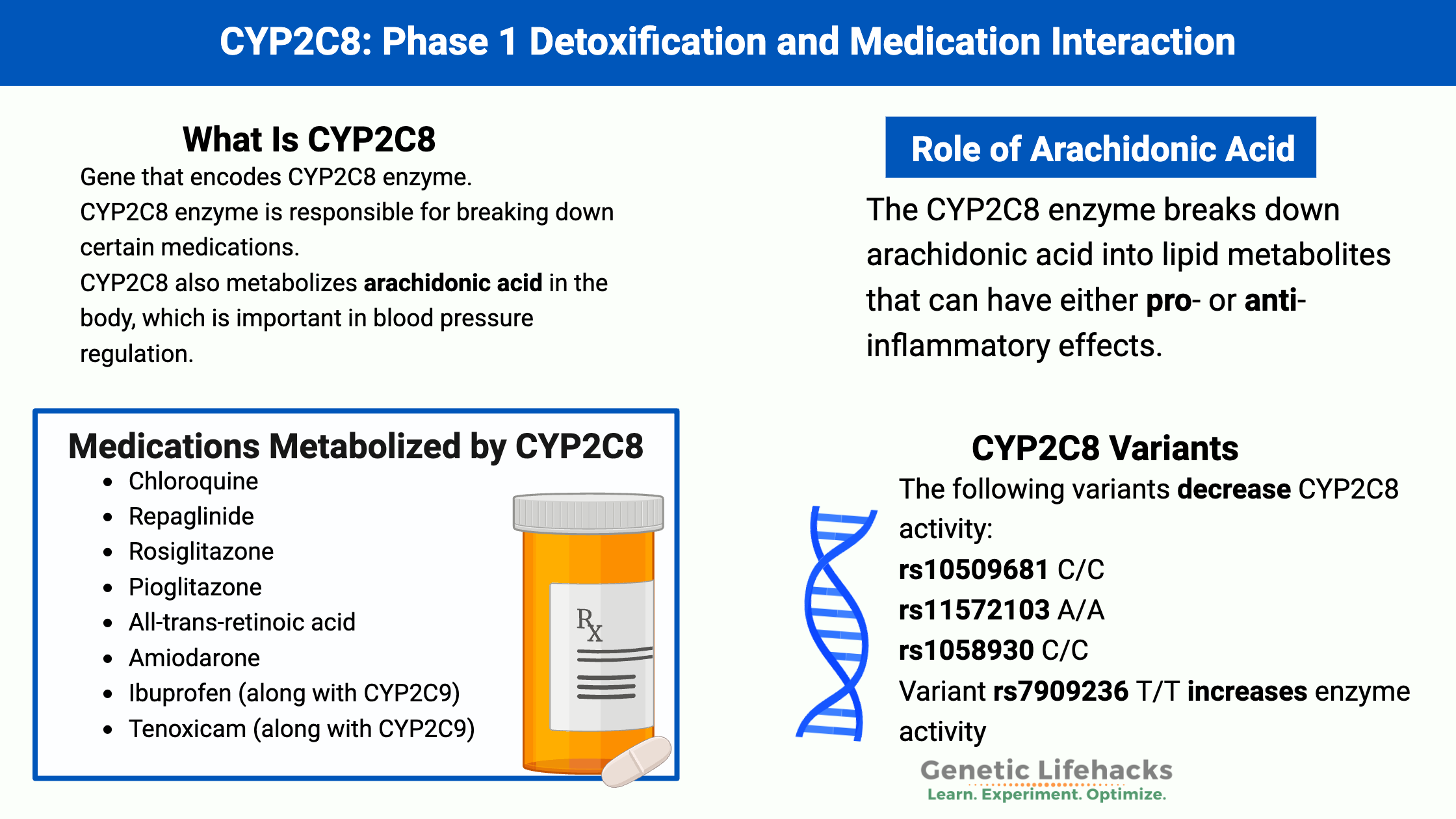
The CYP2C8 enzyme breaks down arachidonic acid into lipid metabolites that can have either pro- or anti-inflammatory effects.[ref] Arachidonic acid is an omega-6 fatty acid that we can get from certain foods or convert from linoleic acid (from soybean oil, corn oil, safflower oil, etc). Arachidonic acid and other polyunsaturated fatty acids can be converted in cells into bioactive molecules that signal for inflammation or for the resolution of inflammation.[ref]

CYP2C8, CYP2C9, and CYP2J2 are all involved in forming epoxyeicosatrienoic acids (EETs) from arachidonic acid. The EETs can be anti-inflammatory and help blood vessels to relax. However, they are short-lived and are broken down into pro-inflammatory molecules when overproduced.[ref] CYP2C8 can also form hydroxyeicosatetraenoic acids (HETEs) primarily in the lungs.[ref]

The metabolism of arachidonic acid by CYP2C8 is also important in eye health in aging. Hypoxia, or low oxygen, increases CYP2C8, which in turn causes more of the conversion of arachidonic acid into epoxyeicosatrienoic acids (EETs). The increased EETs then promote abnormal vascular development in the retina of the eye.

Additionally, the increased CYP2C8 interacted with omega-3 fatty acids, promoting abnormal vascular development with higher levels of DHA in low oxygen conditions.[ref]

Inhibiting CYP2C8 has been shown in studies to decrease the pathological effects in the eye from increased vascular development. This could be important in age-related macular degeneration and diabetic retinopathy.[ref] Please keep in mind that you don’t want to inhibit CYP2C8 if you are on a prescription medication that relies on the enzyme.

Medications metabolized by CYP2C8:

The CYP2C8 gene is essential in the metabolism of several chemotherapy drugs and plays a role in the metabolism of NSAIDs, such as ibuprofen.

Medications that are mainly metabolized by CYP2C8 include[ref]:

  • Chloroquine
  • Repaglinide
  • Rosiglitazone
  • Pioglitazone
  • All-trans-retinoic acid
  • Amiodarone
  • Ibuprofen (along with CYP2C9)
  • Tenoxicam (along with CYP2C9)

For people with genetic variants in CYP2C8 that decrease the function of the enzyme, a medication may remain in their system longer and could build up to a toxic amount. Your doctor or pharmacist should be able to help in dialing in the right dosage.

Keep in mind that some medications can be metabolized using more than one CYP enzyme, so a decrease in CYP2C8 function may interact with other CYP variants in determining your reaction to medications.

The ClinPGx database is a good source of information on pharmacological and genetic interactions. It has information on the CYP2C8 variants and response to tacrolimus, montelukast, rosiglitazone, and pioglitazone.

Natural supplements that interact with CYP2C8:

Natural supplements that you take can also interact with the CYP450 enzymes.

  • quercetin (inhibitor of CYP2C8)[ref]
  • pterostilbene and trans-resveratrol (inhibitor)[ref]
  • luteolin (inhibitor)[ref]
  • diosmetin (inhibitor)[ref]

CYP2C8 Genotype Report:

Members: Log in to see your data below.
Not a member? Join here.


Access this content:

An active subscription is required to access this content.

Join as a member


Lifehacks: What to avoid with CYP2C8 variants

If you have the CYP2C8*3 variant and regularly take NSAIDs, you should talk with your doctor about the increased risk of gastrointestinal bleeding.

Check to see if you also have CYP2C9 variants:

Access this content:

An active subscription is required to access this content.

Join as a member


Related Articles and Topics:

Phase I and Phase II Detoxification Pathways Explained


Nrf2 Pathway: Increasing the Body’s Ability to Get Rid of Toxins


References: 

Agúndez, José A. G., et al. “Genetically Based Impairment in CYP2C8- and CYP2C9-Dependent NSAID Metabolism as a Risk Factor for Gastrointestinal Bleeding: Is a Combination of Pharmacogenomics and Metabolomics Required to Improve Personalized Medicine?” Expert Opinion on Drug Metabolism & Toxicology, vol. 5, no. 6, June 2009, pp. 607–20. PubMed, https://doi.org/10.1517/17425250902970998.
Albassam, Ahmed A., and Reginald F. Frye. “Effect of Pterostilbene on in Vitro Drug Metabolizing Enzyme Activity.” Saudi Pharmaceutical Journal: SPJ: The Official Publication of the Saudi Pharmaceutical Society, vol. 27, no. 3, Mar. 2019, pp. 406–12. PubMed, https://doi.org/10.1016/j.jsps.2019.01.001.
Ammari, Maha Al, et al. “Targeted Next-Generation Sequencing of Genes Involved in Warfarin Pharmacodynamics and Pharmacokinetics Pathways Using the Saudi Warfarin Pharmacogenetic Study (SWAP).” The Pharmacogenomics Journal, vol. 23, no. 4, July 2023, pp. 82–88. PubMed, https://doi.org/10.1038/s41397-023-00300-3.
Aquilante, Christina L., et al. “PharmGKB Summary: Very Important Pharmacogene Information for Cytochrome P450, Family 2, Subfamily C, Polypeptide 8.” Pharmacogenetics and Genomics, vol. 23, no. 12, Dec. 2013, pp. 721–28. PubMed Central, https://doi.org/10.1097/FPC.0b013e3283653b27.
Blanco, Gerardo, et al. “Interaction of CYP2C8 and CYP2C9 Genotypes Modifies the Risk for Nonsteroidal Anti-Inflammatory Drugs-Related Acute Gastrointestinal Bleeding.” Pharmacogenetics and Genomics, vol. 18, no. 1, Jan. 2008, pp. 37–43. PubMed, https://doi.org/10.1097/FPC.0b013e3282f305a9.
Caligiuri, Stephanie P. B., et al. “Dietary Modulation of Oxylipins in Cardiovascular Disease and Aging.” American Journal of Physiology-Heart and Circulatory Physiology, vol. 313, no. 5, Nov. 2017, pp. H903–18. DOI.org (Crossref), https://doi.org/10.1152/ajpheart.00201.2017.
“ClinPGx.” ClinPGx, https://www.clinpgx.org/variant/PA166157968/clinicalAnnotation. Accessed 28 Jan. 2026.
Daily, Elizabeth B, and Christina L Aquilante. “Cytochrome P450 2C8 Pharmacogenetics: A Review of Clinical Studies.” Pharmacogenomics, vol. 10, no. 9, Sept. 2009, pp. 1489–510. PubMed Central, https://doi.org/10.2217/pgs.09.82.
El-Sherbeni, Ahmed A., and Ayman O. S. El-Kadi. “Repurposing Resveratrol and Fluconazole To Modulate Human Cytochrome P450-Mediated Arachidonic Acid Metabolism.” Molecular Pharmaceutics, vol. 13, no. 4, Apr. 2016, pp. 1278–88. PubMed, https://doi.org/10.1021/acs.molpharmaceut.5b00873.
Gong, Yan, et al. “Fenofibrate Inhibits Cytochrome P450 Epoxygenase 2C Activity to Suppress Pathological Ocular Angiogenesis.” EBioMedicine, vol. 13, Nov. 2016, pp. 201–11. ScienceDirect, https://doi.org/10.1016/j.ebiom.2016.09.025.
Hertz, D. L., et al. “CYP2C8*3 Increases Risk of Neuropathy in Breast Cancer Patients Treated with Paclitaxel.” Annals of Oncology: Official Journal of the European Society for Medical Oncology, vol. 24, no. 6, June 2013, pp. 1472–78. PubMed, https://doi.org/10.1093/annonc/mdt018.
Incze, Evelyn, et al. “Potential Association of Cytochrome P450 Copy Number Alteration in Tumour with Chemotherapy Resistance in Lung Adenocarcinoma Patients.” International Journal of Molecular Sciences, vol. 24, no. 17, Aug. 2023, p. 13380. PubMed Central, https://doi.org/10.3390/ijms241713380.
Lee, Craig R., et al. “CYP2J2 and CYP2C8 Polymorphisms and Coronary Heart Disease Risk: The Atherosclerosis Risk in Communities (ARIC) Study.” Pharmacogenetics and Genomics, vol. 17, no. 5, May 2007, pp. 349–58. PubMed Central, https://doi.org/10.1097/FPC.0b013e32809913ea.
Ola, Mohammad S., et al. “Neuroprotective Effects of Quercetin in Diabetic Rat Retina.” Saudi Journal of Biological Sciences, vol. 24, no. 6, Sept. 2017, pp. 1186–94. PubMed, https://doi.org/10.1016/j.sjbs.2016.11.017.
Pang, Chia Yong, et al. “In Vitro Modulatory Effects of Flavonoids on Human Cytochrome P450 2C8 (CYP2C8).” Naunyn-Schmiedeberg’s Archives of Pharmacology, vol. 385, no. 5, May 2012, pp. 495–502. PubMed, https://doi.org/10.1007/s00210-012-0731-5.
Polonikov, Alexey, et al. “The Contribution of CYP2C Gene Subfamily Involved in Epoxygenase Pathway of Arachidonic Acids Metabolism to Hypertension Susceptibility in Russian Population.” Clinical and Experimental Hypertension (New York, N.Y.: 1993), vol. 39, no. 4, 2017, pp. 306–11. PubMed, https://doi.org/10.1080/10641963.2016.1246562.
Quintieri, Luigi, et al. “Inhibition of Cytochrome P450 2C8-Mediated Drug Metabolism by the Flavonoid Diosmetin.” Drug Metabolism and Pharmacokinetics, vol. 26, no. 6, 2011, pp. 559–68. PubMed, https://doi.org/10.2133/dmpk.DMPK-11-RG-048.
Shao, Zhuo, et al. “Cytochrome P450 2C8 Ω3-Long-Chain Polyunsaturated Fatty Acid Metabolites Increase Mouse Retinal Pathologic Neovascularization—Brief Report.” Arteriosclerosis, Thrombosis, and Vascular Biology, vol. 34, no. 3, Mar. 2014, pp. 581–86. PubMed Central, https://doi.org/10.1161/ATVBAHA.113.302927.
Theken, Katherine N., and Craig R. Lee. “Genetic Variation in the Cytochrome P450 Epoxygenase Pathway and Cardiovascular Disease Risk.” Pharmacogenomics, vol. 8, no. 10, Oct. 2007, pp. 1369–83. PubMed, https://doi.org/10.2217/14622416.8.10.1369.
Westphal, Christina, et al. “Cytochrome P450 Enzymes in the Bioactivation of Polyunsaturated Fatty Acids and Their Role in Cardiovascular Disease.” Monooxygenase, Peroxidase and Peroxygenase Properties and Mechanisms of Cytochrome P450, edited by Eugene G. Hrycay and Stelvio M. Bandiera, Springer International Publishing, 2015, pp. 151–87. Springer Link, https://doi.org/10.1007/978-3-319-16009-2_6.
https://drug-interactions.medicine.iu.edu/main-table. Accessed 28 Jan. 2026.

About the Author:
Debbie Moon is a biologist, engineer, author, and the founder of Genetic Lifehacks where she has helped thousands of members understand how to apply genetics to their diet, lifestyle, and health decisions. With more than 10 years of experience translating complex genetic research into practical health strategies, Debbie holds a BS in engineering from Colorado School of Mines and an MSc in biological sciences from Clemson University. She combines an engineering mindset with a biological systems approach to explain how genetic differences impact your optimal health.