
Join Here   |   Log In

GSTM1: GST Enzymes and Glutathione for Environmental Toxins

Key takeaways:
~ The GST family of genes encodes eight different enzymes that combine with glutathione in the elimination of many different environmental toxins.
~ Genetic variants in the GST genes impact your ability to detoxify specific toxins.
~ Understanding where your genetic susceptibility lies may help you to know which toxicants to avoid.

This article explains how glutathione is utilized to detoxify certain toxicants. I’ll explain the glutathione-S-transferase genes and the impact that genetic variants have on phase II detoxification.

Members will see their genotype report below, plus additional solutions in the Lifehacks section. Join today 

GSTs: phase II detoxification enzymes

Exposure to many different man-made chemical compounds occurs every day, and our exposure to new toxicants well exceeds what our ancestors experienced.

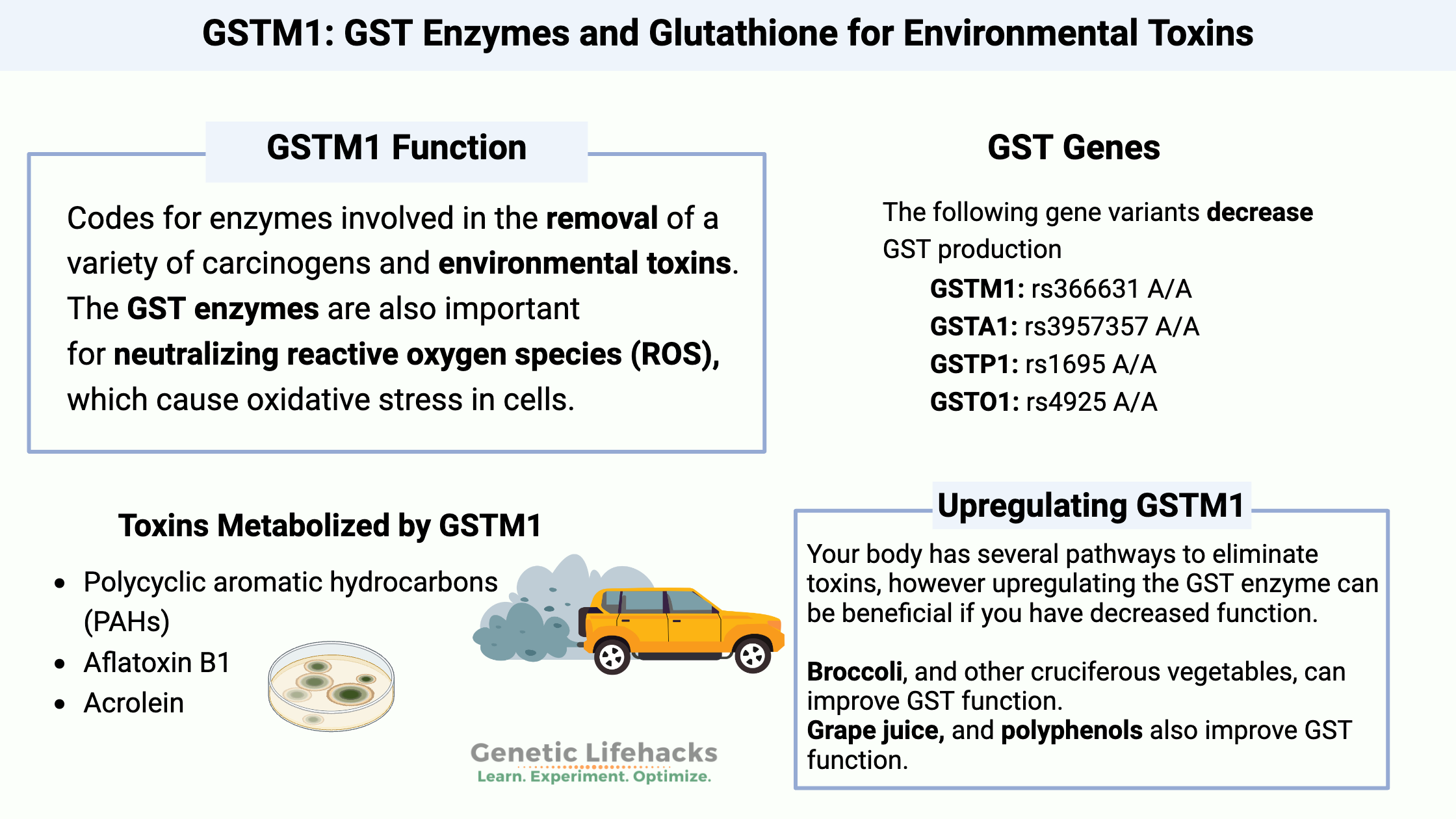
The glutathione S-transferase genes code for enzymes involved in the removal of a variety of carcinogens and environmental toxins.[ref]

These phase II detoxification enzymes combine the metabolites from phase I with molecules that make them less toxic and more easily excreted.

There are eight different enzymes in the GST family of genes identified by Greek letters: alpha, kappa, mu, omega, pi, sigma, theta, and zeta. As such, abbreviations for the classes start with their first letter (i.e., GSTMA for alpha).

The GST enzymes are found in the liver, intestines, and several other tissues. They are responsible for detoxifying a large number of pesticides, herbicides, carcinogens, and chemotherapy drugs.

Glutathione, an endogenous antioxidant

The GST enzymes conjugate (bind) an antioxidant called glutathione to the substance for elimination. Glutathione is considered the master antioxidant for the body.

Related article: Glutathione synthesis and genetic variants

Once a toxic substance has been conjugated with glutathione via the GST-specific enzyme, the body excretes it via bile or urine.

Toxins neutralized by GSTs

The GST enzymes and glutathione conjugation is important in detoxifying hundreds of different environmental toxicants.  Here are just a few  examples:

  • The GST enzymes are essential in detoxifying polycyclic aromatic hydrocarbons (PAHs), which are carcinogenic. Cigarette smoke, diesel exhaust, and grilled meats all contain PAHs.[ref]
  • Aflatoxin B1, a fungal component found on grains and peanuts, is detoxified by conjugation with glutathione using GST enzymes.[ref]
  • Acrolein is an aldehyde used as a pesticide and a byproduct of tobacco smoke. It also forms when frying foods in oil at high temperatures.[ref]

Reducing oxidative stress:

In addition to their role in removing toxicants, the GST enzymes are also important for neutralizing reactive oxygen species (ROS) which cause oxidative stress in cells.[ref][ref]

Genetic variants that decrease GST enzyme function increase the susceptibility to diseases that are caused by oxidative stress, such as neurodegenerative diseases, cancers, epilepsy, and ataxia.[ref]

What happens when you have reduced GST function?

Several fairly common genetic variants can decrease the function of the GST enzymes, but with several different GST enzymes available, your body usually has a backup route for getting rid of toxicants.

Importantly, environmental factors, such as exposure to toxicants (pollution, cigarette smoke), also play a large role here. It really is a matter of genetic susceptibility along with exposure to toxins and carcinogens.

I’ll cover ways to increase GST function in the Lifehacks section.


GST Genotype Report:

Genetic variants greatly impact the way that your GST genes function, with common variants causing non-functioning genes.

Members: Log in to see your data below.
Not a member? Join here.


Access this content:

An active subscription is required to access this content.

Join as a member


Lifehacks: Optimizing diet, supplements, and environment with GST SNPs

There are several dietary ways to naturally increase the amount of GST enzymes the body produces.

Lifestyle factors with GST variants:

Stop smoking and avoid second-hand smoke:
Studies have linked the GSTM1 null genotype with a 46% increase in the risk of lung cancer in smokers.[ref]

Avoid Radon:
People with GSTM1 null genotypes are at a 3-fold increased risk of lung cancer with radon exposure.[ref]

Access this content:

An active subscription is required to access this content.

Join as a member


Related Articles and Topics:

Glutamate Receptors and Transporters

Estrogen: How It Is Made and How We Get Rid of It

BPA and BPS: How Your Genes Influence Bisphenol Detoxification

Phase I and Phase II Detoxification Pathways Explained


References:

Allocati, Nerino, et al. “Glutathione Transferases: Substrates, Inihibitors and pro-Drugs in Cancer and Neurodegenerative Diseases.” Oncogenesis, vol. 7, no. 1, Jan. 2018, p. 8. www.nature.com, https://doi.org/10.1038/s41389-017-0025-3.
Cho, Mi-Ran, et al. “Purple Grape Juice Supplementation in Smokers and Antioxidant Status According to Different Types of GST Polymorphisms.” Journal of Clinical Biochemistry and Nutrition, vol. 56, no. 1, Jan. 2015, pp. 49–56. PubMed Central, https://doi.org/10.3164/jcbn.14-1.
Dragovic, Sanja, et al. “Effect of Human Glutathione S-Transferase hGSTP1-1 Polymorphism on the Detoxification of Reactive Metabolites of Clozapine, Diclofenac and Acetaminophen.” Toxicology Letters, vol. 224, no. 2, Jan. 2014, pp. 272–81. PubMed, https://doi.org/10.1016/j.toxlet.2013.10.023.
“Eating Broccoli May Keep Prostate Cancer Away, Study Suggests.” ScienceDaily, https://www.sciencedaily.com/releases/2008/07/080701221450.htm. Accessed 20 Feb. 2026.
GSTM1 Glutathione S-Transferase Mu 1 [Homo Sapiens (Human)] – Gene – NCBI. https://www.ncbi.nlm.nih.gov/gene?cmd=Retrieve&dopt=full_report&list_uids=2944. Accessed 20 Feb. 2026.
Hayes, J. D., and D. J. Pulford. “The Glutathione S-Transferase Supergene Family: Regulation of GST and the Contribution of the Isoenzymes to Cancer Chemoprotection and Drug Resistance.” Critical Reviews in Biochemistry and Molecular Biology, vol. 30, no. 6, 1995, pp. 445–600. PubMed, https://doi.org/10.3109/10409239509083491.
Jaramillo-Rangel, G., et al. “Polymorphisms in GSTM1, GSTT1, GSTP1, and GSTM3 Genes and Breast Cancer Risk in Northeastern Mexico.” Genetics and Molecular Research: GMR, vol. 14, no. 2, June 2015, pp. 6465–71. PubMed, https://doi.org/10.4238/2015.June.11.22.
Lin, Jie, et al. “Dietary Intake of Vegetables and Fruits and the Modification Effects of GSTM1 and NAT2 Genotypes on Bladder Cancer Risk.” Cancer Epidemiology, Biomarkers & Prevention: A Publication of the American Association for Cancer Research, Cosponsored by the American Society of Preventive Oncology, vol. 18, no. 7, July 2009, pp. 2090–97. PubMed, https://doi.org/10.1158/1055-9965.EPI-08-1174.
Lorenzo-González, María, et al. “Residential Radon, Genetic Polymorphisms in DNA Damage and Repair-Related.” Lung Cancer (Amsterdam, Netherlands), vol. 135, Sept. 2019, pp. 10–15. PubMed, https://doi.org/10.1016/j.lungcan.2019.07.003.
Luo, Lanrong, et al. “Association between Arsenic Metabolism Gene Polymorphisms and Arsenic-Induced Skin Lesions in Individuals Exposed to High-Dose Inorganic Arsenic in Northwest China.” Scientific Reports, vol. 8, Jan. 2018, p. 413. PubMed Central, https://doi.org/10.1038/s41598-017-18925-3.
Menon, Deepthi, et al. “GSTO1-1 Plays a pro-Inflammatory Role in Models of Inflammation, Colitis and Obesity.” Scientific Reports, vol. 7, Dec. 2017, p. 17832. PubMed Central, https://doi.org/10.1038/s41598-017-17861-6.
Miraghaee, Seyyed Shahram, et al. “Assessment of GSTO1 (A140D) and GSTO2 (N142D) Gene Polymorphisms in Iranian Women with Polycystic Ovarian Syndrome.” Reports of Biochemistry & Molecular Biology, vol. 9, no. 1, Apr. 2020, pp. 8–13. PubMed Central, https://doi.org/10.29252/rbmb.9.1.8.
Navarro, Sandi L., et al. “Cruciferous Vegetables Have Variable Effects on Biomarkers of Systemic Inflammation in a Randomized Controlled Trial in Healthy Young Adults12.” The Journal of Nutrition, vol. 144, no. 11, Nov. 2014, pp. 1850–57. PubMed Central, https://doi.org/10.3945/jn.114.197434.
Nock, Nora L., et al. “Polymorphisms in Glutathione S-Transferase Genes Increase Risk of Prostate Cancer Biochemical Recurrence Differentially by Ethnicity and Disease Severity.” Cancer Causes & Control, vol. 20, no. 10, 2009, pp. 1915–26. PubMed Central, https://doi.org/10.1007/s10552-009-9385-0.
Piacentini, Sara, Renato Polimanti, Andrea Iorio, et al. “GSTA1*-69C/T and GSTO2*N142D as Asthma- and Allergy-Related Risk Factors in Italian Adult Patients.” Clinical and Experimental Pharmacology & Physiology, vol. 41, no. 3, Mar. 2014, pp. 180–84. PubMed, https://doi.org/10.1111/1440-1681.12201.
Piacentini, Sara, Renato Polimanti, Flavia Porreca, et al. “GSTT1 and GSTM1 Gene Polymorphisms in European and African Populations.” Molecular Biology Reports, vol. 38, no. 2, Feb. 2011, pp. 1225–30. PubMed, https://doi.org/10.1007/s11033-010-0221-0.
Qiu, Juanjuan, et al. “Association between Polymorphisms in Estrogen Metabolism Genes and Breast Cancer Development in Chinese Women.” Medicine, vol. 97, no. 47, Nov. 2018, p. e13337. PubMed Central, https://doi.org/10.1097/MD.0000000000013337.
Radic, Tanja, et al. “GSTO1*CC Genotype (Rs4925) Predicts Shorter Survival in Clear Cell Renal Cell Carcinoma Male Patients.” Cancers, vol. 11, no. 12, Dec. 2019, p. 2038. PubMed Central, https://doi.org/10.3390/cancers11122038.
Tijhuis, Mariken J., et al. “GSTP1 and GSTA1 Polymorphisms Interact with Cruciferous Vegetable Intake in Colorectal Adenoma Risk.” Cancer Epidemiology, Biomarkers & Prevention: A Publication of the American Association for Cancer Research, Cosponsored by the American Society of Preventive Oncology, vol. 14, no. 12, Dec. 2005, pp. 2943–51. PubMed, https://doi.org/10.1158/1055-9965.EPI-05-0591.
Yang, Haiyan, et al. “The Association of GSTM1 Deletion Polymorphism with Lung Cancer Risk in Chinese Population: Evidence from an Updated Meta-Analysis.” Scientific Reports, vol. 5, Mar. 2015, p. 9392. PubMed, https://doi.org/10.1038/srep09392.
Zhang, Yixiang, et al. “Association between GSTP1 Ile105Val Polymorphism and Urinary System Cancer Risk: Evidence from 51 Studies.” OncoTargets and Therapy, vol. 9, 2016, pp. 3565–69. PubMed, https://doi.org/10.2147/OTT.S106527.
Zhang, Yonglan, et al. “Glutathione S-Transferase Gene Polymorphisms and Risk of Nasal or Colorectal Polyposis.” Bioscience Reports, vol. 39, no. 1, Jan. 2019, p. BSR20181226. PubMed, https://doi.org/10.1042/BSR20181226.
https://carcin.oxfordjournals.org/content/27/9/1876.abstract?ijkey=c50b9fb7d2e7741d297f62910195e9c70c17b714&keytype2=tf_ipsecsha. Accessed 20 Feb. 2026.

About the Author:
Debbie Moon is a biologist, engineer, author, and the founder of Genetic Lifehacks where she has helped thousands of members understand how to apply genetics to their diet, lifestyle, and health decisions. With more than 10 years of experience translating complex genetic research into practical health strategies, Debbie holds a BS in engineering from Colorado School of Mines and an MSc in biological sciences from Clemson University. She combines an engineering mindset with a biological systems approach to explain how genetic differences impact your optimal health.