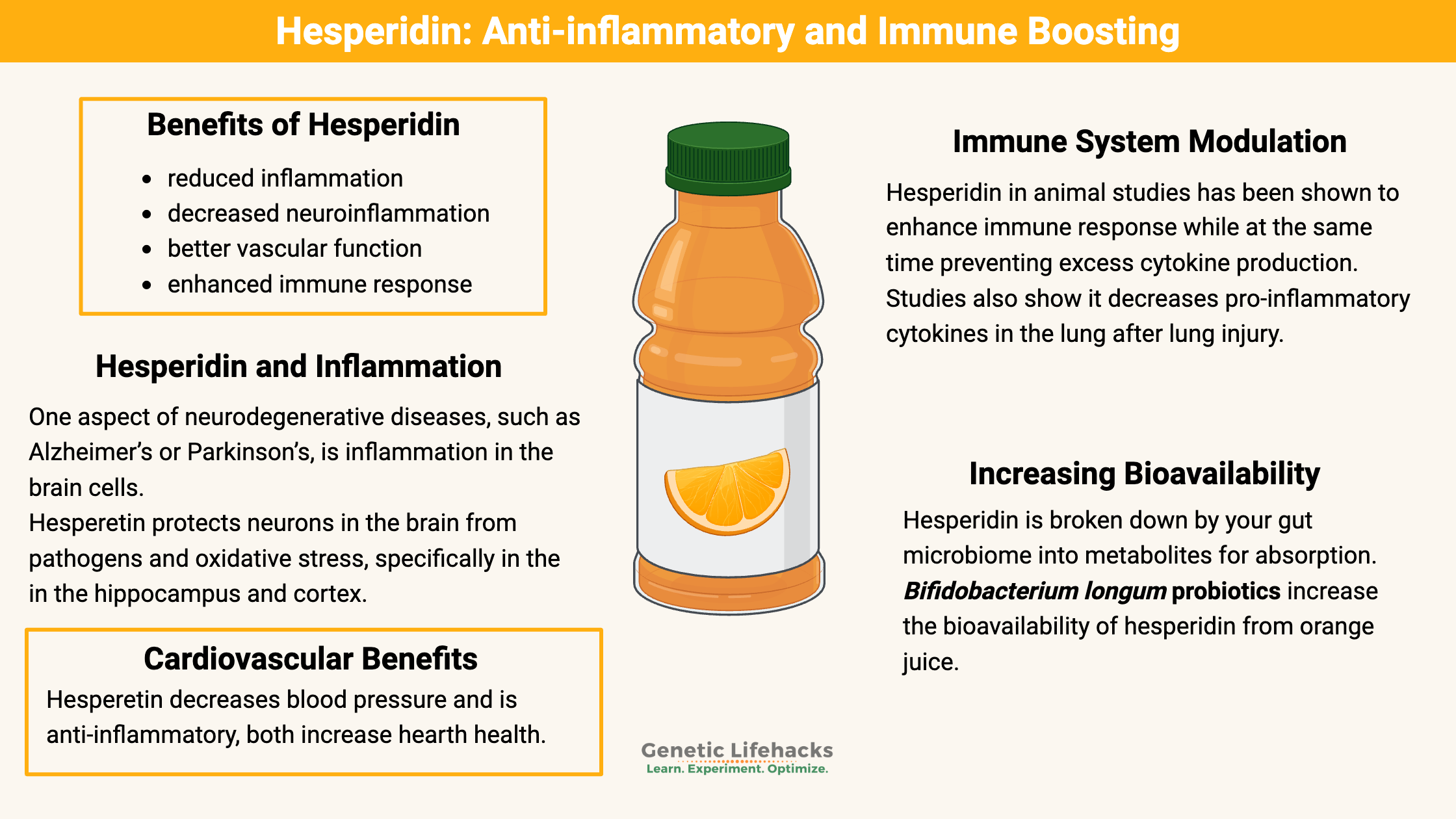
Hesperidin is a flavonoid found in citrus fruits. Its active metabolite is hesperetin, and you will see both mentioned almost interchangeably in studies. Orange juice contains 200-600 mg/L of hesperidin, making up about 90% of the flavonoid content.[ref]
Let’s dig into the details of the studies on hesperidin.
A clinical trial of hesperidin-enriched orange juice (vs an orange-flavored drink) improved cognitive function in older adults.[ref]
Why would a flavonoid affect cognitive function in aging? One driver of cognitive decline and neurodegenerative diseases, such as Alzheimer’s or Parkinson’s, is inflammation in the brain cells. This neuroinflammation involves certain cell types, such as astrocytes and glial cells, which protect the neurons from insults.[ref]
There are several possible causes of neuroinflammation, including pathogens and oxidative stress. Sources of oxidative stress can include heavy metals, pollution, smoking, mold exposure, viral infections, and more.
Several studies on Parkinson’s disease show promise for hesperidin in animal models.[ref]
Animal studies clearly show that hesperetin decreases blood pressure and is anti-inflammatory, thus benefiting the heart.[ref][ref]
As usual, human studies aren’t quite as clear-cut as the animal studies.
Hesperidin supplements (500 mg, 2x a day) reduced fasting glucose, blood pressure, triglycerides, and TNF-α in a placebo-controlled trial on people with metabolic syndrome.[ref]
Another clinical trial using 1g/day of hesperidin also showed decreased triglycerides and lower blood pressure.[ref] And yet another clinical trial with 1g/day also found that hesperidin reduced blood glucose, triglycerides, and LDL.[ref]
A 12-week trial of 1g/day of hesperidin resulted in lower triglycerides, decreased liver fat, and lower inflammatory cytokine markers.[ref]
Hesperidin in animal studies has been shown to enhance immune response while at the same time preventing excess cytokine production.[ref][ref]
Additional animal studies show that hesperidin also decreases pro-inflammatory cytokines in the lung after lung injury.[ref]
Preliminary studies in chronic rhinosinusitis show that hesperidin increases mucosal clearance. This is being looked at for people with cystic fibrosis mutations.[ref]
Numerous studies (mostly animal and cell studies) show that hesperidin inhibits cancer cell proliferation. There are current studies underway investigating the addition of hesperidin to chemotherapy regimens.[ref][ref][ref]
Aggarwal, Vaishali, et al. “Molecular Mechanisms of Action of Hesperidin in Cancer: Recent Trends and Advancements.” Experimental Biology and Medicine (Maywood, N.J.), vol. 245, no. 5, Mar. 2020, pp. 486–97. PubMed, https://doi.org/10.1177/1535370220903671.
Ahmadi, A., et al. “The Role of Hesperidin in Cell Signal Transduction Pathway for the Prevention or Treatment of Cancer.” Current Medicinal Chemistry, vol. 22, no. 30, 2015, pp. 3462–71. PubMed, https://doi.org/10.2174/092986732230151019103810.
Azbell, Christopher, et al. “Hesperidin Stimulates CFTR-Mediated Chloride Secretion and Ciliary Beat Frequency in Sinonasal Epithelium.” Otolaryngology–Head and Neck Surgery : Official Journal of American Academy of Otolaryngology-Head and Neck Surgery, vol. 143, no. 3, Sept. 2010, pp. 397–404. PubMed Central, https://doi.org/10.1016/j.otohns.2010.05.021.
Bellavite, Paolo, and Alberto Donzelli. “Hesperidin and SARS-CoV-2: New Light on the Healthy Function of Citrus Fruits.” Antioxidants, vol. 9, no. 8, Aug. 2020, p. 742. PubMed Central, https://doi.org/10.3390/antiox9080742.
Camps-Bossacoma, Mariona, et al. “Influence of Hesperidin on the Systemic and Intestinal Rat Immune Response.” Nutrients, vol. 9, no. 6, June 2017, p. 580. PubMed Central, https://doi.org/10.3390/nu9060580.
Cheraghpour, Makan, et al. “Hesperidin Improves Hepatic Steatosis, Hepatic Enzymes, and Metabolic and Inflammatory Parameters in Patients with Nonalcoholic Fatty Liver Disease: A Randomized, Placebo-Controlled, Double-Blind Clinical Trial.” Phytotherapy Research: PTR, vol. 33, no. 8, Aug. 2019, pp. 2118–25. PubMed, https://doi.org/10.1002/ptr.6406.
Choi, In-Young, et al. “Hesperidin Inhibits Expression of Hypoxia Inducible Factor-1 Alpha and Inflammatory Cytokine Production from Mast Cells.” Molecular and Cellular Biochemistry, vol. 305, nos. 1–2, Nov. 2007, pp. 153–61. PubMed, https://doi.org/10.1007/s11010-007-9539-x.
Doostdar, H., et al. “Bioflavonoids: Selective Substrates and Inhibitors for Cytochrome P450 CYP1A and CYP1B1.” Toxicology, vol. 144, nos. 1–3, Apr. 2000, pp. 31–38. PubMed, https://doi.org/10.1016/s0300-483x(99)00215-2.
Ferreira de Oliveira, José Miguel P., et al. “Therapeutic Potential of Hesperidin and Its Aglycone Hesperetin: Cell Cycle Regulation and Apoptosis Induction in Cancer Models.” Phytomedicine: International Journal of Phytotherapy and Phytopharmacology, vol. 73, July 2020, p. 152887. PubMed, https://doi.org/10.1016/j.phymed.2019.152887.
Garg, A., et al. “Chemistry and Pharmacology of the Citrus Bioflavonoid Hesperidin.” Phytotherapy Research: PTR, vol. 15, no. 8, Dec. 2001, pp. 655–69. PubMed, https://doi.org/10.1002/ptr.1074.
Hajialyani, Marziyeh, et al. “Hesperidin as a Neuroprotective Agent: A Review of Animal and Clinical Evidence.” Molecules, vol. 24, no. 3, Feb. 2019, p. 648. PubMed Central, https://doi.org/10.3390/molecules24030648.
Homayouni, Fatemeh, et al. “Blood Pressure Lowering and Anti-Inflammatory Effects of Hesperidin in Type 2 Diabetes; a Randomized Double-Blind Controlled Clinical Trial.” Phytotherapy Research: PTR, vol. 32, no. 6, June 2018, pp. 1073–79. PubMed, https://doi.org/10.1002/ptr.6046.
Hou, Maihua, et al. “Topical Hesperidin Improves Epidermal Permeability Barrier Function and Epidermal Differentiation in Normal Murine Skin.” Experimental Dermatology, vol. 21, no. 5, May 2012, pp. 337–40. PubMed Central, https://doi.org/10.1111/j.1600-0625.2012.01455.x.
Kean, Rebecca J., et al. “Chronic Consumption of Flavanone-Rich Orange Juice Is Associated with Cognitive Benefits: An 8-Wk, Randomized, Double-Blind, Placebo-Controlled Trial in Healthy Older Adults.” The American Journal of Clinical Nutrition, vol. 101, no. 3, Mar. 2015, pp. 506–14. PubMed, https://doi.org/10.3945/ajcn.114.088518.
Lin, Cheng-Wen, et al. “Anti-SARS Coronavirus 3C-like Protease Effects of Isatis Indigotica Root and Plant-Derived Phenolic Compounds.” Antiviral Research, vol. 68, no. 1, Oct. 2005, pp. 36–42. PubMed Central, https://doi.org/10.1016/j.antiviral.2005.07.002.
Manach, C., et al. “Bioavailability in Humans of the Flavanones Hesperidin and Narirutin after the Ingestion of Two Doses of Orange Juice.” European Journal of Clinical Nutrition, vol. 57, no. 2, Feb. 2003, pp. 235–42. PubMed, https://doi.org/10.1038/sj.ejcn.1601547.
Muhammad, Tahir, et al. “RETRACTED: Hesperetin, a Citrus Flavonoid, Attenuates LPS-Induced Neuroinflammation, Apoptosis and Memory Impairments by Modulating TLR4/NF-κB Signaling.” Nutrients, vol. 11, no. 3, Mar. 2019, p. 648. PubMed Central, https://doi.org/10.3390/nu11030648.
———. “RETRACTED: Hesperetin, a Citrus Flavonoid, Attenuates LPS-Induced Neuroinflammation, Apoptosis and Memory Impairments by Modulating TLR4/NF-κB Signaling.” Nutrients, vol. 11, no. 3, Mar. 2019, p. 648. PubMed, https://doi.org/10.3390/nu11030648.
Osama, Hasnaa, et al. “The Effect of Hesperidin and Diosmin Individually or in Combination on Metabolic Profile and Neuropathy among Diabetic Patients with Metabolic Syndrome: A Randomized Controlled Trial.” Journal of Dietary Supplements, vol. 20, no. 5, 2023, pp. 749–62. PubMed, https://doi.org/10.1080/19390211.2022.2107138.
Pereira-Caro, Gema, et al. “Chronic Administration of a Microencapsulated Probiotic Enhances the Bioavailability of Orange Juice Flavanones in Humans.” Free Radical Biology & Medicine, vol. 84, July 2015, pp. 206–14. PubMed, https://doi.org/10.1016/j.freeradbiomed.2015.03.010.
Pla-Pagà, Laura, et al. “Effect of the Consumption of Hesperidin in Orange Juice on the Transcriptomic Profile of Subjects with Elevated Blood Pressure and Stage 1 Hypertension: A Randomized Controlled Trial (CITRUS Study).” Clinical Nutrition, vol. 40, no. 12, Dec. 2021, pp. 5812–22. ScienceDirect, https://doi.org/10.1016/j.clnu.2021.10.009.
Rendeiro, Catarina, et al. “Flavanone-Rich Citrus Beverages Counteract the Transient Decline in Postprandial Endothelial Function in Humans: A Randomised, Controlled, Double-Masked, Cross-over Intervention Study.” The British Journal of Nutrition, vol. 116, no. 12, Dec. 2016, pp. 1999–2010. PubMed, https://doi.org/10.1017/S0007114516004219.
Rizza, Stefano, et al. “Citrus Polyphenol Hesperidin Stimulates Production of Nitric Oxide in Endothelial Cells While Improving Endothelial Function and Reducing Inflammatory Markers in Patients with Metabolic Syndrome.” The Journal of Clinical Endocrinology and Metabolism, vol. 96, no. 5, May 2011, pp. E782-792. PubMed, https://doi.org/10.1210/jc.2010-2879.
Ruiz-Iglesias, Patricia, et al. “Influence of Hesperidin on Systemic Immunity of Rats Following an Intensive Training and Exhausting Exercise.” Nutrients, vol. 12, no. 5, May 2020, p. 1291. PubMed Central, https://doi.org/10.3390/nu12051291.
Scoditti, Egeria. “Neuroinflammation and Neurodegeneration: The Promising Protective Role of the Citrus Flavanone Hesperetin.” Nutrients, vol. 12, no. 8, Aug. 2020, p. 2336. PubMed Central, https://doi.org/10.3390/nu12082336.
Stevens, Yala, et al. “The Intestinal Fate of Citrus Flavanones and Their Effects on Gastrointestinal Health.” Nutrients, vol. 11, no. 7, June 2019, p. 1464. PubMed Central, https://doi.org/10.3390/nu11071464.
Yamamoto, Masaki, Hiroko Jokura, et al. “Hesperidin Metabolite Hesperetin-7-O-Glucuronide, but Not Hesperetin-3’-O-Glucuronide, Exerts Hypotensive, Vasodilatory, and Anti-Inflammatory Activities.” Food & Function, vol. 4, no. 9, Sept. 2013, pp. 1346–51. PubMed, https://doi.org/10.1039/c3fo60030k.
Yamamoto, Masaki, Atsushi Suzuki, et al. “Short-Term Effects of Glucosyl Hesperidin and Hesperetin on Blood Pressure and Vascular Endothelial Function in Spontaneously Hypertensive Rats.” Journal of Nutritional Science and Vitaminology, vol. 54, no. 1, Feb. 2008, pp. 95–98. PubMed, https://doi.org/10.3177/jnsv.54.95.
Yari, Zahra, Makan Cheraghpour, et al. “Flaxseed and/or Hesperidin Supplementation in Metabolic Syndrome: An Open-Labeled Randomized Controlled Trial.” European Journal of Nutrition, vol. 60, no. 1, Feb. 2021, pp. 287–98. PubMed, https://doi.org/10.1007/s00394-020-02246-9.
Yari, Zahra, Mina Movahedian, et al. “The Effect of Hesperidin Supplementation on Metabolic Profiles in Patients with Metabolic Syndrome: A Randomized, Double-Blind, Placebo-Controlled Clinical Trial.” European Journal of Nutrition, vol. 59, no. 6, Sept. 2020, pp. 2569–77. PubMed, https://doi.org/10.1007/s00394-019-02105-2.
Yuan, Xiaoyan, et al. “Protective Effect of Hesperidin Against Sepsis-Induced Lung Injury by Inducing the Heat-Stable Protein 70 (Hsp70)/Toll-Like Receptor 4 (TLR4)/ Myeloid Differentiation Primary Response 88 (MyD88) Pathway.” Medical Science Monitor : International Medical Journal of Experimental and Clinical Research, vol. 25, Jan. 2019, pp. 107–14. PubMed Central, https://doi.org/10.12659/MSM.912490.
Zhao, Jing, et al. “Systems Pharmacological Study Illustrates the Immune Regulation, Anti-Infection, Anti-Inflammation, and Multi-Organ Protection Mechanism of Qing-Fei-Pai-Du Decoction in the Treatment of COVID-19.” Phytomedicine, vol. 85, May 2021, p. 153315. PubMed Central, https://doi.org/10.1016/j.phymed.2020.153315.