
Last fact-checked and updated: | Published:
Key takeaways:
- IL-17 is a proinflammatory cytokine produced by T cells, including Th17 cells.
- IL-17 helps coordinate defense against certain extracellular bacteria and fungi, especially at skin and mucosal barriers.
- Some people have a more sensitive immune system and are more prone to inflammatory reactions. Variants in the IL17 genes are part of this.
- Balanced IL-17 is needed – enough to fight off pathogens without an autoimmune or chronic inflammatory response.
Inflammation and IL-17 (Interleukin 17)
IL‑17 (interleukin 17) is an immune signaling protein that helps protect the skin, lungs, mouth, and gut from certain bacteria and fungi. But excessive IL‑17 activity can contribute to chronic inflammation and autoimmune disease. Variants in the IL17A, IL17F, and IL17-pathway genes may shift inflammatory signaling or autoimmune disease susceptibility. They do not diagnose an autoimmune condition, but they can play a role in susceptibility along with other factors.
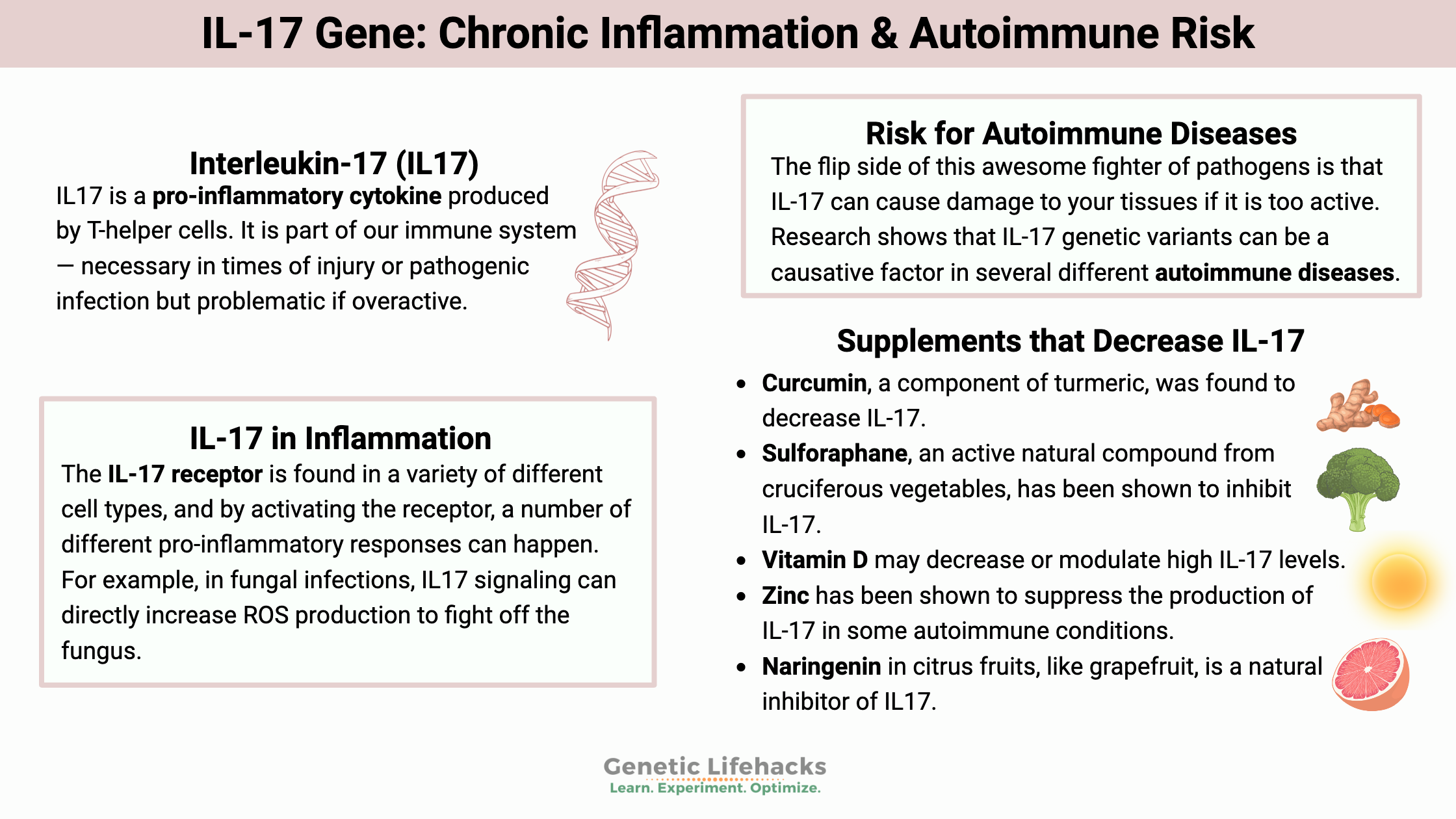
To go a little more in-depth, IL-17 is a pro-inflammatory cytokine produced by T-helper cells. It is part of our immune system — necessary in times of injury or pathogenic infection but problematic if overactive.[ref]
A quick immune system explainer
Our immune system’s composition includes many different parts and is responsible for both fighting off foreign pathogens (bacteria, viruses, etc.) and clearing out old or defective cells in the body. Thus, the immune system needs to recognize which cells are pathogens and which cells are part of the body.
T cells, also called T-lymphocytes, are a type of white blood cell that seek out and destroy pathogens. T cells include several major groups, including CD4+ helper T cells, CD8+ cytotoxic T cells, and regulatory T cells. Th17 cells are a subset of CD4+ helper T cells that produce IL‑17A and IL‑17F, among other signalling molecules.[ref]
Related article: IL-2 Genetics and Immune Balance
IL-17 in Inflammation and Autoimmunity
IL-17 is produced by Th17 and is important in eliminating bacteria and fungi both inside and outside cells.[ref]
IL-17 has six different subtypes, called IL-17A to IL-17F.
Receptor-mediated:
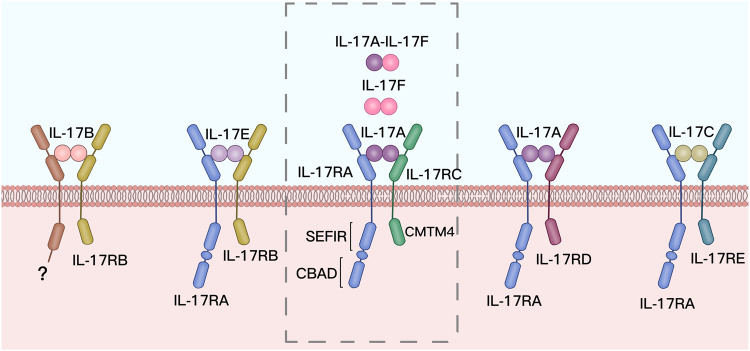
As inflammatory signaling molecules, the different IL-17 subtypes activate receptors on cell membranes of immune system cells and epithelial cells, including those lining the respiratory tract. Both IL‑17A and IL‑17F signal through a receptor complex that includes IL‑17RA and IL‑17RC. They can act individually as IL‑17A or IL‑17F homodimers, or together as an IL‑17A/IL‑17F heterodimer. Their signaling strength and biological effects are not identical, but there is some overlap.
The IL-17 receptor is found in a variety of different cell types, and by activating the receptor, a number of different pro-inflammatory responses can happen. For example, in fungal infections, IL17 signaling can directly increase ROS production to fight off the fungus.[ref]
IL-23 is another inflammatory cytokine that interacts here. IL-23 helps maintain inflammatory type-17 cells; IL-17 mobilizes tissue-level inflammatory and antimicrobial responses. IL-17 can, in turn, promote IL-23 production, creating a reinforcing inflammatory feedback loop.[ref]
Barrier function:
One of the main roles of IL17 is to protect ‘barrier integrity’ – the body’s front line against outside invaders. This means that the IL-17 receptor is found in skin tissue, mucosal tissue, the lungs, and other epithelial cells, such as those lining the intestines. One role of IL-17 is to maintain the tight junctions between the epithelial cells, and another action is to induce the release of antimicrobial chemokines in response to pathogens.[ref]
Pathogen defense – tradeoffs:
IL-17 is important in the defense against tuberculosis (Mycobacterium tuberculosis) and Staph infections on the skin. It is also important in fighting off fungal infections, such as Candida albicans. IL-17 is also important in your body’s defense against whooping cough.[ref] Thus, genetic variants that increased IL-17 were likely an advantage historically, when tuberculosis and pertussis were significant and common threats.
Related article: Candida
PANS and PANDAS: link to IL-17
PANS stands for Pediatric Acute-onset Neuropsychiatric Syndrome. It is a broad term for a sudden change in a child’s behavior and thinking, often associated with OCD like symptoms, mood swings, irritability, and sleep problems. The onset usually follows an illness, with PANDAS being a specific subset that is associated with a Group A strep infection, such as strep throat.
A 2026 study identified IL-17 and the IL-17 receptor as key to PANDAS. The researchers used a mouse model of PANDAS with group A strep infection. They found that repeated Group A Streptococcus (GAS) infections can trigger a Th17-linked neuroinflammatory response relevant to post-streptococcal basal-ganglia disease, including PANDAS-like syndromes. The study identified IL-17A signaling through IL-17RA in microglia as an important contributor to blood–brain barrier (BBB) dysfunction, while emphasizing that blocking IL-17A during an active infection can be harmful. [ref]
A prior study in 2025 found that IL-17 was elevated in both the cerebrospinal fluid (CSF) and serum of pediatric patients with PANS and PANDAS, compared to a control group, with the CSF IL-17 elevation being more significant.[ref] A prior Italian study on PANDAS had shown slightly elevated IL-17 and TNF-alpha in serum samples, but didn’t test CSF.[ref]
Related article: Blood-brain barrier
Increased risk for autoimmune and inflammatory diseases: Excess IL-17 activation
The flip side of this awesome fighter of pathogens is that IL-17 can cause damage to your tissues if it is too active. Research shows that IL-17 genetic variants can play a role in several different autoimmune diseases.[ref][ref]
IL-17 is implicated in increasing the risk for several autoimmune and inflammatory diseases, including psoriasis, Hashimoto’s, and asthma. As mentioned above, IL-17 is mainly active in the epithelial and mucosal regions (lungs, gastrointestinal tract, skin), which explains its role in psoriasis, asthma, and other related conditions.
Genetic variants that increase the body’s production of IL-17A are a risk factor for inflammatory bowel disease (IBD), psoriasis, rheumatoid arthritis, bronchitis severity, gastric cancer, and more.
IL-17A is also implicated in celiac disease, with increased expression of IL-17A found in the intestinal mucosa of Celiac patients. Gluten sensitivity, though, was not found to increase IL-17A.[ref][ref]
Related article: Celiac disease genes & Psoriasis genes & Asthma genes
Chronic itching
IL-17A interacts with your skin microbiome, causing inflammation that drives itching. A 2025 study found that “during inflammation, IL-17A, a response associated with adaptive immunity to the skin microbiota, directly promotes cutaneous hyperinnervation. This process activates regenerative programs within neurons which become maladaptive upon inflammation.” The specific skin bacterium used in the study was Staphylococcus aureus.[ref]
Hidradenitis suppurativa and IL-17
Hidradenitis suppurativa (HS), also called acne inversa, is a skin condition that causes painful, inflammatory boil-like lumps to form under the skin and persist. A 2025 study showed that elevated IL-17A and IL-17F are involved in HS. Dual monoclonal antibody medications are being tested for HS.[ref]
Related article: Hidradenitis supperativa genes
IL-17 Genotype Report
There are genetic variations in IL-17, causing it to be either more active than normal (increasing risk of autoimmune/inflammatory conditions) – OR – less active than normal (protective against autoimmune/inflammatory conditions).
As is almost always the case, diet and environment interact with genetics in the development of chronic diseases. Thus, just carrying the variant doesn’t cause inflammatory diseases, per se, but instead increases the susceptibility to them in conjunction with other factors.
Variants that cause IL-17A to be more active
Studies show the rs2275913 variant (A/A and A/G genotypes) increases the risk of autoimmune diseases, periodontal disease, gastric cancer, and inflammatory bowel diseases. There are hundreds of studies on this variant in different population groups, confirming the increase in IL-17A and an increased risk of inflammatory conditions.
Research & references
Research & references
Protecting against infectious disease: The rs2275913 A/A genotype is protective against infection with Brucella species (brucellosis, bacterial infection)[ref], and against tuberculosis[ref]. Other studies note that people with the AA variant were less likely to get tuberculosis, but if they did get it, the disease’s symptoms could be more severe.[ref] A study in a Chinese population group found that those with A/A or A/G were less likely to get hepatitis B.[ref]
Variants that cause IL-17A to be less active
rs8193037 and rs3819025 variants are linked to a decreased risk of autoimmune diseases in some populations, indicating that IL-17 may be somewhat less active.
Research & references
Research & references
IL-17F genetic variants (more active)
rs763780 variants are associated with increased IL-17 activity. IL-17F is also expressed by Th17 cells.[ref]
Research & references
Access this content:
An active subscription is required to access this content.
Log in below or Join as a member.
Lifehacks: Lifestyle, diet, and supplements that interact with IL-17
Balance is key with the immune response – excess IL-17 is linked to autoimmune and inflammatory conditions, but IL-17 is also important in fighting off specific pathogens.
If you have an increased IL-17 response that is exacerbating an inflammatory condition, you may want to look into natural ways to decrease IL-17.
Keep in mind that tamping down IL-17 may not be a good idea if you’re also trying to fight off a pathogen. Talk with your doctor if you have any questions about supplements and their interactions with medications.
Dietary Changes that Impact IL-17
Salt increases IL-17:
Studies in mice show that a high-salt diet can increase the differentiation of Th17 cells and thus increase IL-17.[ref] Human trials are lacking, but tracking your sodium intake and noting how your symptoms respond is a low-risk experiment. Track how much sodium you consume and talk with your doctor about whether you should try a low-salt diet.
Sprinkle on the spices:
Ursolic acid, which is a natural carboxylic acid found in rosemary and thyme, is a strong inhibitor of IL-17.[ref] It is also a component of rosemary extract, which was traditionally used for treating rashes, wounds, dyspepsia, etc.[ref]
Vitamin C:
Laboratory findings suggest vitamin C can influence T-cell differentiation and IL‑17-related pathways under specific experimental conditions. It appears to upregulate IL-17, which may be good when fighting off a pathogen.[ref] Some vitamin C is essential for your health, and a complete lack of vitamin C results in scurvy. However, if you have an autoimmune disease related to high IL-17, you may want to take this as a heads-up to be on the alert for increased symptoms if supplementing with vitamin C. Talk with your doctor about any questions on supplements.
An apple a day?
Apples contain high concentrations of procyanidin B1 and B2, which inhibit the production of IL17.[ref]
Statins and IL-17
Statins can inhibit IL-17 secretion according to several studies. This may be helpful in autoimmune diseases that are driven by IL-17, but it also may interact with the ability of IL-17 to fight off certain pathogens.[ref]
Related article: Statins and Brain Fog
7 Natural supplements that decrease IL-17
Access this content:
An active subscription is required to access this content.
Log in below or Join as a member.
Related Articles and Topics:
Psoriasis Genes: How genetics point to individualized solutions
TNF-alpha: Inflammation, Chronic Diseases, and Genetic Susceptibility
References:
Wayne, Charlotte R., et al. “Th17 Effector Cytokines Induce Shared and Distinct Microglial and Endothelial Cell Responses in a Mouse Model for Post-Streptococcal Encephalitis.” Nature Communications, vol. 17, Aug. 2026, p. 9658. PubMed Central, https://doi.org/10.1038/s41467-026-76232-w.
Foiadelli, Thomas, et al. “IL-17 in Serum and Cerebrospinal Fluid of Pediatric Patients with Acute Neuropsychiatric Disorders: Implications for PANDAS and PANS.” European Journal of Paediatric Neurology, vol. 54, Jan. 2025, pp. 1–7. DOI.org (Crossref), https://doi.org/10.1016/j.ejpn.2024.11.004.
Leonardi L, et al. Immunological characterization of an Italian PANDAS cohort. Frontiers in Pediatrics. 2024.
Abusleme, Loreto, and Niki M. Moutsopoulos. “IL-17; Overview and Role in Oral Immunity and Microbiome.” Oral Diseases, vol. 23, no. 7, Oct. 2017, pp. 854–65. PubMed Central, https://doi.org/10.1111/odi.12598.