
Join Here   |   Log In

Metformin: Longevity Research and Genetics

A decades-old diabetes drug now holds promise for increasing healthspan. Research shows that metformin may reduce the risk of some of the diseases of aging, thus increasing the number of years someone is healthy.

What is metformin?

Metformin, also known as Glucophage, is the most commonly prescribed medication for reducing blood glucose levels. Metformin prescriptions target people with diabetes, prediabetes, and sometimes PCOS (polycystic ovarian syndrome).

Beyond diabetes, there are also many studies pointing to other positive benefits of metformin as a longevity or healthy aging medication.

How does metformin work?

Metformin has a couple of mechanisms of action:

  1. It decreases glucose production in the liver, which is especially important for overnight blood glucose regulation.
  2. It increases the uptake of glucose in muscles and other parts of the body.

Let’s take a close look at all three of these actions of metformin:

Decreases glucose production in the liver:
When glucose levels in the body fall, such as when fasting or even overnight when sleeping, the liver can produce glucose through a process called gluconeogenesis. This keeps glucose levels in the right range all day and night for people without diabetes.

Research on exactly how metformin decreases gluconeogenesis (glucose production) in the liver isn’t fully elucidated. There seem to be several possibilities:

  • First, metformin may act partially in the mitochondria, inhibiting complex I in the electron transfer chain. This would alter the ratio of AMP (adenosine monophosphate) to ATP (adenosine triphosphate), which triggers AMPK. AMPK does a bunch of things, including decreasing gluconeogenesis.[ref]
  • Second, metformin may be altering the way that lactate is being used for energy in the mitochondria. A January 2020 paper contends that metformin works by decreasing glucose 6-phosphate (G6P).[ref][ref]

New research also questions whether metformin reduces glucose production in the liver for people without type 2 diabetes. The studies indicate that glucose production in the liver may not decrease – and may possibly increase a bit to counteract the drop in blood glucose levels.[ref][ref]

Increases glucose uptake:
Blood glucose levels remain tightly regulated, and the release of insulin by the pancreas facilitates the uptake of glucose into cells. For most cells, glucose can’t cross the cell membrane without a transporter. The glucose transporters are known as GLUT1 through GLUT4, with different transporters in different cell types. The GLUT4 transporters are found in muscle tissue and fat cells. When blood glucose levels are high, the GLUT4 transporters are located in the cytosol of the cell (inside the cell), but when glucose levels fall, insulin levels rise. Insulin then binds to a receptor on the cell membrane, causing a cascade of actions that results in the GLUT4 transporters moving to the cell membrane. There, they can move glucose into the cells.

Metformin is thought to work in a way that keeps the GLUT4 transporters available on the cell surface so that the skeletal muscle cells can take up more glucose without needing more insulin.[ref]

Altered microbiome composition:
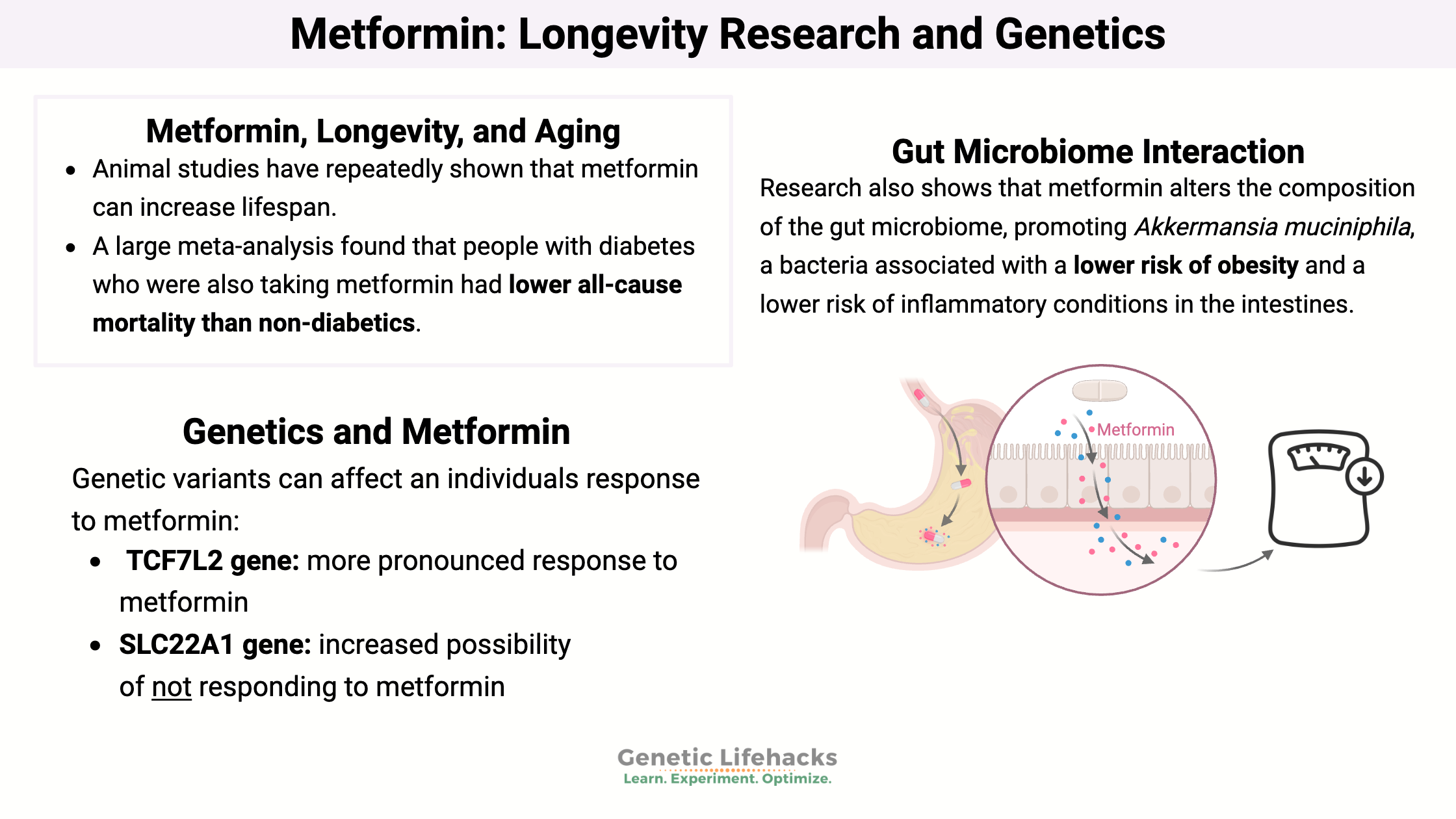
Research also shows that metformin alters the composition of the gut microbiome, promoting Akkermansia muciniphila, a bacteria associated with a lower risk of obesity and a lower risk of inflammatory conditions in the intestines. The altered gut microbiome composition may also be a mechanism through which metformin helps with diabetes. Additionally, metformin has been shown to increase short-chain fatty acid metabolism in the intestines.[ref][ref][ref]

PCOS and metformin:

Polycystic ovarian syndrome (PCOS) is characterized by insulin resistance and altered androgen hormone production. Studies show that metformin may be beneficial for women with PCOS. One study found that 12 weeks of metformin decreased testosterone levels and improved glucose effectiveness.[ref] Read more about PCOS and associated variants here.

Metformin for Longevity and Aging:

Many researchers are now looking at aging as a disease. In fact, the World Health Organization recently added it to its classification system as a disease. With this idea in mind, let’s take a look at the use of metformin to prevent chronic diseases in aging.

Animal studies have repeatedly shown that metformin can increase lifespan. Most of the studies show that starting metformin in middle age or earlier can increase lifespan and health span.[ref][ref][ref]

But humans aren’t the same as mice, and the results of animal studies sometimes don’t hold true for people.

Human studies on metformin show:
A large meta-analysis found that people with diabetes who were also taking metformin had lower all-cause mortality than non-diabetics. They also had lower cardiovascular disease and cancer rates. That is pretty amazing. The study also showed that diabetics taking metformin had lower rates of cancer than diabetics using other types of diabetes medications.[ref]

Another meta-analysis using data from over 1 million patients found that both all-cause mortality and cardiovascular events were reduced significantly (20% for all-cause mortality and over 30% for cardiovascular events).[ref]

Other studies show that all-cause mortality and cancer-related mortality are reduced in people who take metformin.[ref]

Not all human studies show fantastic results:
In a study of heart attack patients, 4 months of metformin did not have beneficial long-term effects.[ref] Other studies show a possible impact that negates the benefits of aerobic exercise.[ref]

How can metformin extend healthspan?

One mechanism (other than decreased blood glucose levels) for a positive effect on healthy aging is that metformin may activate SIRT1. The Sirtuins are a family of enzymes that are important for regulating cellular homeostasis, and SIRT1 (sirtuin 1) is important in healthy aging. A link exists between the activation of SIRT1 and lower rates of cardiovascular and metabolic diseases.[ref][ref]

Another mechanism through which metformin has been shown to act is in the way that mitochondria use fatty acids for energy. The ACAD10 gene codes for an enzyme needed in beta-oxidation and animal studies show that metformin acts through the inhibition of mTORC1 to upregulate ACAD10.[ref]

Impact on muscles:

A Dec 2019 randomized crossover trial shows that 4 days of metformin doesn’t impact skeletal muscle activity. Interestingly, the authors note that metformin caused the participants to feel like exercise took more exertion. Thus, it may cause people to want to exercise a little less.[ref]

In another study in older adults (age ~62), 3 months of metformin seemed to attenuate the benefits of aerobic exercise.[ref]

Potential negative side effects from metformin:

Most importantly, there is an increased risk of lactic acidosis in people taking metformin. This may be more of a risk for people with underlying kidney problems.[ref]

Some people have gastrointestinal side effects from metformin. People with SLC22A1 variants (below) are more likely to have gastrointestinal problems.[ref]

Metformin metabolism and excretion:

Metformin circulates unbound because its metabolism doesn’t occur in the liver. Instead, the kidneys clear it from the body facilitated by SLC22A2 kidney cells. (more on this below)[ref]


Metformin Response Genotype Report:

Access this content:

An active subscription is required to access this content.

Join as a member


Lifehacks:

If you are interested in metformin for longevity, talk with your doctor about whether getting a prescription for it is right for you.

Access this content:

An active subscription is required to access this content.

Join as a member


Related Articles and Topics:

SIRTfoods diet: Sirtuins and Turning on your Skinny Genes

Nicotinamide Riboside and NMN: Boosting NAD+ in Aging with Supplements

Telomere Length: How your Genes affect Telomeres and Aging


References:

Alshawi, Ahmed, and Loranne Agius. “Low Metformin Causes a More Oxidized Mitochondrial NADH/NAD Redox State in Hepatocytes and Inhibits Gluconeogenesis by a Redox-Independent Mechanism.” The Journal of Biological Chemistry, vol. 294, no. 8, Feb. 2019, pp. 2839–53. PubMed, https://doi.org/10.1074/jbc.RA118.006670.
Anisimov, Vladimir N., et al. “If Started Early in Life, Metformin Treatment Increases Life Span and Postpones Tumors in Female SHR Mice.” Aging, vol. 3, no. 2, Feb. 2011, pp. 148–57. PubMed, https://doi.org/10.18632/aging.100273.
Arunachalam, Gnanapragasam, et al. “Metformin Modulates Hyperglycaemia‐induced Endothelial Senescence and Apoptosis through SIRT1.” British Journal of Pharmacology, vol. 171, no. 2, Jan. 2014, pp. 523–35. DOI.org (Crossref), https://doi.org/10.1111/bph.12496.
Campbell, Jared M., et al. “Metformin Reduces All-Cause Mortality and Diseases of Ageing Independent of Its Effect on Diabetes Control: A Systematic Review and Meta-Analysis.” Ageing Research Reviews, vol. 40, Nov. 2017, pp. 31–44. PubMed, https://doi.org/10.1016/j.arr.2017.08.003.
Connelly, Paul J., et al. “Acute Kidney Injury, Plasma Lactate Concentrations and Lactic Acidosis in Metformin Users: A GoDarts Study.” Diabetes, Obesity & Metabolism, vol. 19, no. 11, Nov. 2017, pp. 1579–86. PubMed Central, https://doi.org/10.1111/dom.12978.
Cuyàs, Elisabet, et al. “Metformin Is a Direct SIRT1-Activating Compound: Computational Modeling and Experimental Validation.” Frontiers in Endocrinology, vol. 9, Nov. 2018, p. 657. PubMed Central, https://doi.org/10.3389/fendo.2018.00657.
de la Cuesta-Zuluaga, Jacobo, et al. “Metformin Is Associated With Higher Relative Abundance of Mucin-Degrading Akkermansia Muciniphila and Several Short-Chain Fatty Acid-Producing Microbiota in the Gut.” Diabetes Care, vol. 40, no. 1, Jan. 2017, pp. 54–62. PubMed, https://doi.org/10.2337/dc16-1324.
Dujic, T., et al. “Organic Cation Transporter 1 Variants and Gastrointestinal Side Effects of Metformin in Patients with Type 2 Diabetes.” Diabetic Medicine, vol. 33, no. 4, Apr. 2016, pp. 511–14. PubMed Central, https://doi.org/10.1111/dme.13040.
Dujic, Tanja, et al. “Effects of TCF7L2 Rs7903146 Variant on Metformin Response in Patients with Type 2 Diabetes.” Bosnian Journal of Basic Medical Sciences, vol. 19, no. 4, Nov. 2019, pp. 368–74. PubMed Central, https://doi.org/10.17305/bjbms.2019.4181.
Ebid, Abdel-Hameed I. M., et al. “The Influence of SLC22A1 Rs622342 and ABCC8 Rs757110 Genetic Variants on the Efficacy of Metformin and Glimepiride Combination Therapy in Egyptian Patients with Type 2 Diabetes.” Journal of Drug Assessment, vol. 8, no. 1, June 2019, pp. 115–21. PubMed Central, https://doi.org/10.1080/21556660.2019.1619571.
Gormsen, Lars C., et al. “Metformin Increases Endogenous Glucose Production in Non-Diabetic Individuals and Individuals with Recent-Onset Type 2 Diabetes.” Diabetologia, vol. 62, no. 7, July 2019, pp. 1251–56. PubMed, https://doi.org/10.1007/s00125-019-4872-7.
Goswami, S., et al. “Genetic Variants in Transcription Factors Are Associated With the Pharmacokinetics and Pharmacodynamics of Metformin.” Clinical Pharmacology and Therapeutics, vol. 96, no. 3, Sept. 2014, pp. 370–79. PubMed Central, https://doi.org/10.1038/clpt.2014.109.
Han, Yechen, et al. “Effect of Metformin on All-Cause and Cardiovascular Mortality in Patients with Coronary Artery Diseases: A Systematic Review and an Updated Meta-Analysis.” Cardiovascular Diabetology, vol. 18, no. 1, July 2019, p. 96. PubMed, https://doi.org/10.1186/s12933-019-0900-7.
Hartman, Minke H. T., et al. “Two-Year Follow-up of 4 Months Metformin Treatment vs. Placebo in ST-Elevation Myocardial Infarction: Data from the GIPS-III RCT.” Clinical Research in Cardiology: Official Journal of the German Cardiac Society, vol. 106, no. 12, Dec. 2017, pp. 939–46. PubMed, https://doi.org/10.1007/s00392-017-1140-z.
Haukka, Jari, et al. “Risk of Cause-Specific Death in Individuals with Cancer-Modifying Role Diabetes, Statins and Metformin.” International Journal of Cancer, vol. 141, no. 12, Dec. 2017, pp. 2437–49. PubMed, https://doi.org/10.1002/ijc.31016.
Kim, Jiwoon, et al. “Association between Metformin Dose and Vitamin B12 Deficiency in Patients with Type 2 Diabetes.” Medicine, vol. 98, no. 46, Nov. 2019, p. e17918. PubMed Central, https://doi.org/10.1097/MD.0000000000017918.
Konopka, Adam R., et al. “Metformin Inhibits Mitochondrial Adaptations to Aerobic Exercise Training in Older Adults.” Aging Cell, vol. 18, no. 1, Feb. 2019, p. e12880. PubMed, https://doi.org/10.1111/acel.12880.
Kristensen, Jonas M., et al. “Metformin Does Not Compromise Energy Status in Human Skeletal Muscle at Rest or during Acute Exercise: A Randomised, Crossover Trial.” Physiological Reports, vol. 7, no. 23, Dec. 2019, p. e14307. PubMed, https://doi.org/10.14814/phy2.14307.
Martin-Montalvo, Alejandro, et al. “Metformin Improves Healthspan and Lifespan in Mice.” Nature Communications, vol. 4, 2013, p. 2192. PubMed, https://doi.org/10.1038/ncomms3192.
McCreight, Laura J., et al. “Metformin Increases Fasting Glucose Clearance and Endogenous Glucose Production in Non-Diabetic Individuals.” Diabetologia, vol. 63, no. 2, 2020, pp. 444–47. PubMed Central, https://doi.org/10.1007/s00125-019-05042-1.
Minamii, Takahiro, et al. “Mechanisms of Metformin Action: In and out of the Gut.” Journal of Diabetes Investigation, vol. 9, no. 4, July 2018, pp. 701–03. PubMed Central, https://doi.org/10.1111/jdi.12864.
Moonira, Tabassum, et al. “Metformin Lowers Glucose 6-Phosphate in Hepatocytes by Activation of Glycolysis Downstream of Glucose Phosphorylation.” The Journal of Biological Chemistry, vol. 295, no. 10, Mar. 2020, pp. 3330–46. PubMed, https://doi.org/10.1074/jbc.RA120.012533.
Pau, Cindy T., et al. “Metformin Improves Glucose Effectiveness, Not Insulin Sensitivity: Predicting Treatment Response in Women With Polycystic Ovary Syndrome in an Open-Label, Interventional Study.” The Journal of Clinical Endocrinology and Metabolism, vol. 99, no. 5, May 2014, pp. 1870–78. PubMed Central, https://doi.org/10.1210/jc.2013-4021.
Polianskyte-Prause, Zydrune, et al. “Metformin Increases Glucose Uptake and Acts Renoprotectively by Reducing SHIP2 Activity.” FASEB Journal: Official Publication of the Federation of American Societies for Experimental Biology, vol. 33, no. 2, Feb. 2019, pp. 2858–69. PubMed, https://doi.org/10.1096/fj.201800529RR.
Rodriguez, Julie, et al. “Metformin: Old Friend, New Ways of Action-Implication of the Gut Microbiome?” Current Opinion in Clinical Nutrition and Metabolic Care, vol. 21, no. 4, July 2018, pp. 294–301. PubMed, https://doi.org/10.1097/MCO.0000000000000468.
Sajib, Abu Ashfaqur, et al. “Interaction of Rs316019 Variants of SLC22A2 with Metformin and Other Drugs- an in Silico Analysis.” Journal of Genetic Engineering & Biotechnology, vol. 16, no. 2, Dec. 2018, pp. 769–75. PubMed Central, https://doi.org/10.1016/j.jgeb.2018.01.003.
Song, Jiangbo, et al. “Metformin Prolongs Lifespan through Remodeling the Energy Distribution Strategy in Silkworm, Bombyx Mori.” Aging (Albany NY), vol. 11, no. 1, Jan. 2019, pp. 240–48. PubMed Central, https://doi.org/10.18632/aging.101746.
Srinivasan, Shylaja, et al. “TCF7L2 Genetic Variation Augments Incretin Resistance and Influences Response to a Sulfonylurea and Metformin: The Study to Understand the Genetics of the Acute Response to Metformin and Glipizide in Humans (SUGAR-MGH).” Diabetes Care, vol. 41, no. 3, Mar. 2018, pp. 554–61. PubMed, https://doi.org/10.2337/dc17-1386.
Wu, Lianfeng, et al. “An Ancient, Unified Mechanism for Metformin Growth Inhibition in C. Elegans and Cancer.” Cell, vol. 167, no. 7, Dec. 2016, pp. 1705-1718.e13. PubMed Central, https://doi.org/10.1016/j.cell.2016.11.055.
Yoon, Hwa, et al. “Influences of Organic Cation Transporter Polymorphisms on the Population Pharmacokinetics of Metformin in Healthy Subjects.” The AAPS Journal, vol. 15, no. 2, Feb. 2013, pp. 571–80. PubMed Central, https://doi.org/10.1208/s12248-013-9460-z.

About the Author:
Debbie Moon is a biologist, engineer, author, and the founder of Genetic Lifehacks where she has helped thousands of members understand how to apply genetics to their diet, lifestyle, and health decisions. With more than 10 years of experience translating complex genetic research into practical health strategies, Debbie holds a BS in engineering from Colorado School of Mines and an MSc in biological sciences from Clemson University. She combines an engineering mindset with a biological systems approach to explain how genetic differences impact your optimal health.