
Key takeaways:
- Arsenic exposure can come from well water, rice and rice-based foods, contaminated soil, and some occupational sources. Rice grown in areas with arsenic contamination can absorb high levels of it.
- The body metabolizes inorganic arsenic and excretes it mainly in the urine.
- Variants in genes such as AS3MT and GSTO1 may influence these elimination processes.
- Reduce dietary exposure by varying cereal grains, using low-arsenic water for cooking and drinking, and using rice-cooking methods that discard excess water.
This article covers the pathways the body uses to get rid of arsenic and includes information on genetic variants that may impair the detoxification of arsenic.
Members will see their genotype report below and the solutions in the Lifehacks section. Consider joining today.Arsenic, detoxification pathways, and genetics:
Arsenic is a naturally occurring metalloid, and exposure occurs via drinking water and certain foods, such as rice. Long-term exposure to inorganic arsenic can negatively affect health, so the most important step is identifying and reducing the source. This article explains arsenic metabolism, genes that influence excretion, and practical ways to lower exposure.
Your body has built-in pathways for removing arsenic. It is a naturally occurring toxin, and all animals have detoxification pathways for getting rid of it – up to a point… Arsenic is, of course, deadly at certain levels. The level at which someone is likely to have negative effects from arsenic depends, in part, on their genetic variants. Variants in genes involved in arsenic biotransformation, methylation, and glutathione pathways may influence how efficiently arsenic is processed and how susceptible someone is to its effects.
Exposure sources
Arsenic is naturally occurring at different levels in the soil and groundwater. In certain areas, pollution from ore smelting is a cause of high levels of inorganic arsenic in the soil, which is found as arsenite (AsIII) and arsenate (AsV). Arsenic historically was used as a pesticide, especially in cotton fields, and in pressure-treated lumber. While no longer used, arsenic remains in the soil in many areas.
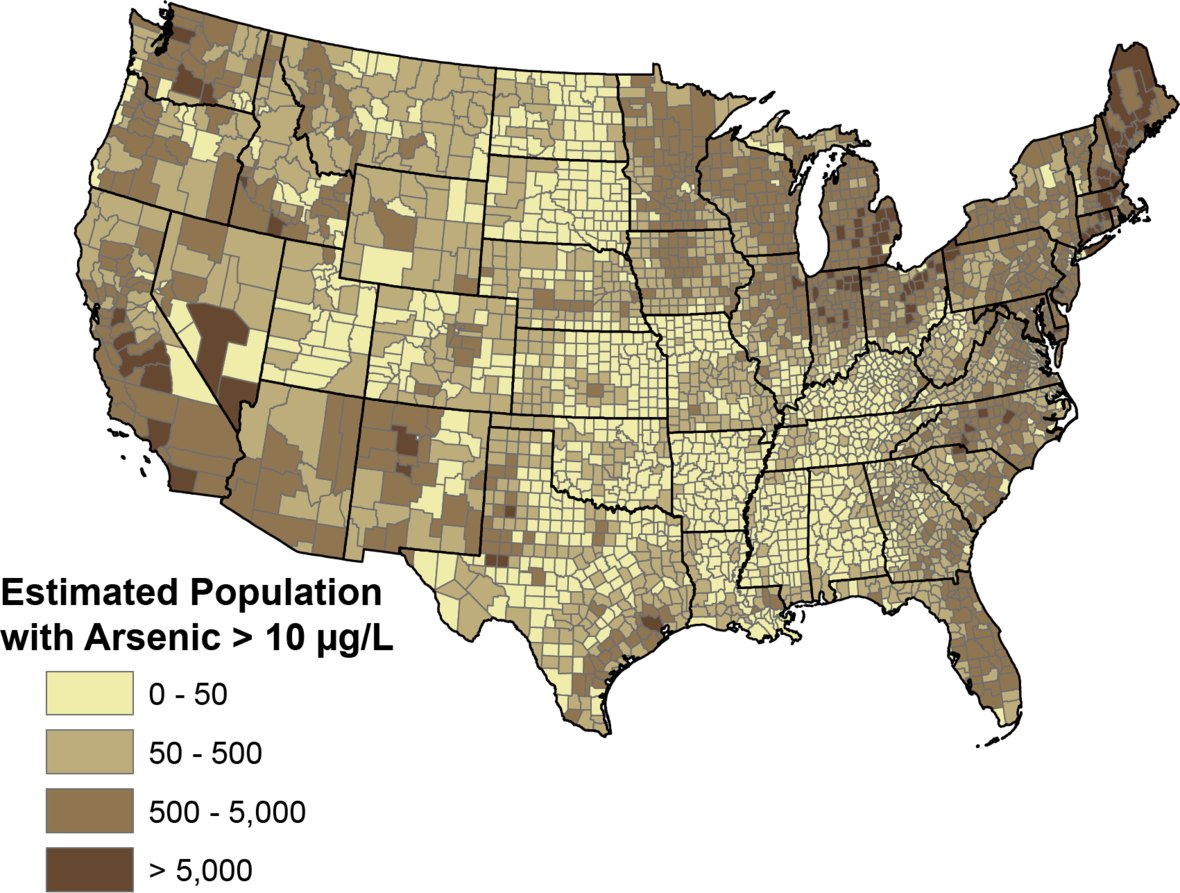
In the US, it is estimated that about 7% of water wells contain arsenic at or above 10 µg/L, which is the EPA target level set in 2006 for public water systems.[ref]
If you live in the US, here is a USGS map showing counties with higher exposure to arsenic in the well water.
Arsenic can also be found in foods grown in contaminated soil or water. Rice readily takes up inorganic arsenic, and where rice is grown affects the amount of arsenic it contains. Organic brown rice grown in Australia contains about the maximum WHO-recommended daily limit of arsenic. It compares with rice from India, which had about a quarter of that amount.[ref] Rice grown in areas of the southern US is often contaminated with arsenic that was left in the soil from historic use of arsenic-based pesticides for growing cotton.
In fact, people eating a gluten-free diet in the US are, on average, exposed to a lot more arsenic from rice. A study showed that people eating gluten-free had almost double the arsenic concentration in their urine. Another study in children diagnosed with celiac disease and going on a gluten-free diet showed their arsenic levels more than tripled. This is due to gluten-free bread, pasta, pizza, and pretzels being made from rice flour.[ref][ref]
The good news is that your body has built-in ways of getting rid of arsenic.
How the body metabolizes and eliminates arsenic
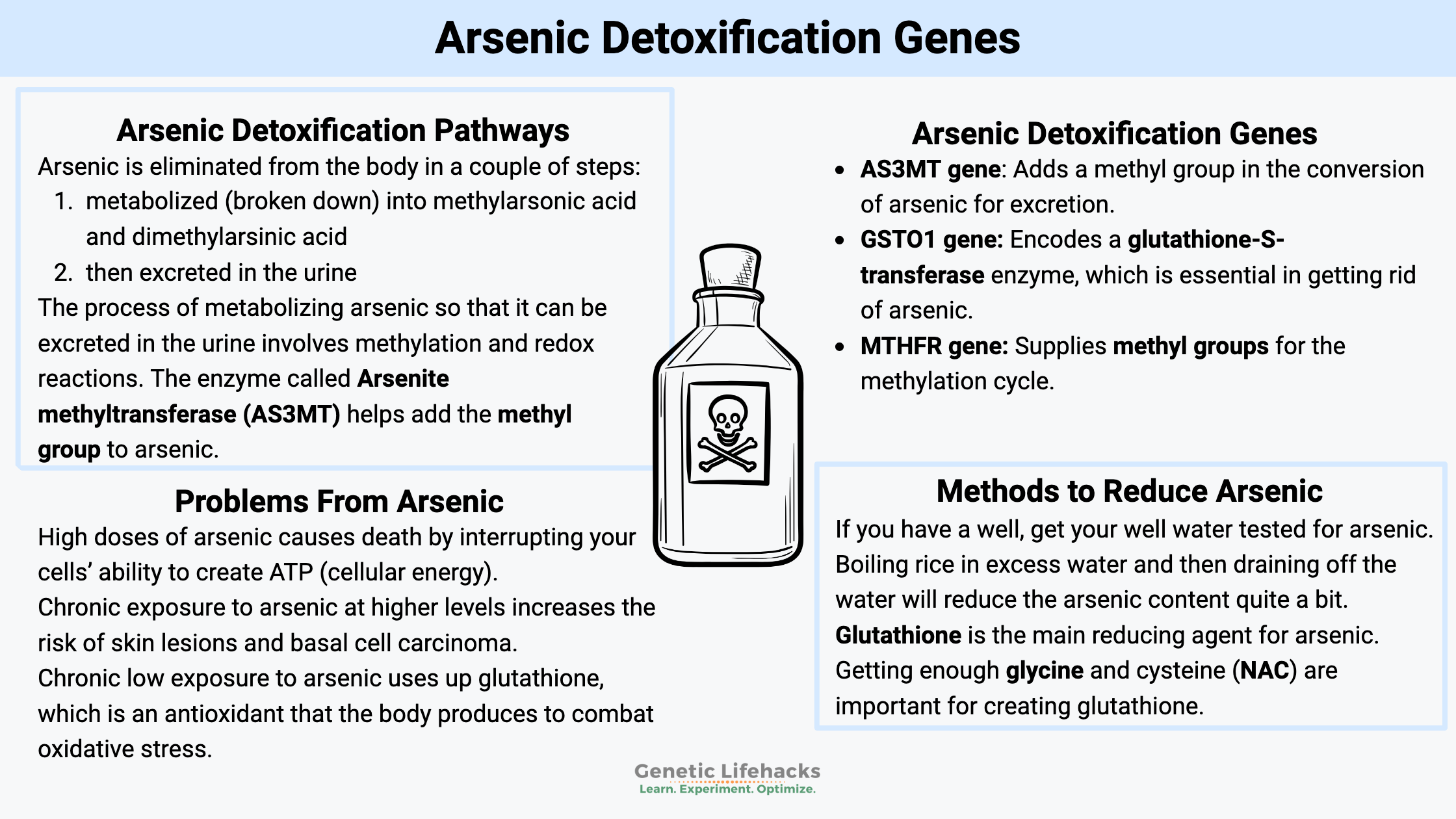
Inorganic arsenic is eliminated from the body in a couple of steps:
- Biotransformed into methylarsonic acid and dimethylarsinic acid
- Arsenic metabolites (some of which are also toxic) are excreted primarily in the urine
Getting a little more in-depth:
The process of metabolizing arsenic so that it can be excreted in the urine involves methylation and redox reactions. Methylation refers to adding a methyl (CH3) group to the molecule. The redox reaction involves glutathione as the reducing agent. The key is that once this detoxification starts, the process needs to continue to the point of excretion. This is because some of the intermediates that are formed are even more toxic than the original arsenic.[ref]
Related article: Methylation cycle genes
The enzyme called Arsenite methyltransferase (AS3MT) helps add the methyl group to arsenic. Because it uses a methyl group, the detoxification process depends on the body having sufficient methyl groups available.
Your cells use glutathione for the redox reactions that occur during arsenic metabolism. Glutathione is the body’s master antioxidant, neutralizing free radicals and reducing oxidative stress. Thus, adequate glutathione is also necessary here.
Related article: Glutathione genes
After arsenic is biotransformed, the metabolites are excreted in the kidneys using efflux transporters, primarily ABCC4. Variants in ABCC4 can affect arsenic excretion.[ref]
Related article: ABCC4 genetic variants
Health effects of arsenic exposure:
A bit of history: You’ve likely heard of arsenic as a poison, perhaps from Agatha Christie. Arsenic trioxide was called “succession” or “inheritance powder”, and was historically used in Italy and France to poison several leaders. The Borgia family in Italy is famous for using a little arsenic in wine to gain wealth and power. In the Victorian era, a pale complexion was all the rage. Women would mix vinegar, chalk, and arsenic trioxide together and eat it to become pale. Essentially, they were poisoning themselves slightly in the name of beauty.[ref]
The dose makes the poison, or so the saying goes. Let’s take a look at how high doses of arsenic differ from low-level environmental exposure.
Acute arsenic poisoning from high doses:
A high dose of arsenic causes death by interrupting your cells’ ability to create ATP (cellular energy). Arsenic in different forms can affect either glycolysis (turning glucose into energy) or the Krebs cycle (producing ATP/energy in the mitochondria). As you can imagine, reducing the production of ATP isn’t a great idea. If you reduce ATP enough, cell death occurs. This is the basis for arsenic poisoning, eventually causing death at higher levels. [ref]
This same property of inducing cell death is why a form of inorganic arsenic is actually used as chemotherapy for Acute Promyelocytic Leukemia (APL). APL causes abnormal, immature white blood cells to crowd out healthy blood cells, and arsenic trioxide induces apoptosis specifically in the mutated cells.
Skin lesions and skin cancer from chronic exposure
Chronic exposure to inorganic arsenic at higher levels (>100 μg/L in drinking water) significantly increases the risk of skin lesions, and higher arsenic exposure significantly increases the risk of skin cancers.[ref]
To put numbers on this: A 2025 meta-analysis found that arsenic exposure increased the relative risk of melanoma by 52%, squamous cell carcinoma by 64%, and basal cell carcinoma by 36%.[ref][ref][ref][ref]
Explaining relative risk: When looking at studies that show an increased risk, the risk is usually given as relative risk – how much the risk increases compared to the baseline incidence. For example, basal cell carcinoma is fairly common. In fair-skinned people, the lifetime risk is 30% or 30 out of every 100 people will likely be diagnosed with it. An increase in relative risk of 36% from arsenic exposure would mean the absolute risk rises to 40% or 40 out of 100 people. For a less common cancer, like melanoma, which affects 3% of fair-skinned people, an increase in relative risk of 50% would mean the absolute risk rises to 4.5%.
Across the board, at higher levels, arsenic increases the risk of skin lesions, hyperkeratosis, or cancer for everyone. But depending on genetics, some people may be at an increased risk of cancer or lesions with only moderate levels of arsenic exposure. For example, genetic variants associated with less efficient arsenic methylation are linked to an increase in the risk of basal cell carcinoma.[ref]
You may wonder if showering or bathing in arsenic water causes skin cancer. That doesn’t seem to be the case. Arsenic is not well absorbed transdermally; instead, the arsenic consumed (food, water) concentrates in skin, hair, and nails.[ref]
Breast cancer risk from arsenic (plus genetic risk factors):
Exposure to arsenic in drinking water is also associated with an increased relative risk of breast cancer of 10-15%, depending on the study. While this is a very small increase in relative risk, when stratified by genetic variants in the AS3MT gene, the risk jumps to a 2- to 3-fold increased relative risk, which is very significant.[ref][ref]
Higher levels of arsenic measured in the urine are consistently linked to increased breast cancer risk. Here are several recent studies on urinary arsenic and breast cancer incidence:
- A large 2023 Canadian study conference abstract showed that women with higher urinary arsenic levels were at a 2-fold increased risk of breast cancer.[ref] A 2026 follow-up study found a 3-fold increase in breast cancer for women with urinary arsenic levels in the top 25%.[ref]
- A 2019 study in Polish women showed that the top quartile of urinary arsenic increased breast cancer risk significantly, with a 13-fold risk increase compared to the lowest quartile. (Note that the magnitude there is likely due to a smaller sample size)[ref]
- A 2025 meta-analysis examined data from 16 epidemiological studies and found that arsenic levels were significantly higher in breast cancer patients than controls in both blood and hair samples.[ref]
Not all studies agree. As an example, a 2025 study in women in Chile, where groundwater arsenic levels can be very high, showed no association with breast cancer risk in a study involving 505 breast cancer cases and a control group of 409 women. Of note here is that everyone (both controls and cancer patients) had higher arsenic levels due to environmental exposure.[ref]
Lung cancer, bladder cancer, overall cancer:
In addition to the epidemiological and animal studies showing that arsenic exposure increases skin and breast cancer risk, a number of studies show that the incidence of lung, bladder, and overall cancer risk is increased with higher inorganic arsenic levels.
A study in Chile showed that lung cancer risk increased significantly with higher quartiles of arsenic exposure. Cigarette smoking was an additive factor – those in the upper 25% of arsenic exposure who also smoked were at a 32-fold increased risk of lung cancer. (Again, the magnitude here may be off due to small sample size of that specific group.)[ref] Other epidemiological studies in regions with higher natural arsenic levels show a similar pattern of lung cancer increase. [ref][ref]
Similarly, multiple epidemiological studies show that bladder cancer incidence rises significantly with higher levels of arsenic in the drinking water.[ref] A meta-analysis involving 28 studies showed that “the predicted risks for bladder cancer incidence were 2.7 [1.2-4.1]; 4.2 [2.1-6.3] and; 5.8 [2.9-8.7] for drinking water arsenic levels of 10, 50, and 150 μg/L, respectively.” [ref] However, in areas where arsenic in the water tends to be lower, the association with bladder cancer risk is only seen in people who both smoke and were exposed to slightly higher arsenic levels. [ref]
Chronic low exposure to arsenic uses up glutathione
While lower amounts of arsenic in drinking water (<50 μg/L) may not cause death or cancer, there can be long-term consequences.
Constantly detoxifying arsenic uses a lot of glutathione. Glutathione is an antioxidant that the body produces to combat oxidative stress in cells and to detoxify several different substances, including arsenic.[ref]
When arsenic is methylated in the first step of detoxification, the intermediary compounds produced are actually more toxic than the original inorganic arsenic. If the cells don’t have enough glutathione or methyl groups available to complete metabolism and excretion processes, the toxic metabolites can hang out in the body for too long. This is one way that arsenic increases the risk of cancer.[ref]
Mitochondrial function:
Arsenic can also increase cellular oxidative stress in several ways, such as impacting mitochondrial energy production. Nrf2 is one way that cells can combat oxidative stress. Indeed, research shows that arsenic exposure upregulates the Nrf2 pathway, and Nrf2 protects cells against arsenic.[ref]
Related article: Nrf2 pathway and genes
Heart disease:
Higher exposure to arsenic over 10 years in community well water is associated with an increased risk of heart disease. The large epidemiological study involved almost 100,000 women and showed an increased relative risk of heart disease of more than 20%.[ref]
Alzheimer’s disease:
A 2026 study of over 1 million people in Sweden looked at the effect of living in areas with higher arsenic in the groundwater vs. medium or low levels of arsenic exposure. The results showed a 156% increased relative risk of Alzheimer’s for those with high groundwater arsenic (>10 µg/l), with high-middle and low-middle arsenic levels increasing risk by 98% and 47% – compared to the lowest levels(<2 µg/l).[ref] Of note here is that in the US, arsenic is allowed in municipal water supplies at up to 10 µg/l, and well water in a lot of areas exceeds that level naturally.
Gut barrier disruption:
Animal research shows that arsenic in drinking water can disrupt the gut mucosal barrier, increasing gut leakiness. It also affects the composition of the gut microbiome.[ref]
We are all unique in how well we metabolize and eliminate arsenic, so let’s look at how your genes influence all these different steps in arsenic detoxification.
Genotype Report: Arsenic Metabolism Genes
What genetics can and cannot tell you: Genetic variants listed here are showing the results of population-level studies. They do not measure current exposure or diagnose impaired clearance. Take into consideration your overall health, diet, and environmental exposure when deciding whether arsenic is something you should be concerned about.
Access this content:
An active subscription is required to access this content.
Log in below or Join as a member.
Lifehacks: Ways to mitigate exposure and detoxify arsenic
For ongoing arsenic exposure, the most effective intervention is identifying and reducing the source—especially contaminated drinking water. After that, look at the amount consumed in foods, and then at ways to support your ability to metabolize and detoxify arsenic.
Test if you’re drinking well water:
The biggest source of arsenic exposure for most people is drinking well water that has high levels. Water testing is relatively inexpensive and will let you know your exposure. If your well water comes back higher in arsenic, consider remediating with a reverse osmosis filter system or talk with a local water filtration expert about what types of filters work best in your area.
What if you drink municipal tap water?
The Environmental Working Group has reports on municipal drinking water contamination in the US, but your best bet for accurate information is to reach out to your municipal water supplier and ask for their latest test numbers.
Water filter pitchers to get rid of arsenic:
ConsumerLab.com has tested a bunch of different pitcher-type water filters for their ability to remove arsenic from the water. The ZeroWater, Travel Berkey, and Pur ’20 filters removed about 90% of arsenic. Other commonly used filter pitchers didn’t remove much arsenic at all.[ref]
Cooking methods to reduce arsenic:
Rice is one of the biggest sources of dietary arsenic since it takes up and stores arsenic from the soil and groundwater. Rice from the southern US is especially high in arsenic, on average, due to residual arsenic in the soils from old pesticides used on cotton.
There are two ways of preparing rice that can decrease the arsenic content:
- Boiling rice in excess water (like you do pasta) and then draining off the water will reduce the arsenic content quite a bit.[ref]
- Soak or even parboil the rice first (discarding the soaking water) and then cook normally to decrease arsenic.[ref]
Of note here… if you cook rice in well water that contains arsenic, the rice will absorb the arsenic from the water.[ref]
ConsumerLab.com has also tested rice for arsenic levels and ranked them based on cost per gram of rice and arsenic. They found that Trader Joe’s Jasmine rice was the second least expensive ($0.11 per serving) and also contained the second least amount of arsenic (0.05 mcg/g). Out of all of the different types of rice, ConsumerLab found that the ‘safest’ (<0.01 mcg/g of arsenic) were seven white rices and one brown rice. No long-grain or wild rices were found to be safe for infant consumption. One brand of forbidden rice, Lotus Foods Organic Forbidden Rice, had arsenic levels that exceeded recommended levels for adults or children.
Folate and B12:
Get your methylation cycle on track. The methylation cycle is at the heart of many processes in the body, including arsenic detoxification.[ref] If you carry the MTHFR C677T variant, it is essential to get enough folate daily. Higher levels of folate intake reduce the risk of arsenic toxicity.[ref] Case studies and epidemiological studies also show that MTHFR variants increase the risk of problems from arsenic exposure — in the context of low folate intake.[ref][ref]
Related article: MTHFR C677T
Foods high in folate include dark leafy green vegetables, lentils, and beef liver. Additionally, methylfolate supplements are available. The recommended daily intake of folate is 400 mcg, with an upper limit set at 1,000 mcg (1 mg). Vitamin B12 is also essential for methylation cycle function, with one study showing that low B12 levels interacted with methylation cycle variants in arsenic detoxification.[ref]
Check your COMT variants before supplementing with high doses of methyl-donor supplements.
Your genotype for COMT rs4680 is —, which means your connected data file indicates slow COMT function. Some people with slow COMT report irritability or mood changes when taking methyl donors or COMT inhibitors. Read the full article on COMT here.
Gluten-free products and rice-based cereals:
ConsumerLab.com notes that a 2026 study found that rice-based cereals had about 12X the arsenic content of other cereals. They didn’t quantify the amount, so we can’t know exact numbers here, but it is important to keep in mind that rice containing arsenic may be incorporated into cereal, bread, crackers, pasta, or pretzels. The group Gluten Free Watchdog also tests gluten-free flour products for arsenic.
As mentioned above, a study showed that people eating gluten-free had almost double the arsenic concentration in their urine due to the rice flour in gluten-free bread, pasta, and pretzels.[ref]
Infants, children, and pregnant women should be particularly careful with arsenic exposure in food and water. The FDA’s action level for inorganic arsenic in infant rice cereal is 100 µg/kg, and rice cereal is recognized as a potentially important exposure source for infants. Varying the cereal grains and sources of grains may be beneficial.
Lifestyle factors:
Smoking and drinking alcohol both decrease your ability to get rid of arsenic, so avoiding cigarette smoking and excess alcohol is a good idea to better allow your body to naturally metabolize and excrete arsenic. (Yes, not smoking or drinking in excess is good for a lot of reasons.)[ref]
Testing your arsenic levels:
Urinary arsenic tests are available and can be ordered through your healthcare provider. Importantly, you want to make sure that you don’t eat seafood for several days before the test. Seafood can be high in organic arsenic, which isn’t carcinogenic or toxic, but can show up on the test. So you want to make sure that your urinary test results are showing just the inorganic arsenic levels.[ref]
Supplements that may help improve arsenic detoxification:
Access this content:
An active subscription is required to access this content.
Log in below or Join as a member.
Related Articles and Topics:
Nrf2 Pathway: Increasing the Body’s Ability to Get Rid of Toxins
References:
Amorós, Rubén, et al. “Selenium Status during Pregnancy: Influential Factors and Effects on Neuropsychological Development among Spanish Infants.” The Science of the Total Environment, vol. 610–611, Jan. 2018, pp. 741–49. PubMed, https://doi.org/10.1016/j.scitotenv.2017.08.042.
Argos, Maria, et al. “A Prospective Study of Arsenic Exposure from Drinking Water and Incidence of Skin Lesions in Bangladesh.” American Journal of Epidemiology, vol. 174, no. 2, July 2011, pp. 185–94. PubMed, https://doi.org/10.1093/aje/kwr062.
Arsenic: A Murderous History | Dartmouth Toxic Metals. https://sites.dartmouth.edu/toxmetal/arsenic/arsenic-a-murderous-history/.
Choudhury, Sreetama, et al. “Pomegranate Protects against Arsenic-Induced P53-Dependent ROS-Mediated Inflammation and Apoptosis in Liver Cells.” The Journal of Nutritional Biochemistry, vol. 38, Dec. 2016, pp. 25–40. PubMed, https://doi.org/10.1016/j.jnutbio.2016.09.001.
Cao, Siyan, et al. “Subchronic Arsenic Exposure Induced Intestinal Microbiota Dysbiosis and Intestinal Inflammation via Activating the NF-κB Signaling Pathway.” Food and Chemical Toxicology, vol. 211, May 2026, p. 115991. DOI.org (Crossref), https://doi.org/10.1016/j.fct.2026.115991.
Christoforidou, Eleni P., et al. “Bladder Cancer and Arsenic through Drinking Water: A Systematic Review of Epidemiologic Evidence.” Journal of Environmental Science and Health, Part A, vol. 48, no. 14, Dec. 2013, pp. 1764–75. DOI.org (Crossref), https://doi.org/10.1080/10934529.2013.823329.
Engström, Karin S., et al. “Genetic Variation in Arsenic (+3 Oxidation State) Methyltransferase ( AS3MT ), Arsenic Metabolism and Risk of Basal Cell Carcinoma in a E Uropean Population.” Environmental and Molecular Mutagenesis, vol. 56, no. 1, Jan. 2015, pp. 60–69. DOI.org (Crossref), https://doi.org/10.1002/em.21896.
García-Alvarado, Francisco Javier, et al. “[Polymorphisms of the Arsenite Methyltransferase (As3MT) gene and urinary efficiency of arsenic metabolism in a population in northern Mexico].” Revista Peruana De Medicina Experimental Y Salud Publica, vol. 35, no. 1, Mar. 2018, pp. 72–76. PubMed, https://doi.org/10.17843/rpmesp.2018.351.3565.
Hu, Yuxin, et al. “The Role of Reactive Oxygen Species in Arsenic Toxicity.” Biomolecules, vol. 10, no. 2, Feb. 2020, p. 240. PubMed Central, https://doi.org/10.3390/biom10020240.
Kile, Molly L., and Alayne G. Ronnenberg. “Can Folate Intake Reduce Arsenic Toxicity?” Nutrition Reviews, vol. 66, no. 6, June 2008, pp. 349–53. PubMed Central, https://doi.org/10.1111/j.1753-4887.2008.00043.x.
Luo, Lanrong, et al. “Association between Arsenic Metabolism Gene Polymorphisms and Arsenic-Induced Skin Lesions in Individuals Exposed to High-Dose Inorganic Arsenic in Northwest China.” Scientific Reports, vol. 8, Jan. 2018, p. 413. PubMed Central, https://doi.org/10.1038/s41598-017-18925-3.
Martinez, Victor D., et al. “Induction of Human Squamous Cell-Type Carcinomas by Arsenic.” Journal of Skin Cancer, vol. 2011, 2011, p. 454157. PubMed Central, https://doi.org/10.1155/2011/454157.
Marciniak, Wojciech, et al. “Blood Arsenic Levels and the Risk of Familial Breast Cancer in Poland.” International Journal of Cancer, vol. 146, no. 10, May 2020, pp. 2721–27. PubMed Central, https://doi.org/10.1002/ijc.32595.
Miraghaee, Seyyed Shahram, et al. “Assessment of GSTO1 (A140D) and GSTO2 (N142D) Gene Polymorphisms in Iranian Women with Polycystic Ovarian Syndrome.” Reports of Biochemistry & Molecular Biology, vol. 9, no. 1, Apr. 2020, pp. 8–13. PubMed Central, https://doi.org/10.29252/rbmb.9.1.8.
Nikravesh, Mehrad, et al. “Relationship Between Arsenic in Biological Media and Breast Cancer: A Systematic Review and Meta-Analysis.” Biological Trace Element Research, vol. 203, no. 1, Jan. 2025, pp. 61–68. DOI.org (Crossref), https://doi.org/10.1007/s12011-024-04157-w.
Pullella, Katherine, et al. “Urinary Arsenic Levels and Risk of Breast Cancer among Women in the Canadian Health Measures Survey: A Population-Based Prospective Study.” Environmental Research, vol. 295, Mar. 2026, p. 123791. DOI.org (Crossref), https://doi.org/10.1016/j.envres.2026.123791.
Rahman, M. Azizur, et al. “Arsenic Speciation in Australian-Grown and Imported Rice on Sale in Australia: Implications for Human Health Risk.” Journal of Agricultural and Food Chemistry, vol. 62, no. 25, June 2014, pp. 6016–24. DOI.org (Crossref), https://doi.org/10.1021/jf501077w.
Rodrigues, Ema G., et al. “GSTO and AS3MT Genetic Polymorphisms and Differences in Urinary Arsenic Concentrations among Residents in Bangladesh.” Biomarkers, vol. 17, no. 3, May 2012, pp. 240–47. PubMed Central, https://doi.org/10.3109/1354750X.2012.658863.
“Rice Reviews & Top Picks.” ConsumerLab.Com, https://www.consumerlab.com/reviews/white-jasmine-thai-hom-mali-basmati-enriched-brown-black-wild-combination-rice/rice/. Accessed 14 Sept. 2026.
Sage, Adam P., et al. “Oncogenomic Disruptions in Arsenic-Induced Carcinogenesis.” Oncotarget, vol. 8, no. 15, Feb. 2017, pp. 25736–55. PubMed Central, https://doi.org/10.18632/oncotarget.15106.
Saint-Jacques, Nathalie, et al. “Arsenic in Drinking Water and Urinary Tract Cancers: A Systematic Review of 30 Years of Epidemiological Evidence.” Environmental Health, vol. 13, no. 1, Dec. 2014, p. 44. DOI.org (Crossref), https://doi.org/10.1186/1476-069X-13-44.
Shen, Hui, et al. “Factors Affecting Arsenic Methylation in Arsenic-Exposed Humans: A Systematic Review and Meta-Analysis.” International Journal of Environmental Research and Public Health, vol. 13, no. 2, Feb. 2016, p. 205. PubMed Central, https://doi.org/10.3390/ijerph13020205.
Skröder, Helena, et al. “Associations between Methylated Metabolites of Arsenic and Selenium in Urine of Pregnant Bangladeshi Women and Interactions between the Main Genes Involved.” Environmental Health Perspectives, vol. 126, no. 2, Feb. 2018, p. 027001. PubMed Central, https://doi.org/10.1289/EHP1912.
Stajnko, Anja, et al. “Arsenic Metabolites; Selenium; and AS3MT, MTHFR, AQP4, AQP9, SELENOP, INMT, and MT2A Polymorphisms in Croatian-Slovenian Population from PHIME-CROME Study.” Environmental Research, vol. 170, Mar. 2019, pp. 301–19. PubMed, https://doi.org/10.1016/j.envres.2018.11.045.
US EPA, OW. Chemical Contaminant Rules. 13 Oct. 2015, https://www.epa.gov/dwreginfo/chemical-contaminant-rules.
Valenzuela, Olga L., et al. “Association of AS3MT Polymorphisms and the Risk of Premalignant Arsenic Skin Lesions.” Toxicology and Applied Pharmacology, vol. 239, no. 2, Sept. 2009, pp. 200–07. PubMed, https://doi.org/10.1016/j.taap.2009.06.007.
Wan, Lin, et al. “Methylenetetrahydrofolate Reductase and Psychiatric Diseases.” Translational Psychiatry, vol. 8, no. 1, Nov. 2018, pp. 1–12. www.nature.com, https://doi.org/10.1038/s41398-018-0276-6.
Wei, Dang, et al. “Association between Arsenic Exposure and the Risk of Alzheimer’s Disease: A Cohort Study in Sweden.” Journal of Alzheimer’s Disease, vol. 110, no. 4, Apr. 2026, pp. 1840–49. DOI.org (Crossref), https://doi.org/10.1177/13872877261427465.
Wlodarczyk, Bogdan J., et al. “Mthfr Gene Ablation Enhances Susceptibility to Arsenic Prenatal Toxicity.” Toxicology and Applied Pharmacology, vol. 275, no. 1, Feb. 2014, pp. 22–27. PubMed Central, https://doi.org/10.1016/j.taap.2013.12.014.