Key takeaways
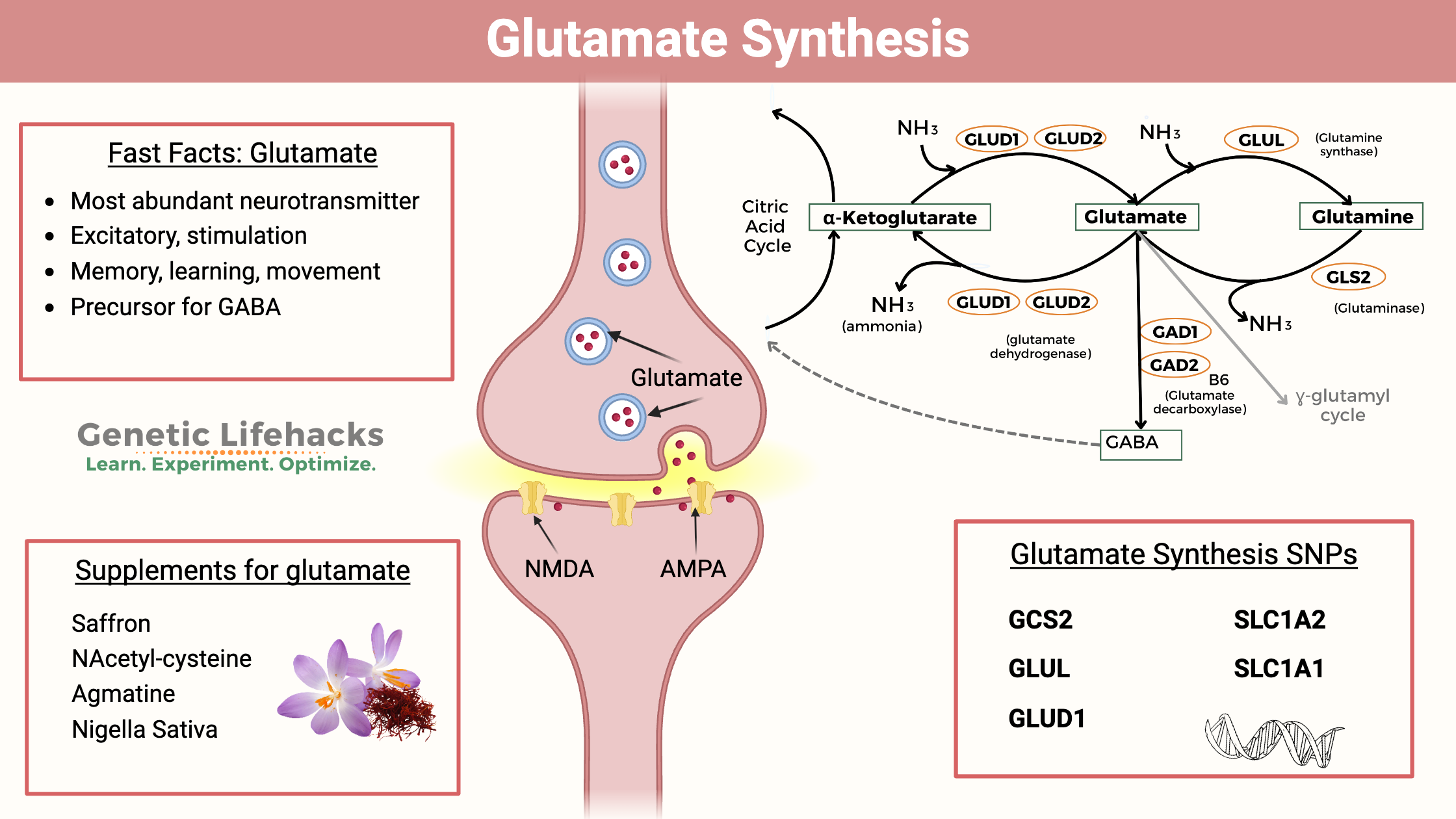
~ Glutamate is the most abundant neurotransmitter in the brain and periphery.
~ Cells can make glutamate from glutamine or alpha-ketoglutarate.
~ There are genetic variants that impact glutamate levels a bit, but overall, glutamate levels are tightly controlled by multiple pathways.
~ Altered glutamate signaling is implicated in schizophrenia, OCD, and migraines.
Members will see their genotype report below, plus additional solutions in the Lifehacks section. Consider joining today.
What is glutamate?
Glutamate is the major excitatory neurotransmitter in the central nervous system (CNS). It’s important for learning, memory, and mood, but it’s not as well known as other neurotransmitters like dopamine or serotonin.
As an excitatory neurotransmitter, glutamate is essential for learning, attention, and focus – but too much glutamate causes too much stimulation in the brain. A balance between stimulation and inhibition is needed.
Let’s look at the research on how glutamate is synthesized, what receptors it binds to, and why it is so important for cognitive function.
How glutamate is synthesized:
Glutamate is the most abundant free amino acid in the brain.[ref] As an excitatory amino acid, glutamate levels are strictly controlled by several mechanisms. Glutamate can be synthesized from multiple sources and can also be converted into other neurotransmitters or amino acids. These pathways interact to keep glutamate levels at the right balance.
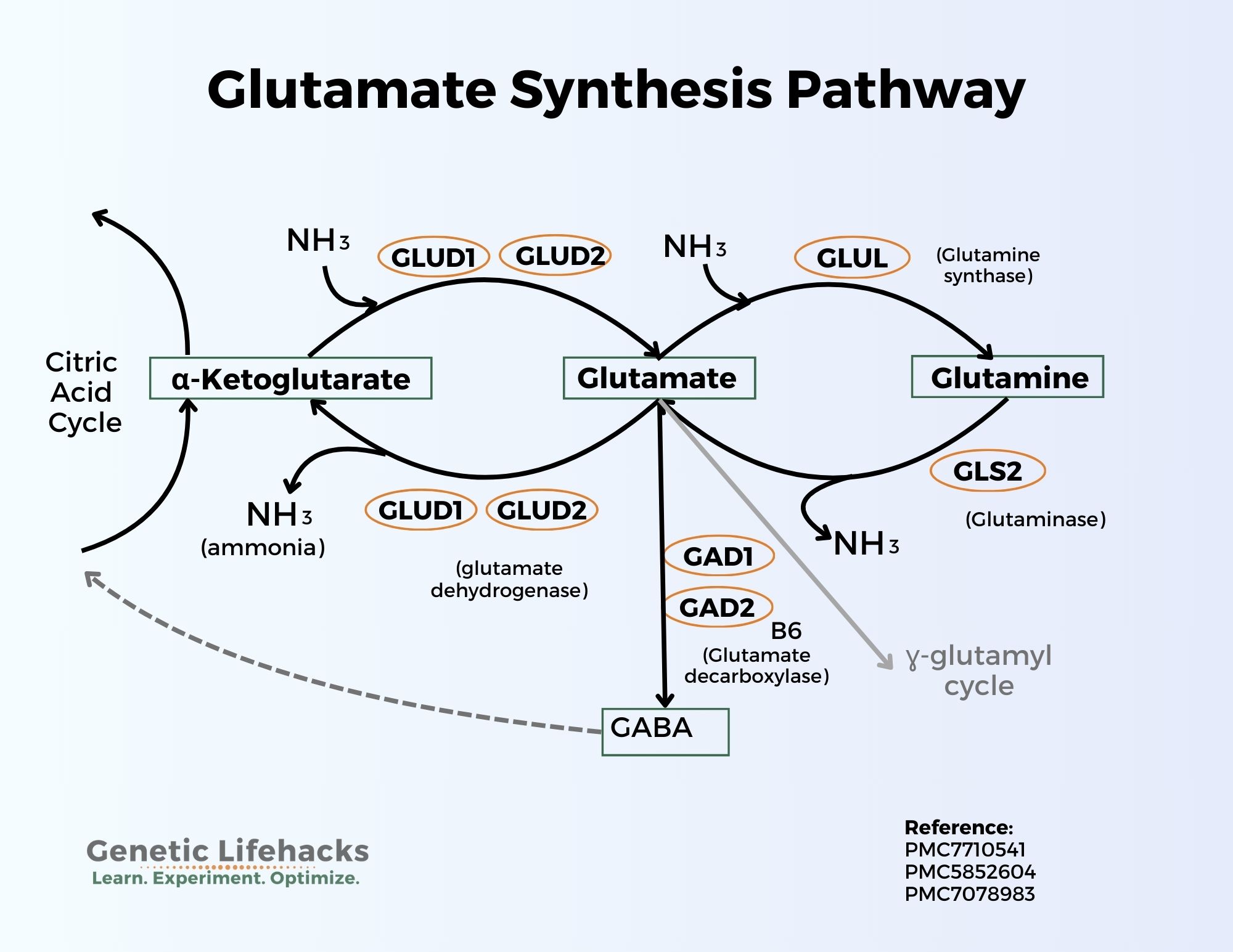
Here’s a graphical overview of the synthesis pathways:
Glutamate from glutamine:
Glutamate can be synthesized from the amino acid glutamine with the help of the enzyme glutaminase (GLS and GLS2 genes). This conversion releases a molecule of ammonia (NH3). In neurons, glutamate is then packaged into synaptic vesicles by vesicular glutamate transporters (VGLUTs) and stored in the presynaptic terminal before release.
The conversion of glutamine to glutamate is a two-way street. Glutamate can also be converted to glutamine with the addition of a molecule of ammonia (NH3).
Glutamine is the most abundant free amino acid in the body. In addition to being used to synthesize glutamate, glutamine is incorporated into many proteins and can be used for nucleotide synthesis. It is considered “conditionally essential,” meaning that most of the time the body can make enough glutamine, but during times of stress (illness, etc.) the demand for glutamine may be such that it is needed from food or supplements.[ref]
Access this content:
An active subscription is required to access this content.
Brandley, Elizabeth T., et al. “The Effect of the Low Glutamate Diet on the Reduction of Psychiatric Symptoms in Veterans With Gulf War Illness: A Pilot Randomized-Controlled Trial.” Frontiers in Psychiatry, vol. 13, 2022, p. 926688. PubMed, https://doi.org/10.3389/fpsyt.2022.926688.
Coqueiro, Audrey Yule, et al. “Glutamine as an Anti-Fatigue Amino Acid in Sports Nutrition.” Nutrients, vol. 11, no. 4, Apr. 2019, p. 863. PubMed, https://doi.org/10.3390/nu11040863.
Cruzat, Vinicius, et al. “Glutamine: Metabolism and Immune Function, Supplementation and Clinical Translation.” Nutrients, vol. 10, no. 11, Oct. 2018, p. 1564. PubMed Central, https://doi.org/10.3390/nu10111564.
D’Onofrio, Grazia, et al. “Crocus Sativus L. (Saffron) in Alzheimer’s Disease Treatment: Bioactive Effects on Cognitive Impairment.” Current Neuropharmacology, vol. 19, no. 9, 2021, pp. 1606–16. PubMed, https://doi.org/10.2174/1570159X19666210113144703.
Gadow, Kenneth D., et al. “Brief Report: Glutamate Transporter Gene (SLC1A1) Single Nucleotide Polymorphism (Rs301430) and Repetitive Behaviors and Anxiety in Children with Autism Spectrum Disorder.” Journal of Autism and Developmental Disorders, vol. 40, no. 9, Sept. 2010, pp. 1139–45. PubMed Central, https://doi.org/10.1007/s10803-010-0961-7.
Gallois, Apolline, et al. “A Comprehensive Study of Metabolite Genetics Reveals Strong Pleiotropy and Heterogeneity across Time and Context.” Nature Communications, vol. 10, no. 1, Oct. 2019, p. 4788. PubMed, https://doi.org/10.1038/s41467-019-12703-7.
Gasiorowska, Anna, et al. “The Biology and Pathobiology of Glutamatergic, Cholinergic, and Dopaminergic Signaling in the Aging Brain.” Frontiers in Aging Neuroscience, vol. 13, July 2021. Frontiers, https://doi.org/10.3389/fnagi.2021.654931.
Gautam, Deepa, Arundhati Tiwari, et al. “Glutamate Induces Synthesis of Thrombogenic Peptides and Extracellular Vesicle Release from Human Platelets.” Scientific Reports, vol. 9, June 2019, p. 8346. PubMed Central, https://doi.org/10.1038/s41598-019-44734-x.
Gautam, Deepa, Ulhas P. Naik, et al. “Glutamate Receptor Dysregulation and Platelet Glutamate Dynamics in Alzheimer’s and Parkinson’s Diseases: Insights into Current Medications.” Biomolecules, vol. 13, no. 11, Nov. 2023, p. 1609. PubMed, https://doi.org/10.3390/biom13111609.
Gipson, Cassandra D., et al. “Interactions of Neuroimmune Signaling and Glutamate Plasticity in Addiction.” Journal of Neuroinflammation, vol. 18, Feb. 2021, p. 56. PubMed Central, https://doi.org/10.1186/s12974-021-02072-8.
Haroon, Ebrahim, et al. “Inflammation, Glutamate, and Glia: A Trio of Trouble in Mood Disorders.” Neuropsychopharmacology, vol. 42, no. 1, Jan. 2017, pp. 193–215. PubMed Central, https://doi.org/10.1038/npp.2016.199.
He, Jason L., et al. “Region-Specific Elevations of Glutamate + Glutamine Correlate with the Sensory Symptoms of Autism Spectrum Disorders.” Translational Psychiatry, vol. 11, no. 1, July 2021, p. 411. www.nature.com, https://doi.org/10.1038/s41398-021-01525-1.
Ji, Chenhui, et al. “Microglial Glutaminase 1 Deficiency Mitigates Neuroinflammation Associated Depression.” Brain, Behavior, and Immunity, vol. 99, Jan. 2022, pp. 231–45. ScienceDirect, https://doi.org/10.1016/j.bbi.2021.10.009.
Karthik, Sheshachala, et al. “Investigating the Role of Glutamate in Obsessive-Compulsive Disorder: Current Perspectives.” Neuropsychiatric Disease and Treatment, vol. 16, Apr. 2020, pp. 1003–13. PubMed Central, https://doi.org/10.2147/NDT.S211703.
Kettunen, Johannes, et al. “Genome-Wide Association Study Identifies Multiple Loci Influencing Human Serum Metabolite Levels.” Nature Genetics, vol. 44, no. 3, Jan. 2012, pp. 269–76. PubMed Central, https://doi.org/10.1038/ng.1073.
Kruse, Andreas O., and Juan R. Bustillo. “Glutamatergic Dysfunction in Schizophrenia.” Translational Psychiatry, vol. 12, no. 1, Dec. 2022, p. 500. www.nature.com, https://doi.org/10.1038/s41398-022-02253-w.
Langan, Mackenzie T., et al. “Low Glutamate Diet Improves Working Memory and Contributes to Altering BOLD Response and Functional Connectivity within Working Memory Networks in Gulf War Illness.” Scientific Reports, vol. 12, no. 1, Oct. 2022, p. 18004. www.nature.com, https://doi.org/10.1038/s41598-022-21837-6.
McQueen, Grant, et al. “Effects of N-Acetylcysteine on Brain Glutamate Levels and Resting Perfusion in Schizophrenia.” Psychopharmacology, vol. 235, no. 10, 2018, pp. 3045–54. PubMed Central, https://doi.org/10.1007/s00213-018-4997-2.
NM_001033044.4(GLUL):C.1021C>T (p.Arg341Cys) AND Congenital Brain Dysgenesis Due to Glutamine Synthetase Deficiency – ClinVar – NCBI. https://www.ncbi.nlm.nih.gov/clinvar/RCV000017464.27/. Accessed 14 Jan. 2026.
Qi, Lu, et al. “Association Between a Genetic Variant Related to Glutamic Acid Metabolism and Coronary Heart Disease in Type 2 Diabetes.” JAMA : The Journal of the American Medical Association, vol. 310, no. 8, Aug. 2013, p. 10.1001/jama.2013.276305. PubMed Central, https://doi.org/10.1001/jama.2013.276305.
Schirmbeck, Frederike, et al. “Polymorphisms in the Glutamate Transporter Gene SLC1A1 and Obsessive-Compulsive Symptoms Induced by Second-Generation Antipsychotic Agents.” Psychiatric Genetics, vol. 22, no. 5, Oct. 2012, pp. 245–52. PubMed, https://doi.org/10.1097/YPG.0b013e328353fbee.
Scott, William K., et al. “Human Genetic Variation in GLS2 Is Associated with Development of Complicated Staphylococcus Aureus Bacteremia.” PLoS Genetics, vol. 14, no. 10, Oct. 2018, p. e1007667. PubMed, https://doi.org/10.1371/journal.pgen.1007667.
Thier, Sandra, et al. “Polymorphisms in the Glial Glutamate Transporter SLC1A2 Are Associated with Essential Tremor.” Neurology, vol. 79, no. 3, July 2012, pp. 243–48. PubMed Central, https://doi.org/10.1212/WNL.0b013e31825fdeed.
Wang, Lina, et al. “Polymorphism of Rs12294045 in EAAT2 Gene Is Potentially Associated with Schizophrenia in Chinese Han Population.” BMC Psychiatry, vol. 22, Mar. 2022, p. 171. PubMed Central, https://doi.org/10.1186/s12888-022-03799-1.
Willard, Stacey S., and Shahriar Koochekpour. “Glutamate, Glutamate Receptors, and Downstream Signaling Pathways.” International Journal of Biological Sciences, vol. 9, no. 9, Sept. 2013, pp. 948–59. PubMed Central, https://doi.org/10.7150/ijbs.6426.
Zhou, Y., and N. C. Danbolt. “Glutamate as a Neurotransmitter in the Healthy Brain.” Journal of Neural Transmission, vol. 121, no. 8, 2014, pp. 799–817. PubMed Central, https://doi.org/10.1007/s00702-014-1180-8.
About the Author: Debbie Moon is a biologist, engineer, author, and the founder of Genetic Lifehacks where she has helped thousands of members understand how to apply genetics to their diet, lifestyle, and health decisions. With more than 10 years of experience translating complex genetic research into practical health strategies, Debbie holds a BS in engineering from Colorado School of Mines and an MSc in biological sciences from Clemson University. She combines an engineering mindset with a biological systems approach to explain how genetic differences impact your optimal health.