
Key takeaways:
- The NQO1 gene codes for a phase II detoxification enzyme that breaks down quinones, benzene, and some specific chemotherapy drugs, acting as a reducing agent to make certain substances easier for the body to eliminate.
- It is also important in metabolizing and removing estrogen quinone metabolites, which are linked to breast cancer risk.
- Genetic variants in the NQO1 gene can change its function, increasing or decreasing your risk of cancer or other negative effects from toxins.
In this article, we’ll start with what NQO1 does at the biochemical level, then look at how it protects you from environmental toxins and oxidative stress in the gut, brain, heart, and skin. Next, we’ll dig into common NQO1 genetic variants, and then end with lifehacks that may help if your function is reduced.
Members will see their genotype report below, plus additional solutions in the Lifehacks section. Join today.
NQO1 gene: What NQO1 does
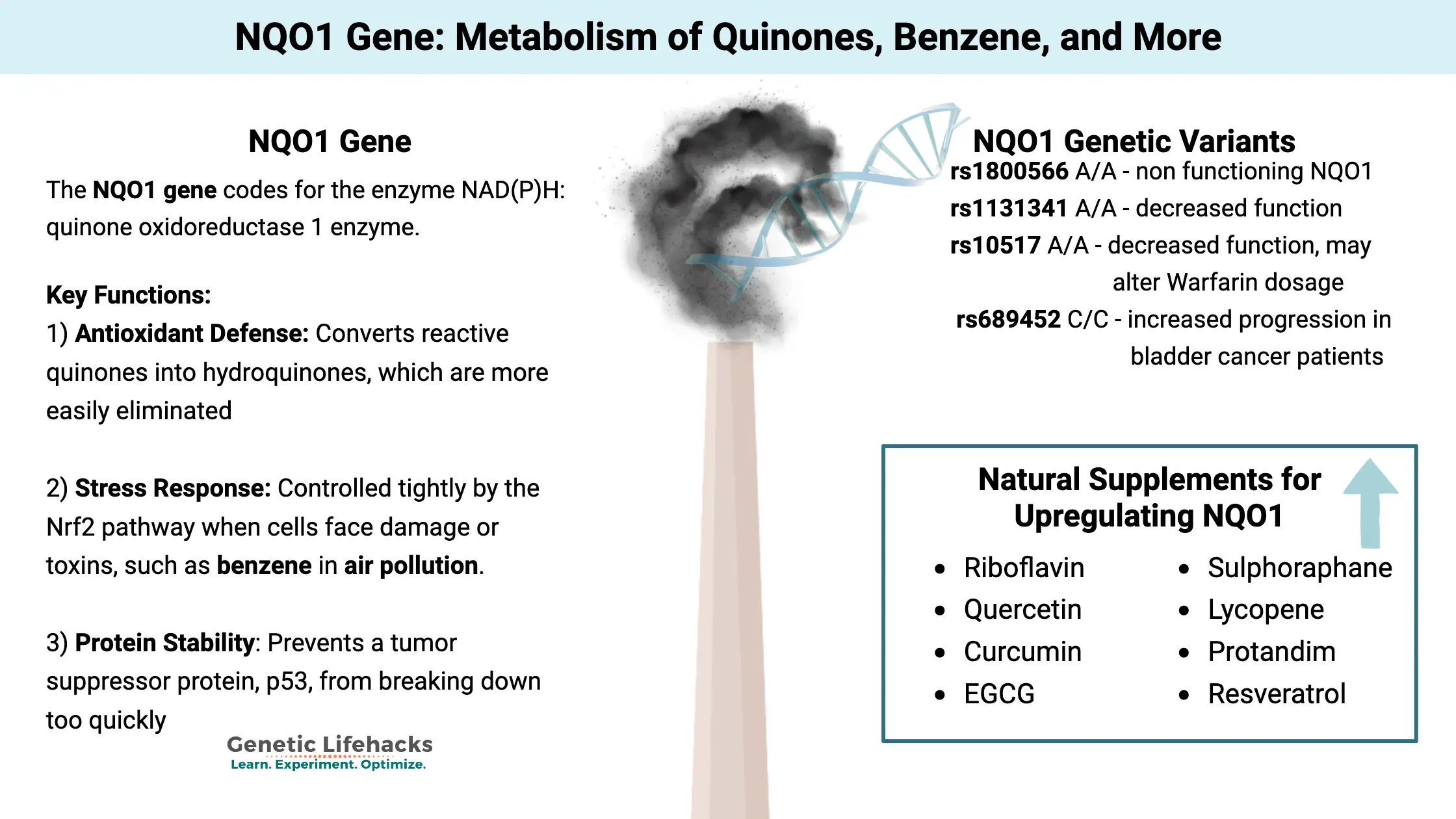
The NQO1 gene encodes the NAD(P)H: quinone oxidoreductase 1 enzyme, which plays a crucial role in the body’s phase II detoxification processes.
This enzyme utilizes NADH or NADPH to convert quinones, which are reactive intermediates formed during the breakdown of various substances, into hydroquinones, making them easier for the body to eliminate.
In addition to quinones, NQO1 is also involved in the metabolism of benzene metabolites and a few specific chemotherapy drugs. NQO1 can also act as a direct antioxidant by scavenging superoxide. It also acts as a protein chaperone for p53, an important protein for preventing cancer.[ref]
1) Antioxidant Defense: Converts reactive quinones into hydroquinones, which are more easily eliminated
2) Stress Response: Controlled tightly by the Nrf2 pathway when cells face damage or toxins.
3) Protein Stability: Prevents a tumor suppressor protein, p53, from breaking down too quickly
If you think back to high school chemistry, you may remember redox reactions in which the reactants either lose or gain an electron. NQO1 acts as a reducing agent (donates electrons), which is important in the body’s ability to make certain toxic substances easier to eliminate.
Where NQO1 matters:
NQO1 affects the way your body handles specific external toxicants as well as internally produced compounds that need to be broken down and eliminated.
NQO1 plays a role in:
- mitigating oxidative stress
- getting rid of benzene and other toxins
- reducing neuroinflammation
- keeping your skin from wrinkling and aging prematurely
- promoting heart health and preventing diabetes
Let’s take a look at each of these in depth, and then we will look at what your NQO1 variants mean:
Quinones and hydroquinones: Role of NQO1 in reducing oxidative stress
The NQO1 gene codes for the NAD(P)H: quinone oxidoreductase 1 enzyme. This enzyme uses NADH or NADPH to reduce quinones to hydroquinone. Quinone is a general term that refers to a class of organic compounds with a certain structure. They are formed in the conversion of aromatic compounds, such as benzene or naphthalene, and in the body for several energy-intensive pathways, such as generating ATP. The problem is that quinone molecules can often form reactive oxygen species (ROS) if not completely oxidized and then excreted.
Quinones are usually formed in the body as intermediates – the product that occurs when the body is breaking down certain substances. These types of reactions go on all the time in the body. Because quinones are so reactive, it is important for the body to convert quinones into hydroquinones quickly.
The hydroquinones formed in NQO1 reactions are not always benign, and they must be removed from the body as well. So it isn’t as simple as more NQO1 activity always being good for quinone detoxification – it must be balanced with excretion of hydroquinones.[ref]
Examples of endogenous quinone reactions:
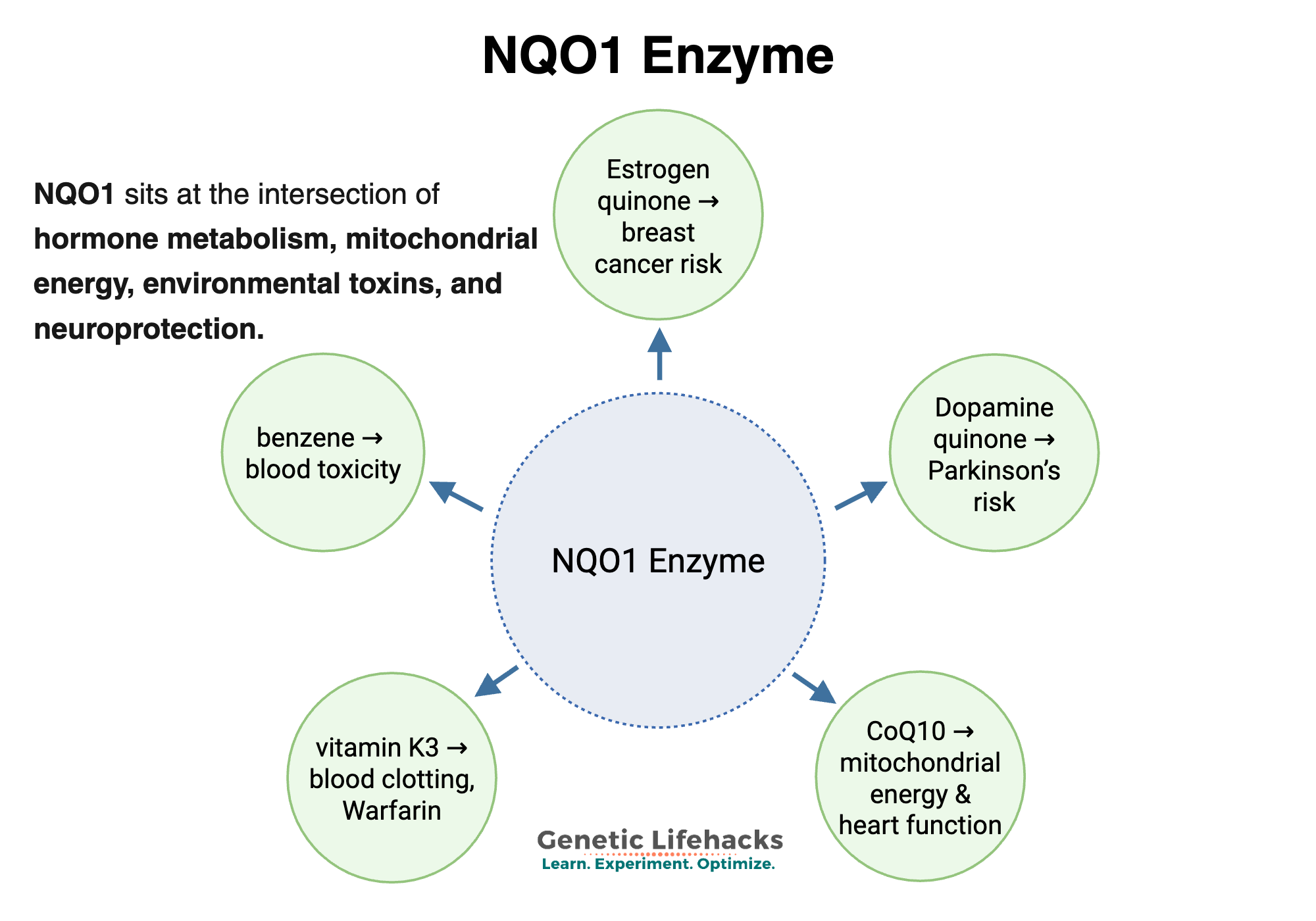
- Estrogen: When the body breaks down estrogen for elimination, an intermediate is formed, which is an estrogen quinone metabolite linked to breast cancer risk. NQO1 can help to metabolize and get rid of estrogen quinone metabolites, thus decreasing cancer risk. (NQO1 isn’t the only enzyme that can metabolize estrogen quinones – NQO2 is another available enzyme that can act on the pathway.)
Related article: Estrogen Metabolism Genes - CoQ10: NQO1 is also involved in cellular defense against oxidative stress, as well as the conversion of CoQ10. Specifically, NQO1 reduces the ubiquinone form of CoQ10 to hydro-ubiquinone. This conversion provides protection against lipid peroxidation.[ref]
Related article: CoQ10 genes and mitochondrial energy - Vitamin K3: Another quinone, vitamin K3 (menadione), is also converted by NQO1. In the reduction of Vitamin K, NQO1 is mostly involved in turning vitamin K3 into an active form for blood clotting and bone-building[ref]. Note that NQO1 is not the only enzyme that can act on vitamin K3, so it may not be a limiting factor if the function if the gene is impaired.
Related article: Vitamin K genes - Dopamine ortho-quinones: The metabolism of dopamine is complex, and one pathway can result in a quinone that needs to be eliminated in the brain. NQO1 is one of the enzymes that can break down this quinone, and it may be important in preventing Parkinson’s.[ref]
Cell division:
Additionally, NQO1 is important in the process that a cell goes through to divide and create a new cell. NQO1 has been shown to interact with NAD+ and SIRT2 during cell division.[ref]
Related article: NAD+, NR, NMN and genetics
Nrf2 pathway:
The Nrf2 pathway is activated by cellular stress, such as in response to a toxin. Nrf2 pathway activation increases NQO1 gene expression. Essentially, when a toxin (or plant-based supplement, such as sulforaphane) activates Nrf2, part of the response is to increase the production of NQO1 in the cell.[ref]
Environmental toxins: NQO1 and Benzene
NQO1 is also involved in breaking down environmental toxins such as benzene, naphthalene, and some chemotherapy drugs.
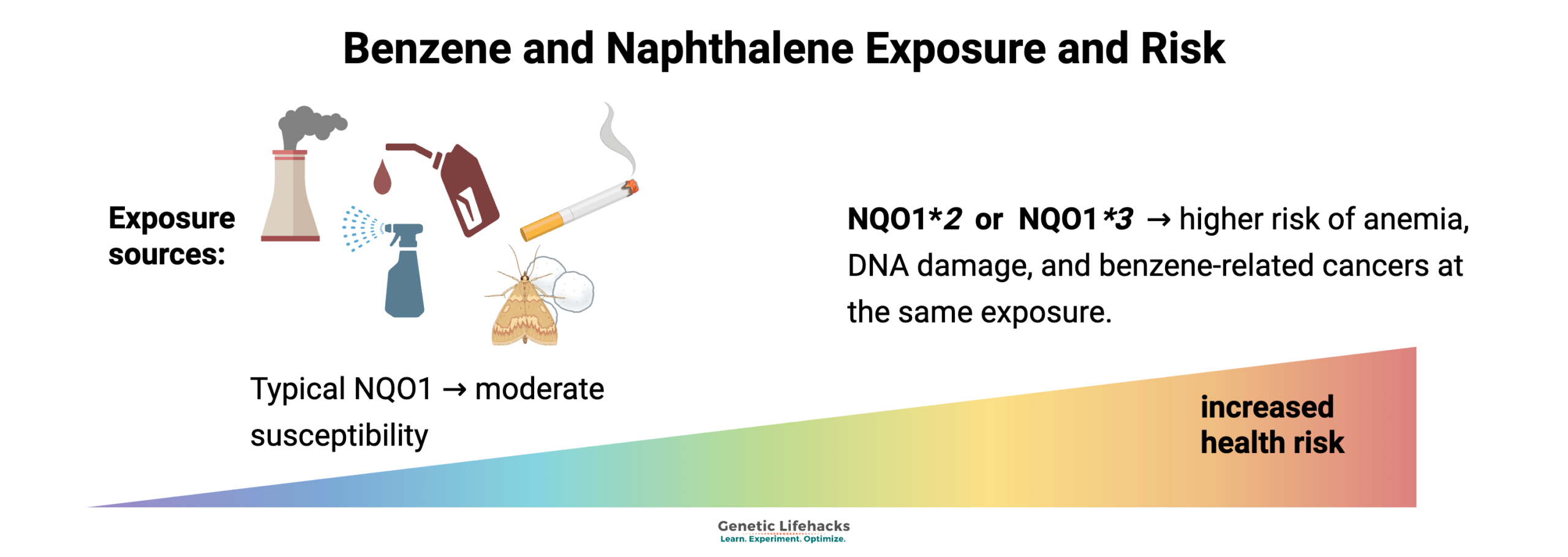
Benzene is a carcinogen found in gasoline fumes, laundry detergent, furniture wax, industrial uses, pesticides, skin creams, and smoke. For example, benzene is one of the harmful components of smog.[ref]
NQO1 comes into play in the phase II metabolism of benzene after it has been acted on by CYP2E1. People who have impaired NQO1 function are much more likely to have problems with benzene poisoning, which can cause anemia, DNA damage, and possibly cancer.[ref][ref][ref]
Related article: CYP2E1 gene
Links to gut health:
Beyond benzene, NQO1 activity also shapes the barrier function of your gut lining. Animal studies show that a non-functioning NQO1 gene leads to gut permeability and inflammation (leaky gut). The lack of NQO1 caused a decrease in the proteins that promote tight junctions (claudin and occludin).[ref] Interestingly, in mouse models of ulcerative colitis, idebenone, a synthetic form of CoQ10, is beneficial and increases the expression of NQO1 in the gut lining.[ref]
NQO1 in the brain:
NQO1 is also important in moderating the inflammatory response in the brain in neuroinflammation. Acting as an antioxidant, NQO1 can reduce oxidative stress in the brain. Essentially, NQO1 is reducing quinones in a way that prevents the formation of oxidative stress. Quinones can easily undergo redox reactions, and one type of reaction forms semiquinone radicals, which are reactive oxygen species that cause oxidative stress. NQO1 converts quinones in a way that avoids semiquinones and instead skips to hydroquinone, which is water-soluble and able to be excreted.[ref]
One way that NQO1 protects the brain from ROS is in the interaction with vitamin E, also called tocopherol. The α-tocopherol quinone is formed in reactions where vitamin E is acting as an antioxidant. That quinone then can be converted to the hydroquinone form, preventing oxidative stress in the cell. In addition, NQO1 is activated in microglial cells through the Nrf2 pathway to counteract ROS and prevent oxidative stress in the brain.[ref]
Neurodegenerative disease connections:
Genetic variants in the NQO1 gene (see genotype report below) increase the risk for Parkinson’s disease, and decreased NQO1 function is linked to an increased risk of Alzheimer’s disease. The specific connection to Parkinson’s is not only NQO1’s role as an antioxidant but also its role in metabolizing dopamine quinones. A lack of NQO1 activity can then lead to oxidative stress in the dopaminergic neurons responsible for Parkinson’s.[ref][ref]
NQO1 uses FAD as a cofactor, and the NQO1*2 variant (below in genotype report) that reduces NQO1 function can be modulated by increasing riboflavin to increase FAD. Studies show that riboflavin supplementation may be beneficial for some people with Parkinson’s disease. Keep in mind that Parkinson’s is a complex condition with multiple underlying causes, so this may not be key for everyone.[ref]
NQO1 and cardiometabolic diseases:
Oxidative stress and disrupted redox homeostasis can be an underlying cause of cardiometabolic conditions, such as high blood pressure or type 2 diabetes. Genetic studies link NQO1 variants to increased risk of hypertension and type 2 diabetes. [ref]
Heart failure is a complex disease, with reduced energy metabolism in the cardiac muscle cells playing a causative role. CoQ10 is important in mitochondrial energy production in the heart. A study in chronic heart failure patients looked at CoQ10 levels and NQO1 activity. The results showed that serum CoQ10 levels didn’t differ by NQO1 variant, but that heart failure patients with the rs1800566 TT genotype (reduced function) had a decrease in mitochondrial membrane potential.[ref]
NQO1 and Warfarin:
As mentioned above, NQO1 is involved in vitamin K3 metabolism. Warfarin is a drug that acts as a blood thinner by decreasing vitamin K levels. It’s a delicate balance to get warfarin levels right, and NQO1 levels and gene variants can affect the dose of warfarin needed for maintaining the right vitamin K level reduction.[ref]
Skin aging: Surprising role for NQO1
On the surface, NQO1’s redox function influences how quickly your skin shows signs of aging. The overproduction of ROS is a strong factor in skin aging – wrinkles, age spots, etc. UV exposure, air pollution, and even the products we use on our face can increase the production of ROS, leading to the ravages of aging.
A recent study looking at genetic variants associated with faster skin aging showed that an NQO1 variant with low function was strongly associated with premature skin aging (see your genes in the genotype report below).[ref] Moreover, a study looking at how royal jelly (from bees) helps protect against UVB stress specifically identified its role in promoting NQO1 expression as key.[ref]
NQO1 and Nrf2 pathway:
Nrf2 (Nuclear factor erythroid 2-related factor 2) is a transcription factor that regulates the expression of antioxidant and detoxification genes, including NQO1. The activation of the Nrf2 pathway can lead to increased NQO1 expression, enhancing the body’s defense against oxidative stress and xenobiotics.
Related article: Nrf2 pathway
All of these effects—on toxins, gut, brain, heart, and skin—depend on how much NQO1 your cells can produce, so let’s take a look at how your genetic variants affect your NQO1 function.
NQO1 Genotype Report:
Research shows there are two common NQO1 variants that reduce function and increase the risk for certain cancers.
- The variant NQO1*2 (P187S) leads to a deficiency in the enzyme.
- The NQO1*3 (R139W) variant has reduced enzyme activity, which may be dependent on the substance.
Access this content:
An active subscription is required to access this content.
Lifehacks: What can you do if you have impaired NQO1 function?
Your NQO1 genotype sets your baseline enzyme function, but environmental exposures (benzene, smoke, pesticides), diet (riboflavin status, plant polyphenols), and Nrf2 activation likely account for a large portion of your actual day‑to‑day NQO1 activity.
Here are several evidence-backed lifestyle changes, dietary interactions, and supplements that can help to mitigate genetic variants that impair NQO1 function.
Avoiding toxins: Benzene and naphthalene
Poor NQO1 function is a problem in conjunction with aromatic compounds that are detoxified in phase II metabolism to form quinones. Benzene and naphthalene are two of these compounds.
- Benzene is found in smog, petroleum products, cigarette smoke, and various industrial chemicals. In addition, recent studies have also found that some spray sunscreens, athlete’s foot sprays, dry hair shampoo sprays, and even acne creams can contain benzene.[ref]
- Naphthalene has a pungent odor and is found in mothballs. While I am not finding any specific studies on NQO1 polymorphisms and mothballs, if you have reduced NQO1 function, you may want to avoid breathing in naphthalene.
Melatonin as an antioxidant:
More than just a sleep hormone, melatonin has many roles in cellular health.
- Supplemental melatonin:
A study on smokers found that melatonin supplementation (3g/night) increased Nrf2 and NQO1 levels and reduced oxidative stress.[ref] - Boosting natural melatonin:
A natural way to boost your melatonin levels at night is to avoid blue light, such as from LED lights and screens, for a couple of hours before bedtime. Exposure to full sun during the morning hours also boosts melatonin at night. Related article: How to Shift Your iPhone Screen to Red at Night
Skin aging a problem? Try royal jelly or isoquercetin for NQO1
The rs1800566 variant is strongly associated with a higher risk of premature skin aging due to a decreased ability to combat ROS.[ref]
A 2021 study showed that topical royal jelly protects against skin aging specifically through upregulating the NQO1 pathway.[ref] For someone with one copy of the rs1800566 variant, this may be a particularly effective way to protect your skin.
Another study showed that isoquercetin significantly increased NQO1 expression in skin.[ref]
Increase riboflavin (especially if insufficient):
FAD (flavin adenine-dinucleotide) is a cofactor for NQO1, so ensuring that you get enough riboflavin (vitamin B2) in your diet or through supplements may be important. One study showed that increasing riboflavin can mitigate the negative effects of the NQO1 genetic variants.[ref] Specifically, some of the NQO1 variants have reduced binding to FAD, so supplying a greater pool of riboflavin to ensure plenty of FAD can increase NQO1 availability. Without sufficient FAD, the NQO1 is more likely to unfold and be degraded.[ref]
Riboflavin-rich foods include eggs, organ meats, dairy, and some green vegetables.[ref] If you don’t get enough riboflavin from food, it is available as a stand-alone riboflavin supplement or as part of a B-complex. (It is what causes your pee to turn bright yellow after taking a B-complex.)
Related article: Riboflavin genes
Natural Supplements with research for boosting NQO1:
Here are seven natural supplements with research studies showing that they can increase NQO1 levels.
Access this content:
An active subscription is required to access this content.