
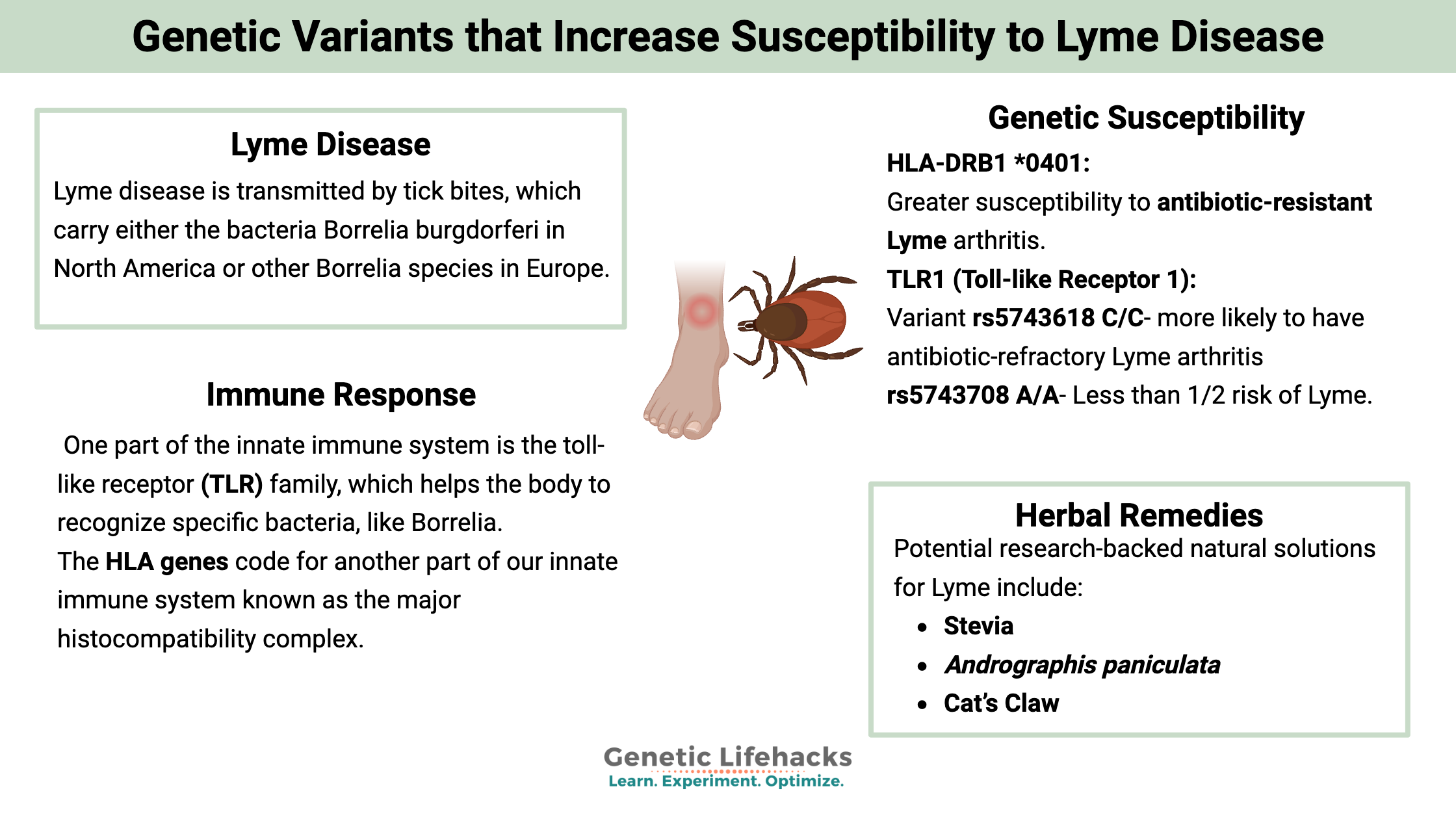
Lyme disease is transmitted by tick bites, which carry either the bacteria Borrelia burgdorferi in North America or other Borrelia species in Europe.
General symptoms of Lyme disease include a bull’s-eye rash, fever, headache, pain, and general malaise. The majority of people recover after a few weeks, but some people have symptoms (neurological, cardiovascular, fatigue, arthritis) that can last for months or even years.
Whether you are one of the ones who recover quickly or have chronic symptoms, including joint pain or arthritis, may be due to genetic variants that you carry.
Immune Response Against Borrelia:
The innate immune system reacts quickly to pathogens, giving us the initial inflammatory response to fight off bacterial invaders. One part of the innate immune system is the toll-like receptor (TLR) family, which helps the body to recognize specific bacteria, like Borrelia.
The simplified picture is that the innate immune system recognizes the Borrelia bacteria, raises an alarm bringing in inflammatory molecules to destroy it. It is the front line of the body’s army, quick to rise and fight a short battle.
The different genetic variations in our innate immune system contribute to our individuality. It makes sense for a population to carry different variants – some may be better at fighting off leprosy; others good at surviving cholera. While variation is good on the whole, for an individual, though, it can end up causing increased susceptibility to a pathogen like Borrelia.
Lyme Disease Genotype Report:
Access this content:
An active subscription is required to access this content.
Lifehacks:
Antibiotics are, of course, the first line of defense against Borrelia. Your doctor can give you more information on effective antibiotics.
Testing:
Talk with your doctor about testing for Lyme. If you can’t get tested through your doctor, there is direct testing available. Look up Acudart Health from Igenex.
Other factors affecting Lyme:
A study found that age is a factor in susceptibility to Lyme, with elderly people likely to have a less vigorous immune response to the pathogen. The study also found that BMI, gender, vitamin D levels, and previous exposure to Borrelia had no effect on Lyme susceptibility.[ref]
Herbal remedy recommendations for chronic Lyme symptoms persisting after antibiotic treatment:
Stevia, an herbal sweetener, has been shown in lab studies to kill Borrelia, similar in effectiveness to antibiotics.[ref] I question whether this holds true in people rather than just in Petri dishes… On the other hand, stevia is likely a safe choice with few side effects, and thus may be worth a try.
Manganese:
A new study found that manganese, when overloaded, counteracts oxidative stress from B. burgdorferi. However, the researchers warn that manganese is a double-edged sword for B. burgdorferi, and can both strengthen or weaken the bacterium. [ref]
Andrographis paniculata is an Asian herb used in traditional medicine for respiratory infections and other ailments. For chronic Lyme disease, it is recommended as an herbal remedy (combined with other herbs). While I didn’t find any studies on its effectiveness against Borrelia, there are quite a few studies on it for other diseases. Studies have found it to be somewhat effective in the treatment of ulcerative colitis, changing TH1/TH17 immune response, decreasing fatigue from MS, and as an antibiotic.[ref][ref][ref][ref]
Access this content:
An active subscription is required to access this content.
Related Articles and Topics:
HLA-B27: Genetic Variant That Increases Susceptibility to Autoimmune Diseases
References: