Key takeaways:
~ Vitamin B12 is a cofactor for biological reactions such as creating the myelin sheath in nerve cells and the synthesis of DNA.
~ A lack of vitamin B12 (also known as cobalamin) can create a cascade of negative effects.
~ There are several genes that can influence how much vitamin B12 you absorb, transport, and need. Some people need higher amounts of B12, while others thrive on different forms of B12. Looking at your genetic data may help you figure out what is going on in your body.
Members will see their genotype report below and the solutions in the Lifehacks section. Consider joining today.
Vitamin B12: Why we need it, where we get it, and what it does
Vitamin B12, also known as cobalamin, is an essential nutrient that is needed for DNA synthesis, red blood cell formation, nerve function, cellular energy, and homocysteine metabolism.
Foods that are high in vitamin B12 include meat, fish, eggs, and dairy. Vegetarian and vegan diets are lacking in vitamin B12, and supplementation is usually recommended.
Vitamin B12 as a supplement can be found in four different forms:
Form
Used Directly?
Suitable For
Cyanocobalamin
No (needs conversion)
General use, cost-effective
Methylcobalamin (MethylB12)
Yes
Genetic variants impacting methylation, nervous system; individuals with intermediate or fast COMT
Adenosylcobalamin (AdenosylB12)
Yes
Mitochondrial function, energy; individuals with slow or fast COMT
Hydroxocobalamin (HydroxyB12)
Yes
Individuals needing slow-release or detox support; individuals with slow or fast COMT
The cyanocobalamin form is often found in cheaper vitamins and added to processed foods. It must be converted by the body before use. Methylcobalamin and adenosylcobalamin are active forms used by the body.
Vitamin B12 deficiency symptoms:
Vitamin B12 deficiency or insufficiency has been shown to cause:[ref][ref]
To be able to absorb B12 from foods, you need to have adequate intrinsic factor produced in the stomach. This is something that is often depleted in the elderly, leading to B12 deficiency.
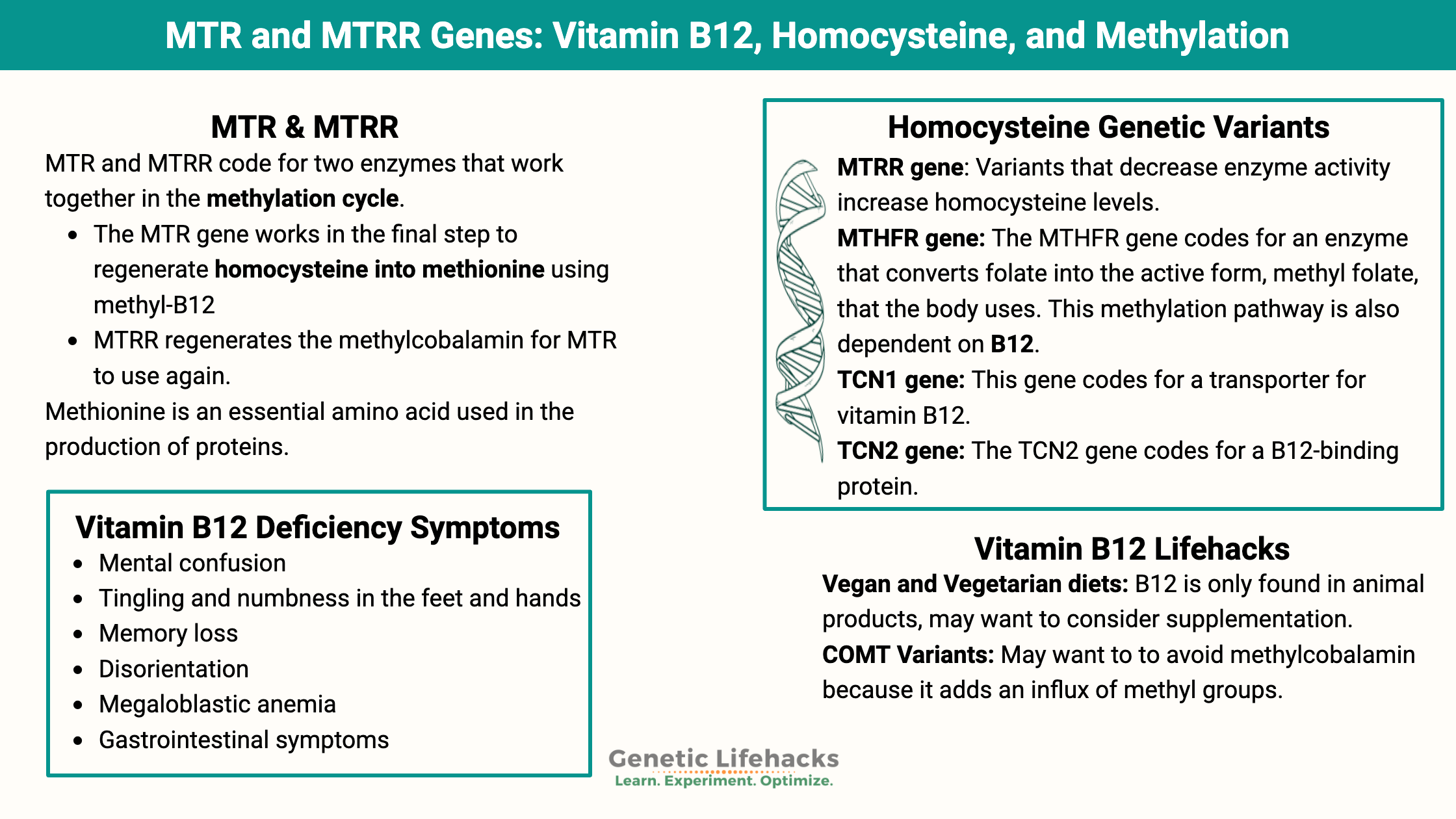
MTR & MTRR: Genetic connections between Methionine and Vitamin B12
Methionine is an essential amino acid used in the production of proteins. It is literally the starting amino acid for every protein your body makes.
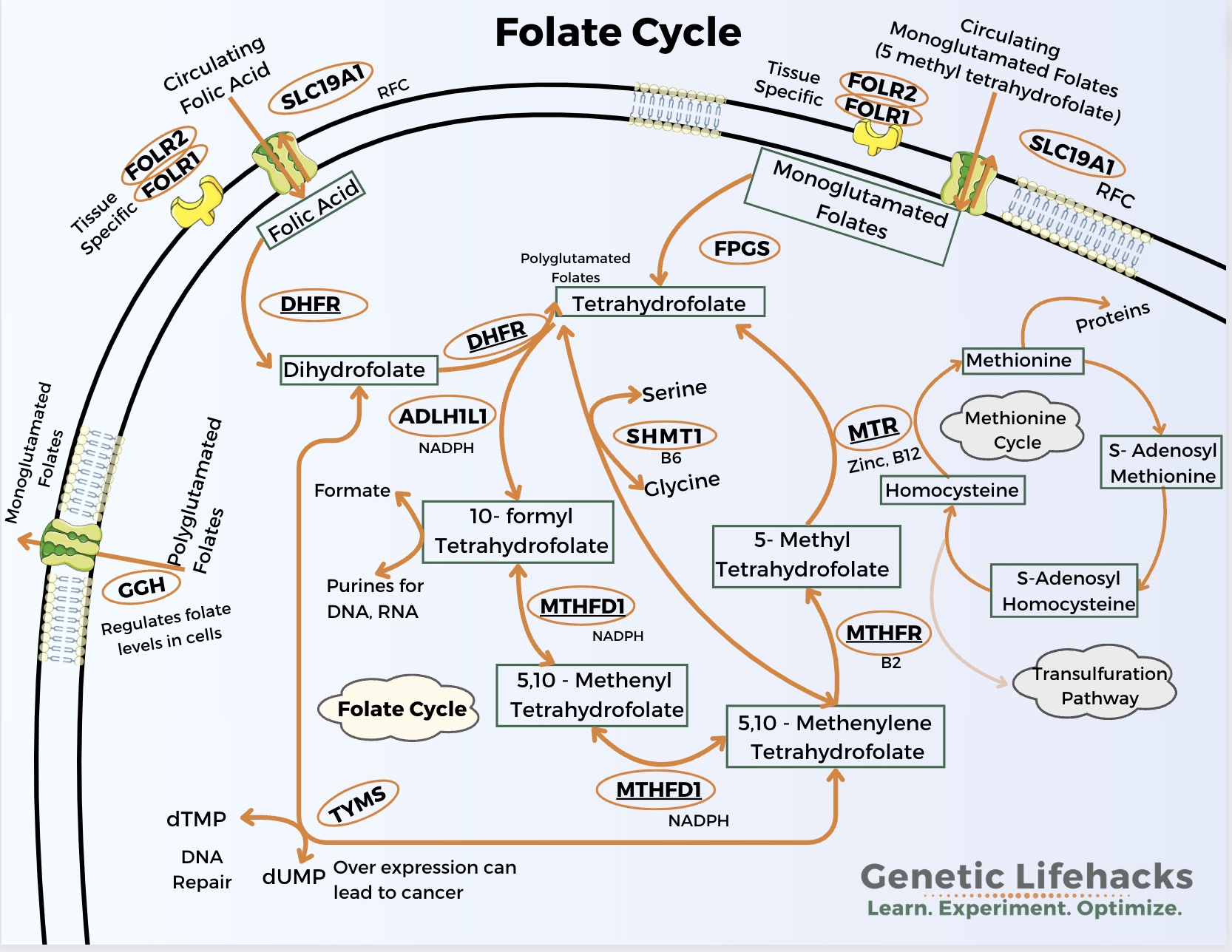
MTR (methionine synthase) and MTRR (methionine synthase reductase) code for two enzymes that work together in the methylation cycle.
The MTR gene works in the final step to regenerate homocysteine into methionine using methyl-B12 (methylcobalamin)
MTRR regenerates the methylcobalamin for MTR to use again.[ref]
Both are a vital part of the methylation cycle.
Methyl groups and the methylation cycle: Quick background
A methyl group is made up of a carbon plus three hydrogen atoms. Your body is made up of organic molecules, a lot of which contain carbon bonded to hydrogen. Adding in a methyl group is like adding a building block to the molecule.
The methylation cycle is your body’s way of recycling certain molecules to ensure that there are enough methyl groups (carbon plus three hydrogens) available for cellular processes. When it comes to the functioning of your cells, methyl groups are used in methylation reactions.[ref]
Examples of methylation reactions include:
synthesis of some of the nucleic acid (DNA) bases
turning off genes so that they aren’t transcribed (DNA methylation)
converting serotonin into melatonin
methylating arsenic so that it can be excreted
breaking down neurotransmitters
metabolizing estrogen
regenerating methionine from homocysteine
Methylation in the right amount:
For example, you need enough folate (vitamin B9) and methylcobalamin (vitamin B12) for the methionine synthase reaction to occur. Methylfolate is the source of the methyl group that methionine synthase uses for converting homocysteine to methionine.
Not enough B12 or methylfolate?
Without sufficient methylfolate and vitamin B12, MTR won’t convert as much homocysteine to methionine, leading to a buildup of homocysteine and limiting methionine. Too much homocysteine is strongly associated with an increased risk of heart disease.[ref]
Excess B12 and cancer growth:
The other side of the picture, though, is that there may be times when limiting methionine is helpful, such as in fighting the proliferation of cancer cells. Excess vitamin B12 is linked to increased cancer growth in certain types of cancer.[ref]
Methotrexate, a chemotherapy drug, works by inhibiting the production of methyl folate, thus limiting methionine and DNA synthesis for cell growth.
TCN1 and TCN2: Transporting vitamin B12
TCN1 (transcobalamin I, TCN1 gene):
TCN1 is a protein that binds to and transports vitamin B12. It is also known as haptocorrin or protein R. TCN1 binds to vitamin B12 as cobalamin and transports it into cells. It also plays a role in protecting B12 from being destroyed by stomach acid, such as in the stomach and intestines.[ref]
TCN2 (transcobalamin II, TCN2 gene)
TCN2 is a B12 transport protein that moves vitamin B12 from the bloodstream into cells throughout the body. Rare mutations in TCN2 cause transcobalamin deficiency, which has symptoms of neurological problems, failure to thrive, vomiting, and low blood cell counts. Common genetic variants cause minor changes in cellular B12 levels.[ref]
Vitamin B12 Genotype Report:
Access this content:
An active subscription is required to access this content.
Lifehacks: Dietary options, picking the right B12 supplements
How much B12 do you need?
At a glance:
RDA: 2.4 mcg/day (adults)
UL: Not established (insufficient evidence to set a tolerable upper limit)[ref]
Dietary considerations:
Vegan and vegetarian diets:
Vitamin B12 is only found in animal-based foods, so vegans and vegetarians are often deficient or marginal in their B12 status.[ref] B12 is often added to breakfast cereals and other refined products, so eating a vegetarian diet that includes packaged and refined foods may actually result in higher B12 levels (although probably not in better health).
It takes several years to completely deplete your liver’s stores of B12, so people who have recently started a vegan or vegetarian diet may still have moderate vitamin B12 levels.[ref]
Dietary sources: Foods that are highest in B12 include:[ref]
beef liver
mussels
lamb
caviar
chicken livers
High Homocysteine and B12:
Homocysteine levels: If your homocysteine levels are high and you carry the MTHFR or MTRR reduced function variant above, supplementing with vitamin B12, methylfolate, riboflavin, and B6 may help to lower your levels.[ref][ref][ref]
Interaction with alcohol:
Alcohol is metabolized into acetaldehyde, which is toxic and inhibits methionine synthase (MTR). This is one reason why alcoholism causes B12 deficiency. If you have reduced MTR or MTRR activity, you may want to avoid excess acetaldehyde by not drinking much alcohol. [ref]
Achour, Ons, et al. “The C677T MTHFR Genotypes Influence the Efficacy of B9 and B12 Vitamins Supplementation to Lowering Plasma Total Homocysteine in Hemodialysis.” Journal of Nephrology, vol. 29, no. 5, Oct. 2016, pp. 691–98. PubMed, https://doi.org/10.1007/s40620-015-0235-8.
Al-Batayneh, Khalid M., et al. “Association between MTHFR 677C>T Polymorphism and Vitamin B12 Deficiency: A Case-Control Study.” Journal of Medical Biochemistry, vol. 37, no. 2, Apr. 2018, pp. 141–47. PubMed, https://doi.org/10.1515/jomb-2017-0051.
du Plessis, Jacomina P., et al. “Gene Interactions Observed with the HDL-c Blood Lipid, Intakes of Protein, Sugar and Biotin in Relation to Circulating Homocysteine Concentrations in a Group of Black South Africans.” Molecular Genetics and Metabolism Reports, vol. 22, Mar. 2020, p. 100556. ScienceDirect, https://doi.org/10.1016/j.ymgmr.2019.100556.
Ducker, Gregory S., and Joshua D. Rabinowitz. “One-Carbon Metabolism in Health and Disease.” Cell Metabolism, vol. 25, no. 1, Jan. 2017, pp. 27–42. PubMed Central, https://doi.org/10.1016/j.cmet.2016.08.009.
Gallego-Narbón, Angélica, et al. “Vitamin B12 and Folate Status in Spanish Lacto-Ovo Vegetarians and Vegans.” Journal of Nutritional Science, vol. 8, Feb. 2019, p. e7. PubMed Central, https://doi.org/10.1017/jns.2019.2.
Hazra, Aditi, et al. “Genome-Wide Significant Predictors of Metabolites in the One-Carbon Metabolism Pathway.” Human Molecular Genetics, vol. 18, no. 23, Dec. 2009, pp. 4677–87. PubMed Central, https://doi.org/10.1093/hmg/ddp428.
———. “Genome-Wide Significant Predictors of Metabolites in the One-Carbon Metabolism Pathway.” Human Molecular Genetics, vol. 18, no. 23, Dec. 2009, pp. 4677–87. PubMed Central, https://doi.org/10.1093/hmg/ddp428.
Homocysteine Studies Collaboration. “Homocysteine and Risk of Ischemic Heart Disease and Stroke: A Meta-Analysis.” JAMA, vol. 288, no. 16, Oct. 2002, pp. 2015–22. PubMed, https://doi.org/10.1001/jama.288.16.2015.
Hu, Yao, et al. “A Common TCN1 Loss-of-Function Variant Is Associated with Lower Vitamin B12 Concentration in African Americans.” Blood, vol. 131, no. 25, June 2018, pp. 2859–63. PubMed Central, https://doi.org/10.1182/blood-2018-03-841023.
Kenyon, S. H., et al. “The Effect of Ethanol and Its Metabolites upon Methionine Synthase Activity in Vitro.” Alcohol (Fayetteville, N.Y.), vol. 15, no. 4, May 1998, pp. 305–09. PubMed, https://doi.org/10.1016/s0741-8329(97)00134-1.
Lahner, Edith, et al. “Single Nucleotide Polymorphisms Related to Vitamin B12 Serum Levels in Autoimmune Gastritis Patients with or without Pernicious Anaemia.” Digestive and Liver Disease: Official Journal of the Italian Society of Gastroenterology and the Italian Association for the Study of the Liver, vol. 47, no. 4, Apr. 2015, pp. 285–90. PubMed, https://doi.org/10.1016/j.dld.2015.01.147.
Lan, X., et al. “[Meta-analysis on effect of combined supplementation of folic acid, vitamin B12 and B6 on risk of cardio-cerebrovascular diseases in randomized control trials].” Zhonghua Liu Xing Bing Xue Za Zhi = Zhonghua Liuxingbingxue Zazhi, vol. 37, no. 7, July 2016, pp. 1028–34. PubMed, https://doi.org/10.3760/cma.j.issn.0254-6450.2016.07.024.
Liang, Shuang, et al. “The Effect of Multiple Single Nucleotide Polymorphisms in the Folic Acid Pathway Genes on Homocysteine Metabolism.” BioMed Research International, vol. 2014, 2014, p. 560183. PubMed, https://doi.org/10.1155/2014/560183.
Nongmaithem, Suraj S., et al. “GWAS Identifies Population-Specific New Regulatory Variants in FUT6 Associated with Plasma B12 Concentrations in Indians.” Human Molecular Genetics, vol. 26, no. 13, July 2017, pp. 2551–64. PubMed Central, https://doi.org/10.1093/hmg/ddx071.
Oussalah, Abderrahim, et al. “Association of TCN2 Rs1801198 c.776G>C Polymorphism with Markers of One-Carbon Metabolism and Related Diseases: A Systematic Review and Meta-Analysis of Genetic Association Studies.” The American Journal of Clinical Nutrition, vol. 106, no. 4, Oct. 2017, pp. 1142–56. PubMed Central, https://doi.org/10.3945/ajcn.117.156349.
Sawaengsri, Hathairat, et al. “Transcobalamin 776C→G Polymorphism Is Associated with Peripheral Neuropathy in Elderly Individuals with High Folate Intake.” The American Journal of Clinical Nutrition, vol. 104, no. 6, Dec. 2016, pp. 1665–70. PubMed, https://doi.org/10.3945/ajcn.116.139030.
Serapinas, Danielius, et al. “The Importance of Folate, Vitamins B6 and B12 for the Lowering of Homocysteine Concentrations for Patients with Recurrent Pregnancy Loss and MTHFR Mutations.” Reproductive Toxicology (Elmsford, N.Y.), vol. 72, Sept. 2017, pp. 159–63. PubMed, https://doi.org/10.1016/j.reprotox.2017.07.001.
Velkova, Aneliya, et al. “The FUT2 Secretor Variant p.Trp154Ter Influences Serum Vitamin B12 Concentration via Holo-Haptocorrin, but Not Holo-Transcobalamin, and Is Associated with Haptocorrin Glycosylation.” Human Molecular Genetics, vol. 26, no. 24, Dec. 2017, pp. 4975–88. PubMed Central, https://doi.org/10.1093/hmg/ddx369.
———. “The FUT2 Secretor Variant p.Trp154Ter Influences Serum Vitamin B12 Concentration via Holo-Haptocorrin, but Not Holo-Transcobalamin, and Is Associated with Haptocorrin Glycosylation.” Human Molecular Genetics, vol. 26, no. 24, Dec. 2017, pp. 4975–88. PubMed Central, https://doi.org/10.1093/hmg/ddx369.
Vitamin B12 | Linus Pauling Institute | Oregon State University. 22 Apr. 2014, https://lpi.oregonstate.edu/mic/vitamins/vitamin-B12.
Waśkiewicz, Anna, et al. “Dietary Intake of Vitamins B6, B12 and Folate in Relation to Homocysteine Serum Concentration in the Adult Polish Population – WOBASZ Project.” Kardiologia Polska, vol. 68, no. 3, Mar. 2010, pp. 275–82. PubMed.
Wolffenbuttel, Bruce H.R., et al. “The Many Faces of Cobalamin (Vitamin B12) Deficiency.” Mayo Clinic Proceedings: Innovations, Quality & Outcomes, vol. 3, no. 2, May 2019, pp. 200–14. PubMed Central, https://doi.org/10.1016/j.mayocpiqo.2019.03.002.
Yang, Boyi, et al. “Associations of MTHFR C677T and MTRR A66G Gene Polymorphisms with Metabolic Syndrome: A Case-Control Study in Northern China.” International Journal of Molecular Sciences, vol. 15, no. 12, Nov. 2014, pp. 21687–702. PubMed Central, https://doi.org/10.3390/ijms151221687.
About the Author: Debbie Moon is a biologist, engineer, author, and the founder of Genetic Lifehacks where she has helped thousands of members understand how to apply genetics to their diet, lifestyle, and health decisions. With more than 10 years of experience translating complex genetic research into practical health strategies, Debbie holds a BS in engineering from Colorado School of Mines and an MSc in biological sciences from Clemson University. She combines an engineering mindset with a biological systems approach to explain how genetic differences impact your optimal health.