
Key takeaways:
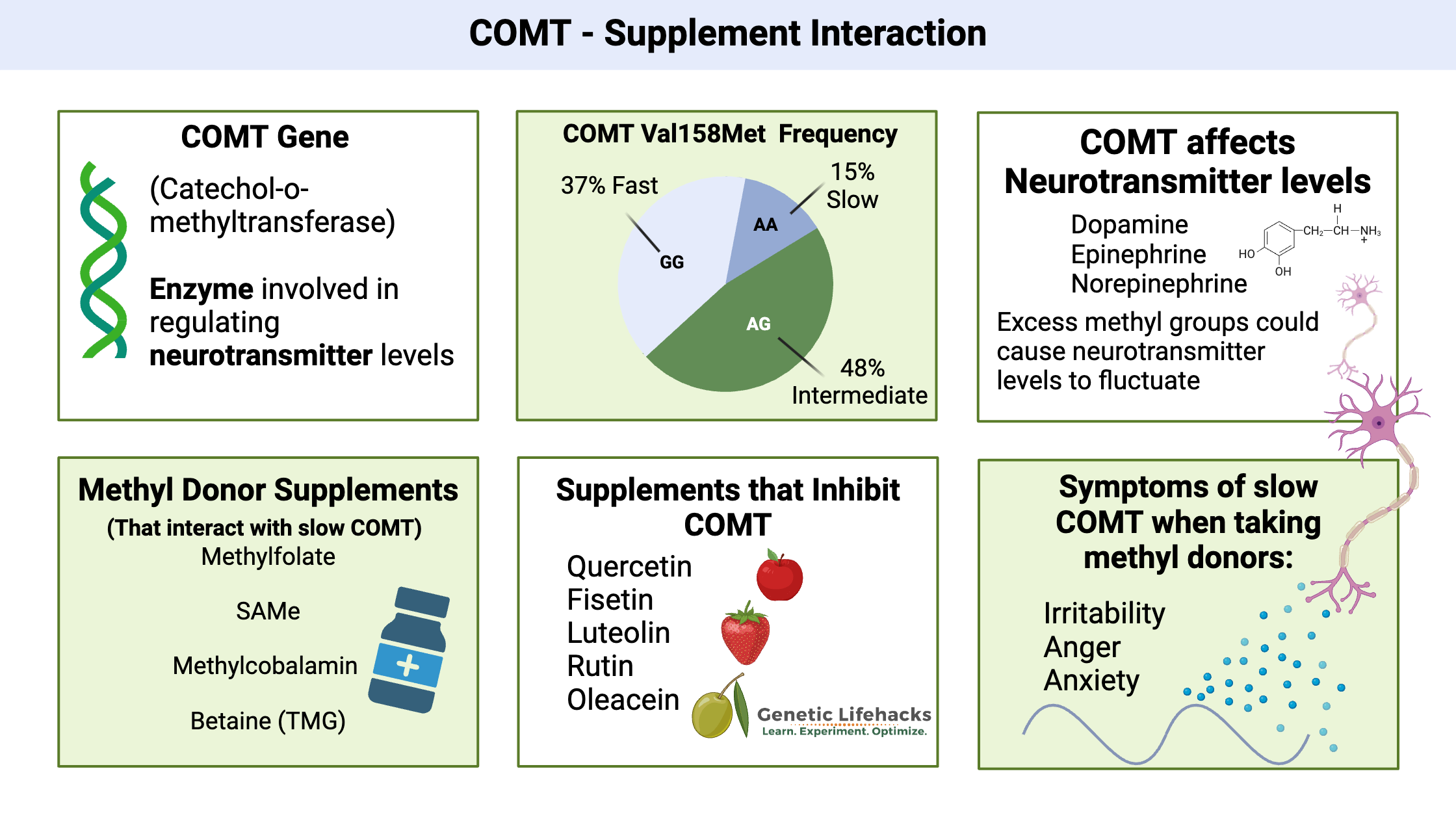
- The COMT enzyme can be slow or fast, depending on your genes.
- Some people with slow COMT enzyme function have side effects from methylated vitamins (methylfolate, methylB12), methyl donor supplements, and COMT inhibitor supplements.
- Understanding your COMT SNPs can help you with deciding which supplements may work best for you.
COMT Gene & Supplements: How Slow or Fast COMT Affects Your Response
Have you ever taken a supplement, such as methylfolate or methylB12, and noticed an immediate improvement in your mood? Only to have that rebound on you to the point that you are angry and irritable with everyone around you…
COMT has recently gained attention in the biohacking and personalized health communities as a key gene for understanding supplement tolerance and neurotransmitter balance. In this article, I’ll explain how some supplements can interact with COMT variants (COMT slow and fast SNPs), causing noticeable side effects.
What is the COMT Enzyme?
The COMT gene encodes an enzyme called catechol-O-methyltransferase, which breaks down catechols.
What are catechols — and why do we need to break them down?
Catechols include neurotransmitters such as dopamine, epinephrine, and norepinephrine. Other catechols include estrogen metabolites as well as drugs and natural substances with a catechol structure.
The COMT enzyme plays an essential role in maintaining neurotransmitter levels at the right amount.
Without the COMT-controlled methylation reaction, catecholamines can accumulate and generate free radicals, which can damage DNA. Thus, COMT is essential in protecting cells, including brain cells, from oxidative stress.[ref]
COMT is also important in converting estrogen metabolites into forms that can easily be excreted by the body. [ref]
How does COMT relate to methylation?
The methyl in catechol-O-methyltransferase (COMT) is because COMT uses a methyl group in the process of metabolizing catechols. Methyl groups are used in hundreds of reactions in the body, and adding a methyl group can change one substance into another. For example, serotonin is converted into melatonin through a process that involves adding a methyl group.
COMT Variants: Slow COMT vs. Fast COMT (Val158Met)
A common genetic variant, called COMT Val158Met changes the way that the COMT enzyme functions.
- Fast (Higher) COMT: Val/Val, usually lower dopamine levels, sometimes referred to as the ‘warrior’ type
- Intermediate COMT: Val/Met, one allele for high activity (Val) and one for low activity (Met). This is usually considered the normal type.
- Slow (Lower) COMT: Met/Met, usually higher dopamine levels, referred to as the ‘worrier’ type, ~20–30% of European-ancestry people are Met/Met
Side effects of methylated vitamins with slow COMT:
People with slow COMT enzyme variants may find that supplements that affect the methylation cycle can affect their neurotransmitter levels.
For example, a sudden influx of methyl groups from high doses of methyl donor supplements may increase and then decrease the pool of methyl groups available for COMT to use in neurotransmitter reactions.
A quick cycling of neurotransmitter levels may make someone irritable, angry, or anxious.
For example, some people with slow COMT function initially feel great when taking supplemental methylfolate, but then they may notice later in the day that they are more irritable and anxious than normal. Or, their friends and family may notice their irritability and mood swings.
COMT also interacts with the perception of pain through neurotransmitter levels. Research shows that there can be interactions between slow COMT and medications in pain management.[ref] Adding methyl donor supplements to the stack may cause fluctuations in how well pain medications work.
How common are COMT polymorphisms?
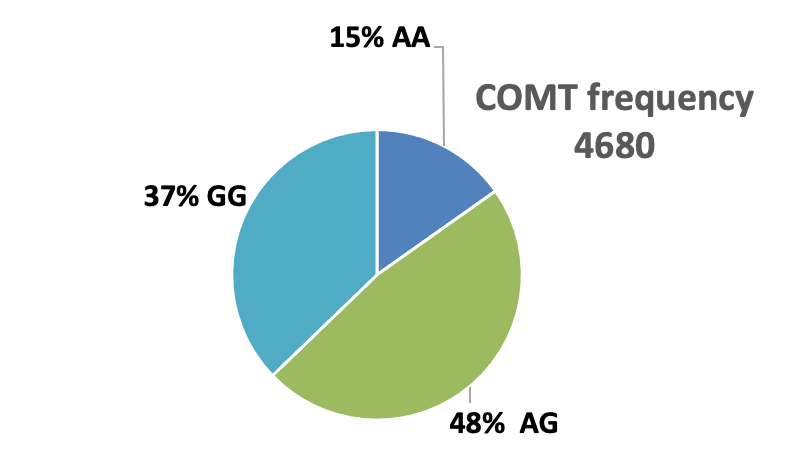
The frequency of the slow or fast variants varies a little, depending on the population group. The G/G (fast) genotype is found in about 29% of Caucasians and about 52% of the Chinese Han population groups. The A/A (slow) genotype is found in about 25% of Caucasians and about 10% of the Chinese population groups.
Some websites label these variants with a +/+ or -/- or indicate that slow COMT is a negative. Whether slower COMT is ‘good’ or ‘bad’ depends on the context. There are benefits and drawbacks to both slow and fast COMT enzyme function.
Related article: Deep dive into COMT and studies on mood, cognitive function, and more.
COMT and Supplement Sensitivity: Possible Side Effects
Let’s dig into the details on which supplements interact with the COMT enzyme. This is NOT a “never take this supplement” list, but instead is an explanation of the circumstances that may cause interactions.
Supplements that inhibit COMT:
Certain flavonoids use COMT for metabolism, and high doses of them can inhibit (slow down) the availability of COMT for breaking down neurotransmitters.
Some people with slow COMT function may find that supplements that inhibit COMT also affect their neurotransmitter levels, leading to irritability, anger, or anxiousness.
The following are commonly used natural anti-inflammatory and mast cell inhibitor supplements. These natural flavonoids contain a catechol structure and are metabolized by COMT.[ref][ref][ref]
Again, it isn’t set in stone that everyone with slow COMT will have anxiety or irritability with the above supplements.
What about EGCG in green tea?
I’ve seen EGCG listed on various functional medicine sites as a COMT inhibitor, but the research in humans doesn’t back this up at normal supplemental doses.
The COMT enzyme is used in the metabolism of EGCG. While animal and cell studies show EGCG to be an inhibitor of COMT, studies in humans give a different result. A study involving people with both fast and slow COMT variants showed that 750mg of supplemental EGCG did not impair COMT activity.[ref]
Research does show that people with slow COMT break down EGCG more slowly than people with fast COMT.[ref][ref][ref] However, a study that looked directly at the effect of an EGCG supplement (750 mg) found that it did not impair the activity of COMT, even in people with the slow variant.[ref]
Is inhibiting COMT always bad?
While the word ‘inhibit’ may sound bad, this isn’t always a bad thing… stick with me here for different scenarios in which COMT inhibitors are good or bad.
Scenario #1) Supplements that inhibit COMT function may hang around a bit longer in your system and have more beneficial effects. For example, if you are looking to enhance the beneficial effects of EGCG, research shows that quercetin or fisetin supplements along with EGCG (green tea) increased the bioactive form of EGCG in cells.[ref][ref][ref] This may be most beneficial in people with fast COMT enzyme function.
Scenario #2) In Parkinson’s disease, there is not enough dopamine in certain regions of the brain. COMT inhibitors are used to increase dopamine levels in people who are taking Levodopa.[ref] EGCG and quercetin have been tested for this in animal models of Parkinson’s.[ref]
Scenario #3) On the other hand, if you have slow COMT and need to get rid of estrogen in ways that limit cancer risk, then the COMT-inhibiting flavonoids may have negative consequences.[ref][ref]
Does diet affect COMT?
Should you stop drinking tea or eating apples that contain quercetin? Research shows that at levels found in drinking green tea, EGCG doesn’t have much of an effect on COMT.[ref] While apples are high in quercetin, it would take a ton of apples to reach the levels of quercetin that are used in studies to inhibit COMT.
Reactions using COMT also include magnesium as a cofactor.[ref] Thus, it is important to get plenty of magnesium in your diet or through a mineral supplement to support COMT function.
Alternative anti-inflammatory supplement for slow COMT:
You may be wondering which natural flavonoid supplements you can take with COMT that won’t cause an interaction. It seems that every article on decreasing inflammation mentions quercetin or hesperidin, but there are other options. Here are some alternative natural anti-inflammatory supplements that don’t interact with COMT:
- Berberine
- Resveratrol
- Melatonin
- Hesperidin
Methyl-donor supplements increase COMT reactions:
The COMT enzyme needs methyl groups for its reactions, and increasing methyl donors through high-dose supplements can increase COMT reactions.
BUT… Many clinicians recommend against taking any methyl donor supplements for slow COMT (rs4680 A/A).
The reasoning for this is that suddenly adding a bunch of methyl donors may affect mood in people with slow COMT. Revving up the rate at which neurotransmitters are broken down can affect mood. Adding a large dose of methyl donors increases and then decreases neurotransmitter metabolism rates.
Personal experience shows this to be true:
Methyl donor supplements at higher doses may cause irritability, anger, or anxiety in people with slow COMT. This is anecdotal, but it is worth watching out for these types of reactions if you have the slow COMT variant.
Methyl-donor supplements include:
- Methylfolate
- Methylcobalamin (methylB12)
- TMG/betaine
- SAMe (s-adenosylmethionine)
Without clinical trials on this interaction with methyl donors, the need to limit this is something that may be unique to an individual. It may also depend on your MTHFR variants or other genes.
Thus, take this as a ‘heads-up’ to watch out for mood swings when increasing your consumption of methyl donor supplements.
Medication and vitamin interactions with COMT:
Vitamin E and COMT:
A 10-year follow-up to a trial on vitamin E (alpha-tocopherol) supplementation showed that the COMT rs4680 variants impacted the risk of cancer. The study showed that people with rs4680 (A/A – slow) who took vitamin E (alpha-tocopherol) had about a 12% reduction in overall cancer rates.
On the other hand, people with rs4680 (G/G – fast) had a slight increase in cancer rates. In the middle, with no real effect on cancer rate, were the study participants with rs4680 val/met (A/G).[ref]
Aspirin and COMT:
A study of women who took aspirin or a placebo for heart disease prevention found that incidents of cardiovascular disease increased in women with rs4680 val/val (G/G, fast) who took aspirin.
The opposite was true for women with the slow COMT variant, and aspirin prevented heart disease compared to placebo.[ref]
Modafinil:
Modafinil, a prescription drug for narcolepsy, is also popularly used as a nootropic off-label. Modafinil seems to work by increasing dopaminergic neurotransmission, which depends on COMT. Research shows that those with the COMT Val/Val genotype had a much better response than those with the Met/Met genotype in terms of sustained vigilant attention.[ref] (Read more about modafinil and COMT)
COMT Genotype Report:
View your COMT and MTHFR genotypes below.
Access this content:
An active subscription is required to access this content.
Lifehacks:
Let’s dig into some specifics of how to optimize your supplements if you have slow COMT or fast COMT.
Which type of vitamin B12 should you take if you have slow COMT?
If you plan to take supplemental vitamin B12 instead of methylB12, look for
- AdenosylB12 (adenosylcobalamin)
- HydroxyB12 (hydroxocobalamin)
- A combination of adenosyl and hydroxyB12
5 Diet and supplements options for Slow COMT:
If you have MTHFR variants along with slow COMT, you may be wondering, “What should I do?” Many functional medicine practitioners, health websites, and podcast hosts recommend methylfolate and methylB12 for anyone with MTHFR, MTRR, or MTHFD1 SNPs.
Here are 5 options for improving your methylation cycle function without resorting to high-dose methyl donor supplements.
1) Creatine to take the strain off the methylation cycle:
About 40% of methyl groups are used in the body to synthesize creatine. Thus, adding in creatine (low doses) may help to take the strain off the methylation pathways. Supplemental creatine is commonly used for weight lifting and muscle building. It usually comes in a powdered form that can be easily mixed into a drink.
Related article: Creatine for muscle and cognitive function
2) Dietary folate instead of methyl folate supplements:
If you have slow COMT, there are a couple of dietary changes that may help you optimize neurotransmitter function.
Instead of a high-dose methyl folate supplement, you could try:
- Consume more folate-rich foods in your diet (RDA is 400 mcg).
- If you rarely eat folate-containing foods (e.g., dark leafy greens, lentils, liver), then try a low dose of methyl folate – such as 100 to 200 mcg.
- Folinic acid may be another alternative.
Access this content:
An active subscription is required to access this content.
FAQ’s about COMT
What is slow COMT?
Answer: The COMT Val158Met variant (Met/Met genotype) produces an enzyme with 3–4x reduced activity, meaning dopamine, norepinephrine, and estrogen metabolites are broken down more slowly.
What supplements should you avoid with slow COMT?
Answer: People with slow COMT may want to be cautious with high-dose methylfolate, methyl-B12, SAMe, tyrosine, and COMT inhibitors like EGCG and quercetin, as these can increase neurotransmitter levels that are already elevated.
Does COMT affect estrogen levels?
Answer: Yes, COMT is responsible for methylating catechol estrogen metabolites. Slow COMT may lead to slower clearance of certain estrogen forms.
What is the COMT warrior/worrier gene?
Answer: The Val158Met variant is sometimes called the warrior (Val/Val, fast COMT) vs. worrier (Met/Met, slow COMT) gene because it affects stress resilience and cognitive style through dopamine levels.
Can COMT variants affect how methylfolate works?
Answer: Yes, people with slow COMT may experience mood swings or anxiety from methylfolate because the sudden influx of methyl groups can cause rapid cycling of neurotransmitter levels.
Related Articles and Topics:
Lithium Orotate and Vitamin B12: Benefits for Mood and Cognitive Support
References:
Bodenmann, S., Xu, S., Luhmann, U. F. O., Arand, M., Berger, W., Jung, H. H., & Landolt, H. P. (2009). Pharmacogenetics of modafinil after sleep loss: Catechol-O-methyltransferase genotype modulates waking functions but not recovery sleep. Clinical Pharmacology and Therapeutics, 85(3), 296–304. https://doi.org/10.1038/clpt.2008.222
Branched chain amino acids selectively promote cardiac growth at the end of the awake period. (2021). Journal of Molecular and Cellular Cardiology, 157, 31–44. https://doi.org/10.1016/j.yjmcc.2021.04.005
Chen, J., Lipska, B. K., Halim, N., Ma, Q. D., Matsumoto, M., Melhem, S., Kolachana, B. S., Hyde, T. M., Herman, M. M., Apud, J., Egan, M. F., Kleinman, J. E., & Weinberger, D. R. (2004). Functional analysis of genetic variation in catechol-O-methyltransferase (Comt): Effects on mRNA, protein, and enzyme activity in postmortem human brain. American Journal of Human Genetics, 75(5), 807–821. https://doi.org/10.1086/425589
Chung, J.-O., Lee, S.-B., Jeong, K.-H., Song, J.-H., Kim, S.-K., Joo, K.-M., Jeong, H.-W., Choi, J.-K., Kim, J.-K., Kim, W.-G., Shin, S.-S., & Shim, S.-M. (2018). Quercetin and fisetin enhanced the small intestine cellular uptake and plasma levels of epi-catechins in in vitro and in vivo models. Food & Function, 9(1), 234–242. https://doi.org/10.1039/c7fo01576c
Dietary quercetin exacerbates the development of estrogen-induced breast tumors in female ACI rats. (2010). Toxicology and Applied Pharmacology, 247(2), 83–90. https://doi.org/10.1016/j.taap.2010.06.011
Hall, K. T., Buring, J. E., Mukamal, K. J., Vinayaga Moorthy, M., Wayne, P. M., Kaptchuk, T. J., Battinelli, E. M., Ridker, P. M., Sesso, H. D., Weinstein, S. J., Albanes, D., Cook, N. R., & Chasman, D. I. (2019). Comt and alpha-tocopherol effects in cancer prevention: Gene-supplement interactions in two randomized clinical trials. JNCI: Journal of the National Cancer Institute, 111(7), 684–694. https://doi.org/10.1093/jnci/djy204
Hall, K. T., Loscalzo, J., & Kaptchuk, T. J. (n.d.-a). Systems pharmacogenomics – gene, disease, drug and placebo interactions: A case study in COMT. Pharmacogenomics, 20(7), 529–551. https://doi.org/10.2217/pgs-2019-0001
Hall, K. T., Loscalzo, J., & Kaptchuk, T. J. (n.d.-b). Systems pharmacogenomics – gene, disease, drug and placebo interactions: A case study in COMT. Pharmacogenomics, 20(7), 529–551. https://doi.org/10.2217/pgs-2019-0001
Hall, K. T., Nelson, C. P., Davis, R. B., Buring, J. E., Kirsch, I., Mittleman, M. A., Loscalzo, J., Samani, N. J., Ridker, P. M., Kaptchuk, T. J., & Chasman, D. I. (2014). Polymorphisms in catechol-o-methyltransferase modify treatment effects of aspirin on risk of cardiovascular disease. Arteriosclerosis, Thrombosis, and Vascular Biology, 34(9), 2160–2167. https://doi.org/10.1161/ATVBAHA.114.303845
Kang, K. S., Yamabe, N., Wen, Y., Fukui, M., & Zhu, B. T. (2013). Beneficial effects of natural phenolics on levodopa methylation and oxidative neurodegeneration. Brain Research, 1497, 1–14. https://doi.org/10.1016/j.brainres.2012.11.043
Miller, R. J., Jackson, K. G., Dadd, T., Nicol, B., Dick, J. L., Mayes, A. E., Brown, A. L., & Minihane, A. M. (2012). A preliminary investigation of the impact of catechol-O-methyltransferase genotype on the absorption and metabolism of green tea catechins. European Journal of Nutrition, 51(1), 47–55. https://doi.org/10.1007/s00394-011-0189-0
Sak, K. (2017a). The Val158Met polymorphism in COMT gene and cancer risk: Role of endogenous and exogenous catechols. Drug Metabolism Reviews, 49(1), 56–83. https://doi.org/10.1080/03602532.2016.1258075
Sak, K. (2017b). The Val158Met polymorphism in COMT gene and cancer risk: Role of endogenous and exogenous catechols. Drug Metabolism Reviews, 49(1), 56–83. https://doi.org/10.1080/03602532.2016.1258075
Sak, K. (2017c). The Val158Met polymorphism in COMT gene and cancer risk: Role of endogenous and exogenous catechols. Drug Metabolism Reviews, 49(1), 56–83. https://doi.org/10.1080/03602532.2016.1258075
Scoditti, E. (2020). Neuroinflammation and neurodegeneration: The promising protective role of the citrus flavanone hesperetin. Nutrients, 12(8). https://doi.org/10.3390/nu12082336
The extra virgin olive oil phenolic oleacein is a dual substrate-inhibitor of catechol-O-methyltransferase. (2019). Food and Chemical Toxicology, 128, 35–45. https://doi.org/10.1016/j.fct.2019.03.049
Wang, L.-J., Lee, S.-Y., Chen, S.-L., Chang, Y.-H., Chen, P. S., Huang, S.-Y., Tzeng, N.-S., Chen, K. C., Lee, I. H., Wang, T.-Y., Yang, Y. K., & Lu, R.-B. (2015). A potential interaction between COMT and MTHFR genetic variants in Han Chinese patients with bipolar II disorder. Scientific Reports, 5, 8813. https://doi.org/10.1038/srep08813
Wang, P., Heber, D., & Henning, S. M. (2012). Quercetin increased the antiproliferative activity of green tea polyphenol (−)-epigallocatechin gallate in prostate cancer cells. Nutrition and Cancer, 64(4), 580–587. https://doi.org/10.1080/01635581.2012.661514