
Key takeaways:
- UPC2 is involved in mitochondrial energy dissipation, and it helps you produce heat and burn energy.
- Variants in the UPC2 gene are linked to increased weight gain and higher BMI.
- Understanding your UCP2 variants can give you a head start in managing your weight.
What does the UCP2 gene do?
Turning up the heat on your metabolism is the job of UCP2.
The UCP2 gene encodes uncoupling protein 2, which works in the mitochondria, producing heat through the uncoupling of the protons. It essentially “uncouples” or separates the creation of the proton gradient in the mitochondria from the actual production of ATP. UCP2 is one of the ways that cells manage oxidative stress.
In addition to producing heat from the proton gradient in the mitochondria, UCP2 also mitigates the production of reactive oxygen species (ROS). Thus, it plays a role in energy production, metabolism, and inflammation.
Where is UCP2 found?
UCP2 is found in various tissues throughout the body, including white and brown fat cells, muscle, liver, kidney, heart, lungs, and more.[ref] It’s important in brown fat in producing heat without the need for shivering. Brown fat is the type that is full of mitochondria, producing heat while also keeping you lean.
Functions of UCP2:
Moving mitochondrial metabolites: UCP2 transports metabolites, which has the dual role of preventing the accumulation of ROS while also dissipating the proton gradient to reduce mitochondrial membrane potential. Specifically, UCP2 acts as a catalyst in the exchange of malate, oxaloacetate, and aspartate for phosphate. This regulates these metabolites of the citric acid cycle and controls the oxidation of glucose.[ref]
Energy dissipation: By altering the way glucose and fatty acids are metabolized, UCP2 controls how much energy the cell produces vs. how much it releases as heat.
Immune regulation: UPC2 regulates immune cell activation and the inflammatory response by modulating mitochondrial activity.[ref]
UCP2 Genotype Report:
The UCP2 gene encodes the uncoupling protein 2 enzyme, which helps dissipate energy and prevent oxidative stress in the mitochondria.[ref]
Access this content:
An active subscription is required to access this content.
Log in below or Join as a member.
Lifehacks for UPC2 variants:
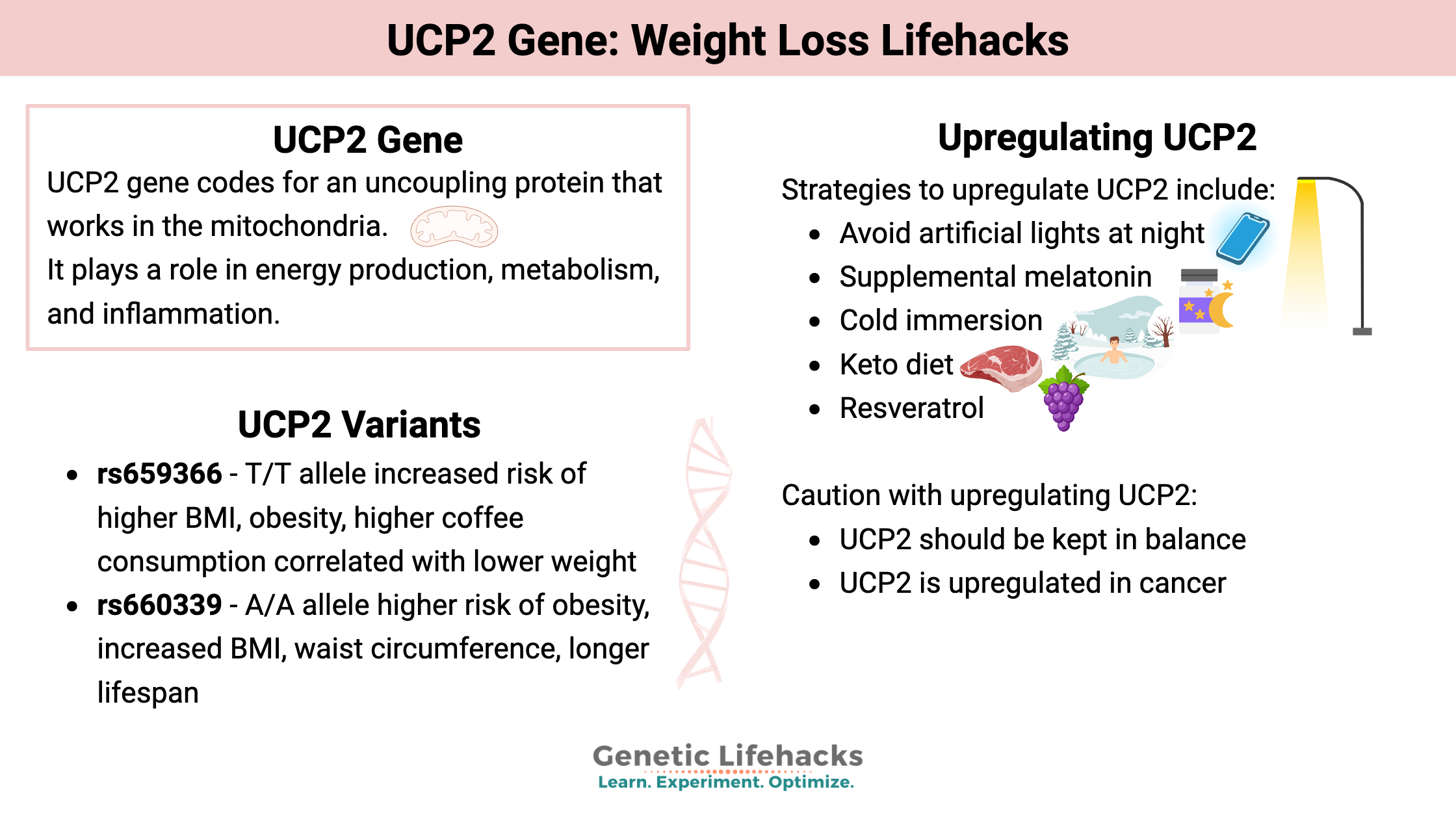
Increasing UPC2 should promote fat burning and weight loss.
Light:
One study in Bali found that the UCP2 genetic variant only contributed to an increased risk of obesity in urban people (compared to rural).[ref] Some environmental differences between urban environments and rural environments would include the presence of more light at night and a greater likelihood of staying up later, as well as a difference in the types of food eaten.
Related Article: Color TV has made us fat: melatonin, genetics, and light at night
Melatonin:

Related Article: Blue-blocking Glasses: Why? Which ones?
Cold and Keto:
UCP2 is increased by cold and high-fat feeding.[ref] Cold exposure can be done with immersion in cold water or even just turning your shower on to cold for a couple of minutes. A high-fat diet option would be the ketogenic diet.
Resveratrol:
A high-fat diet, red wine, and resveratrol increase UCP2 expression in muscle tissue (rat study). Grape juice increased UCP2 expression in adipose (fat) tissue.[ref]
Related article: Resveratrol: Genetic Interactions and Bioavailability & Changing Your Circadian Gene Expression with Polyphenols
Coffee:
Research on coffee consumption showed that people with the UCP2 variant had less body fat with more coffee. It was independent of caffeine intake.[ref]
Is caution warranted?
Overall, I’m not convinced that trying to increase UCP2 is a good idea in the long term. It seems to be a balancing act between reactive oxygen species, inflammation, and energy balance. Plus, UCP2 is upregulated in cancer.[ref]
Recap of your genes:
| Gene | RS ID | Your Genotype | Notes for Your Genotype | Effect allele | Effect allele frequency |
|---|---|---|---|---|---|
| UCP2 | rs659366 | — | typicalincreased risk of higher BMI, obesity, higher coffee consumption correlated with lower weightincreased risk of higher BMI, obesity T2D, higher coffee consumption correlated with lower weight | T | 0.37 |
| UCP2 | rs660339 | — | typicalhigher risk of obesity, increased BMI, waist circumferencehigher risk of obesity, increased BMI, waist circumference longer lifespan | A | 0.4 |
Related Articles and Topics:
References:
Baturin, A. K., et al. “[The study of the association of polymorphism rs659366 gene UCP2 c obesity and type 2 diabetes among residents of the Moscow Region].” Voprosy Pitaniia, vol. 84, no. 1, 2015, pp. 44–49.
“Burning More Fat With Cold.” Ben Greenfield Fitness – Diet, Fat Loss and Performance Advice, 17 Sept. 2012, https://bengreenfieldfitness.com/article/fat-loss-articles/burning-more-fat-with-cold/.
Dalgaard, Louise T. “Genetic Variance in Uncoupling Protein 2 in Relation to Obesity, Type 2 Diabetes, and Related Metabolic Traits: Focus on the Functional −866G>A Promoter Variant (Rs659366).” Journal of Obesity, vol. 2011, 2011, p. 340241. PubMed Central, https://doi.org/10.1155/2011/340241.
de Souza Rocha, Gabrielle, et al. “Effects of Resveratrol, Grape Juice or Red Wine Consumption Irisin Levels and Fibronectin Type III Domain Containing Protein 5 and Uncoupoling Protein Gene Expression Modulation in Rats.” Clinical Nutrition Experimental, vol. 5, Feb. 2016, pp. 1–5. ScienceDirect, https://doi.org/10.1016/j.yclnex.2016.02.001.
Martinez-Hervas, Sergio, et al. “Polymorphisms of the UCP2 Gene Are Associated with Body Fat Distribution and Risk of Abdominal Obesity in Spanish Population.” European Journal of Clinical Investigation, vol. 42, no. 2, Feb. 2012, pp. 171–78. PubMed, https://doi.org/10.1111/j.1365-2362.2011.02570.x.
—. “Polymorphisms of the UCP2 Gene Are Associated with Body Fat Distribution and Risk of Abdominal Obesity in Spanish Population.” European Journal of Clinical Investigation, vol. 42, no. 2, Feb. 2012, pp. 171–78. PubMed, https://doi.org/10.1111/j.1365-2362.2011.02570.x.
Muhammad, Harry Freitag Luglio, et al. “The Interaction between Coffee: Caffeine Consumption, UCP2 Gene Variation, and Adiposity in Adults-A Cross-Sectional Study.” Journal of Nutrition and Metabolism, vol. 2019, 2019, p. 9606054. PubMed, https://doi.org/10.1155/2019/9606054.
—. “The Interaction between Coffee: Caffeine Consumption, UCP2 Gene Variation, and Adiposity in Adults-A Cross-Sectional Study.” Journal of Nutrition and Metabolism, vol. 2019, 2019, p. 9606054. PubMed, https://doi.org/10.1155/2019/9606054.
Oktavianthi, Sukma, et al. “Uncoupling Protein 2 Gene Polymorphisms Are Associated with Obesity.” Cardiovascular Diabetology, vol. 11, Apr. 2012, p. 41. PubMed Central, https://doi.org/10.1186/1475-2840-11-41.
Pan, Pan, et al. “Melatonin Balance the Autophagy and Apoptosis by Regulating UCP2 in the LPS-Induced Cardiomyopathy.” Molecules (Basel, Switzerland), vol. 23, no. 3, Mar. 2018, p. E675. PubMed, https://doi.org/10.3390/molecules23030675.
Rose, Giuseppina, et al. “Further Support to the Uncoupling-to-Survive Theory: The Genetic Variation of Human UCP Genes Is Associated with Longevity.” PLOS ONE, vol. 6, no. 12, Dec. 2011, p. e29650. PLoS Journals, https://doi.org/10.1371/journal.pone.0029650.
Salopuro, Titta, et al. “Variation in the UCP2 and UCP3 Genes Associates with Abdominal Obesity and Serum Lipids: The Finnish Diabetes Prevention Study.” BMC Medical Genetics, vol. 10, Sept. 2009, p. 94. PubMed, https://doi.org/10.1186/1471-2350-10-94.
—. “Variation in the UCP2 and UCP3 Genes Associates with Abdominal Obesity and Serum Lipids: The Finnish Diabetes Prevention Study.” BMC Medical Genetics, vol. 10, Sept. 2009, p. 94. PubMed, https://doi.org/10.1186/1471-2350-10-94.
Souza, Bianca Marmontel de, et al. “The Role of Uncoupling Protein 2 (UCP2) on the Development of Type 2 Diabetes Mellitus and Its Chronic Complications.” Arquivos Brasileiros de Endocrinologia & Metabologia, vol. 55, June 2011, pp. 239–48. SciELO, https://doi.org/10.1590/S0004-27302011000400001.
Sreedhar, Annapoorna, et al. “UCP2 Overexpression Redirects Glucose into Anabolic Metabolic Pathways.” Proteomics, vol. 19, no. 4, Feb. 2019, p. e1800353. PubMed, https://doi.org/10.1002/pmic.201800353.