
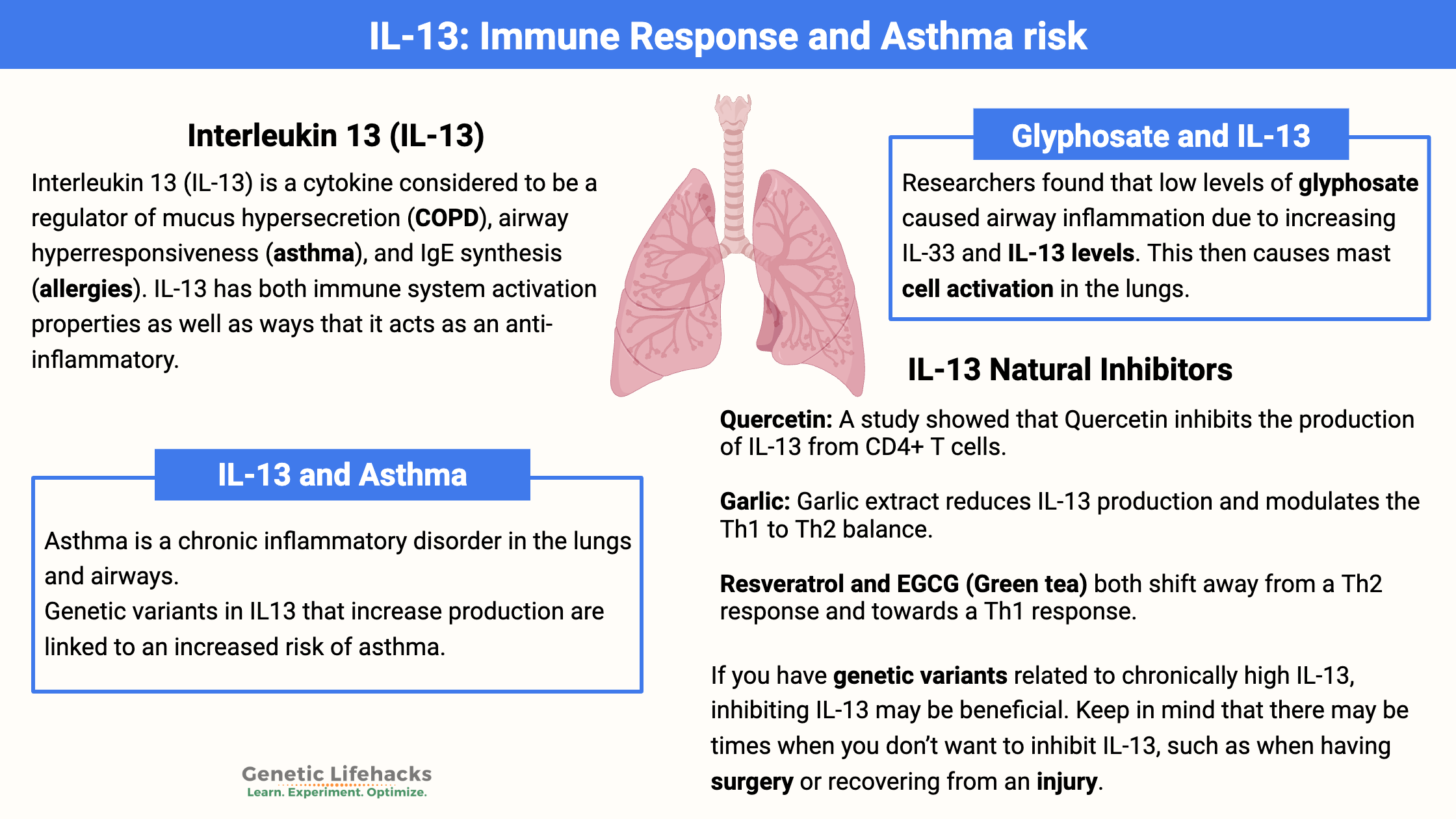
Key takeaways:
- IL-13 is an immune signaling molecule that pushes the immune system toward a Th2 response, the branch involved in allergies, asthma, and eczema.
- Genetic variants in the IL13 gene can raise IL-13 activity and increase susceptibility to allergic disease.
- Several natural compounds may help modulate IL-13 signaling.
Members will see their genotype report below, plus additional solutions in the Lifehacks section. Join today.
IL-13 and Th2 Activation
Let me start by giving a brief overview of T cells and the immune system; then, I’ll dive into specifics on IL-13.
A T cell is a type of white blood cell that matures in the thymus. T cells can mature and differentiate into different and distinct types of immune cells that have important functions in shaping the immune system’s response.
There are two main categories of T cells: CD4+ “helper” T cells and CD8+ “killer” T cells.
The CD4+ helper T cells (abbreviated Th) are part of the adaptive immune response and activate other immune cells to mount a full response to pathogens.
The T helper cells are further divided into Th1 cells, Th2 cells, Th17 cells, T regulatory cells, and more.
Th2 dominance
Th2 cells are what we are going to focus on here. The Th2 cells are vital to how the body responds to extracellular (outside the cell) pathogens, such as worm infections.
Th2 cells produce specific cytokines, called interleukin 4 (IL-4), interleukin 5, and interleukin 13 (IL-13). The cytokines produced by Th2 cells can trigger other immune cells to act (usually against parasitic worms). Th2 cells can also cause B cells to proliferate and produce IgE antibodies.[ref]
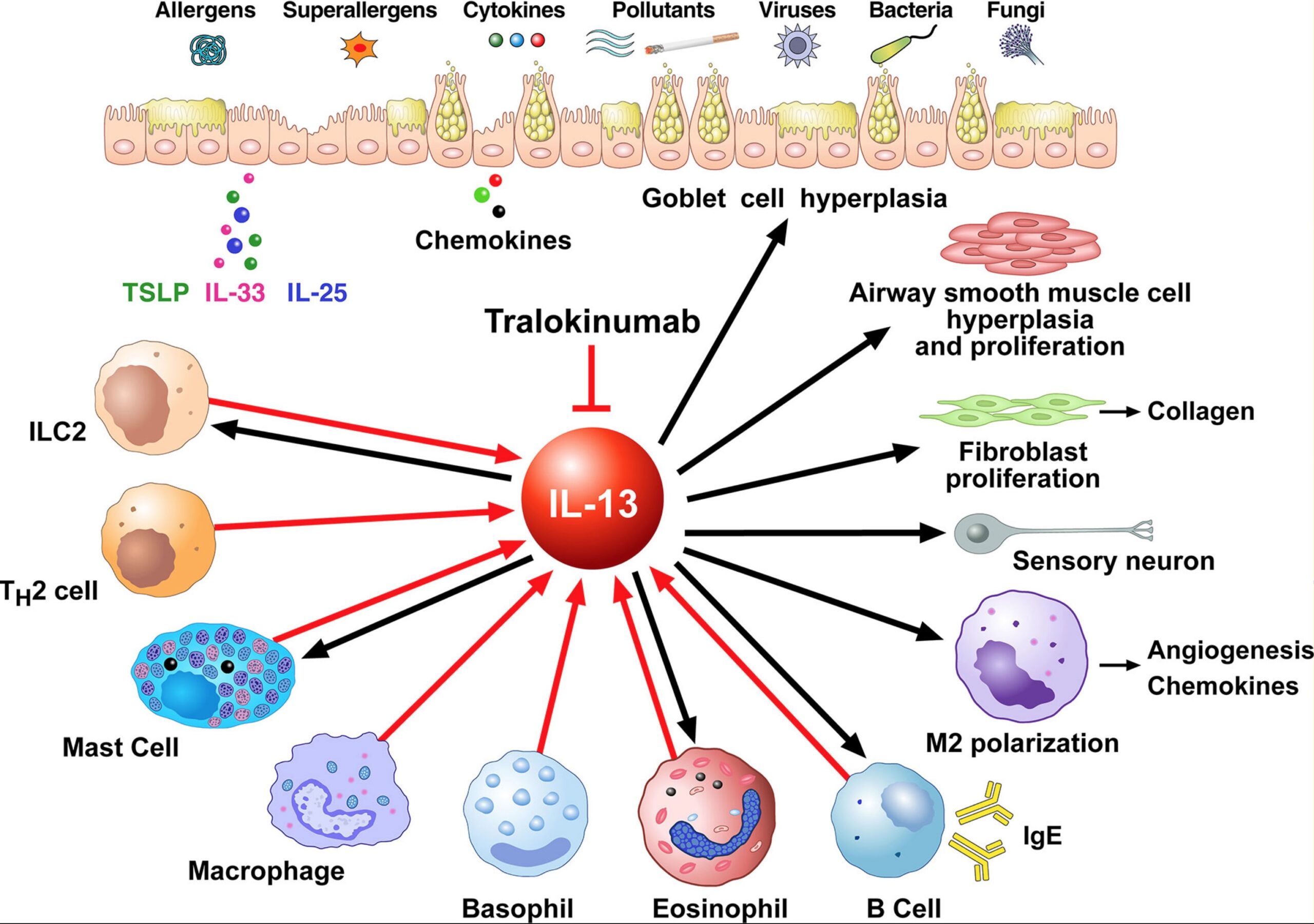
Th2 cells produce IL-13, which acts on other immune cells, including mast cells, basophils, and eosinophils. When IL-13 activates mast cells or basophils, they can release histamine, serotonin, and other substances that can trigger blood vessels to dilate, stomach acid to be released, and intestinal peristalsis to increase. In the case of parasitic worms, this results in diarrhea to expel the worms.
When the Th2 system is overactive, allergies can occur with IgE antibodies produced for allergens.
Excessive Th2 activation, also called Th2 dominance, is linked to:[ref]
- allergies
- atopic dermatitis
- asthma
- histamine intolerance
- chemical sensitivities
- hyperactive immune response
What is interleukin 13 (IL-13)?
Interleukin 13 (IL-13) is a cytokine secreted by Th2 cells, mast cells, basophils, eosinophils, and natural killer T cells. It is considered to be a regulator of mucus hypersecretion (COPD), airway hyperresponsiveness (asthma), and IgE synthesis (allergies).[ref]
IL-13 has both immune system activation properties as well as ways that it acts as an anti-inflammatory.
As a cytokine, IL-13 is a signaling molecule that acts on cell receptors. The receptors that IL-13 binds to are the IL-4 alpha receptor (IL-4Ra) and the IL-13 receptor (IL-13R1).[ref]
Often when reading about IL-13, you will also see IL-4, another interleukin, mentioned. IL-4 and IL-13 are similar in structure and have some overlapping functions. Together, they activate receptors that combine to create a specific response. Separately, IL-4 can activate different types of immune responses.[ref]
On bronchial epithelial cells lining the lungs, IL-13 and IL-4 together stimulate the production of a lot of mucus. It is a crucial way to get rid of pathogens in the lungs – trapping them in mucus and coughing them out.
IL-13 also promotes the production of IgE by B cells.[ref]
Asthma and IL-13
Asthma is a chronic inflammatory disorder in the lungs and airways. Researchers are now classifying asthma in two ways: T2-high asthma and T2-low asthma. T2-high asthma has increased levels of Th2 cells, IgE, mast cells, eosinophils, and basophils. One research study explains, “Patients with T2-high asthma have eosinophilia and other signs of type 2 inflammation, including high levels of IL-4 and IL-13.”[ref]
Genetic variants in IL13 that increase production are linked to an increased risk of asthma.
Related article: Asthma Genes: Understanding your genetic pathways
Dust mites and airway inflammation
House dust mites are microscopic little critters that live inside homes, eating dead skin cells. They thrive in humid indoor air, but high altitude and very dry regions are pretty much dust-mite-free. (Did you know the average adult sheds 1.5 grams of dead skin cells daily?)[ref]
Dust mites are a common airborne allergen that often triggers allergic asthma. IL-13 and IL-4 are elevated with repeated exposure to dust mites, and genetic variants in IL-13 are linked to an increased risk of allergy or asthma from dust mites.[ref][ref]
IL-13 and aspirin-exacerbated respiratory disease
Taking aspirin or NSAIDS can trigger flares in about 10% of people with asthma. IL-13 plays a role in regulating the arachidonic acid pathway, downregulating PGE2.[ref]
IL-13 in the skin barrier
A protein called filaggrin is integral to the structure of the outer layer of the skin. IL-13 can inhibit the production of filaggrin, causing the skin barrier to be disrupted. Excessive IL-13, such as from genetic variants, can lead to atopic dermatitis or eczema.[ref]
IL-13 in cancer
IL-13 receptors are overexpressed in several types of solid cancers, and IL-13 levels can be elevated in certain cancers (pancreatic, esophageal).[ref]
IL-13 and Rheumatoid Arthritis
It is all about the balance between the Th1 and Th2 immune responses. IL-13 (and IL-4) have been shown to down-regulate the inflammatory processes that cause Rheumatoid arthritis.[ref]
Myocarditis, heart injuries, and IL-13
Researchers have recently found that IL-13 is also secreted by a special type of cell called a type 2 innate lymphoid cell. These type 2 innate lymphoid cells in heart tissue are essential to the response to heart injuries, such as myocarditis or heart failure. Research seems to point to IL-13 having a positive role in younger hearts for exercise endurance, but in failing hearts, IL-13 over-activation seems to “be the final straw”.[ref]
Glyphosate, airway inflammation
In an animal study, researchers found that low levels of glyphosate (the active ingredient in Roundup) caused airway inflammation due to increasing IL-33 and IL-13 levels. This then causes mast cell activation in the lungs.[ref]
Related article: Mast Cells: MCAS, Genetics, and Solutions
The proof IL-13 matters: drugs that block it
If you want evidence that IL-13 is a real driver of allergic disease rather than a bystander, look at what’s happened when drug companies tried to switch it off.
Two monoclonal antibodies that bind IL-13 directly are now FDA-approved for atopic dermatitis: tralokinumab (Adbry) and lebrikizumab (Ebglyss, approved in 2024). Both work by keeping IL-13 from signaling through its receptor on skin cells.[ref]
Here’s the interesting part. Both drugs were tested for asthma first. Tralokinumab missed its primary endpoints in two phase 3 asthma trials, and lebrikizumab’s asthma results were inconsistent. Blocking IL-13 by itself wasn’t enough to reliably control asthma, but IL-13 is part of the picture along with IL-4.[ref] Essentially, in the skin, IL-13 seems to be the main actor. In the airways, IL-4 and IL-13 overlap enough that you have to block both.
What this means for you: If your genotype report shows variants that raise IL-13 and you have eczema, that’s pointing to a pathway with medications that you can talk with your doctor about. The natural inhibitors below in the lifehacks section may not be a substitute for these medications in severe disease, but they target the same signal and may be something to explore with your doctor.
IL-13 Genotype Report
The genetic variants below are linked to an overactive response that may increase the relative risk of several allergy or asthma-type reactions. However, these variants are fairly common in the population because they also protect against parasite infections, which was a significant survival advantage for our ancestors.[ref]
Access this content:
An active subscription is required to access this content.
Log in below or Join as a member.
Lifehacks for high IL-13
What can you do if you are genetically geared towards higher IL-13 levels?
First off, this is an advantage if you end up with parasitic worms :-). These variants are likely common in the population due to the superpower they give you for fighting the helminths.
But in the modern world, with hygiene and worm medicines, an excessive IL-13 response may tip you towards too much Th2 response – allergies, asthma, atopic dermatitis, etc.
Keep in mind that there may be times when you don’t want to inhibit IL-13, such as when having surgery or recovering from an injury.[ref]
IL13 natural inhibitors
Access this content:
An active subscription is required to access this content.
Log in below or Join as a member.
Related Articles and Topics:
Thyroid Hormones: Genes, Hypothyroidism, and T4/T3 Conversion
References:
Betz, Regina C., et al. “Genome-Wide Meta-Analysis in Alopecia Areata Resolves HLA Associations and Reveals Two New Susceptibility Loci.” Nature Communications, vol. 6, Jan. 2015, p. 5966. PubMed Central, https://doi.org/10.1038/ncomms6966.
Black, S., et al. “Contribution of Functional Variation in the IL13 Gene to Allergy, Hay Fever and Asthma in the NSHD Longitudinal 1946 Birth Cohort.” Allergy, vol. 64, no. 8, Aug. 2009, pp. 1172–78. PubMed, https://doi.org/10.1111/j.1398-9995.2009.01988.x.
Bunyavanich, Supinda, et al. “A Meta-Analysis of Th2 Pathway Genetic Variants and Risk for Allergic Rhinitis.” Pediatric Allergy and Immunology: Official Publication of the European Society of Pediatric Allergy and Immunology, vol. 22, no. 4, June 2011, pp. 378–87. PubMed, https://doi.org/10.1111/j.1399-3038.2010.01124.x.
Costa, D. J., et al. “Efficacy and Safety of the Probiotic Lactobacillus Paracasei LP-33 in Allergic Rhinitis: A Double-Blind, Randomized, Placebo-Controlled Trial (GA2LEN Study).” European Journal of Clinical Nutrition, vol. 68, no. 5, May 2014, pp. 602–07. PubMed, https://doi.org/10.1038/ejcn.2014.13.
de Vries, J. E. “The Role of IL-13 and Its Receptor in Allergy and Inflammatory Responses.” The Journal of Allergy and Clinical Immunology, vol. 102, no. 2, Aug. 1998, pp. 165–69. PubMed, https://doi.org/10.1016/s0091-6749(98)70080-6.
Dust Mite Allergy | AAFA.Org. https://www.aafa.org/dust-mite-allergy/. Accessed 10 Aug. 2022.
Furue, Kazuhisa, et al. “The IL‐13–OVOL1–FLG Axis in Atopic Dermatitis.” Immunology, vol. 158, no. 4, Dec. 2019, pp. 281–86. PubMed Central, https://doi.org/10.1111/imm.13120.
Gong, Yi, et al. “Association between the Interleukin-13 Gene and Development of Chronic Obstructive Pulmonary Disease in Southern Chinese Han Population: A Case-Control Study.” Chinese Medical Journal, vol. 126, no. 23, Dec. 2013, pp. 4403–08.
Granada, Mark, et al. “A Genome Wide Association Study of Plasma Total IgE Concentration in the Framingham Heart Study.” The Journal of Allergy and Clinical Immunology, vol. 129, no. 3, Mar. 2012, pp. 840-845.e21. PubMed Central, https://doi.org/10.1016/j.jaci.2011.09.029.
Hsieh, Chia-Chen, et al. “The Protective Role of Garlic on Allergen-Induced Airway Inflammation in Mice.” The American Journal of Chinese Medicine, vol. 47, no. 5, 2019, pp. 1099–112. PubMed, https://doi.org/10.1142/S0192415X19500563.
Iwasaki, Naruhito, et al. “Th2 Cells and Macrophages Cooperatively Induce Allergic Inflammation through Histamine Signaling.” PLoS ONE, vol. 16, no. 3, Mar. 2021, p. e0248158. PubMed Central, https://doi.org/10.1371/journal.pone.0248158.
Iwaszko, Milena, et al. “Significance of Interleukin (IL)-4 and IL-13 in Inflammatory Arthritis.” Cells, vol. 10, no. 11, Nov. 2021, p. 3000. PubMed Central, https://doi.org/10.3390/cells10113000.
Jagielska, Dagny, et al. “Follow-Up Study of the First Genome-Wide Association Scan in Alopecia Areata: IL13 and KIAA0350 as Susceptibility Loci Supported with Genome-Wide Significance.” Journal of Investigative Dermatology, vol. 132, no. 9, Sept. 2012, pp. 2192–97. www.jidonline.org, https://doi.org/10.1038/jid.2012.129.
Jang, You Jin, et al. “Lactobacillus Fermentum Species Ameliorate Dextran Sulfate Sodium-Induced Colitis by Regulating the Immune Response and Altering Gut Microbiota.” Gut Microbes, vol. 10, no. 6, 2019, pp. 696–711. PubMed, https://doi.org/10.1080/19490976.2019.1589281.
Kang, Min-Gyu, et al. “Probiotic NVP-1703 Alleviates Allergic Rhinitis by Inducing IL-10 Expression: A Four-Week Clinical Trial.” Nutrients, vol. 12, no. 5, May 2020, p. E1427. PubMed, https://doi.org/10.3390/nu12051427.
Kouriba, Bourema, et al. “Analysis of the 5q31-Q33 Locus Shows an Association between IL13-1055C/T IL-13-591A/G Polymorphisms and Schistosoma Haematobium Infections.” Journal of Immunology (Baltimore, Md.: 1950), vol. 174, no. 10, May 2005, pp. 6274–81. PubMed, https://doi.org/10.4049/jimmunol.174.10.6274.
Liu, Yongan, et al. “Interleukin-13 +1923C/T Polymorphism Is Associated with Asthma Risk: A Meta-Analysis.” BioMed Research International, vol. 2013, 2013, p. 394316. PubMed Central, https://doi.org/10.1155/2013/394316.
Malaviya, Ravi, et al. “Repeated Exposure of House Dust Mite Induces Progressive Airway Inflammation in Mice: Differential Roles of CCL17 and IL‐13.” Pharmacology Research & Perspectives, vol. 9, no. 3, Apr. 2021, p. e00770. PubMed Central, https://doi.org/10.1002/prp2.770.
Marone, Giancarlo, et al. “The Intriguing Role of Interleukin 13 in the Pathophysiology of Asthma.” Frontiers in Pharmacology, vol. 10, Dec. 2019, p. 1387. DOI.org (Crossref), https://doi.org/10.3389/fphar.2019.01387.
Nie, Wei, et al. “Effects of Polymorphisms -1112C/T and +2044A/G in Interleukin-13 Gene on Asthma Risk: A Meta-Analysis.” PLoS ONE, vol. 8, no. 2, Feb. 2013, p. e56065. PubMed Central, https://doi.org/10.1371/journal.pone.0056065.
Park, Min Jee, et al. “Effect of Early‐life Antibiotic Exposure and IL‐13 Polymorphism on Atopic Dermatitis Phenotype.” Pediatric Allergy and Immunology, edited by Jon Genuneit, vol. 32, no. 7, Oct. 2021, pp. 1445–54. DOI.org (Crossref), https://doi.org/10.1111/pai.13531.
Qian, Ningjing, et al. “Emerging Role of Interleukin‐13 in Cardiovascular Diseases: A Ray of Hope.” Journal of Cellular and Molecular Medicine, vol. 25, no. 12, June 2021, pp. 5351–57. PubMed Central, https://doi.org/10.1111/jcmm.16566.
Rael, Efren L., and Richard F. Lockey. “Interleukin-13 Signaling and Its Role in Asthma.” The World Allergy Organization Journal, vol. 4, no. 3, Mar. 2011, pp. 54–64. PubMed Central, https://doi.org/10.1097/WOX.0b013e31821188e0.
Sanctuary, Megan R., et al. “Pilot Study of Probiotic/Colostrum Supplementation on Gut Function in Children with Autism and Gastrointestinal Symptoms.” PloS One, vol. 14, no. 1, 2019, p. e0210064. PubMed, https://doi.org/10.1371/journal.pone.0210064.
Schwager, Joseph, et al. “Resveratrol, EGCG and Vitamins Modulate Activated T Lymphocytes.” Molecules, vol. 26, no. 18, Jan. 2021, p. 5600. www.mdpi.com, https://doi.org/10.3390/molecules26185600.
Shirkani, Afshin, et al. “The Role of Interleukin-4 and 13 Gene Polymorphisms in Allergic Rhinitis: A Case Control Study.” Reports of Biochemistry & Molecular Biology, vol. 8, no. 2, July 2019, pp. 111–18. PubMed Central, https://www.ncbi.nlm.nih.gov/pmc/articles/PMC6844616/.
Tanaka, Yoshihito, et al. “Modulation of Th1/Th2 Cytokine Balance by Quercetin In Vitro.” Medicines (Basel, Switzerland), vol. 7, no. 8, July 2020, p. E46. PubMed, https://doi.org/10.3390/medicines7080046.
Van Broeckhoven, Jana, et al. “Macrophage-Based Delivery of Interleukin-13 Improves Functional and Histopathological Outcomes Following Spinal Cord Injury.” Journal of Neuroinflammation, vol. 19, Apr. 2022, p. 102. PubMed Central, https://doi.org/10.1186/s12974-022-02458-2.
Xu, Yueli, et al. “Association between IL-13 +1923C/T Polymorphism and Asthma Risk: A Meta-Analysis Based on 26 Case-Control Studies.” Bioscience Reports, vol. 37, no. 1, Jan. 2017, p. BSR20160505. PubMed Central, https://doi.org/10.1042/BSR20160505.
Zhang, Wenbo, et al. “IL-13 -1112 Polymorphism and Periodontitis Susceptibility: A Meta-Analysis.” BMC Oral Health, vol. 18, Feb. 2018, p. 21. PubMed Central, https://doi.org/10.1186/s12903-018-0481-y.