
Last fact-checked and updated: | Published:
Do you have “good genes”? That question comes up a lot – and means something different to everyone. For some, the term “good genes” means they are tall, good-looking, and have good teeth. Others may prioritize intelligence or emotional IQ.
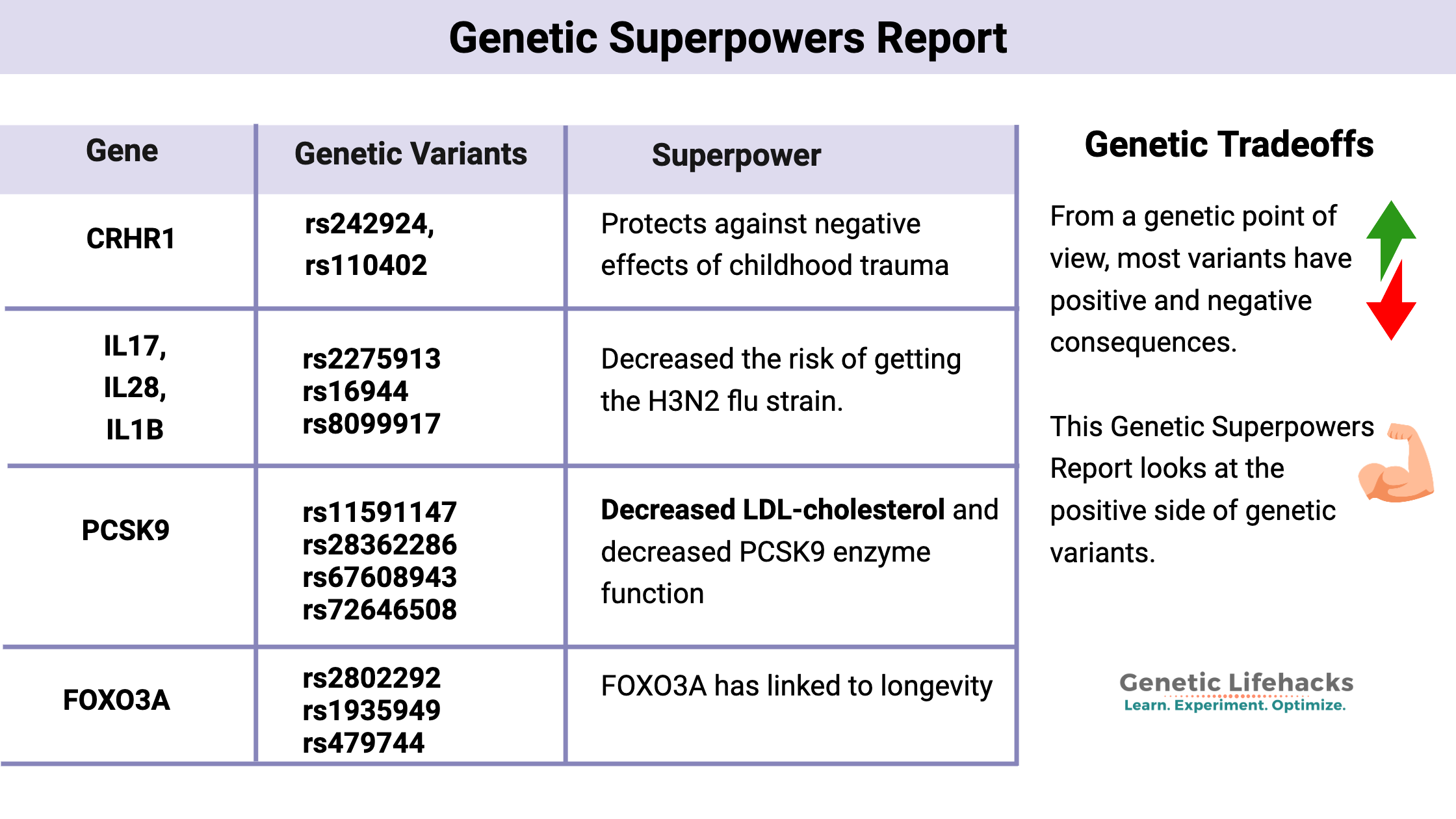
From a genetic point of view, most variants have positive and negative consequences. In our modern world, a variant that may have helped your ancestor survive the black plague may give rise to chronic inflammation.
This Genetic Superpowers Report looks at the positive side of genetic variants. Everyone has some kind of genetic superpower, and hopefully, this report will highlight yours! Members will see their genotype in the reports below. Consider joining today.
| Gene | RS ID | Your Genotype | Notes for Your Genotype | Effect allele | Effect allele frequency |
|---|---|---|---|---|---|
| CRHR1 | rs242924 | — | Resiliency! Protective against the negative effects of childhood trauma.somewhat increased risk of depression, anxiety due to childhood trauma.increased risk of depression, anxiety due to childhood trauma | G | 0.54 |
| CRHR1 | rs110402 | — | Resiliency! Protective against the negative effects of childhood trauma.somewhat increased risk of depression, anxiety due to childhood trauma.increased risk of depression, anxiety due to childhood trauma | G | 0.55 |
| IL17 | rs2275913 | — | typical risk for H3N2 flu (compared to A/A)typical risk for H3N2 flu (compared to A/A)~ half the risk for H3N2 flu | A | 0.33 |
| IL1B | rs16944 | — | typical risk for H3N2 flutypical risk for H3N2 fluless than half the risk for H3N2 flu | G | 0.63 |
| IL28B | rs8099917 | — | typical risk for H3N2 flu~ half the risk for H3N2 flu~ half the risk for H3N2 flu | G | 0.19 |
| PCSK9 | rs11591147 | — | typicaldecreased LDL-cholesterol, 30% lower risk of heart diseasedecreased LDL-cholesterol, > 30% lower risk of heart disease | T | 0.01 |
| PCSK9 | rs28362286 | — | typicaldecreased LDL-cholesterol, lower risk of heart disease, decreased fasting glucose levelsdecreased LDL-cholesterol, lower risk of heart disease, decreased fasting glucose levels | A | 0.0003 |
| PCSK9 | rs67608943 | — | typicaldecreased LDL and decreased risk of heart diseasedecreased LDL and decreased risk of heart disease | G | 0.00004 |
| PCSK9 | rs72646508 | — | typicaldecreased LDL and decreased risk of heart diseasedecreased LDL and decreased risk of heart disease | T | 0.0001 |
| CCR5 | rs333 | — | typicalOne copy of CCR5-delta 32 mutation; a slower progression from HIV to AIDs, significantly reduced mortality risk from HIVTwo copies of CCR5-delta 32 mutation; resistant to most strains of HIV | D | 0.09 |
| FOXO3A | rs2802292 | — | typicalincreased odds of living longerincreased odds of living longer (1.5 to 2.75-fold increased odds); lower blood glucose levels in women; increased FOXO3 | G | 0.43 |
| FOXO3A | rs1935949 | — | typicalincreased longevity for womenincreased longevity for women | A | 0.32 |
| FOXO3A | rs479744 | — | typicalsomewhat higher probability of increased longevitysomewhat higher probability of increased longevity | T | 0.24 |
| FUT2 | rs601338 | — | blood type secretorblood type secretornon-secretor of blood type, lower amounts of Bifidobacteria, resistance to norovirus | A | 0.47 |
| FUT2 | rs1047781 | — | “secretor” if Japanese or Korean ancestry“secretor” if Japanese or Korean ancestry“non-secretor” if Japanese or Korean ancestry | T | 0.01 |
| FOXC2 | rs121909106 | — | typicaldouble lash mutation increased risk of lymphedemadouble lash mutation increased risk of lymphedema (rare) | T | 0 |
| FOXC2 | rs121909107 | — | typicaldouble lash mutation, increased risk of lymphedemadouble lash mutation increased risk of lymphedema (rare) | A | 0 |
| TAS2R38 | rs713598 | — | Probably unable to taste some bitter flavorsProbably can taste bitterCan taste bitter in broccoli, etc. | G | 0.42 |
| TAS2R38 | rs10246939 | — | Probably unable to taste some bitter flavorsProbably can taste bitterCan taste bitter in broccoli, etc. | C | 0.46 |
| TAS2R16 | rs846672 | — | Can taste bitter in ethanol, fermented foods, etcProbably can taste bitterCan taste bitter in ethanol, fermented foods, etc | C | 0.68 |
| TAS2R16 | rs846664 | — | Can taste bitter in ethanol, fermented foods, etcProbably can taste bitterCan taste bitter in ethanol, fermented foods, etc | C | 0.03 |
| TAS2R16 | rs978739 | — | less able to taste some bitter flavorsProbably can taste bitterCan taste bitter in ethanol, fermented foods, etc | T | 0.64 |
| DEC2 | rs121912617 | — | typicalnatural short sleeper (less than 0.5% of population)natural short sleeper (really, really rare) | T | 0.0002 |
Resiliency Superpower
“I get knocked down, but I get up again…” may be your theme song if you have resiliency genetic variants.
For some, childhood traumas can permanently change how their bodies react to stress as adults. But others are much more resilient — able to bounce back more easily when experiencing adversity.
Cortisol is released in response to stress. It is a normal and necessary response if a tiger is chasing you. However, some people experience altered cortisol responses as adults due to epigenetic modifications brought on by childhood trauma. These changes alter how the brain controls the release of cortisol, and it alters the ability to recover from stressors.
For others, though, traumatic events at an early age have no lasting physiological effect. They are resilient and bounce back completely in stressful situations.
Resiliency Genotype Report
CRHR1 gene: This gene encodes a receptor for corticotropin-releasing hormone (CRH). In the brain, CRH is released from the hypothalamus and initiates the pathway that involves the release of cortisol and stress hormones. Traumatic events during childhood, whether psychological or physical, can permanently alter the CRH receptor for some people, while others will remain more resilient.
Research & references
Research & references
Read the full article on resilience to childhood trauma.
Flu Fighters
If you’ve ever wondered why you never seem to get the flu, this may be the genetic answer.
Our genome is shaped by the pathogens that our ancestors survived. It is really pretty cool – you carry specific genetic variants passed down to you from ancestors who lived through diseases and epidemics. (The ones that didn’t survive didn’t pass on their genes…)
Throughout history, humanity’s biggest threats to survival have been the microscopic pathogens that we now battle using antibiotics, antifungals, vaccines, clean water, etc. All of the genetic variants that gave your ancestors a survival advantage in ages past are still written in your genome today.
The flu comes around in different strains each year, and some people are champions at fighting off specific strains. The genes that encode different parts of the immune system have lots of different variants in them. This makes humans able to survive new and varied pathogens.
Flu Fighter Genotype Report
Researchers found that variants in IL17 (interleukin-17), IL28 (interleukin-28), and IL1B (interleukin-1 Beta) decreased the risk of getting the H3N2 flu strain.[ref] Keep in mind that even if you are at half the normal risk, you could still get the flu, especially if you have a compromised immune system.
Research & references
Research & references
Research & references
Research & references
Research & references
Research & references
Research & references
Research & references
Research & references
Research & references
Research & references
Research & references
Research & references
Research & references
Research & references
Research & references
Research & references
Research & references
Research & references
Read the full article on susceptibility to viral infections.
Lower cholesterol, reduced risk of heart disease
For some people, even a bad diet doesn’t seem to affect their cholesterol much. Year after year, their blood tests show they are on the lower end of the cholesterol range. It turns out that genetics can play a significant role in whether you have low or high cholesterol.
The PCSK9 gene encodes an enzyme vital to how cholesterol is transported throughout the body. PCSK9 regulates cholesterol levels by controlling the number of LDL receptors on liver cells, which is where cholesterol is synthesized and eliminated.
Researchers discovered that PCSK9 variants (loss-of-function) lead to lower cholesterol levels. These loss-of-function variants are linked with lower lifetime LDL cholesterol levels and a lower risk of heart disease.[ref][ref]
PCSK9 Genotype Report
PCSK9 variants associated with decreased LDL-cholesterol and decreased PCSK9 enzyme function:
Research & references
Research & references
Research & references
Research & references
Research & references
Research & references
Research & references
Research & references
Read the in-depth article on PCSK9.
AIDS Resistance
HIV uses the CCR5 receptor to gain access to cells. In the mid-90s, geneticists investigated why some people who were exposed to HIV either didn’t get HIV at all or didn’t progress to AIDS. They found that a mutation in the CCR5 gene, called the Delta32 mutation, prevented HIV from binding to T cells and macrophages.[ref]
People with one copy of a genetic variant in the CCR5 receptor are much less likely to have an HIV infection progress to full-blown AIDS. Two copies of the variant significantly decrease the likelihood of even getting most strains of HIV.
Common sense note: The research on this CCR5 mutation is extensive, but there are constant viral changes to HIV with new strains emerging. Definitely do not rely on your genetic ‘superpower’ here to protect you from HIV/AIDS.
AIDS Genotype Report
23andMe data is not guaranteed to be clinically accurate. You shouldn’t rely solely on it for any medical decisions.
Research & references
Research & references
Read the full article on CCR5 delta 32.
Longevity Superpowers
Scientists have long been fascinated with figuring out why some people are likely to live to be 100 or more. It is a tantalizing thought – perhaps a genetic variant extends lifespan?
The FOXO3A gene was one of the first genes identified as being tied to living longer. The gene impacts both apoptosis, which is cell death, and cancer risk. Apoptosis is crucial because it is one way that the body gets rid of cells that are damaged, infected, or have DNA damage. And not getting cancer is an excellent way to live longer…
Longevity Genotype Report
FOXO3A gene: The FOXO3A gene (forkhead box O3 or FOXO3) has links to longevity in many studies. This gene is thought to regulate apoptosis (cell death) and function as a tumor suppressor. It is also involved in nutrient sensing, regulating IGF1, and the response to oxidative stress (all important in longevity).[ref][ref]
Research & references
Research & references
Research & references
Research & references
Research & references
Research & references
Research & references
Research & references
Research & references
Research & references
Read the full article on longevity here.
Impervious to the stomach flu!
About 20% of us have a genetic superpower that protects us from a norovirus or rotavirus infection. These are the viruses that cause what is commonly called the ‘stomach flu’.
The FUT2 gene encodes the enzyme fucosyltransferase, which controls whether your blood type is expressed in your bodily fluids (other than your blood).
About 20% of people with European or African ancestry are non-secretors of their blood type. It changes the gut microbiome and also changes the way that viruses can interact and replicate in the intestines.
The norovirus and the rotavirus are much, much less likely to infect a non-secretor. Researchers estimate that they are about 99% protected from getting these infections![ref][ref]
Norovirus Resistance Genotype Report
FUT2 Gene: codes for the fucosyltransferase enzyme, which controls whether you secrete your blood type or not
Research & references
East Asian ancestry: The SNP to check for secretor vs. non-secretor is different if you are of East Asian ancestry.
Research & references
Read the in-depth article on secretor status.
Elizabeth Taylor’s double lashes
A change in the FOXC2 gene results in the development of double eyelashes called distichiasis.
The FOX (forkhead box) gene family produces transcription factor proteins, a subclass of proteins. This kind of protein switches genes on and off both during cellular replication and throughout development.[ref][ref]
The FOXC2 gene turns genes on and off during prenatal development. Mutations in the FOXC2 gene cause a double row of lashes to form during the baby’s development. It essentially turns on excess transcription for eyelash development.
Double Lashes Genotype Report
| Gene | RS ID | Your Genotype | Notes for Your Genotype | Effect allele | Effect allele frequency |
|---|---|---|---|---|---|
| FOXC2 | rs121909106 | — | typicaldouble lash mutation; increased risk of lymphedemagreatly increased LDL, considered pathogenic for familial hypercholesterolemia | T | 0 |
| FOXC2 | rs121909107 | — | typicaldouble lash mutation, increased risk of lymphedemadouble lash mutation, increased risk of lymphedema | A | 0 |
| FOXC2 | rs104894516 | — | typicalDistichiasis-lymphedema syndrome possible, increased risk of lymphedemaDistichiasis-lymphedema syndrome possible, increased risk of lymphedema | G | 0 |
| FOXC2 | rs61753346 | — | typicalmilder mutation in FOXC2 linked to increased glaucoma riskmilder mutation in FOXC2 linked to increased glaucoma risk | C | 0.002 |
| FOXC2 | rs1035550 | — | typicalincreased risk of varicose veins; part of a haplotype that increases the risk of lymphedema with breast cancer treatmentincreased risk of varicose veins part of a haplotype that increases the risk of lymphedema with breast cancer treatment | A | 0.009 |
Read the full article on double lashes here.
Supertasters: Detecting flavors and avoiding poisons
It turns out that each of us has a distinct sense of taste. Our taste buds include a wide variety of taste receptors, and changes to the genes encoding these receptors affect how we perceive flavors.
Key to survival, our taste buds are essential for knowing whether a food contains the nutrients we need or a poison we should avoid. We instinctively know that a ripe strawberry is delicious, but an overripe strawberry that contains mold or bacteria could be harmful.
People who taste certain flavors more strongly than usual are called supertasters. They are particularly sensitive to the bitter flavors found in broccoli, coffee, dark chocolate, or beer. Some people can taste certain bitter toxins that grow on plants, thus alerting the rest of their village or tribe not to eat them.
In our modern era, someone who can taste a wider range of flavors may become an excellent chef or perhaps a wine connoisseur.
Supertaster Genotype Report
TAS2R38 gene: codes for the receptor linked to the taste of bitterness in broccoli, Brussels sprouts, cabbage, watercress, chard, ethanol, and PROP.[ref][ref]
TAS2R16 gene: encodes the receptor associated with the taste of beta-glucopyranoside[clinvar], which is in ethanol, bearberry, bacteria in spoilt or fermented foods, and willow bark (salicin).[ref]
| Gene | RS ID | Your Genotype | Notes for Your Genotype | Effect allele | Effect allele frequency |
|---|---|---|---|---|---|
| TAS2R38 | rs713598 | — | Probably unable to taste some bitter flavorsProbably can taste bitterCan taste bitter in broccoli, etc. | G | 0.42 |
| TAS2R38 | rs10246939 | — | Probably unable to taste some bitter flavorsProbably can taste bitterCan taste bitter in broccoli, etc. | C | 0.46 |
| TAS2R16 | rs846672 | — | Probably unable to taste some bitter flavorsProbably can taste bitterCan taste bitter in ethanol, fermented foods, etc | C | 0.68 |
| TAS2R16 | rs846664 | — | Can taste bitter in ethanol, fermented foods, etcProbably can taste bitterless able to taste some bitter flavors | C | 0.03 |
| TAS2R16 | rs978739 | — | less able to taste some bitter flavorsProbably can taste bitterCan taste bitter in ethanol, fermented foods, etc | T | 0.64 |
| TAS2R19 | rs10772420 | — | Less able to taste bitter in quinineProbably can taste bitter in quinineCan taste bitter in quinine | A | 0.48 |
| TAS2R4 | rs2234001 | — | a sweet taste for stevia; part of a haplotype associated with reduced thyroid cancer risk.a mix of bitter vs. sweet tastersa bitter taste for stevia | G | 0.5 |
| TAS2R14 | rs3741843 | — | Lower sensitivity to bitter taste from stevia; better sperm motilityStevia tastes more bitter (if able to taste bitter); better sperm motilityStevia tastes more bitter (if able to taste bitter); decrease sperm motility | C | 0.16 |
| TAS1R3 | rs35744813 | — | Normal taste receptor for sucroseSomewhat decreased taste sensitivity for sucroseDecreased taste sensitivity for sucrose | T | 0.16 |
| TAS1R3 | rs307355 | — | Normal taste sensitivity for sucroseSomewhat decreased tasteDecreased taste sensitivity for sucrose | T | 0.13 |
| SCNN1A | rs11614164 | — | typicalblood pressure less likely to be salt-sensitiveblood pressure less likely to be salt-sensitive | G | 0.41 |
Read the in-depth article on taste receptor genetic variants.
Sleep Superpowers
Have you ever wanted to have more hours in the day? Some people naturally feel great after five to six hours of sleep due to a mutation in DEC2. Just think… this adds several hours to their day without any health drawbacks.
The DEC2 gene encodes a protein that affects gene transcription of core circadian rhythm genes.[ref]
The DEC2 mutation is pretty rare, though, with only about 0.5% of the population having it.[ref] The rest of us need to get 7.5-8 hours of sleep on average each night.
Sleep Genotype Report
BHLHE41 (DEC2) gene:
| Gene | RS ID | Your Genotype | Notes for Your Genotype | Effect allele | Effect allele frequency |
|---|---|---|---|---|---|
| BHLHE41 (DEC2) | rs121912617 | — | typicalnatural short sleeper (less than 0.5% of population)natural short sleeper (really, really rare) | T | 0.0002 |
Read the full article on DEC2 and short sleep mutations.
Conclusion
We all have genetic superpowers, whether yours shows up on this list or not!
It is easy to get sucked into the mindset that our genes are ‘bad’, but that just isn’t true. We all have variants that may be less suited for our modern world, and we all have other variants that are beneficial.
I find the research on how certain rare mutations survive in the human population fascinating. For example, cystic fibrosis mutation carriers are at a lower risk for tuberculosis and cholera. Researchers theorize that the mutation is relatively common in people from certain areas due to carriers of the mutation being more likely to have survived cholera epidemics in the past.[ref][ref]
I hope this brings you a new perspective on your genes!
Access this content:
An active subscription is required to access this content.
Log in below or Join as a member.
Related Articles and Topics:
References:
Bai, Yaqiang, et al. “Fucosylated Human Milk Oligosaccharides and N-Glycans in the Milk of Chinese Mothers Regulate the Gut Microbiome of Their Breast-Fed Infants during Different Lactation Stages.” MSystems, vol. 3, no. 6, Dec. 2018, pp. e00206-18. PubMed, https://doi.org/10.1128/mSystems.00206-18.
Benn, Marianne, et al. “PCSK9R46L, Low-Density Lipoprotein Cholesterol Levels, and Risk of Ischemic Heart Disease: 3 Independent Studies and Meta-Analyses.” Journal of the American College of Cardiology, vol. 55, no. 25, June 2010, pp. 2833–42. ScienceDirect, https://doi.org/10.1016/j.jacc.2010.02.044.
Berry, Fred B., et al. “The Establishment of a Predictive Mutational Model of the Forkhead Domain through the Analyses of FOXC2 Missense Mutations Identified in Patients with Hereditary Lymphedema with Distichiasis.” Human Molecular Genetics, vol. 14, no. 18, Sept. 2005, pp. 2619–27. PubMed, https://doi.org/10.1093/hmg/ddi295.
Bosch, Lander, et al. “Cystic Fibrosis Carriership and Tuberculosis: Hints toward an Evolutionary Selective Advantage Based on Data from the Brazilian Territory.” BMC Infectious Diseases, vol. 17, no. 1, May 2017, p. 340. PubMed, https://doi.org/10.1186/s12879-017-2448-z.
Carey, Ryan M., et al. “Taste Receptors: Regulators of Sinonasal Innate Immunity.” Laryngoscope Investigative Otolaryngology, vol. 1, no. 4, June 2016, pp. 88–95. PubMed Central, https://doi.org/10.1002/lio2.26.
Chikowore, Tinashe, et al. “C679X Loss-of-Function PCSK9 Variant Lowers Fasting Glucose Levels in a Black South African Population: A Longitudinal Study.” Diabetes Research and Clinical Practice, vol. 144, Oct. 2018, pp. 279–85. PubMed, https://doi.org/10.1016/j.diabres.2018.09.012.
Cohen, Jonathan, et al. “Low LDL Cholesterol in Individuals of African Descent Resulting from Frequent Nonsense Mutations in PCSK9.” Nature Genetics, vol. 37, no. 2, Feb. 2005, pp. 161–65. PubMed, https://doi.org/10.1038/ng1509.
Farrell, Philip, et al. “Estimating the Age of p.(Phe508del) with Family Studies of Geographically Distinct European Populations and the Early Spread of Cystic Fibrosis.” European Journal of Human Genetics, vol. 26, no. 12, Dec. 2018, pp. 1832–39. PubMed Central, https://doi.org/10.1038/s41431-018-0234-z.
Flachsbart, Friederike, et al. “Association of FOXO3A Variation with Human Longevity Confirmed in German Centenarians.” Proceedings of the National Academy of Sciences of the United States of America, vol. 106, no. 8, Feb. 2009, pp. 2700–05. PubMed, https://doi.org/10.1073/pnas.0809594106.
Gillespie, Charles F., et al. “Risk and Resilience: Genetic and Environmental Influences on Development of the Stress Response.” Depression and Anxiety, vol. 26, no. 11, 2009, pp. 984–92. PubMed Central, https://doi.org/10.1002/da.20605.
Grossi, Valentina, et al. “The Longevity SNP Rs2802292 Uncovered: HSF1 Activates Stress-Dependent Expression of FOXO3 through an Intronic Enhancer.” Nucleic Acids Research, vol. 46, no. 11, June 2018, pp. 5587–600. PubMed, https://doi.org/10.1093/nar/gky331.
Günaydın, Gökçe, et al. “Association of Elevated Rotavirus-Specific Antibody Titers with HBGA Secretor Status in Swedish Individuals: The FUT2 Gene as a Putative Susceptibility Determinant for Infection.” Virus Research, vol. 211, Jan. 2016, pp. 64–68. PubMed, https://doi.org/10.1016/j.virusres.2015.10.005.
Hader, Carlos, et al. “Mesenchymal-Epithelial Transition in Epithelial Response to Injury: The Role of Foxc2.” Oncogene, vol. 29, no. 7, Feb. 2010, pp. 1031–40. PubMed Central, https://doi.org/10.1038/onc.2009.397.
Kent, Shia T., et al. “PCSK9 Loss-of-Function Variants, Low-Density Lipoprotein Cholesterol, and Risk of Coronary Heart Disease and Stroke: Data From 9 Studies of Blacks and Whites.” Circulation. Cardiovascular Genetics, vol. 10, no. 4, Aug. 2017, p. e001632. PubMed, https://doi.org/10.1161/CIRCGENETICS.116.001632.
Kudo, T., et al. “Molecular Genetic Analysis of the Human Lewis Histo-Blood Group System. II. Secretor Gene Inactivation by a Novel Single Missense Mutation A385T in Japanese Nonsecretor Individuals.” The Journal of Biological Chemistry, vol. 271, no. 16, Apr. 1996, pp. 9830–37. PubMed, https://doi.org/10.1074/jbc.271.16.9830.
Li, Yuan, et al. “FoxO3a Regulates Inflammation-Induced Autophagy in Odontoblasts.” Journal of Endodontics, vol. 44, no. 5, May 2018, pp. 786–91. PubMed, https://doi.org/10.1016/j.joen.2017.12.023.
Liu, Rong, et al. “Homozygous Defect in HIV-1 Coreceptor Accounts for Resistance of Some Multiply-Exposed Individuals to HIV-1 Infection.” Cell, vol. 86, no. 3, Aug. 1996, pp. 367–77. www.cell.com, https://doi.org/10.1016/S0092-8674(00)80110-5.
Mao, Yu-Qin, et al. “Longevity-Associated Forkhead Box O3 (FOXO3) Single Nucleotide Polymorphisms Are Associated with Type 2 Diabetes Mellitus in Chinese Elderly Women.” Medical Science Monitor: International Medical Journal of Experimental and Clinical Research, vol. 25, Apr. 2019, pp. 2966–75. PubMed, https://doi.org/10.12659/MSM.913788.
Norden, Pieter R., et al. “Shear Stimulation of FOXC1 and FOXC2 Differentially Regulates Cytoskeletal Activity during Lymphatic Valve Maturation.” ELife, vol. 9, p. e53814. PubMed Central, https://doi.org/10.7554/eLife.53814. Accessed 16 Aug. 2022.
Pawlikowska, Ludmila, et al. “Association of Common Genetic Variation in the Insulin/IGF1 Signaling Pathway with Human Longevity.” Aging Cell, vol. 8, no. 4, Aug. 2009, pp. 460–72. PubMed Central, https://doi.org/10.1111/j.1474-9726.2009.00493.x.
Pellegrino, Renata, et al. “A Novel BHLHE41 Variant Is Associated with Short Sleep and Resistance to Sleep Deprivation in Humans.” Sleep, vol. 37, no. 8, Aug. 2014, pp. 1327–36. PubMed, https://doi.org/10.5665/sleep.3924.
Polanczyk, Guilherme, et al. “Protective Effect of CRHR1 Gene Variants on the Development of Adult Depression Following Childhood Maltreatment: Replication and Extension.” Archives of General Psychiatry, vol. 66, no. 9, Sept. 2009, pp. 978–85. PubMed, https://doi.org/10.1001/archgenpsychiatry.2009.114.
Postmus, Iris, et al. “PCSK9 SNP Rs11591147 Is Associated with Low Cholesterol Levels but Not with Cognitive Performance or Noncardiovascular Clinical Events in an Elderly Population.” Journal of Lipid Research, vol. 54, no. 2, Feb. 2013, pp. 561–66. PubMed Central, https://doi.org/10.1194/jlr.M033969.
Rogo, Lawal Dahiru, et al. “Seasonal Influenza A/H3N2 Virus Infection and IL-1Β, IL-10, IL-17, and IL-28 Polymorphisms in Iranian Population.” Journal of Medical Virology, vol. 88, no. 12, Dec. 2016, pp. 2078–84. PubMed, https://doi.org/10.1002/jmv.24572.
Rs121912617 RefSNP Report – DbSNP – NCBI. https://www.ncbi.nlm.nih.gov/snp/rs121912617?horizontal_tab=true. Accessed 16 Aug. 2022.
Schembre, Susan M., et al. “Variations in Bitter-Taste Receptor Genes, Dietary Intake, and Colorectal Adenoma Risk.” Nutrition and Cancer, vol. 65, no. 7, 2013, pp. 982–90. PubMed, https://doi.org/10.1080/01635581.2013.807934.
Shi, Guangsen, et al. “Human Genetics and Sleep Behavior.” Current Opinion in Neurobiology, vol. 44, June 2017, pp. 43–49. PubMed Central, https://doi.org/10.1016/j.conb.2017.02.015.
Tu, Li-Tzu, et al. “Genetic Susceptibility to Norovirus GII.4 Sydney Strain Infections in Taiwanese Children.” The Pediatric Infectious Disease Journal, vol. 36, no. 4, Apr. 2017, pp. 353–57. PubMed, https://doi.org/10.1097/INF.0000000000001446.
Tyrka, Audrey R., et al. “Interaction of Childhood Maltreatment with the Corticotropin-Releasing Hormone Receptor Gene: Effects on HPA Axis Reactivity.” Biological Psychiatry, vol. 66, no. 7, Oct. 2009, pp. 681–85. PubMed Central, https://doi.org/10.1016/j.biopsych.2009.05.012.
Ye, Byong Duk, et al. “Association of FUT2 and ABO with Crohn’s Disease in Koreans.” Journal of Gastroenterology and Hepatology, vol. 35, no. 1, Jan. 2020, pp. 104–09. PubMed, https://doi.org/10.1111/jgh.14766.
https://academic.oup.com/nar/article/46/11/5587/4992648. Accessed 16 Aug. 2022.